

Why Rebar Supports Concrete — and Why the Right Accessories Matter
Rebar supports concrete structures by carrying the tensile loads that concrete simply can’t handle on its own. Here’s the quick answer if you need it fast:
How rebar supports concrete:
- Concrete is strong under compression but weak under tension — it cracks easily when pulled or bent
- Steel rebar is embedded in the concrete to absorb those tensile forces
- Rebar chairs and spacers hold the rebar at the correct height during the pour, ensuring proper concrete cover
- Without adequate cover, rebar corrodes, concrete spalls, and the structure fails
Common rebar support products used on the job:
| Product Type | Best For |
|---|---|
| Plastic rebar chairs | Slabs, footings, general flatwork |
| Steel wire chairs | Heavier rebar, industrial pours |
| Continuous wire spacers | Long spans, beam and wall reinforcement |
| Concrete dobies | High-load or aggressive environments |
Getting the rebar at the right elevation isn’t just good practice — it’s a code requirement. Too low, and you lose cover. Too high, and the rebar can shift or sink during the pour.
I’m Jordan Harris, a licensed Professional Engineer with a master’s degree in structural engineering and five years of hands-on experience designing large-scale concrete and steel structures — work that gave me a deep appreciation for how critical it is that rebar supports concrete at exactly the right position. As part of the team behind the Hercules Chair, I’ll walk you through the best bar supports and rebar accessories available for your next pour.
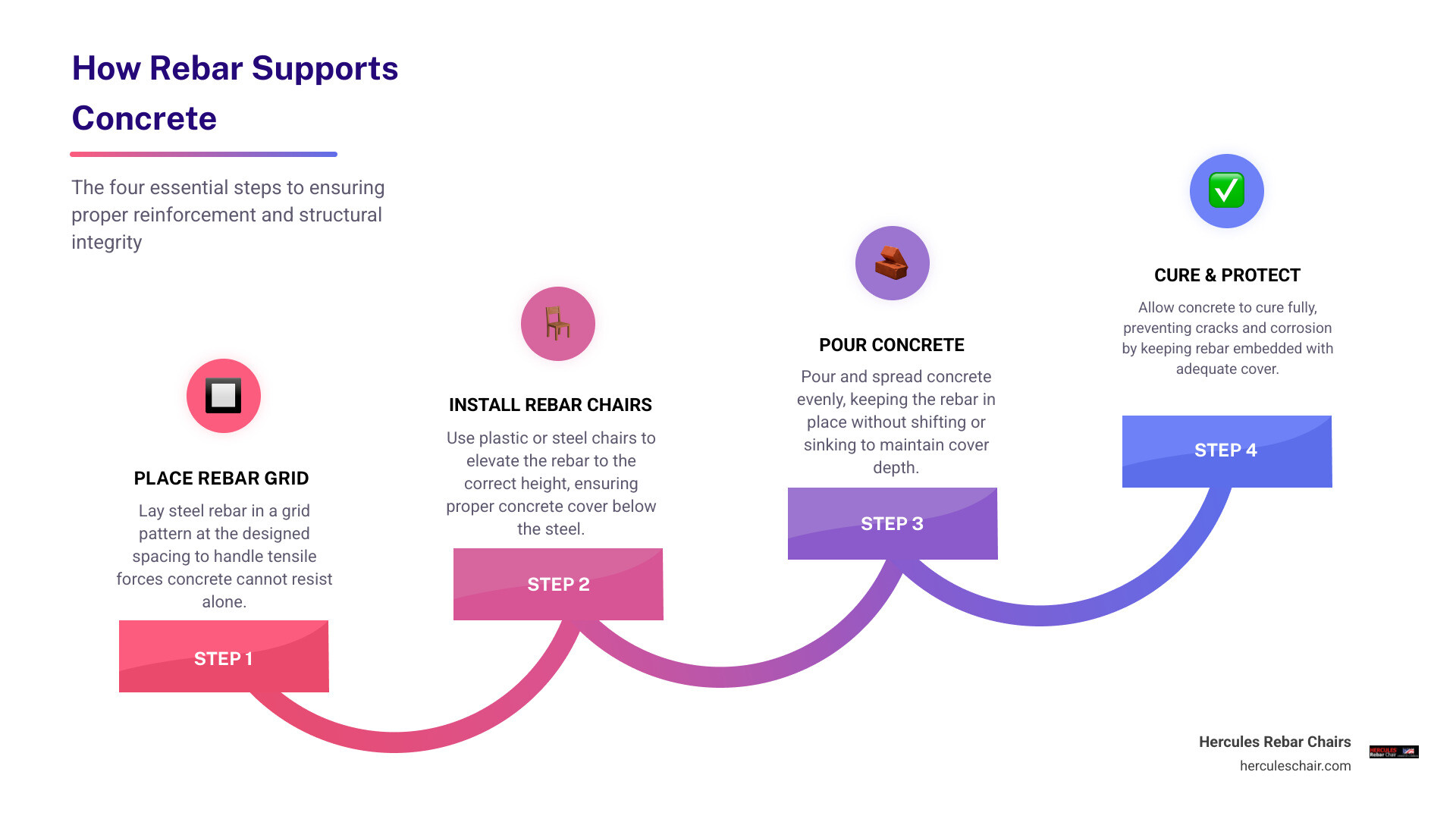
How Rebar Supports Concrete: The Science of Reinforcement
To understand why we need rebar, we have to look at how concrete behaves under load. Concrete is a composite material, but on its own, it functions like stone. It is incredibly strong when squeezed (compression) but surprisingly fragile when pulled apart (tension).
When a heavy truck drives over a concrete bridge deck, the top of the slab is compressed, while the bottom of the slab is stretched. Without reinforcement, the bottom of the slab would quickly develop micro-cracks that rapidly expand, leading to a sudden, catastrophic failure. This is why Rebar – Wikipedia is cast directly into the concrete matrix: it acts as a high-tensile skeleton that absorbs these pulling forces.
Why Rebar Supports Concrete Under Tensile Stress
The primary mechanical reason rebar supports concrete is to compensate for concrete’s low tensile strength. In structural engineering, we divide reinforcement into two primary categories:
- Primary Reinforcement: This steel is designed to carry the major structural loads calculated by structural engineers. It is positioned precisely where the highest tensile stresses will occur (such as the bottom of a beam or slab).
- Secondary Reinforcement: Also known as distribution or temperature-shrinkage reinforcement, this steel is distributed throughout the concrete to resist cracking caused by shrinkage as the concrete cures, as well as stresses caused by temperature fluctuations.
To work effectively, the steel must be deeply embedded in the concrete—typically 40 to 60 times its diameter—to prevent it from pulling out under extreme stress. If the rebar is allowed to sag to the bottom of the pour, it cannot perform either of these functions. This is why using high-quality supports is vital; as explained in our guide on Why Your Slab Needs Rebar Chair Supports, un-supported rebar simply sinks to the dirt, rendering it useless.
Thermal Expansion and the Steel-Concrete Bond
One of the greatest coincidences in materials science is that steel and concrete share almost identical coefficients of thermal expansion.
When the temperature rises in the heat of a July 2026 summer day, both materials expand at virtually the same rate. When the winter freeze sets in, they contract together. If their thermal expansion rates were different, the concrete would experience severe internal differential stress with every temperature change, destroying the mechanical bond between the steel and the concrete.
Because they expand and contract in unison, they remain locked together. This bond is enhanced by the physical deformations (ribs and lugs) on the rebar, which mechanically lock into the surrounding concrete matrix. To prevent structural cracking under these thermal shifts, engineers rely on robust support systems. You can read more about avoiding thermal and load-induced cracking in our article on how to Don’t Crack Under Pressure With These Extra Strong Rebar Supports.
The Evolution, Materials, and Global Standards of Reinforcing Steel
The history of reinforced concrete is a story of trial, error, and eventual standardization. Today, strict codes from organizations like the American Concrete Institute (ACI) and the American Society for Testing and Materials (ASTM) govern exactly how rebar is made, sized, and placed.
A Brief History of Reinforced Concrete
The concept of reinforcing masonry with metal dates back centuries. In the 14th century, builders used approximately 2,500 meters of iron tie rods to reinforce the stone arches of the Château de Vincennes in France.
However, modern reinforced concrete took off in the 19th century. A French gardener named Joseph Monier patented reinforced concrete flowerpots in 1867 before expanding his designs to concrete bridges and reservoirs.
In the United States, Ernest L. Ransome pioneered the use of twisted square iron bars to improve the mechanical bond between the metal and the concrete. Though his twisted rebar was initially ridiculed by contemporaries who believed the twisting process would weaken the iron, Ransome proved them wrong, building the first reinforced concrete bridge in the US in San Francisco.
Shortly after, Julius Kahn patented a diamond-shaped “Kahn Trussed Bar” system. Although some engineers argued Kahn’s system would cause catastrophic structural failures, it proved highly successful. While early 20th-century structural failures like the Bixby Hotel and Eastman Kodak Building collapses in 1906 were initially blamed on these innovative systems, investigations later revealed that poor labor quality and inadequate concrete mix control were the true culprits.
Deformation requirements (the ribs and lugs we see on rebar today) were finally standardized in the US around 1950, leading to the highly predictable structural steel we use today.
Rebar Material Types: From Carbon Steel to FRP
Depending on the environment, structural engineers specify different types of rebar:
- Carbon Steel (Black Rebar): The most common and cost-effective option, used in the vast majority of residential and commercial structures where moisture exposure is minimal.
- Epoxy-Coated Rebar: Coated with a protective epoxy barrier to resist road salts and marine environments. It is currently used in over 70,000 bridge decks across the United States. However, it requires delicate handling during transport and installation to prevent scratches in the coating.
- Stainless Steel Rebar: Highly resistant to corrosion, stainless steel is used in highly corrosive environments or structures requiring an exceptionally long service life.
- Fibre-Reinforced Polymer (FRP): Non-conductive, non-magnetic, and completely rust-proof, FRP rebar is ideal for specialized facilities like MRI rooms in hospitals or chemical processing plants. To learn more about selecting the right accessories for these specialized projects, check out our guide on Heavy Duty Rebar Chairs for Chemical and Power Plant Construction.
International Rebar Sizes and Grades
Rebar sizes and grades vary by region, but they all serve to standardize the yield strength and cross-sectional area of the steel. In the United States, Grade 60 (yielding at 420 MPa) is the most widely used rebar grade in modern construction.
US rebar sizes #2 through #8 represent the nominal diameter of the bar in eighths of an inch (for example, a #4 bar is 4/8″ or 0.5 inches, while a #8 bar is exactly 1 inch). Rebar smaller than #3 is informally referred to on jobsites as “pencil rod” because of its thin profile.
Here is how common US sizes compare to Canadian and European standards:
| US Size | US Nominal Diameter (in) | Canadian Size (Soft Metric) | European Size (mm) |
|---|---|---|---|
| #3 | 0.375 | 10M | 10 |
| #4 | 0.500 | 15M | 12 |
| #5 | 0.625 | – | 16 |
| #6 | 0.750 | 20M | 20 |
| #8 | 1.000 | 25M | 25 |
Essential Bar Supports and Accessories for Concrete Pours
No matter how high the quality of your steel, it cannot support the concrete if it isn’t held in the correct position. If the rebar shifts during the concrete pour, the structural integrity of the entire slab is compromised.
How Proper Placement of Rebar Supports Concrete Longevity
The distance between the outer surface of the concrete and the embedded rebar is known as the concrete cover. Proper concrete cover is critical because the highly alkaline environment of concrete (which must maintain a pH value higher than 12) protects the steel from rusting.
If the rebar is placed too close to the surface, carbonation and moisture will penetrate the concrete, lower the pH, and cause the steel to rust. Conversely, if the rebar is placed too deep, the structural capacity of the slab drops significantly, and surface crack widths will increase.
Using precise elevation supports ensures code-compliant cover depth and prevents the steel grid from sagging under the weight of workers walking on it during the pour. For a deep dive into maintaining perfect elevation, see our Rebar Slab Support Complete Guide.
Types of Rebar Chairs and Spacers
To accommodate different subbases and loading conditions, contractors use several types of supports:
- Plastic Rebar Chairs: Lightweight, rust-proof, and easy to install. They are perfect for vapor barriers because they won’t puncture the plastic sheeting. If you want to master using these, read Spacer Secrets Unpacking the Role of Plastic Rebar Chairs and explore options via Elevate Your Concrete Game With the Best Plastic Rebar Chairs for Sale.
- Steel Wire Chairs: Strong and traditional, these are ideal for heavy rebar configurations. Learn more in our article about The Strong Silent Type Choosing the Best Steel Rebar Chairs for Your Project.
- Concrete Dobies: Solid concrete blocks with embedded tie wires. They are excellent for heavy-duty civil projects and matches the thermal expansion of the surrounding concrete. Discover their applications in From Dobies to Double Mats A Comprehensive Look at Rebar Chair Types.
- Continuous Spacers: Designed to support long spans of steel without requiring dozens of individual chairs.
For a comprehensive overview of how to choose the right style, consult The Ultimate Guide to Rebar Chairs and Spacers and our breakdown on The Ultimate Guide to Rebar Chairs Types Uses and Sizing for Concrete Slabs.
To ensure you stay compliant with local building codes, check out Compliant Rebar Elevation Chairs for Professional Results and learn how to keep your grid level with Don’t Let Your Rebar Sag With These Support Tools.
To round out your knowledge on support selection, we recommend reviewing these helpful resources:
- Chair-ish Your Concrete Everything You Need to Know About Reinforcement Supports
- Sitting Pretty Everything You Need to Know About Rebar Supports
- A Practical Guide to Concrete Chairs for Rebar
- How to Choose the Right Concrete Rebar Chair for Your Project
- Keep Your Rebar Up A Guide to Concrete Support Blocks
- Pulling Up a Chair With Professional Rebar Standoffs
Tying, Welding, and Mechanical Connections
Securing the rebar grid together is just as important as raising it off the ground.
- Tying: The most common method. Workers use steel tie wire to wrap around intersections, securing the bars in place.
- Welding: Only permitted with specific weldable rebar grades (such as ASTM A706). Welding standard carbon steel rebar can embrittle the steel and lead to sudden structural failures.
- Mechanical Connections: Mechanical couplers are used to join rebar end-to-end in high-stress applications, providing a continuous load path.
To understand how to combine wire tying with advanced supports, read our guide on How to Use Galvanized Rebar Chairs and Continuous Wire Spacers Like a Pro.
Frequently Asked Questions About Rebar Supports
What is oxide jacking and how do you prevent it?
Oxide jacking, also known as “concrete cancer,” is the physical process that occurs when moisture reaches the steel rebar, causing it to rust.
When steel corrodes, the resulting rust (iron oxide) expands to as much as six times the volume of the original steel. This dramatic volume increase creates massive internal pressure within the concrete structure. Eventually, this pressure exceeds the tensile strength of the concrete, causing it to crack, delaminate, and spall off.
To prevent oxide jacking, you must maintain proper concrete cover using reliable rebar chairs, and ensure the concrete mix has low permeability to prevent water and salt intrusion. For more tips on keeping your steel dry, check out Don’t Let Your Rebar Sink A Guide to Concrete Chairs.
What safety measures prevent injuries from exposed rebar?
Exposed vertical rebar ends on a jobsite pose a severe impalement hazard. If a worker falls from a ladder or scaffold onto unprotected rebar, the results can be fatal.
To prevent this, OSHA requires all exposed rebar ends to be capped. Standard plastic “mushroom” caps are designed only to prevent scratches and minor cuts. For true impalement protection, contractors must use steel-reinforced plastic caps or lumber troughs that are certified to withstand the impact of a falling worker.
How does recycled steel impact rebar sustainability?
Modern steel manufacturing is highly sustainable. Nucor, the largest steel producer in the United States, manufactures its steel bar products from 97% recycled scrap steel. This makes rebar one of the most recycled products on earth, significantly lowering the carbon footprint of reinforced concrete construction and helping projects achieve valuable LEED green building certifications.
Conclusion
At Hercules Rebar Chairs (a brand of the T.J. Harris Co.), we understand that the strength of your concrete depends entirely on the stability of your steel. As America’s #1 manufacturer of high-strength concrete supports, we have sold over 14 million units across the country, saving contractors time and money while ensuring absolute code compliance on every pour.
Our iconic red rebar chairs are engineered to withstand heavy jobsite foot traffic without crushing, slipping, or puncturing vapor barriers. Whether you are pouring a residential driveway in Texas, a commercial foundation in Ohio, or a highway bridge in Florida, our products keep your steel locked in its perfect design position.
Ready to elevate your next concrete pour? Explore our heavy-duty continuous support systems by reading The Long Span Solution: Understanding Continuous Rebar Supports, and contact us today to get the ultimate support for your steel.