

What Is a Concrete Rebar Chair and Why Does It Matter?
In construction, a concrete rebar chair might look like a simple accessory, but it performs a heavy-duty job. At its core, a rebar chair is a support system designed to elevate reinforcing steel (rebar) or wire mesh off the ground or formwork. This ensures that the steel is perfectly positioned within the concrete slab rather than sinking to the bottom.
What a concrete rebar chair does during a pour
When the concrete starts flowing, things get heavy and chaotic. Without a sturdy concrete rebar chair, the weight of the wet concrete and the boots of the crew walking on the mats would push the rebar into the dirt or against the forms.
The chair acts as a permanent spacer. It provides bar positioning that allows the concrete to flow under, over, and around the steel. This creates a monolithic bond, where the steel and concrete work together to handle tension and compression. Because these supports are designed to be embedded, they stay in the slab forever, becoming a seamless part of the finished structure.
Why proper cover is critical for strength and durability
Cover refers to the distance between the outer surface of the concrete and the reinforcing steel. If the rebar is too close to the surface, it is vulnerable to moisture and oxygen, which leads to rust. When steel rusts, it expands, causing the concrete to crack and spall.
Using the correct concrete rebar chair ensures you meet inspection readiness by maintaining the exact cover required by building codes. This corrosion protection is what keeps a driveway from cracking after two winters or a bridge deck from failing prematurely. For more insights, check out why your slab needs rebar chair supports and the broader basics of reinforced concrete.
Main Types of Concrete Rebar Chair Options
Not all projects are created equal, which is why there are several varieties of chairs available. Choosing the right one depends on your slab thickness, the weight of your rebar, and the environment of the build.
| Feature | Metal Chairs | Plastic Chairs | Continuous High Chairs | Snap Chairs |
|---|---|---|---|---|
| Material | Steel Wire | Polypropylene | Steel Wire / 5′ Lengths | High-Density Plastic |
| Corrosion Risk | High (unless coated) | Zero | High (unless coated) | Zero |
| Best For | Heavy Rebar Mats | Slab-on-Grade | Upper Mats/Double Mats | Fast Installation |
| Stability | Excellent | Good | Superior | Excellent |
Metal vs plastic concrete rebar chair: key differences
The debate between metal and plastic usually comes down to strength versus corrosion resistance. Metal chairs are incredibly strong and can support massive loads without deforming. However, if they are not coated, the tips of the metal legs can eventually rust, creating rust bleeds on the surface of the concrete.
Plastic chairs, like our Hercules line, are molded from durable, rust-proof polypropylene. They are more economical and completely immune to corrosion. While metal is often preferred for massive industrial mats, plastic is the go-to for residential slabs, sidewalks, and architectural finishes where a clean look is mandatory.
Continuous high chairs, individual high chairs, and snap-on styles
For complex projects like elevated slabs or double-mat foundations, you need specialized heights.
- Continuous High Chairs: These are fabricated in 5-foot lengths with legs spaced on 7-1/2-inch centers. They are available in heights from 2 inches to 14 inches and eliminate the need for carrier bars.
- Individual High Chairs: These support steel at specific points and can range from 2 inches up to 15 inches in 1/4-inch increments.
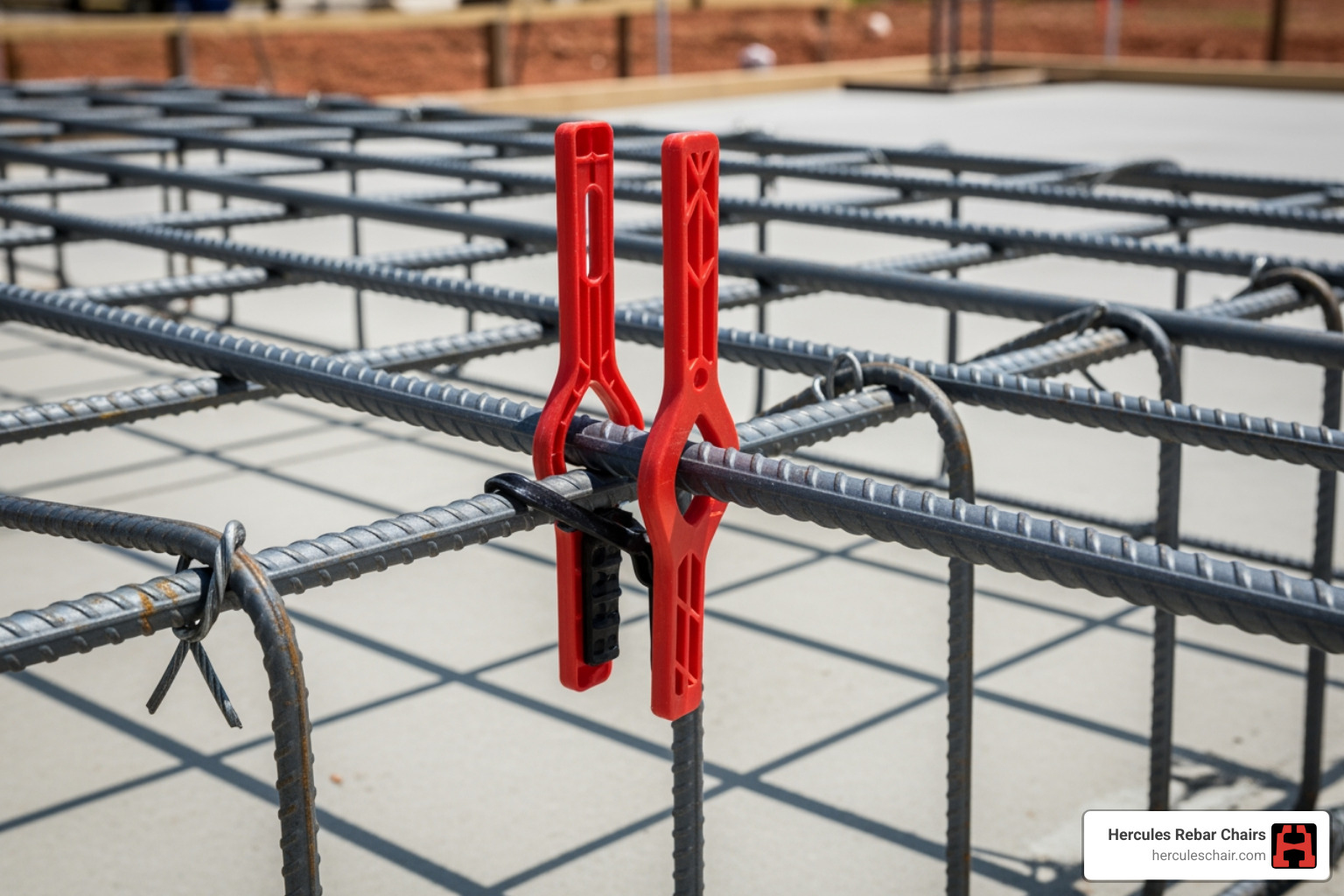
- Snap-on Chairs: These are a game-changer for speed. Instead of using tie wire to secure the bar to the chair, the rebar simply snaps into the clip. For example, our Hercules 1.5-inch and 3-inch chairs are designed to hold #4 rebar securely without any extra wire.
To dive deeper into these variations, read the ultimate guide to rebar chairs: types, uses, and sizing for concrete slabs.
How to choose among concrete rebar chair styles for your slab or deck
If you are pouring a standard 4-inch slab-on-grade, a simple 1.5-inch or 2-inch plastic chair is often sufficient. However, if you are working on an elevated deck with a double mat of steel, you will need high chairs to support the upper mat while the lower mat sits on smaller bolsters. Always consider the footprint of the chair; a wider base is better for soft surfaces like vapor barriers to prevent the chair from punching through. Learn more about these setups in our guide from dobies to double mats: a comprehensive look at rebar chair types.
How to Choose the Right Height, Material, and Fit
Selecting a concrete rebar chair isn’t just about grabbing a box off the shelf. You need to match the chair to the engineering specs of your project.
Match chair height to required concrete cover
The height of the chair determines the “clearance” from the ground. Common heights include:
- 1.5-inch cover: Standard for 4-inch slabs (driveways, sidewalks).
- 3-inch cover: Often required for footings or concrete poured against earth.
- Custom heights: Some projects require 75mm (approx 3-inch) or even 15-inch heights for massive structural beams.
Always check your design drawings. If the plan calls for 2 inches of cover, you need a 2-inch chair. It’s that simple.
Choose for bar size, mat configuration, and project loads
The “chair” must fit the “guest.” A chair designed for #3 rebar might not accommodate a #5 bar.
- Hercules 1.5-inch chairs are specifically designed for #4 rebar.
- Fast Clip Bar Chairs can often fit a range of sizes, such as 4mm to 20mm.
- Load Capacity: If your chairs are over 12 inches tall, they may require cross bracing or leg lacing to prevent them from buckling under the weight of the steel and the crew.
Pick the best material and coating for the environment
If you choose metal, the coating is your best friend.
- Plain Steel: Best for interior slabs where moisture isn’t an issue.
- Plastic-Dipped or Galvanized: Essential for preventing rust stains on architectural finishes.
- Epoxy-Coated: Best for bridges or coastal areas where salt air is a factor.
- Stainless Steel: The ultimate (and most expensive) protection for highly corrosive environments.
For a full breakdown of materials, see everything you need to know about concrete reo chairs.
Installation Best Practices for a Concrete Rebar Chair
Buying the right chair is only half the battle; you have to put them in the right spots.
How far apart should chairs be spaced?
The most common mistake is not using enough chairs. If the rebar sags between supports, it’s not doing its job.
- General Rule: Space chairs 2 to 3 feet apart along the length of the bar.
- Best Practice: We recommend placing a chair at every reinforcement crossing for maximum stability.
- Mesh Support: When using wire mesh, you may need closer spacing to prevent the “wave” effect when workers walk on it.
How to install chairs so they do not tip or sink
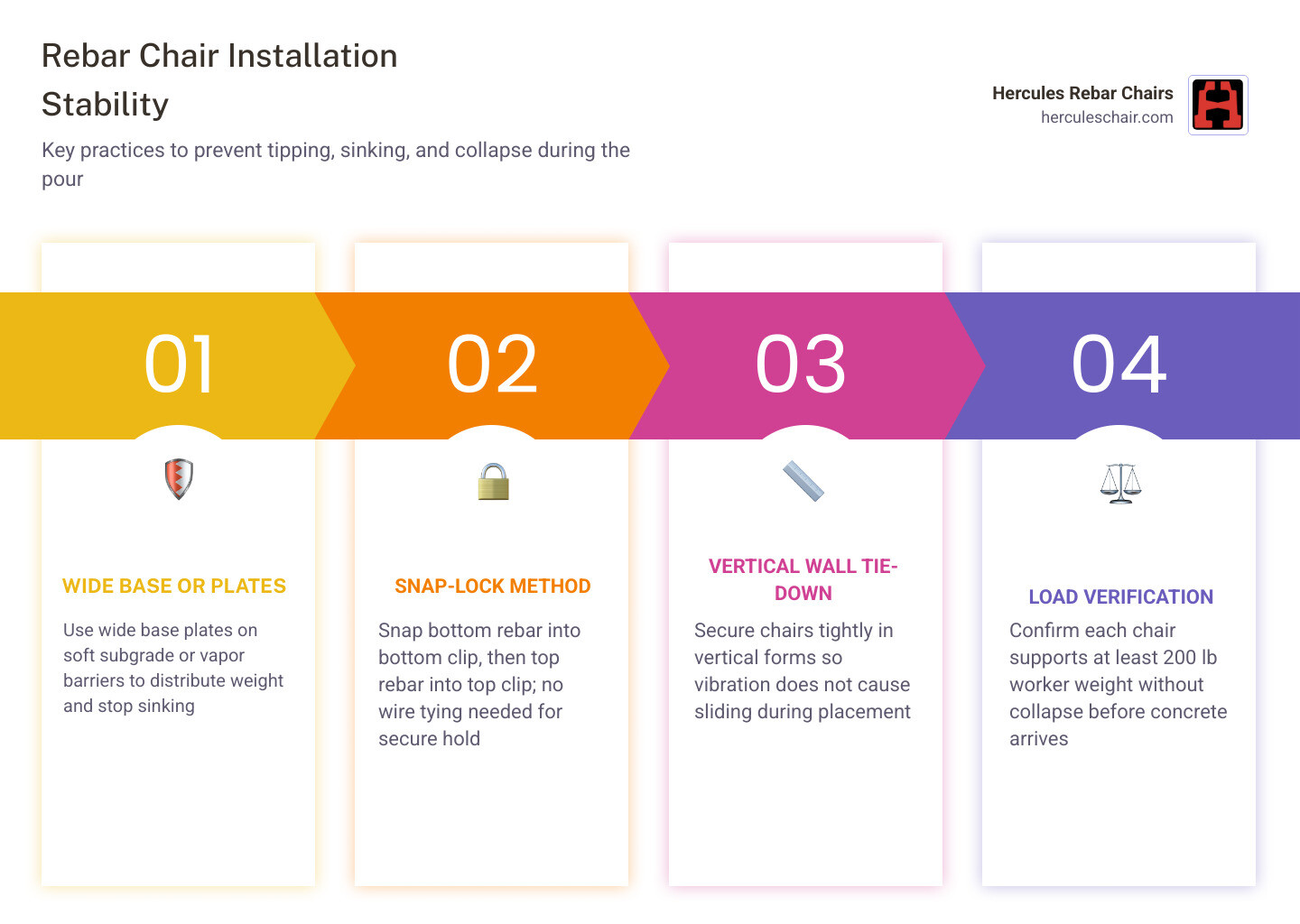
Stability is key. If you are pouring on a soft subgrade or a vapor barrier, use chairs with a wide base or “base plates” to distribute the weight.
- Snap-Lock Method: If using Hercules chairs, simply snap the bottom rebar into the bottom clip, then snap the top rebar into the top clip. No wire tying is required.
- Vertical Walls: Yes, you can use chairs in vertical forms! Just ensure they are secured tightly so they don’t slide down during the vibration of the concrete.
- No Collapse: A sturdy chair should be able to withstand the weight of a 200lb worker without collapsing.
For more tips on keeping your steel level, read don’t let your rebar sag with these support tools.
Are rebar chairs left in the concrete, and are they safe?
We get this question a lot: “Do I take them out once the concrete is halfway poured?” The answer is a resounding no. Rebar chairs are designed to be buried. They do not affect the structural integrity of the concrete because they are made of materials that bond well with the mix or have a minimal footprint that doesn’t create a “void.” In fact, by keeping the steel in the right place, they are the very thing ensuring structural integrity.
Pricing, Availability, and Compliance Checks Before You Buy
When you’re ready to order, you’ll find that concrete rebar chair products are sold in various quantities.
What affects concrete rebar chair pricing and supply?
Pricing is usually driven by the material (plastic vs. metal) and the height of the chair.
- Hercules 1.5-inch chairs are typically sold in 50-packs.
- Hercules 3-inch chairs often come in 100-packs.
- Large Metal Chairs: A 7-inch metal support chair might come in a 90-piece carton weighing about 25 lbs. Buying in bulk (pallets or cartons) is always the most cost-effective way for contractors to stock up.
Where contractors source chairs and what product details to verify
You can find rebar chairs at major retailers like Home Depot or through specialized construction supply houses. When ordering, verify:
- Bar range: Will it hold the #3, #4, or #5 bar you’re using?
- Cover height: Is it the exact height specified in your plans?
- Quantity: Do you have enough to cover a chair at every 2-3 feet?
Explore our full range of Hercules Rebar Chairs product options to find the right fit for your next job.
Safety, standards, and environmental considerations
Always check for compliance. In the US, look for Prop 65 warnings if applicable. For international or high-spec projects, you might see standards like AS/NZS 2425:2015. Using high-quality, rust-proof polypropylene chairs ensures you aren’t introducing degradable materials into your slab.
Frequently Asked Questions About Concrete Rebar Chair Selection
Do I need metal or plastic for my project?
If you are worried about rust stains or working on a residential driveway, go with plastic. If you are building a heavy industrial floor with #8 rebar, metal might be necessary for the weight.
Can one chair style work for slabs, footings, and walls?
Many chairs are multi-use. A snap-lock chair can work just as well in a vertical wall as it does in a flat slab. However, always ensure the chair is rated for the specific bar size you are using.
How many chairs do I need for a slab?
Calculate your total linear footage of rebar and divide by 2.5 (for 2.5-foot spacing). Then, add about 10% for waste and extra support at the edges.
Conclusion: Choose a Concrete Rebar Chair That Matches the Structure, Not Just the Price
At the end of the day, a concrete rebar chair is an insurance policy for your concrete. You might save a few pennies by choosing a cheaper, flimsy support, but the cost of a slab failure or a failed inspection is thousands of times higher.
Choose a chair that matches your structure’s needs—whether that’s the rust-proof reliability of a Hercules plastic chair or the heavy-duty reach of a continuous metal high chair. By maintaining the correct cover and ensuring the stability of your reinforcement, you are building something that will stand the test of time.

Ready to elevate your next project? Explore our Hercules Rebar Chairs product options or learn more about why bar chairs are essential for strong slabs.