

What “Castle Chairs Concrete” Actually Means (And Why It Matters)
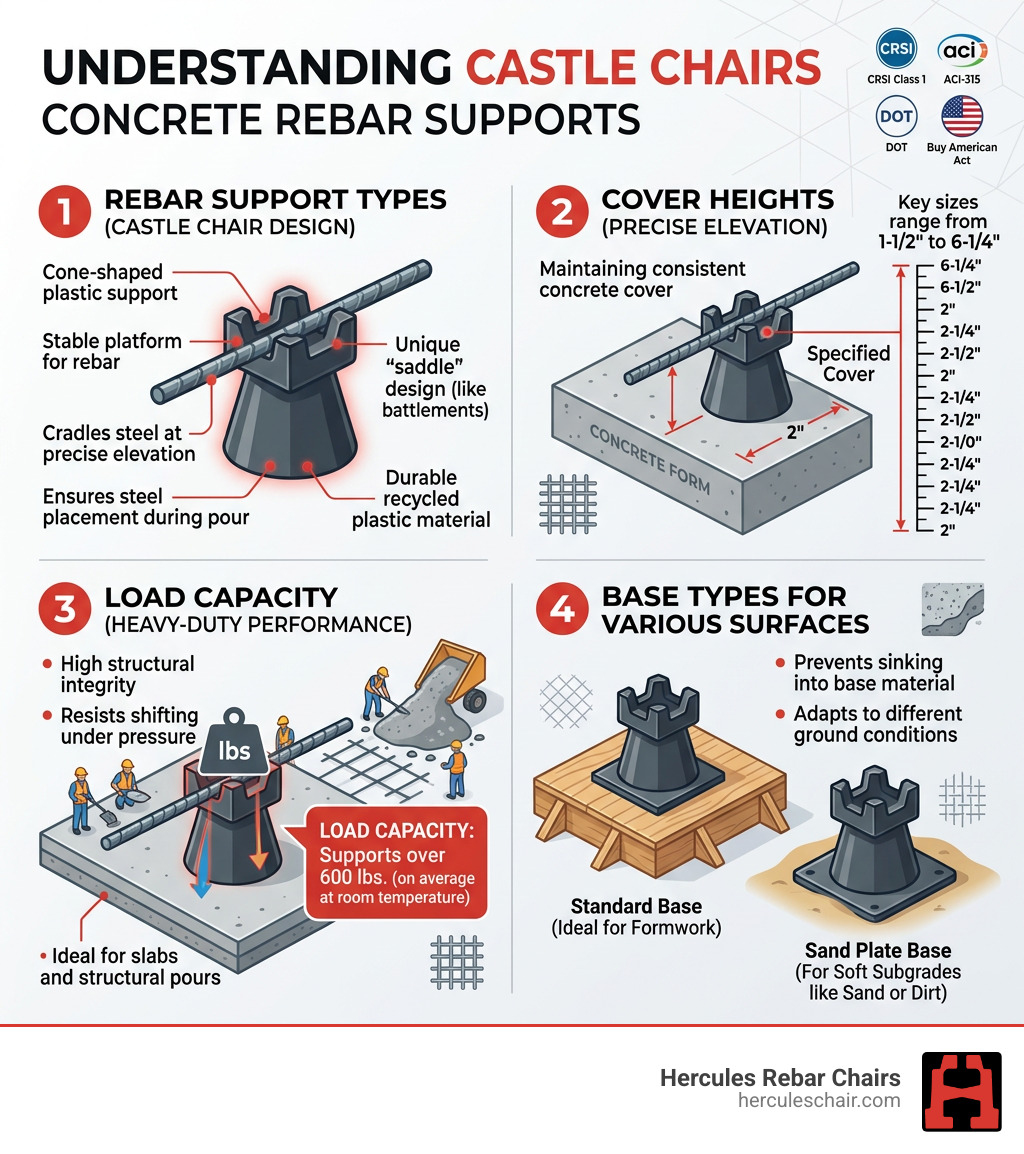
Castle chairs concrete refers to a specific type of plastic rebar support used to hold steel reinforcement at the correct height inside a concrete pour. Here’s a quick overview:
- What they are: Cone-shaped plastic chairs that sit on the form surface and cradle rebar at a precise elevation
- Primary use: Maintaining consistent concrete cover over steel reinforcement in slabs and structural pours
- Key sizes: Cover heights from 1-1/2″ to 6-1/4″ in 1/4″ increments
- Load capacity: Supports on average over 600 lbs. at room temperature
- Compliance: Meets CRSI Class 1, ACI-315, DOT, and Buy American Act standards
- Material: Made from recycled plastic, which can contribute to LEED credits
Without proper rebar support, steel can shift during a pour — ending up too close to the surface or unevenly placed. That leads to cracking, corrosion, and structural failure down the road. Castle chairs solve that problem simply and affordably.
This guide breaks down everything you need to know — sizes, base types, installation, compliance, and how these supports compare to other rebar chair options on the market.
I’m Jordan Harris, a licensed Professional Engineer with a master’s in structural engineering and years of hands-on experience specifying concrete reinforcement systems on large-scale projects. As part of the team behind Hercules Rebar Chairs, I’ve spent considerable time studying castle chairs concrete supports and how they stack up against other rebar positioning solutions available to contractors today.
What Are Castle Chairs Concrete Supports?
When we talk about castle chairs concrete supports, we are describing a heavy-duty, individual plastic bar support designed specifically for reinforced concrete. They get their name from their unique silhouette—a cone-shaped body topped with “saddles” that look a bit like the battlements of a medieval castle.
These chairs are engineered to be the backbone of your slab’s reinforcement. Unlike flimsy alternatives, a high-quality castle chair provides a stable platform for rebar, ensuring that the steel stays exactly where the engineer intended it to be during the high-pressure environment of a concrete pour.
One of the most significant advantages of these supports is their versatility on different surfaces. While some chairs are only meant for hard formwork, castle chairs excel on soft material form surfaces. This includes:
- Carton forms: Used in expansive soil conditions.
- Fill material: Such as sand or crushed stone.
- Vapor barriers: Where a wide base is needed to prevent puncturing.
To understand how these fit into the broader world of construction accessories, you can check out our Spacer Secrets: Unpacking the Role of Plastic Rebar Chairs for a deeper dive into material science.
Primary Purpose in Reinforcement
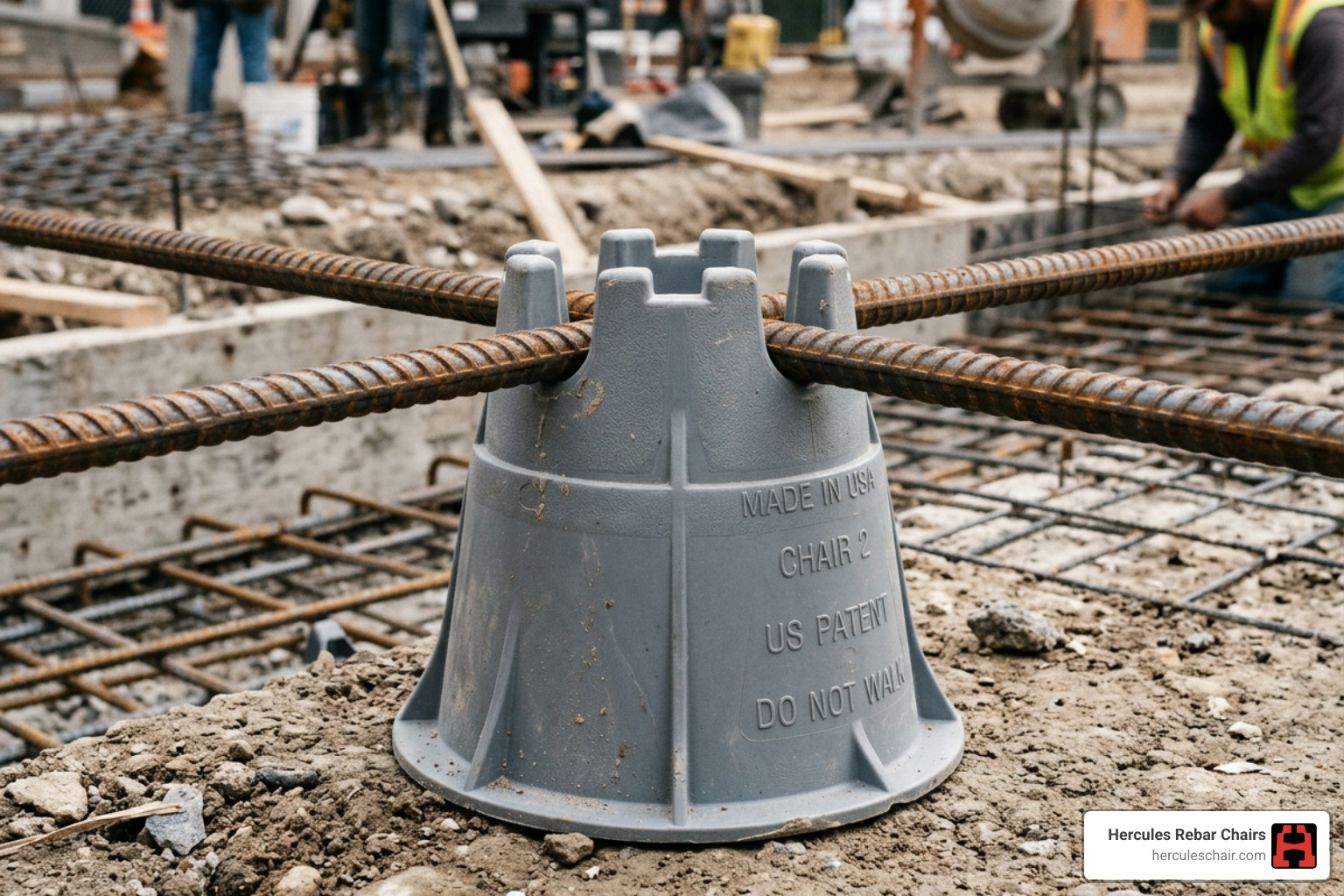
The primary mission of castle chairs concrete supports is “elevation maintenance.” In concrete, “cover” is king. If your rebar is supposed to have 2 inches of concrete protecting it from the elements, but it sags to 1 inch, you’re looking at future rust and “spalling” (where the concrete pops off).
The saddle design is the secret sauce here. Most castle chairs feature dual-height saddles. This means one chair might offer a 2-inch cover if you turn it one way, and a 2-1/4-inch cover if you rotate it. This “two-in-one” functionality is a lifesaver for contractors because it reduces the amount of inventory they have to carry on the truck.
The wide, stable base and the cone-shaped body are specifically designed to resist tipping. When workers are walking on the rebar grid or when the concrete hose is dragging across the steel, you need a chair that won’t buckle. For more on how these compare to other support styles, see our guide on What Are Concrete Bolster Chairs and Why Do You Need Them?.
Material and Compliance Standards
We take compliance seriously in the US construction industry. Most professional-grade castle chairs concrete supports are manufactured right here in the USA. This is crucial for public works projects that fall under the Buy American Act or BABA (Build America, Buy America) requirements.
Key standards these chairs meet include:
- CRSI Class 1: This is the highest “weathering” grade for bar supports.
- ACI-315/315R: Standards set by the American Concrete Institute for detailing reinforced concrete.
- LEED Credits: Because many of these chairs are made from dark, recycled plastic, they can help your project earn points toward LEED certification.
- DOT Approvals: Many state Departments of Transportation have pre-approved these specific models for highway and bridge work.
Key Features and Technical Specifications
When you’re choosing castle chairs concrete supports, you aren’t just looking for “a piece of plastic.” You’re looking for an engineered component. The load capacity is the most impressive stat here. On average, a single castle chair can support over 600 lbs. at room temperature. That is a massive amount of weight for a product that typically weighs less than a tenth of a pound!
This high compressive strength ensures that the chair won’t flatten out under the weight of heavy rebar cages or the “live load” of construction crews. For a full breakdown of how to size these for your specific slab, refer to The Ultimate Guide to Rebar Chairs: Types, Uses, and Sizing for Concrete Slabs.
Sizing and Cover Heights for Castle Chairs Concrete
Precision is everything in structural engineering. Castle chairs concrete supports are available in a massive range of heights to meet any spec. You can typically find them from 1-1/2″ all the way up to 6-1/4″, usually moving in 1/4″ increments.
Because of the dual-height saddle design, you’ll often see them listed in ranges, such as:
- 1-1/2″ to 1-3/4″
- 2″ to 2-1/4″
- 3″ to 3-1/4″
- 4″ to 4-1/4″
If you are working on a thicker slab and need more height, we have resources to help you decide, such as From 4-Inch to 6-Inch: Choosing the Right Rebar Chair Support.
Base Types and Packaging Quantities
The base of the chair is what determines its stability on the ground. Generally, the taller the chair, the wider the base needs to be to prevent it from becoming “top-heavy.”
- Round Base: Typically used for heights between 1-1/2″ and 4-1/4″. These are compact and easy to place.
- Square Base: Usually reserved for the taller chairs (4-1/2″ to 6-1/4″) to provide a larger footprint on soft surfaces like sand or fill.
Packaging is also standardized to help with project estimating:
- 1-1/2″ – 1-3/4″ sizes: 300 chairs per box.
- 2″ – 2-1/4″ sizes: 480 chairs per box (these are the most common).
- 4″ – 4-1/4″ sizes: 200 chairs per box.
Knowing these quantities is vital for calculating your “burn rate” on a job site. You don’t want to run out of chairs halfway through tying a mat! Check out The Goldilocks Guide to Concrete Bar Chair Sizes: Not Too Big, Not Too Small for more inventory tips.
Installation and Best Practices for Rebar Reinforcement
Installing castle chairs concrete supports isn’t rocket science, but doing it wrong can lead to structural headaches. The goal is to create a rigid, level grid of steel that won’t move when the “mud” starts flowing.
Proper Placement of Castle Chairs Concrete Supports
Follow these steps for a perfect installation:
- Clear the Base: Ensure your vapor barrier or fill is level and free of debris.
- Orient the Saddle: Look at the chair. One side of the saddle will be slightly higher than the other. Orient the chair so the rebar sits at the exact height required by your blueprints.
- Spacing: Space the chairs according to the engineer’s requirements—usually every 2 to 3 feet in both directions, though this varies by rebar diameter.
- Tying: While the saddles are designed to “cradle” the bar, we always recommend wire tying the rebar to the chair, especially on sloped pours. Use a high-quality tie wire to ensure the connection is secure.
For a quick refresher on calculating exactly how many you need, see How to Determine Bar Chair Sizes in 3 Easy Steps. Keeping the steel elevated is the only way to ensure a “strong slab.” Learn more at Elevate Your Concrete: Why Bar Chairs Are Essential for Strong Slabs.
Related Products for Concrete Projects
A castle chair rarely works alone. To get the best results, you’ll likely need a suite of related products:
- Vapor Barriers & Polyfilm: To keep moisture from seeping up through the slab.
- Bond Tape: For sealing seams in your vapor barrier.
- Safety Caps: These are those bright orange (or red!) caps that go on the ends of vertical rebar to prevent impalement or “jabs and cuts.”
- Tie Wire: Essential for securing the rebar to the chairs.
You can find a complete list of these essentials in our article Chair-ish Your Concrete: Everything You Need to Know About Reinforcement Supports.
Comparing Construction Supports to Decorative Concrete Furniture
This is where things get a little funny in the search results. If you search for “concrete chairs,” you might find two very different things: the industrial supports we’ve been talking about, and high-end, designer outdoor furniture.
While they share a name, they couldn’t be more different!
Design Differences in Castle Chairs Concrete
Industrial Castle Chairs:
- Purpose: Hidden inside the concrete forever to support steel.
- Material: High-density recycled plastic.
- Look: Technical, cone-shaped, usually black or grey.
- Weight: About 0.07 lbs to 0.25 lbs each.
Decorative Concrete Furniture:
- Purpose: For people to sit on in gardens, terraces, or modern interiors.
- Material: Often glassfiber reinforced concrete (GFRC) to keep them “light” (though “light” for a concrete chair is still about 60–80 lbs!).
- Features: Some use nano-coatings for a soft finish, and others feature designer bases made of wood or steel.
- Designers: Famous pieces like “Chair One” or the “Morgan” chair are engineering masterpieces that celebrate the raw, geometric look of concrete.
So, if you’re looking to finish a driveway, you want the plastic ones. If you’re looking to finish a patio with a “brutalist” vibe, you want the furniture!
Frequently Asked Questions about Castle Chairs
What is the maximum load capacity of a castle chair?
Most professional-grade castle chairs concrete supports are rated to hold over 600 lbs. at room temperature. This is more than enough to handle the weight of heavy rebar and the workers who have to walk on the grid during the tie-in phase.
How do round bases differ from square bases in application?
It mostly comes down to height and stability. Round bases are standard for shorter chairs and are very easy to maneuver. Square bases provide a larger surface area (footprint), which is necessary for taller chairs (over 4 inches) to prevent them from tipping over or sinking into soft fill material like sand.
Are there Made in USA options for public works projects?
Yes! In fact, most high-quality castle chairs used in the US are manufactured domestically. When ordering for a government or municipal project, always specify that you need “Made in USA” or “BABA compliant” products to ensure you meet DOT and Buy American Act standards.
Conclusion
Whether you are a DIYer tackling a backyard patio or a foreman on a massive industrial site, understanding castle chairs concrete supports is key to a successful pour. These little plastic cones are the unsung heroes of the construction world, keeping our bridges, roads, and buildings standing strong by ensuring rebar stays exactly where it belongs.
At Hercules Rebar Chairs, we pride ourselves on providing the strongest, most reliable supports in the industry. Our chairs are identifiable by their signature red color—a mark of quality that says your project is built to last. By choosing high-quality, American-made supports, you save time, save money, and ensure your project is 100% code-compliant.
Ready to get started on your next project? Buy Rebar Chairs today and experience the difference that “America’s #1” rebar support can make.