

Why Getting Rebar Depth Right Makes or Breaks Your Concrete Slab
Rebar chairs for concrete are small plastic or metal supports that hold reinforcing steel at the correct height inside a form before and during a concrete pour.
Here’s a quick summary of what you need to know:
- What they do: Keep rebar suspended at the right depth so it ends up fully embedded in cured concrete — not resting on the ground
- Why it matters: Rebar sitting too low loses its concrete cover, corrodes faster, and weakens the slab over time
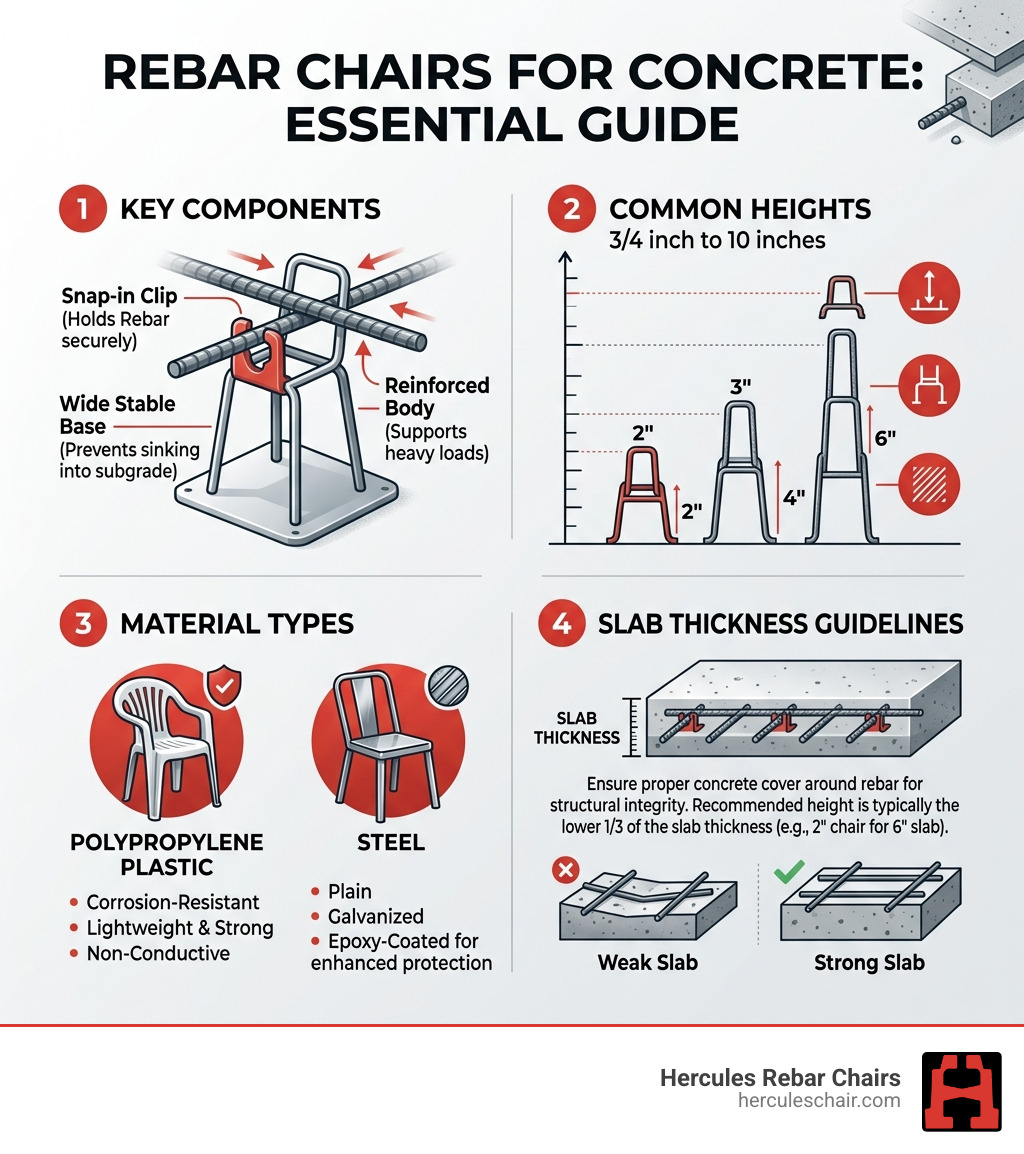
- Common heights: 3/4 in. to 10 in., matched to your slab thickness
- Main types: Standard individual chairs, double chairs, footing stands, and continuous bolsters
- Common materials: Polypropylene plastic and steel (plain, galvanized, or epoxy-coated)
- Who uses them: Residential and commercial concrete contractors for slabs, footings, walls, and more
Rebar does its job only when it’s in the right place. If it sinks to the bottom of the pour, or floats too high, the structural integrity of your slab is compromised — and no amount of finishing work will fix that.
This is a problem contractors run into constantly. Traditional methods like dobies or hand-tying rebar in position are slow, unreliable, and frustrating on a busy job site. A simple, well-designed chair snaps into place in seconds and stays put through the entire pour.
I’m Jordan Harris, a licensed Professional Engineer with a background in large-scale structural concrete projects and a key part of the team at Hercules Rebar Chairs — so I’ve seen how the right rebar chairs for concrete can save serious time and prevent costly structural failures. In the sections below, I’ll walk you through everything you need to choose, size, and install rebar chairs correctly on your next project.
What are Rebar Chairs for Concrete and Why Do They Matter?
When we talk about concrete, we often think of it as an indestructible rock. But concrete is like a great sports team: it has a star player (the concrete itself) that is amazing at handling “compression” (being squished), and a supporting player (rebar) that handles “tension” (being pulled or bent). For this team to win, the rebar has to be in the exact right position.
This is where rebar chairs for concrete come in. Their primary purpose is to provide Why Your Slab Needs Rebar Chair Supports. Without them, rebar tends to sink to the bottom of the pour under its own weight or when workers walk on the grid. If rebar ends up at the bottom of the slab, it’s basically just sitting on the dirt. It won’t provide any structural reinforcement, and it will quickly begin to corrode as moisture from the ground reaches the steel.
Using high-quality bar chairs ensures Elevate Your Concrete: Why Bar Chairs Are Essential for Strong Slabs. By holding the steel in the “middle third” of the slab, you ensure that the concrete can flow completely around the bars. This creates a perfect bond and provides the necessary “concrete cover”—the protective layer of concrete that keeps oxygen and water away from the steel, preventing rust and “concrete cancer” (spalling).
In April 2026, as building codes become stricter and materials more expensive, ensuring the longevity of your slab through proper positioning isn’t just a best practice; it’s a financial necessity. A slab that lasts 50 years instead of 15 starts with a simple red chair.
Types of Rebar Chairs and Material Options
Choosing the right material for your supports is just as important as the rebar itself. In the industry, we generally see two main contenders: polypropylene plastic and steel.
Polypropylene Plastic Chairs
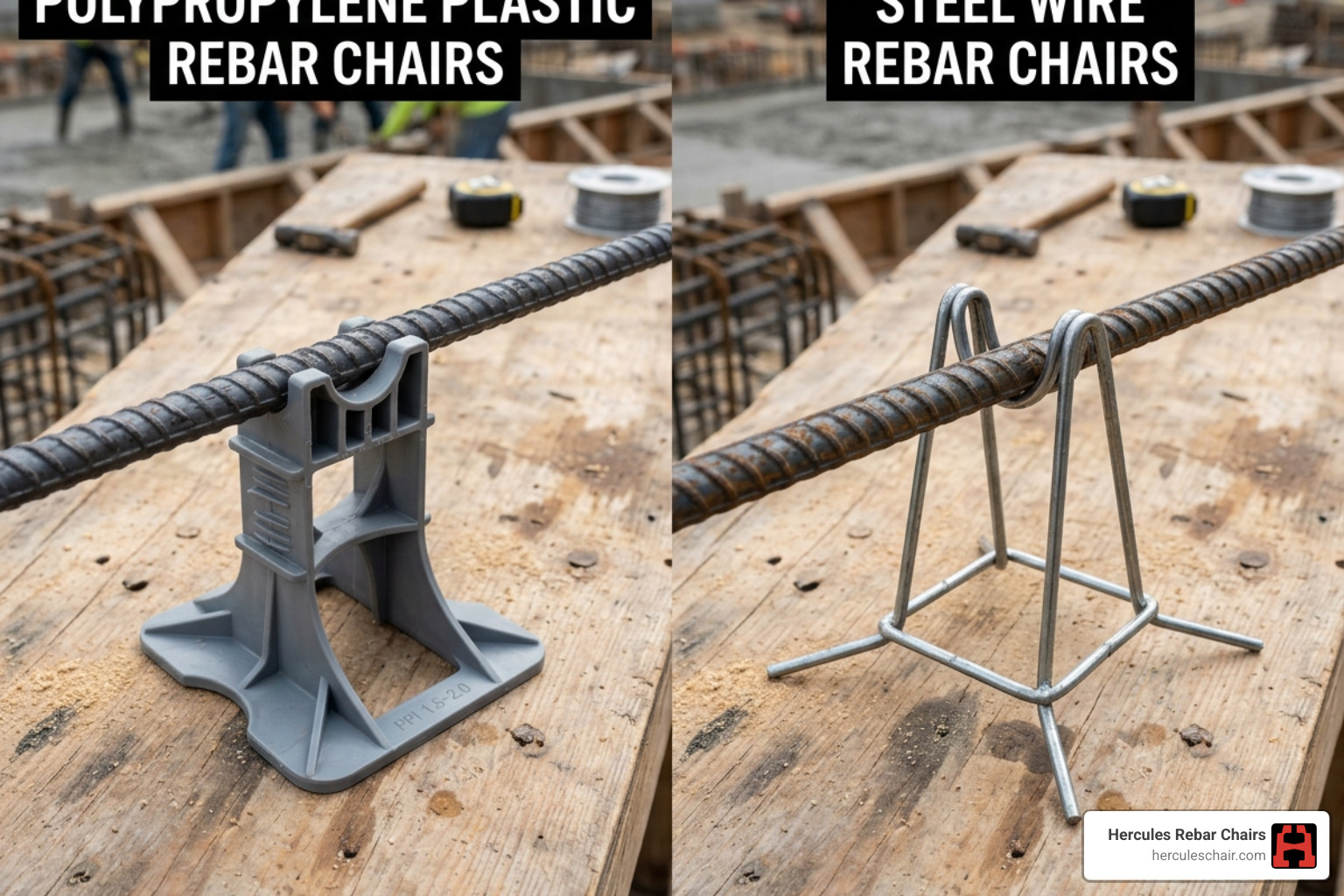
Most modern contractors are moving toward polypropylene. Why? Because plastic doesn’t rust. At Hercules, our patented red chairs are made from high-strength polypropylene. They feature a triangular construction that provides incredible stability. One of the biggest advantages of plastic is the “snap-in” design. Instead of fumbling with tie wire, you simply snap the rebar into the clip. This can reduce placement time by up to one-third.
Steel Wire Chairs
Steel chairs are the “old school” choice. They are strong and can handle very heavy loads. However, they come with a catch: corrosion. If you use plain steel chairs and the feet are exposed at the bottom of the slab, they can rust and leave unsightly stains on the surface or, worse, provide a path for moisture to enter the slab. To combat this, many steel chairs now feature plastic-dipped legs or are made from galvanized or stainless steel.
| Feature | Polypropylene (Plastic) | Steel Wire |
|---|---|---|
| Corrosion Resistance | Excellent (Never Rusts) | Poor to Good (Depends on Coating) |
| Installation Speed | Fast (Snap-in) | Slower (Requires Tying) |
| Cost | Cost-effective | Varies by Coating |
| Durability | High (Impact Resistant) | Very High (Heavy Loads) |
| Vapor Barrier Safe | Yes (Wide Base) | Requires sand plates/caps |
For more on the different varieties, check out our From Dobies to Double Mats: A Comprehensive Look at Rebar Chair Types. If you are curious about the technical benefits of polymers, we’ve hidden some Spacer Secrets: Unpacking the Role of Plastic Rebar Chairs in our detailed guide.
Selecting the Right Size and Height for Your Project
One size definitely does not fit all in concrete. If your chair is too short, the rebar is too close to the ground. If it’s too tall, the rebar might poke out the top of the slab—which is a great way to ruin a finish (and your tools).
The general rule of thumb is to aim for the center of the slab or slightly above, ensuring at least 1.5 to 2 inches of concrete cover. Here’s how we typically break it down:
- 1.5-inch Chairs: Perfect for 4-inch to 5-inch slabs. These are common for residential driveways, sidewalks, and garage floors.
- 3-inch Chairs: The “Gold Standard” for 6-inch to 8-inch slabs. These are used heavily in commercial parking lots and industrial floors.
- Footing Stands: Often taller and designed to hold two or three parallel bars in foundation footings.
For a deeper dive, read The Goldilocks Guide to Concrete Bar Chair Sizes: Not Too Big, Not Too Small. If you’re standing in the middle of a job site right now trying to do the math, our guide on How to Determine Bar Chair Sizes in 3 Easy Steps is a lifesaver. We also offer Concrete Bar Chair Sizes for Every Project and a specific look at moving From 4-inch to 6-inch: Choosing the Right Rebar Chair Support.
Standard vs. Continuous High Chairs for Concrete
While individual chairs are great for most grids, some projects require a different approach.
Standard Chairs are individual units placed at rebar intersections. They are versatile and easy to move around.
Continuous High Chairs (CHC), also known as slab bolsters, are long supports (usually 5 feet in length) that provide a continuous line of support. These are fantastic for supporting upper slab steel in thick, multi-mat pours. They eliminate the need for “carrier bars” and can be much faster to set up over large areas. Our research shows that high-quality continuous chairs often have legs spaced on 7-1/2″ centers for maximum stability.
If you’ve ever wondered What Are Concrete Bolster Chairs and Why Do You Need Them?, the answer usually lies in the scale of the project. For a massive warehouse floor, bolsters are often the way to go.
Best Practices for Installing Rebar Chairs
Installation is where the magic happens—or where things go sideways. To ensure your rebar stays “sitting pretty,” follow these professional steps.
- Prep the Subgrade: Ensure your ground is compacted or your vapor barrier is laid flat.
- Layout the Grid: Lay out your rebar according to your project’s spacing requirements (e.g., 12 inches on center).
- The “Every Crossing” Rule: For maximum stability, we recommend placing a chair at every reinforcement crossing. While some contractors skip every other one, placing a chair at every intersection prevents the bars from sagging or shifting when the heavy concrete starts flowing.
- Snap and Lock: If using Hercules chairs, snap the bottom bar into the lower clip and the top bar into the upper clip. No tie wire is required!
- Check for Stability: Give the grid a “kick test.” It should feel rigid. We’ve seen our chairs stand up to five grown men walking on them during a pour without collapsing or puncturing the vapor barrier.
For more installation tips, see Sitting Pretty: Everything You Need to Know About Rebar Supports. And don’t guess how many you need—use the Hercules Rebar Chair Estimator to get an exact count for your slab dimensions.
Avoiding Common Mistakes with Rebar Chairs for Concrete
Even pros make mistakes. Here are the big ones to watch out for:
- Puncturing the Vapor Barrier: Many thin-legged metal chairs will poke right through your moisture barrier. We designed our chairs with a wide, flat base to prevent this.
- Ignoring the Code: Every region has specific requirements for concrete cover. Failing to meet Rebar Chair Code: Ensuring Stability and Compliance can lead to failed inspections and expensive tear-outs.
- Overloading: Don’t expect a single chair to hold up a literal ton of steel. Proper spacing is key.
- The “Float” Fallacy: Some people think they can just “pull up” the rebar during the pour. This is a myth. You can’t see where the rebar is once the concrete covers it, and it almost always sinks back down. Use chairs from the start.
You can find more tips on avoiding these pitfalls in our guide, Chair-ish Your Concrete: Everything You Need to Know About Reinforcement Supports.
Frequently Asked Questions about Rebar Supports
Can rebar chairs be used with different rebar sizes?
Yes! Most of our standard chairs are designed to be compatible with #4 and #5 rebar, which are the most common sizes for residential and light commercial work. If you are working with wire mesh, we also offer the 2-inch Steel Mesh Chair Product 944, specifically designed for 6, 8, and 10-gauge steel wire.
Do rebar chairs stay in the concrete?
Absolutely. They are permanent fixtures. Once the concrete is poured, the chairs are buried forever. They become a part of the structural matrix of the slab. This is why using a non-corrosive material like our red polypropylene is so critical—it won’t degrade or cause issues inside the slab over the decades.
Where can I buy rebar chairs for concrete in bulk?
For large projects, buying in bulk is the only way to go. You can Buy Rebar Chairs directly or find us at major retailers. For example, the Hercules 3 in. Rebar Chair (100-Pack) 912 – The Home Depot is a top choice for contractors who need reliable supplies fast. We also offer wholesale pricing for large-scale industrial orders.
Conclusion
At the end of the day, a concrete slab is only as strong as the steel inside it—and that steel is only as effective as the chairs holding it up. By choosing the right rebar chairs for concrete, you aren’t just buying pieces of plastic or metal; you are investing in structural longevity, labor savings, and peace of mind.
We take pride in being America’s #1 choice, with over 14 million units sold across the USA. From the snowy job sites of Alaska to the heat of Texas and the coasts of Florida, our red chairs are the silent heroes of the construction world. They ensure your project stays code-compliant, your vapor barrier stays intact, and your rebar never sinks.
Ready to elevate your next pour? Explore Our Products and see why the best in the business always look for the color red.