

Why Continuous Wire Chairs Are Essential for Reliable Concrete Reinforcement
Continuous wire chairs are long, linear rebar supports used to hold reinforcing steel at the correct height inside a concrete slab — ensuring proper concrete cover and preventing rebar from shifting during a pour.
Quick answer: What are continuous wire chairs?
- They are wire spacers, typically 2m (or 60″) long, shaped in a triangular or lattice profile
- They support rebar or mesh at a consistent, even height across the full length of a slab
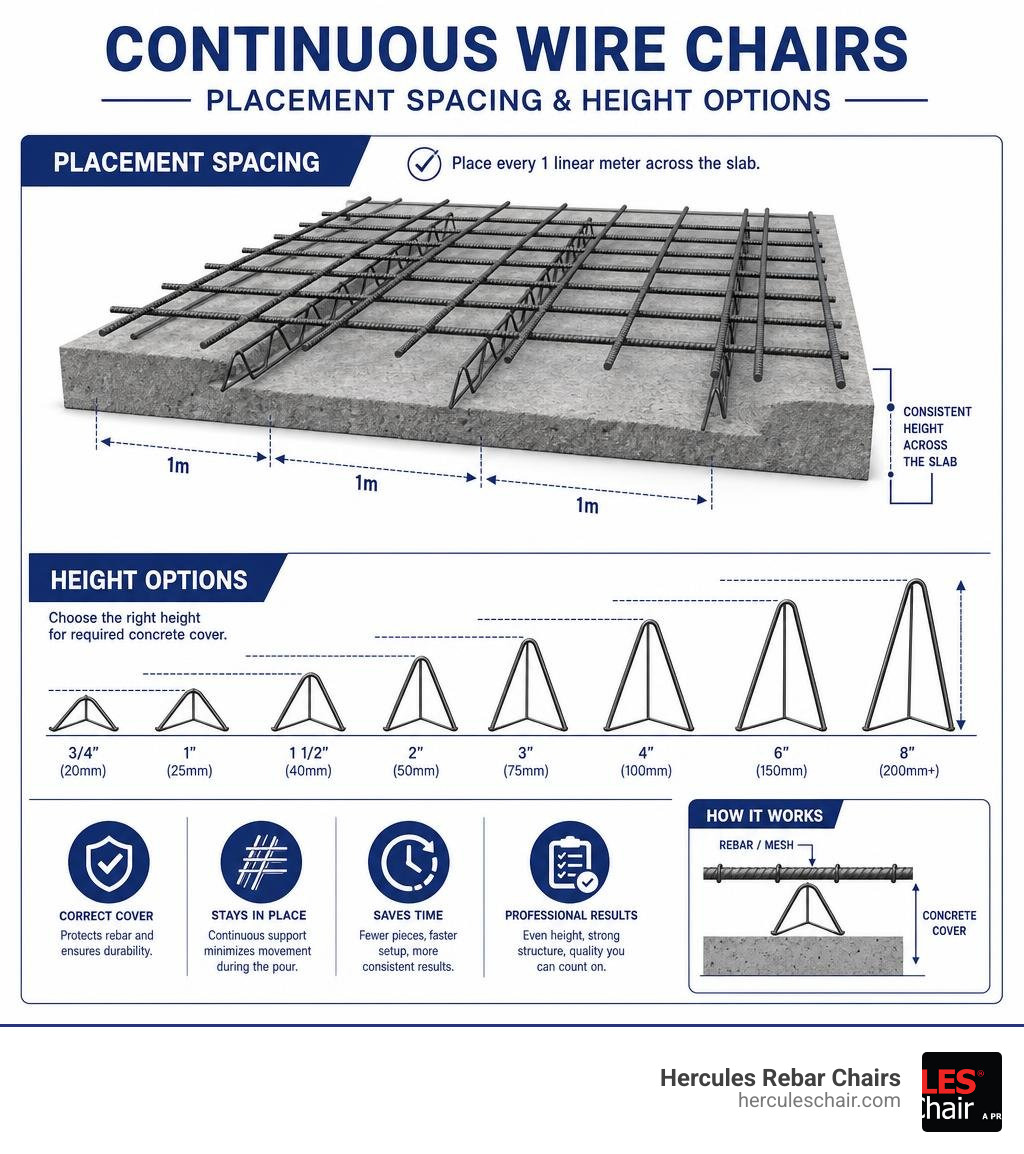
- They come in heights ranging from 3/4″ to 8″ (roughly 20mm to 200mm+) to match different cover requirements
- They are placed roughly every 1 linear meter across the slab
- They meet ASTM A82/82M and CRSI standards for commercial concrete work
Getting concrete cover right is one of the most critical steps in any slab pour. Too little cover and the rebar corrodes. Too much and the structural design is compromised. Yet on busy job sites, rebar shifts, workers step on mesh, and individual chairs tip over or space out unevenly — all before a single bucket of concrete is placed.
That’s exactly the problem continuous wire chairs are built to solve.
I’m Jordan Harris, a licensed Professional Engineer and structural engineer with hands-on experience in large-scale concrete projects. As part of the team at Hercules Rebar Chairs, I work daily with continuous wire chairs and the full range of rebar support solutions that keep concrete pours performing as designed. In the sections below, I’ll walk you through everything you need to know to use them correctly on your next project.
Continuous wire chairs word guide:
What Are Continuous Wire Chairs and How Do They Work?
In concrete construction, keeping your reinforcing steel exactly where the structural drawings dictate is non-negotiable. Continuous wire chairs are specialized, long-span structural accessories designed to support reinforcing steel in elevated concrete decks, footings, slab on metal decks, bridge decks, and other heavy-duty applications.
Unlike individual point supports that only hold up a single intersection of rebar, continuous wire supports provide a continuous line of elevation. They function as a bridge, carrying the weight of the steel mesh or rebar mats evenly across the entire bay. By distributing the weight of the steel over a continuous length, these supports ensure that your reinforcement never sags, dips, or dives toward the bottom of the slab. Learn more about continuous rebar supports to see how they maintain perfect structural alignment under heavy construction loads.
Key Differences: Individual vs. Continuous Wire Chairs
When setting up your reinforcement matrix, you will generally choose between individual chairs (like single-point plastic or wire chairs) and continuous supports (like slab bolsters and continuous high chairs).
Individual chairs require meticulous placement at every intersection. If a worker steps on a bar between two individual chairs, the bar can bow downward, compromising your concrete cover. Furthermore, individual chairs are prone to tipping over when hit by concrete pump hoses or heavy foot traffic.
Continuous wire supports, on the other hand, eliminate these localized point loads. Because they stretch across 5-foot (60″) or 2-meter lengths, they offer unmatched lateral stability. They cannot easily tip over, and they distribute the weight of workers and equipment over a much larger surface area. For a detailed breakdown of how these different options stack up on the job site, take a comprehensive look at rebar chair types.
Structural Design of Continuous Wire Chairs
The engineering behind continuous wire supports is beautifully simple yet incredibly strong. Structurally, they are manufactured in two main styles:
- The Triangular “Toblerone” Shape: Often referred to as snake spacers or continuous deck chairs, these feature a continuous, repeating lattice design that resembles a long triangular prism. This geometry provides exceptional three-dimensional stability, making them virtually impossible to tip over.
- The Continuous High Chair / Slab Bolster: These feature a straight top wire supported by upright wire legs spaced at regular intervals (usually every 2 to 5 inches), often reinforced with a continuous bottom runner wire to prevent the legs from sinking into the subgrade.
Both designs are engineered to allow concrete to flow freely through the support during the pour, eliminating the risk of voids, honeycombing, or air pockets. To dive deeper into the physics of these structural geometries, read our guide on continuous wire chair design and specifications.
Key Advantages, Specifications, and Compliance Standards
Using continuous wire chairs on your project does more than just make the inspector happy—it actively protects the structural elements of your building from long-term environmental hazards.
Preventing Membrane Punctures in Flooring Slabs
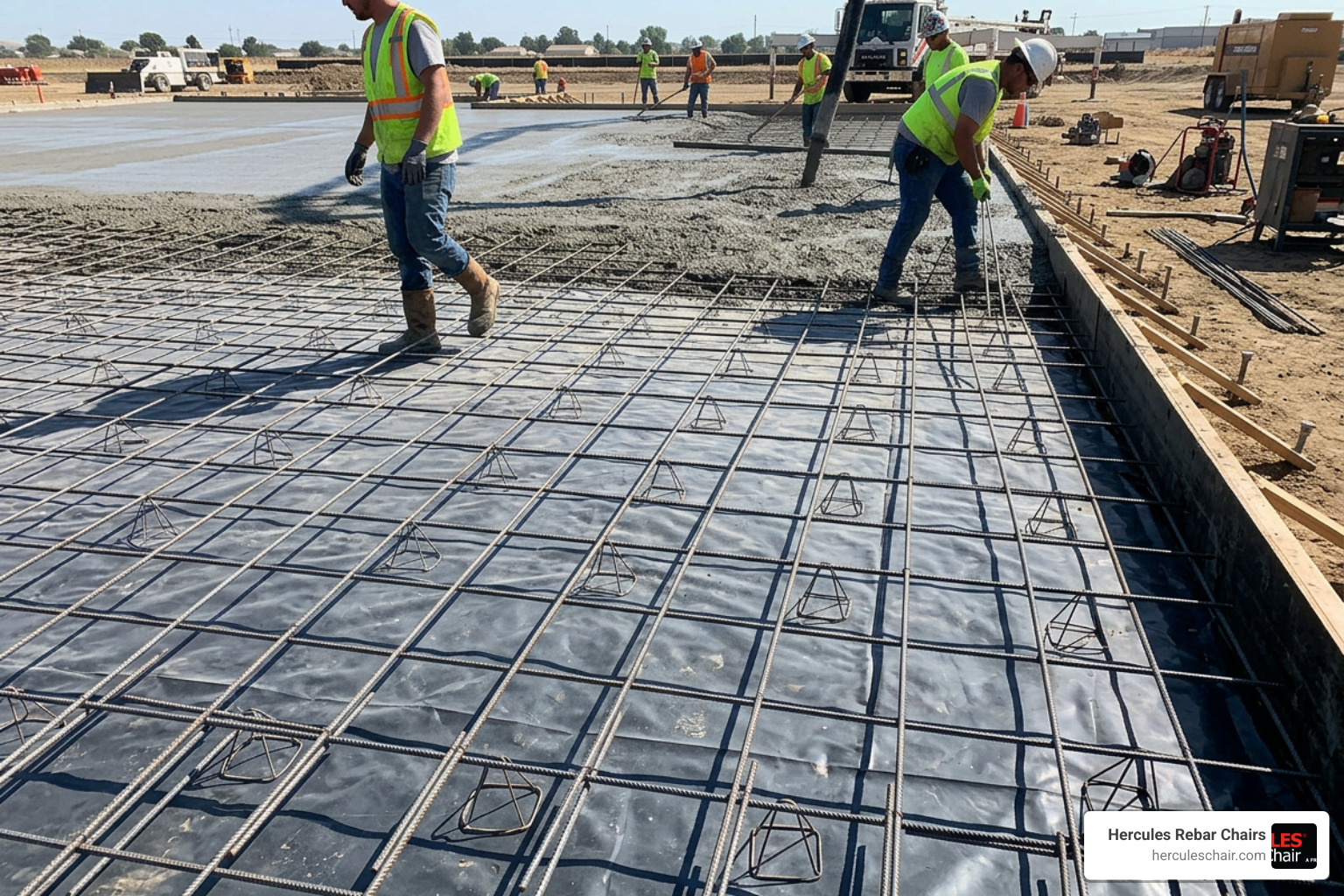
One of the greatest headaches in slab-on-grade construction is protecting the vapor barrier or damp-proof membrane. When you use individual plastic or wire chairs, the heavy weight of the rebar mat combined with workers walking on the steel creates intense point loads. These point loads can easily drive the sharp legs of individual chairs straight through your plastic vapor barrier, creating holes that allow moisture and radon gas to seep into the finished building.
Continuous wire supports solve this issue entirely. By distributing the weight over 2-meter or 60-inch metal runners, the pressure on the subgrade is minimized. The continuous bottom wire design glides smoothly over the membrane rather than digging into it, ensuring your moisture barrier remains 100% intact. For more tips on keeping your subgrade barriers safe, check out our guide to concrete chairs.
Standard Dimensions and Height Increments
To accommodate everything from thin elevated decks to massive industrial foundation slabs, continuous wire supports are manufactured in an extensive range of sizes.
In the United States, they are typically manufactured in 60-inch (5-foot / 1.52m) lengths and are available in heights ranging from 3/4″ to 8″ in precise 1/4″ increments. Internationally, they are commonly sold in 2-meter lengths with heights ranging from 50mm to 350mm (or even 400mm).
Here is a quick reference table comparing typical continuous wire chair sizes:
| Region | Standard Length | Height Range | Common Increments | Best For |
|---|---|---|---|---|
| US Standard | 60 inches (5 ft) | 3/4″ to 8″ | 1/4″ | Elevated decks, commercial slabs, footings |
| Metric / International | 2.0 meters (6.5 ft) | 50mm to 400mm | 10mm to 25mm | Ground floor slabs, multi-layer mesh |
Choosing the right height is vital to maintaining the exact concrete cover required by your project’s structural drawings. If you are working on complex multi-layer slabs, our guide to continuous high chairs will help you select the exact height configuration for your upper rebar mats.
Industry Standards and Code Compliance
In commercial and civil construction, you cannot just use any bent wire to support your steel. Your reinforcing accessories must comply with strict engineering standards.
High-quality continuous wire supports are manufactured from cold-drawn steel wire conforming to ASTM A82/82M specifications. Furthermore, they must meet the rigorous design standards set by the Concrete Reinforcing Steel Institute (CRSI). For federally funded projects in the United States, these supports must also comply with “Buy America” requirements, ensuring that the steel is melted and manufactured domestically.
In European-spec projects, you will often see references to German DBV guidelines, which ensure that the spacers do not create structural weaknesses or “foreign body” paths for water to penetrate the concrete. To make sure your job site stays fully compliant with all local building codes, consult our slab bolster chairs guide.
How to Install and Space Continuous Wire Supports Like a Pro
Now that you know what they are and why they are specified, let’s talk about how to actually lay them out on your job site to get the best results.
Recommended Spacing and Layout
The secret to a successful setup is consistent, structured spacing. You do not need to blanket the entire subgrade in wire; doing so is a waste of material and money.
Instead, follow this industry-standard rule of thumb:
- Recommended Spacing: Lay your continuous wire chairs in parallel rows spaced approximately 1,000mm (or roughly 3 to 3.5 feet) apart.
- The 1:1 Rule: This spacing corresponds to approximately 1 linear meter of continuous wire chair per square meter of reinforcement (or roughly 1 linear foot per square foot of slab area for top reinforcement).
By keeping your rows parallel and spaced at 3-foot intervals, you ensure that the reinforcing mesh or rebar mat has zero opportunity to sag. For a step-by-step breakdown of layout patterns, take a look at our guide on how to space your wire mesh chairs like a pro.
Securing the Reinforcement
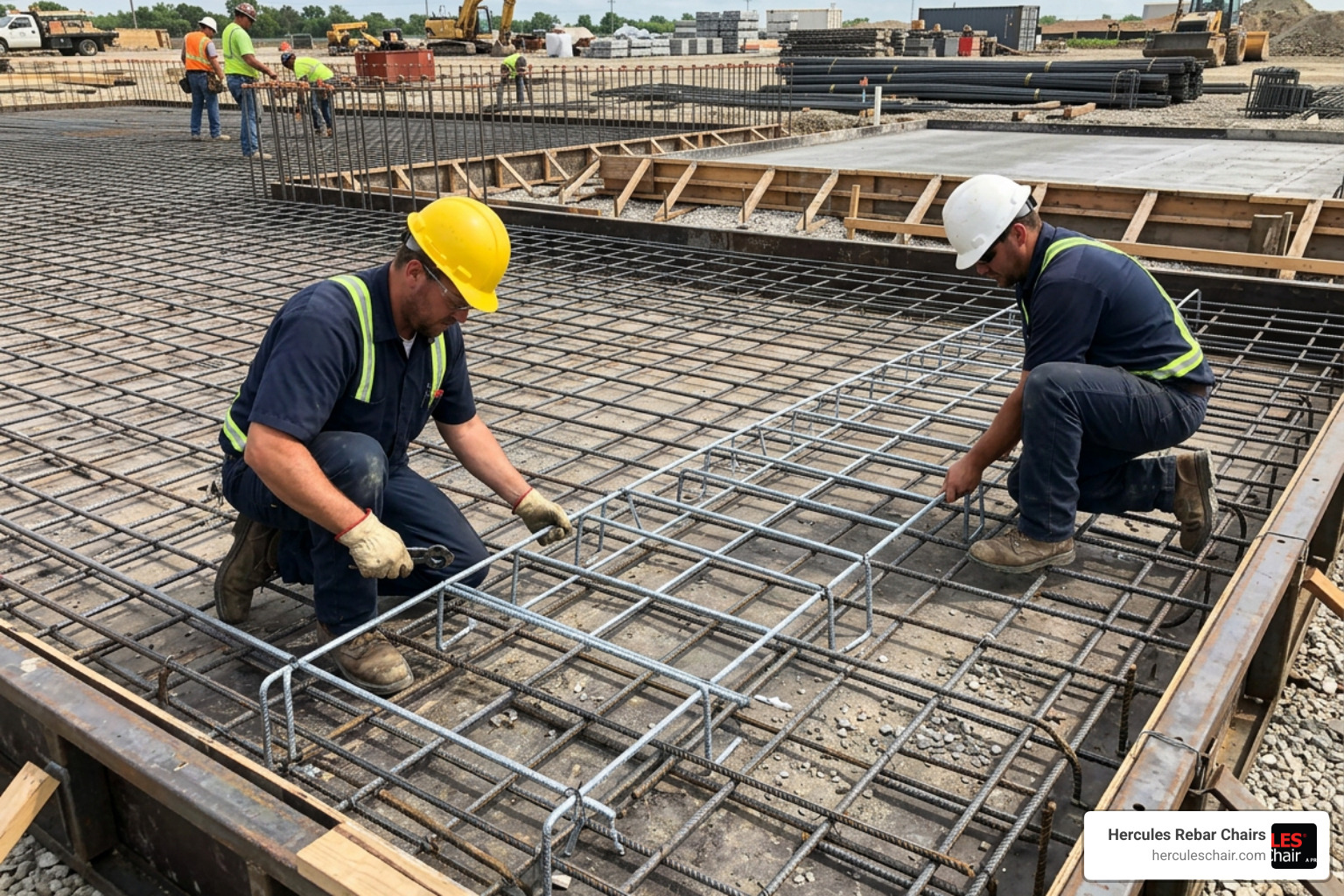
While continuous wire chairs are incredibly stable, you still need to secure them to your reinforcement to prevent any movement during the concrete pour.
Once your continuous chairs are laid out in parallel rows, place your reinforcing steel or wire mesh directly on top of them. Use standard tie wire to secure the rebar to the top wire of the continuous chairs at regular intervals—typically every third or fourth intersection.
Tying the steel not only keeps the chairs from sliding around when the concrete pump crew starts dragging heavy hoses over the deck, but it also creates a rigid, unified steel cage. This unified cage dramatically speeds up your pre-pour inspection and saves hours of on-site labor. To learn how this setup translates to massive time savings, read how to elevate your slab with concrete mesh chairs.
Frequently Asked Questions About Continuous Wire Spacers
Can continuous wire chairs be used with both rebar and mesh?
Absolutely! Continuous wire supports are highly versatile. They are equally suited for supporting heavy bar reinforcement (rebar mats) and lighter fabric sheet reinforcement (welded wire mesh). Because of their continuous linear profile, they are actually the preferred choice for wire mesh, which is naturally flexible and prone to sagging between individual point supports. To see how to optimize your mesh setups, check out the ultimate guide to mesh chairs.
How do metal continuous chairs compare to plastic spacers?
| Feature | Metal Continuous Chairs | Plastic Spacers / Individual Chairs |
|---|---|---|
| Load Capacity | Extremely High; will not crush under heavy mats | Moderate; can crack or deform under heavy loads |
| Concrete Bonding | Excellent; concrete flows around thin wire | Poor; large plastic footprints can create weak bond planes |
| Stability | Superior; 5ft/2m lengths prevent tipping | Low; single-point chairs easily tip over during pours |
| Vapor Barrier Protection | Excellent; runner wires distribute weight | Poor; sharp legs can puncture membranes |
While plastic chairs have their place in light residential work, commercial-grade continuous wire chairs offer vastly superior load capacity, better concrete bonding, and unmatched stability.
What is a continuous high chair upper (CHCU)?
A Continuous High Chair Upper (CHCU) is a specialized continuous support designed for multi-layer steel reinforcement. In thick slabs or elevated decks, you often have a bottom mat of rebar and a top mat of rebar.
The CHCU is designed to rest directly on top of the lower mat of steel, providing a stable platform to support the upper mat of steel. This ensures perfect vertical separation between your top and bottom reinforcement layers without needing to run exceptionally tall chairs all the way to the subgrade. Learn more by reading our guide on understanding continuous high chair uppers.
Conclusion
At the end of the day, the strength of your concrete slab relies entirely on the placement of its internal steel. If your rebar sinks to the bottom of the pour, your slab loses its tensile strength.
By using continuous wire chairs, you guarantee that your reinforcement remains exactly where it belongs, ensuring structural integrity, code compliance, and a flawless pour every single time.
When you are ready to secure your next project, look to Hercules Rebar Chairs. As America’s #1 manufacturer of heavy-duty concrete supports, we have sold over 14 million units across the United States. Easily identifiable by our signature red color, our chairs are engineered to save you time and money on-site while ensuring absolute code compliance.
Ready to elevate your concrete game? Buy high-quality rebar chairs from Hercules today and build with confidence!