

What Are Precast Concrete Elements and How Do They Differ From Cast-in-Place?
Precast concrete elements vocabulary:
If you work in construction, you have probably seen precast concrete elements everywhere without always stopping to name them. Wall panels, hollow-core planks, stair flights, bridge girders, parking garage tees, and facade panels all fall into this category. The big idea is simple: instead of pouring everything at the jobsite, we cast concrete components in a controlled plant, cure them there, then transport them to the project for installation.
That one shift changes a lot. It can improve quality control, reduce weather delays, speed up schedules, and make jobsites cleaner and safer. It also introduces new considerations like shipping size limits, crane picks, connection detailing, and erection sequencing. In other words, precast is fast, but it is not magic. It is a system, and good planning makes it work.
As of May 2026, precast continues to be one of the most practical ways to deliver structural and architectural concrete across residential, commercial, and infrastructure projects in the United States. Another reason it matters: plant fabrication and site preparation can happen at the same time, which can significantly shorten overall construction duration.
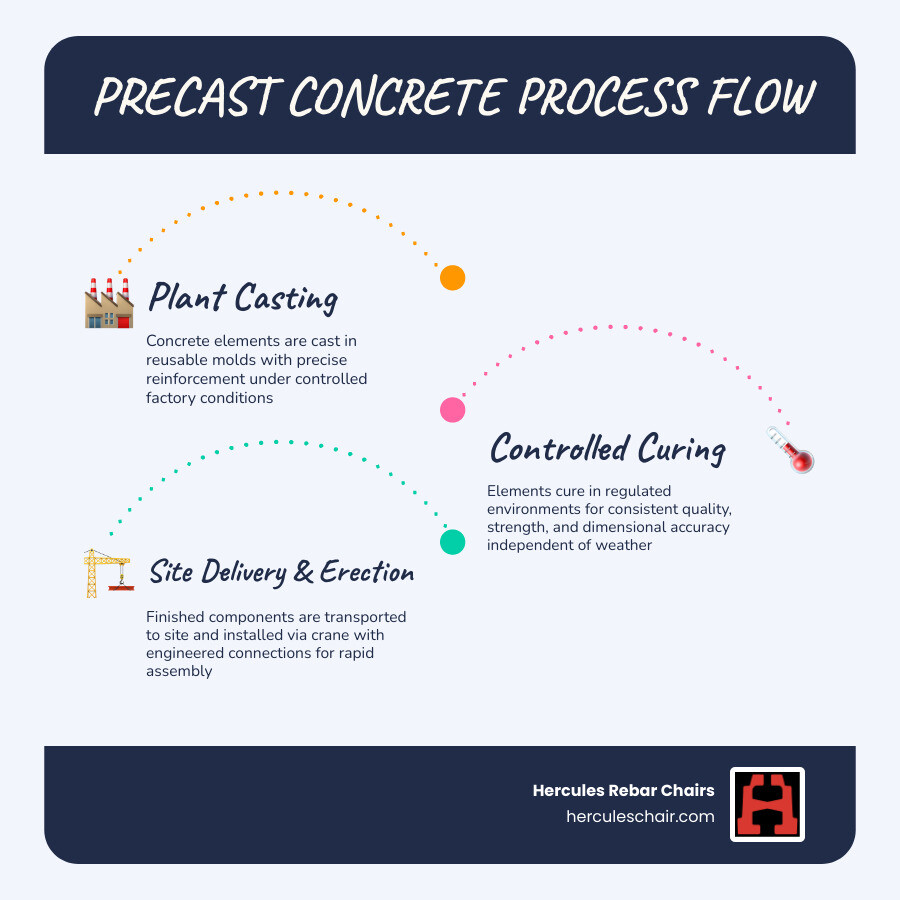
Precast concrete elements are concrete components made off-site in reusable molds or forms, cured under controlled conditions, then delivered and erected at the project location. Cast-in-place concrete, by contrast, is poured into its final position on the jobsite and cures there.
That difference affects nearly everything: schedule, labor, quality, safety, logistics, tolerances, and finish.
What Is Precast Concrete?
Precast concrete is concrete cast in a plant or casting yard instead of its final location. Forms may be made of steel, timber, plastic, rubber, fiberglass, or other durable materials, and many can be reused hundreds or even thousands of times. Because production happens in a controlled environment, plants can manage mix consistency, curing temperature, reinforcement placement, embedded items, and dimensions far more closely than most open-air jobsites.
Once the element reaches the required strength, it is stripped from the form, stored, marked for identification, shipped to the site, and lifted into place by crane.
The basic process sounds straightforward because it is. The engineering behind it is where the fun begins.
Precast Concrete Elements vs Cast-in-Place Concrete
Here is the practical comparison:
| Factor | Precast concrete | Cast-in-place concrete |
|---|---|---|
| Production location | Plant or casting yard | Final jobsite |
| Curing | Controlled environment | Weather-exposed site conditions |
| Formwork | Reusable molds | Often project-specific forms |
| Schedule | Fabrication can overlap site prep | More sequential workflow |
| Labor | More factory labor, less site labor | Heavier site labor demand |
| Safety | More work at ground level | More site exposure and temporary works |
| Quality consistency | Generally high and repeatable | More variable |
| Custom changes late in project | Harder | Easier |
| Transport limits | Yes | Minimal for poured-in-place work |
| Crane dependence | High | Moderate to low depending on work |
Precast often wins when speed, repeatability, long spans, quality finishes, or labor efficiency matter most. Cast-in-place still makes sense when geometry is irregular, access is poor, shipping is difficult, or last-minute design changes are likely.
Precast vs Prestressed: Not the Same Thing
These terms are related, but they are not synonyms.
Precast describes where the element is made: off-site in a controlled facility.
Prestressed describes how the element is structurally enhanced: steel strands are tensioned to place the concrete in compression, helping it resist tensile stresses during service.
Many beams and slabs are both precast and prestressed, but not all precast elements are prestressed. If you want a broader definition, see Precast concrete.
Main Types of Precast Concrete Elements Used in Construction
From floor to roof, precast can cover nearly the whole structure. In many projects, it also handles part of the enclosure and finish.

Structural Precast Concrete Elements
The main structural categories include:
- Beams and girders
- Columns
- Load-bearing wall panels
- Shear walls
- Floor and roof slabs
- Stairs and landings
- Bridge girders and deck members
- Spandrels and lintels
Common slab systems include hollow-core planks, solid prestressed planks, and double tees. Hollow-core slabs reduce self-weight by using internal voids, while double tees are popular for long spans in parking structures, warehouses, and schools. Research indicates hollow-core units commonly span about 6 to 16 m, while double-tee units often span 10 to 20 m.
Shear walls are especially important in multi-story structures because they resist lateral loads from wind and earthquakes. Precast shear walls have been used in buildings as tall as 30 stories.
Architectural and Insulated Precast Concrete Elements
Architectural precast focuses on appearance as much as performance. This includes:
- Cladding panels
- Facade panels
- Decorative screens
- Window surrounds
- Cornices and trim
- Insulated sandwich wall panels
Sandwich panels are especially useful because they can combine structure, enclosure, insulation, and finish in one assembly. Modern systems with continuous insulation and composite connectors can reach thermal performance up to R-28.2. That is a serious number for wall performance, not just marketing fluff.
Most Common Building Components From Floor to Roof
In everyday building work, the most common precast components are:
- Columns as the vertical load path
- Beams and girders supporting floors and roofs
- Floor slabs such as hollow-core planks or double tees
- Roof slabs for large-span buildings
- Stair flights and landings
- Elevator and stair core walls
- Partition and facade panels
For a product-focused overview of structural systems, see Structural Precast Concrete.
How Precast Concrete Elements Are Manufactured and Controlled for Quality
The quality advantage of precast comes from process discipline. Plants can standardize steps that are difficult to control consistently in the field.

Step-by-Step Manufacturing Process for Precast Concrete Elements
A typical sequence looks like this:
- Shop drawings are finalized.
- Forms or casting beds are cleaned and prepared.
- Reinforcement, welded wire reinforcement, or prestressing strands are placed.
- Embedded hardware is installed, including plates, lifters, anchors, sleeves, and conduit.
- Concrete is poured into the form.
- The mix is vibrated unless self-consolidating concrete is used.
- The element cures under controlled conditions, sometimes with accelerated or steam curing.
- The piece is stripped after reaching the specified release strength.
- Finishes are completed.
- The element is inspected, marked, stored, and sequenced for delivery.
Production lead times vary. Standard hollow-core runs may be available in roughly 2 to 4 weeks, while custom elements can take 8 to 16 weeks depending on design complexity and shop drawing approval.
Reinforcement, Supports, and Embedded Hardware
Reinforcement layout matters just as much in precast as it does in cast-in-place work. Cover must be maintained, cages must stay stable during casting, and lifting or connection hardware must land exactly where the drawings say it should.
Typical embedded items include:
- Rebar cages
- Prestressing strands
- Weld plates
- Bolted connection inserts
- Lifting anchors
- Conduit and sleeves
- Bearing plates
- Window and door blockouts
This is where reliable concrete supports earn their keep. Good supports help maintain bar position, concrete cover, and consistency from element to element. If you want a deeper refresher on reinforcement support and placement, see Slab Strong: Mastering Rebar Placement for Durable Concrete and Building Strong Foundations: Formwork and Reinforcement Essentials.
Quality Control, Testing, and Certifications
Plant QA/QC usually includes:
- Mix verification
- Slump or flow checks where applicable
- Compression testing of cylinders or samples
- Dimensional tolerance checks
- Cover verification
- Crack and edge inspection
- Surface finish review
- Verification of embedded hardware locations
- Release strength confirmation before stripping and lifting
Field QA continues after delivery, with checks for shipping damage, fit-up, alignment, bearing, joint preparation, and connection completion.
In U.S. practice, certification from organizations such as PCI and NPCA is commonly required, especially for transportation and utility work.
Advantages, Disadvantages, Sustainability, and Performance
Precast has real strengths, but it is not automatically the best answer for every project.
Key Advantages of Precast Concrete Elements
The biggest advantages include:
- Faster project delivery because fabrication and site work can happen at the same time
- Year-round production with less dependence on weather
- Better dimensional consistency and finish quality
- Safer casting at ground level
- Reusable forms that reduce cost per unit over repeated runs
- Lower site labor demand
- Long service life and low maintenance
- Good fire resistance and sound control
- High load capacity and strong durability
- Useful thermal mass for energy efficiency
Some published examples are striking. One commercial building assembled from precast panels was erected by just three workers in minimal time. Another source notes that one floor of a multi-storey precast building can be erected within a week under the right conditions.
Common Drawbacks and When Precast May Not Be Ideal
Now the other side of the coin:
- Transportation costs can be high
- Element size is limited by roads, trailers, and handling equipment
- Cranes and erection crews are essential
- Projects need staging or just-in-time delivery planning
- Late design changes are harder and more expensive
- Shipping damage is possible
- Some repairs are more complex than simple site patching
- Lead times must be managed early
- Tight or obstructed sites can complicate erection
If your project has awkward geometry, little crane access, or endless design revisions, cast-in-place may be the calmer choice.
Sustainability, Energy Efficiency, and Durability
Precast can support sustainability goals in several ways:
- Reusable molds reduce formwork waste
- Controlled production reduces material variability and rejects
- Just-in-time deliveries can reduce site clutter and damage
- Thermal mass can lower heating and cooling swings
- Insulated panels improve enclosure efficiency
- Durable concrete reduces replacement frequency over the building lifecycle
Precast buildings also tend to have greater thermal mass than wood or steel-dominant structures, which can improve energy performance. Sandwich panels can combine insulation and mass in one assembly, and as noted earlier, some systems achieve R-values up to R-28.2.
For a broader industry overview, see About Precast.
Connections, Transportation, Installation, and Finishes
Connections are where design meets reality. A beautiful panel that cannot be safely connected is just a very expensive paperweight.
How Precast Concrete Elements Are Connected On-Site
Two basic connection families are common:
- Dry joints
- Wet joints
Dry joints use bolted or welded steel connectors, embedded plates, and bearing details. Wet joints use protruding reinforcement, added steel, and cast-in-place grout or concrete to complete the structural connection.
Common connection methods include:
- Welded plate connections
- Bolted inserts
- Grouted sleeve couplers for column splices
- Bearing pads and dowels
- Grouted keyways
- Reinforcement lap zones with closure pours
Tolerance management is a huge part of successful erection. Connections must allow enough adjustability to fit real-world dimensions while still meeting structural intent. For diaphragms and lateral systems, the connections between slabs, beams, and walls are critical to transferring wind and seismic forces.
Transportation, Lifting, and Jobsite Safety
Precast rewards planning and punishes improvisation.
Key transportation and lifting considerations include:
- Confirm element weights and centers of gravity
- Match delivery order to erection sequence
- Protect corners, edges, and architectural finishes
- Use proper dunnage in storage and transport
- Verify lifting points and rigging angles
- Plan haul routes for size, turning radius, and bridge restrictions
- Maintain temporary bracing until the engineer authorizes removal
- Control erection stability at every stage
Typical weights show why this matters. Hollow-core planks often weigh about 250 to 400 kg/m, so a 6 m by 1.2 m unit may weigh around 2 to 3 tonnes. Large double tees can reach 15 to 25 tonnes. That is not a “grab it and scoot it over” situation.
Finishes, Customization, Repair, and Maintenance
Precast is not limited to plain gray surfaces. Available finishes commonly include:
- Smooth cast finish
- Exposed aggregate
- Acid-etched finish
- Sandblasted finish
- Form liner textures
- Pigmented concrete
- Reveals and rustications
- Thin brick or stone facing in some systems
Customization can also include cast-in openings, embeds, conduit, and utility chases. In some projects, windows, electrical pathways, and similar features are integrated before delivery.
Over time, maintenance usually focuses on:
- Joint sealant replacement
- Surface cleaning
- Inspection of cracks or spalls
- Connection corrosion checks
- Localized patching and repair
- Review of water infiltration at panel joints
If cracks or damage appear, repair methods depend on whether the issue is cosmetic, durability-related, or structural. Structural connection repairs should always be engineered.
Applications of Precast Concrete Elements in Real Projects
One reason precast remains popular is its range. It is not just for parking garages, though yes, parking garages do love it.
Residential and Commercial Applications of Precast Concrete Elements
In residential and commercial buildings, precast is often used for:
- Multifamily housing
- Hotels
- Office buildings
- Schools
- Hospitals
- Data centers
- Retail and mixed-use buildings
Typical elements include facade panels, stair towers, shear walls, floor planks, columns, beams, and partition walls. Partition wall systems can install much faster than masonry, and precast columns may be erected several times faster than comparable in-situ work.
Infrastructure and Industrial Uses
Infrastructure and industrial applications include:
- Bridges and girders
- Rail and transit structures
- Transportation barriers
- Retaining walls
- Stormwater and wastewater structures
- Utility vaults
- Warehouses
- Distribution centers
- Industrial sheds and process buildings
- Stadium and arena seating structures
Historically, precast has also been used extensively in public transport construction. The broader lesson is that once a project benefits from repetition, durability, speed, and controlled manufacturing, precast becomes attractive.
When to Choose Precast Over Other Systems
Precast is often the right choice when you need:
- Tight schedules
- Repetitive floor plates or bays
- Long spans and fewer interior columns
- High-quality factory finishes
- Reduced site labor
- Better weather independence
- Efficient enclosure systems
- Strong fire and acoustic performance
- Robust seismic or lateral systems with proper connection design
For a structural engineering perspective on system selection, see Precast Concrete Structures: A Comprehensive Guide.
Frequently Asked Questions About Precast Concrete Elements
How long does it take to manufacture and install precast concrete elements?
It depends on the element type and project complexity. Standard hollow-core products may be produced in 2 to 4 weeks, while custom pieces often take 8 to 16 weeks from approved shop drawings to delivery. The real advantage is that fabrication can run at the same time as foundations, utilities, and site preparation. On some projects, that overlap is what shortens the total schedule.
Can precast concrete elements be used in seismic zones and high-rise projects?
Yes. Precast is widely used in moderate and high seismic regions, but the connection design becomes more demanding. Shear walls, diaphragms, collectors, and joint detailing must all be engineered carefully to meet code requirements. Precast is also common in multi-story and high-rise work, especially for walls, stairs, facade systems, and floor framing.
What maintenance do precast concrete elements need over time?
Most systems need routine inspection rather than constant repair. Typical maintenance includes checking joint sealants, inspecting for cracks or spalls, reviewing exposed connections for corrosion, and addressing any water entry issues. Harsh exposure conditions may require more frequent inspections. The concrete itself is usually low-maintenance when properly detailed and installed.
Conclusion
Precast concrete elements offer a smart balance of speed, quality, durability, and design versatility. They can serve as structure, enclosure, finish, and even part of the building’s energy strategy. But successful precast work depends on early planning, accurate shop drawings, reinforcement support, realistic lead times, transportation logistics, and well-detailed connections.
That is also why the basics still matter. Even the most advanced precast system relies on correct reinforcement position and dependable concrete supports. If you want to tighten up your concrete workflow, we recommend reading The Concrete Contractors Toolkit: What You Need to Get the Job Done.
And if you need reliable support products for concrete construction, explore https://herculeschair.com/buy-rebar-chairs/. At Hercules Rebar Chairs, we build rebar chairs and concrete supports designed to save time, support code compliance, and make bar positioning easier to inspect on the jobsite. Our red chairs are hard to miss, which, frankly, is kind of the point.