

Why Slab Bolster Chairs Matter for Every Concrete Pour
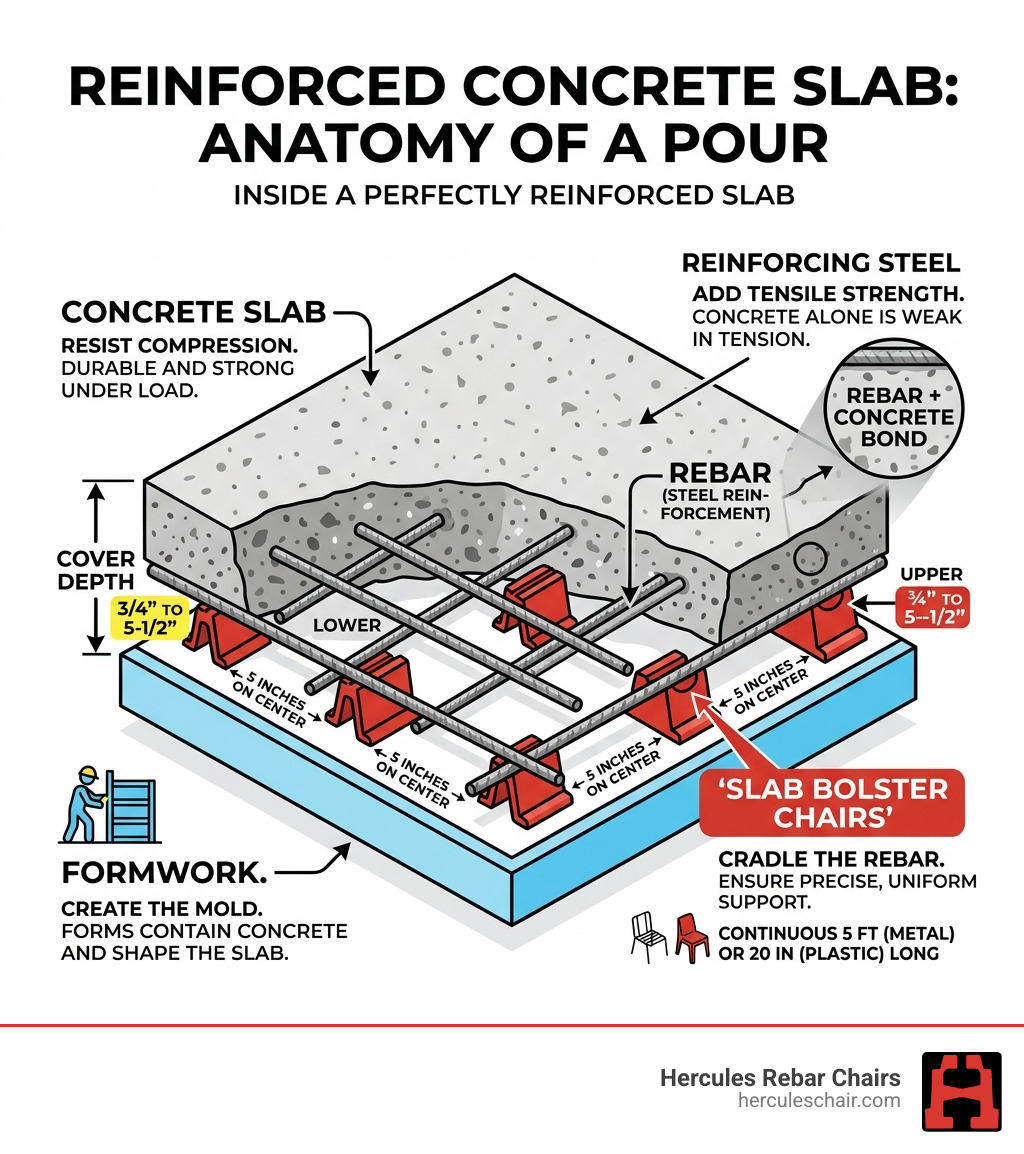
Slab bolster chairs are continuous wire or plastic supports used to hold rebar at the correct height inside a concrete slab before and during the pour.
Here’s a quick breakdown of what you need to know:
| Feature | Details |
|---|---|
| What they do | Hold rebar at the correct height (concrete cover) inside a slab |
| Common materials | Steel wire, polypropylene plastic |
| Height range | 3/4″ to 5-1/2″ |
| Standard length | 5 ft (metal); 20 in (plastic) |
| Main types | Light duty, standard, heavy duty, upper, lower |
| Typical spacing | 5 inches on center |
| Common applications | Slabs on grade, elevated decks, bridge decks, precast panels |
Concrete is only as strong as the reinforcement inside it. If rebar shifts during a pour — even by a fraction of an inch — you lose concrete cover, and that means reduced structural strength, faster corrosion, and potential code violations. Slab bolster chairs solve that problem.
They sit on the formwork or subgrade, cradle the rebar, and keep everything exactly where the engineer specified it — no shifting, no settling.
I’m Jordan Harris, a licensed Professional Engineer with a background in large-scale structural concrete projects and a product developer at T.J. Harris Company, where I’ve worked closely with rebar support systems including slab bolster chairs. In this guide, I’ll walk you through everything you need to pick the right bolster for your next pour.
Slab bolster chairs further reading:
Understanding Slab Bolster Chairs and Their Functions
When we talk about reinforcing a slab, we often focus on the rebar itself, but the unsung heroes of the jobsite are the supports that keep that steel in place. Slab bolster chairs are designed to provide stable, continuous support for reinforcing steel. Unlike individual chairs that support a single point, bolsters are linear. This means they distribute the weight of the rebar and the workers walking on it over a much larger area.
The primary function of these bolsters is to maintain the “concrete cover”—the specific distance between the edge of the concrete and the steel reinforcement. If the rebar is too high, the slab can crack; if it’s too low, the steel is exposed to moisture and oxygen, leading to rust. By using concrete bolster chairs, you ensure that the rebar doesn’t settle into the mud or sag between supports during the heavy vibration of a concrete pour.
Structurally, these supports prevent lateral movement. Many metal bolsters feature locking ends, allowing you to connect multiple 5-foot sections into one long, continuous run. This creates a rigid “track” for your rebar, which is essential for maintaining structural stability in large-scale projects like bridge decks or elevated parking garages. For a deeper dive into how these fit into the broader world of reinforcement, check out the ultimate guide to rebar chairs.
Material Varieties: Metal vs. Plastic Slab Bolster Chairs
Choosing between metal and plastic isn’t just about price—it’s about the environment of your pour and the finish you need. We see both used across the USA, from the humid coasts of Florida to the dry plains of Kansas.
| Feature | Metal Slab Bolsters | Plastic Slab Bolsters |
|---|---|---|
| Strength | Extremely high (6 gauge steel common) | High, but varies by duty rating |
| Corrosion Resistance | Depends on coating (Epoxy/Galvanized) | Naturally non-corrosive |
| Visibility | Can leave “rust bleeds” if not tipped | Virtually invisible (fine-point legs) |
| Standard Length | 5 Feet | 20 Inches to 30 Inches |
| Weight | Heavier, more rigid | Lightweight, easy to carry |
Plastic bolsters, often made from high-impact polypropylene, are fantastic because they never rust. In high-end architectural concrete, where the bottom of the slab might be visible (like a ceiling in a modern office), you don’t want metal feet showing through. While some designers look for inspiration in aesthetic slab designs for furniture, in the construction world, “aesthetic” means the support disappears entirely.
On the other hand, metal is the “strong, silent type.” It can handle the heaviest rebar mats without flinching. If you are working on a heavy-duty industrial floor, you’ll likely be choosing the best steel rebar chairs or bolsters to ensure nothing moves under the weight of the concrete pump hose.
Metal Slab Bolster Chairs and Corrosion Resistance
For metal slab bolster chairs, the finish is everything. Standard “bright” or plain wire is fine for interior slabs where moisture isn’t a concern, but for most projects, you’ll want a bit more protection.
- Epoxy Coated: These are the gold standard for bridge decks and saltwater environments. The green coating prevents the steel from reacting with the elements.
- Plastic Tipped: These metal bolsters have little plastic “boots” on the legs. This prevents the metal from touching the formwork, which stops rust from bleeding through to the surface of the finished concrete.
- Galvanized Steel: A zinc coating provides excellent rust protection for general outdoor use.
- Stainless Steel: The most expensive option, used only when the highest level of corrosion resistance is required.
Most metal bolsters are sold in 5-foot lengths and come in bundles of 20 (totaling 100 feet per bundle). For large-scale procurement, skids can contain up to 6,000 feet of bolster!
Plastic Bolster Options for Precast
In the precast industry, plastic is king. Plastic slab bolster chairs are lightweight and incredibly easy to snap together. Many of these products are tested to meet DOT (Department of Transportation) specifications, ensuring they can handle the rigors of highway and bridge construction.
One unique feature of plastic bolsters is the “fine-point leg.” These legs have a very small footprint, which minimizes visibility in cured precast panels. They are also designed with large cavities that allow concrete to flow completely around the support, ensuring there are no air pockets or “honeycombing” around the reinforcement. Common lengths for these plastic units are around 20 inches, making them easy to box and transport to the jobsite.
Sizing, Spacing, and Specialized Bolster Types
Getting the size right is the difference between a perfect slab and a structural failure. Slab bolster chairs come in heights ranging from 3/4 inch all the way up to 5-1/2 inches.
When determining bar chair sizes, you must account for the thickness of the slab and the required cover. For example, if you have a 6-inch slab and need 2 inches of cover on the bottom, you’ll be looking for a 2-inch bolster. We often see projects categorized by duty:
- Light-Duty: For thin slabs or wire mesh.
- Standard-Duty: The workhorse for most residential and commercial slabs.
- Heavy-Duty: For thick mats of #8 rebar or larger.
Proper Spacing for Slab Bolster Chairs
How many bolsters do you actually need? While you should always follow the engineer’s specs, the industry standard for slab bolster chairs is typically 5 inches on center for the legs along the runner wire, but the spacing between the rows of bolsters is what really matters.
Usually, rows of bolsters are spaced every 2 to 4 feet depending on the weight of the rebar. If the rebar starts to sag when you walk on it, you need more bolsters. Some high-end metal bolsters feature a corrugated top wire. This “wavy” wire acts as a guide, helping workers snap the rebar into the correct horizontal spacing without having to pull out a tape measure every five seconds.
Installation Best Practices:
- Clear the Deck: Ensure formwork is clean of debris.
- Lock the Ends: If using metal, snap the locking ends together to create a continuous line.
- Check the Gauge: For heavy mats, ensure you’re using at least 6-gauge steel bolsters.
- Stagger Joints: Don’t have all your bolster connections in a single line across the slab.
Slab Bolster Uppers vs. Lowers
In many modern slabs, especially suspended decks or bridge decks, we use two layers of rebar. This is where the distinction between “Uppers” and “Lowers” becomes critical.
- Slab Bolster Lowers: These are designed to sit directly on the formwork or the ground to support the bottom layer of steel.
- Slab Bolster Uppers (SBU): These are used to support a second (top) layer of steel. They are often placed on top of the first layer of rebar or on soft surfaces like carton forms. An SBU typically has two runner wires at the bottom for stability and a single support wire at the top.
Using bolsters for double mats ensures that the top layer of steel doesn’t get pushed down during the pour. This is vital for “slab on metal deck” applications where the concrete needs to bond perfectly with the steel fluting.
Frequently Asked Questions about Slab Bolsters
What is the difference between a slab bolster and a slab bolster chair?
In common jobsite lingo, the terms are often used interchangeably. However, technically, a “slab bolster” refers to the long, continuous linear support, while a “chair” often refers to a single-point support. A slab bolster chair is essentially a hybrid term used to describe these continuous supports that act as a series of chairs connected by a runner wire.
How many feet of slab bolster do I need per square foot of concrete?
A good rule of thumb for estimating is to take your total square footage and divide by 2.5 to 3. For example, a 1,000 sq. ft. slab might require roughly 350 to 400 linear feet of bolster, depending on the rebar grid size. Always check your specific project plans, as heavy reinforcement will require tighter spacing.
Can slab bolsters be used for both rebar and wire mesh?
Yes! While they are most commonly used for rebar, they provide excellent, level support for welded wire mesh (WWM). In fact, using continuous bolsters for mesh is often better than individual chairs because mesh is flexible and prone to sagging. A continuous bolster prevents the mesh from being pushed to the bottom of the slab when the crew walks on it.
Conclusion
At the end of the day, your concrete is only as reliable as the steel inside it—and that steel is only as reliable as the supports holding it up. At Hercules Rebar Chairs, we’ve seen millions of feet of reinforcement go into the ground. We are proud to be America’s #1 choice, with over 14 million units sold across the USA.
Our signature red slab bolster chairs are designed to save you time on the clock and money in the bank. They ensure code compliance, prevent costly structural failures, and make inspections a breeze. Whether you’re pouring a patio in Ohio or a bridge deck in California, we have the heights and materials you need to get the job done right.
Don’t let your rebar sit in the dirt. Give it the support it deserves.