

Introduction
What Are Plastic Rebar Chairs for Sale — and Which Should You Buy?
Plastic rebar chairs for sale are widely available from retailers, wholesalers, and manufacturers — but not all are created equal. Here’s a quick overview to answer your core questions:
Quick-Reference Guide:
| Question | Answer |
|---|---|
| What are they? | Plastic supports that hold rebar at the correct height in a concrete slab |
| Why plastic? | Non-corrosive, lightweight, fast to install, and cost-effective |
| Common heights | 1 inch to 6 inches |
| Rebar compatibility | Fits sizes #3 through #6 |
| How far apart? | Place every 2 to 3 feet along the rebar |
| Do they stay in? | Yes — permanently embedded in the concrete |
| Where to buy? | Home improvement stores, wholesale suppliers, and direct from manufacturers |
| Typical pricing | Ranges from ~$38 for a 50-pack to ~$187 for a 500-pack |
Rebar doesn’t hold itself in place. Without proper support, it sinks to the bottom of the form before the concrete sets — weakening the entire structure. That’s where plastic rebar chairs come in. They’re small, but they do a critical job: keeping your rebar at the exact height needed for proper concrete coverage and load distribution.
Whether you’re pouring a residential foundation slab or reinforcing a retaining wall, the right rebar chair saves you time, money, and headaches on the job site.
I’m Jordan Harris, a licensed Professional Engineer with a master’s degree in structural engineering and five years of hands-on experience designing large-scale concrete and steel structures. Through my work with Hercules Rebar Chairs, I’ve spent years engineering and evaluating plastic rebar chairs for sale, and I know exactly what separates a chair that performs from one that fails mid-pour.
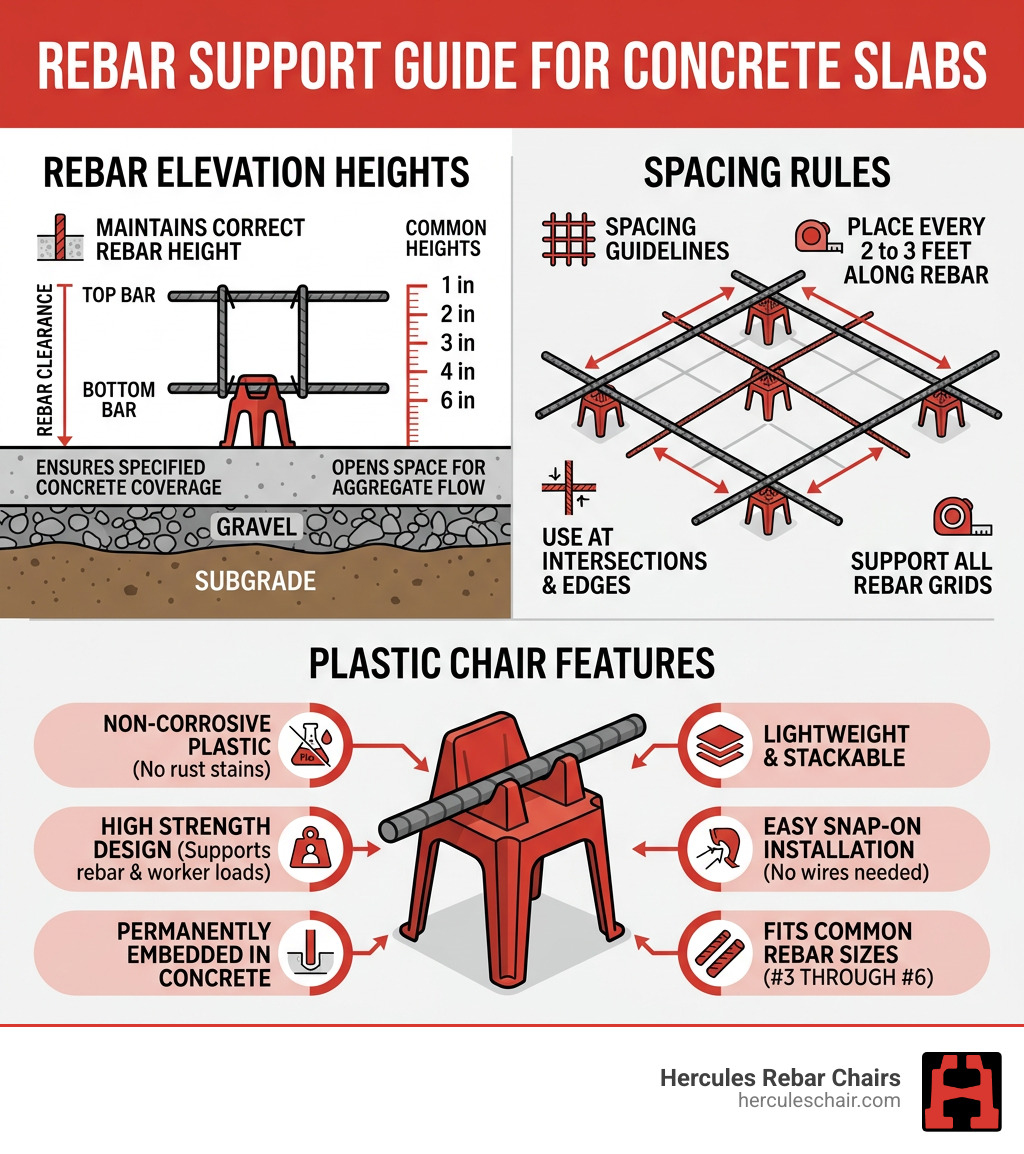
When we talk about concrete reinforcement, we are really talking about the backbone of a building. Rebar provides the tensile strength that concrete lacks on its own. However, for that steel to do its job, it must be positioned perfectly within the concrete “envelope.” If the steel is too high, it creates trip hazards or pops out of the surface; if it is too low (or sitting on the dirt), it provides zero structural benefit and will eventually rust.
Plastic rebar chairs for sale solve this by acting as a permanent “seat” for the steel. They ensure optimal concrete flow around the bars, allowing the wet mix to fully encapsulate the reinforcement. This creates a monolithic structure where the load distribution is balanced exactly as the engineers intended.
Why Choose Plastic Rebar Chairs for Sale?
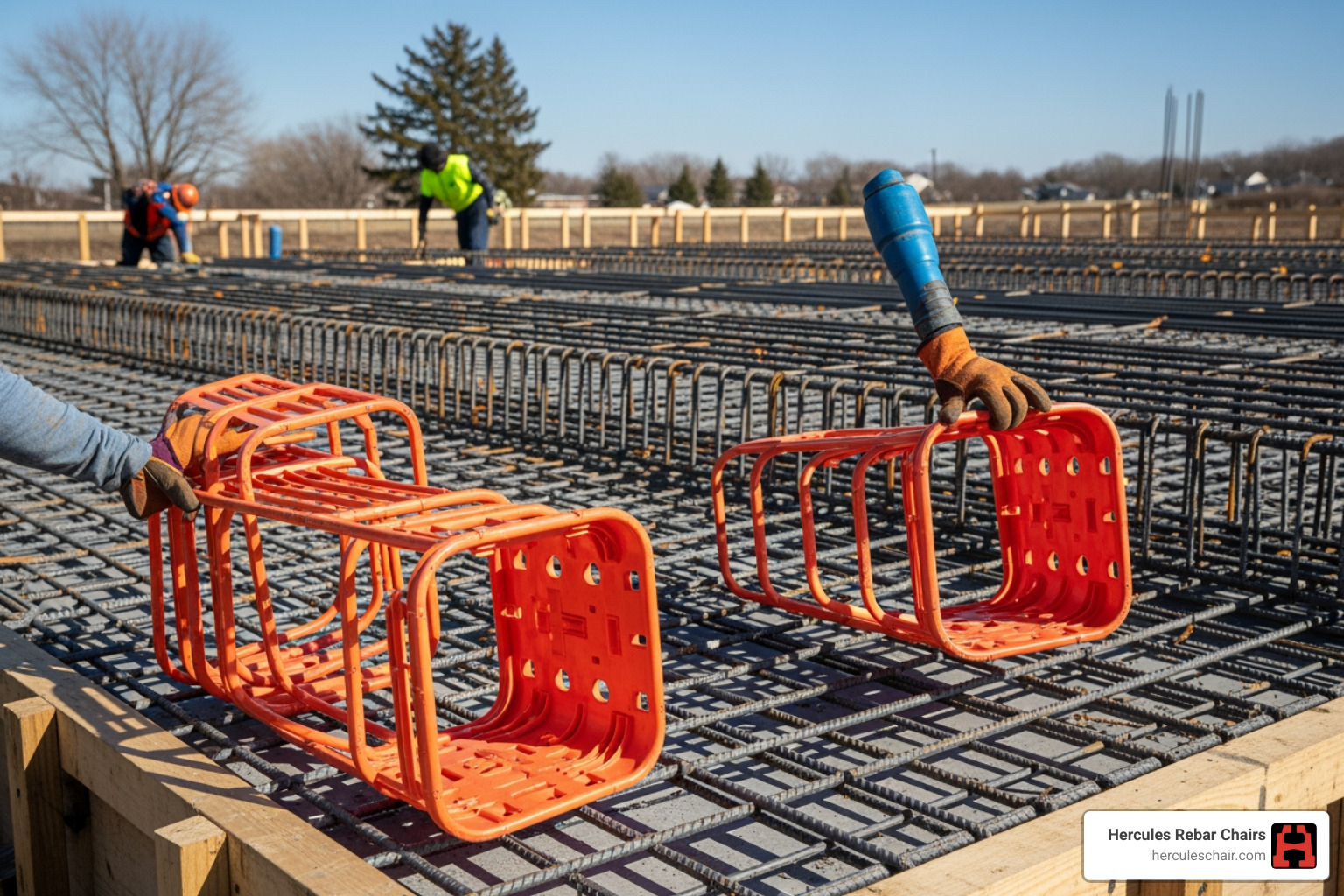
In the old days, many crews used “dobies” (small concrete blocks) or metal bolsters. While those still have their place, the industry has seen a massive shift toward high-quality plastic. Why? Because plastic doesn’t rust.
When you use metal supports, there is always a risk of “concrete cancer.” If moisture reaches a metal chair that is touching the surface of the concrete, that chair will rust. That rust then travels up the chair and into your main rebar grid. Since rust expands, it eventually cracks the concrete from the inside out. By choosing plastic rebar chairs for sale, you eliminate this risk entirely.
Our chairs are typically made from non-corrosive polypropylene or high-density polyethylene. These materials are chemically resistant, meaning they won’t react with the alkaline environment of the concrete or any soil chemicals. They are also incredibly lightweight, making them much easier to transport around a massive job site than heavy bags of concrete dobies.
Advantages of Plastic Rebar Supports
The most immediate advantage we see on the job site is installation speed. Time is money in construction, and the labor savings associated with plastic chairs are significant.
Furthermore, plastic has a thermal expansion coefficient that is often more compatible with the surrounding concrete environment in certain applications than large metal bolsters. They are also non-conductive. This makes them the gold standard for bridge deck suitability or any project involving electrical components or post-tension cables, where you want to avoid any electrical paths through the reinforcement. You can learn more about why these supports are so essential for strong slabs in our detailed breakdown of concrete integrity.
Key Features and Material Benefits
When you are looking at plastic rebar chairs for sale, you’ll notice a few design features that make a world of difference. The most important is the snap-lock design.
In the past, workers had to use tie wire to secure every single intersection of rebar to its support. It was back-breaking, slow work. Modern plastic chairs allow the rod to simply “snap” into the seat. This eliminates the need for wire tying at the support points, which can cut your prep time in half.
Another feature to look for is a wide base. Stability is everything during a pour. As the wet concrete comes out of the pump or the chute, it carries a lot of force. A flimsy chair with a narrow base will tip over, leaving your rebar sagging. A wide, sturdy base ensures the chair stays upright even under the pressure of the mix.
Don’t let the “plastic” label fool you regarding strength. High-quality plastic rebar chairs for sale are engineered for high load capacity. For example, some heavy-duty models are rated for a maximum load of up to 1,400 lbs. That is more than enough to support the weight of the steel and the workers moving around on top of it. For a deeper dive into these specs, check out our ultimate guide to rebar chair types.
Sizing and Height Options for Plastic Rebar Chairs for Sale
Rebar isn’t “one size fits all,” and neither are the chairs. Most plastic supports are designed to accommodate rebar gauges from #3 (3/8″) up to #6 (3/4″).
The elevation height—how far the chair lifts the bar off the ground—is the most critical spec. We generally see a range from 1-inch to 6-inch heights.
- 1-inch to 2-inch chairs: Common for thinner slabs or “sidewalk” style pours.
- 3-inch to 4-inch chairs: The industry standard for residential foundations and heavy-duty driveways.
- 5-inch to 6-inch chairs: Used for deep structural slabs, bridge piers, and heavy commercial footings.
Many of our popular plastic rebar chairs for sale feature dual-height notches. This is a clever design where one side of the chair provides one elevation (say, 2.5 inches), and if you flip the bar to the other notch, it provides a different elevation (like 3 inches). This versatility means you can buy one type of chair for multiple areas of a project. If you’re unsure what you need, we have a guide on how to determine bar chair sizes in 3 easy steps to help you get the “Goldilocks” fit—not too big, not too small.
Selecting the Right Plastic Rebar Chairs for Sale for Your Project
When selecting your chairs, consider the substrate. Are you pouring on top of a vapor barrier, sand, or a hard mud mat?
- Chairs with Bases: If you are pouring on sand or a soft vapor barrier, you need a chair with a flat, wide base (often called a “sand plate”) to prevent the chair from sinking into the ground.
- Single-Direction Chairs: These hold a single bar running in one direction.
- Dual-Direction Supports: These are designed to sit at the “cross” where two bars intersect, supporting both bars simultaneously. This provides maximum grid stability.
Best Practices for Installation and Spacing
Even the best plastic rebar chairs for sale won’t help if you don’t use enough of them. The goal is to prevent the rebar from “deflecting” or sagging between the supports.
The general rule of thumb is the 2 to 3 feet rule. You should place a chair every 2 to 3 feet along the length of the rebar. However, if you are using thinner rebar (like #3) or if workers will be walking extensively on the grid, you should lean toward the 2-foot spacing.
For foundation slabs, we recommend a “checkerboard” pattern of chairs to ensure the entire grid stays level. For retaining walls, ensure the chairs are clipped tightly so they don’t shift when the concrete is dropped from the top of the forms. For more on the art of positioning, see our tips on sitting pretty with rebar supports.
Frequently Asked Questions about Rebar Supports
Are rebar chairs left in the concrete?
Yes, they are! Plastic rebar chairs for sale are designed for permanent placement. Once the concrete is poured, they become a part of the finished structure. Because they are made of non-corrosive materials, they won’t degrade over time or create “voids” in the concrete. They actually help with the structural safety by ensuring the steel stays in the “sweet spot” of the slab for the next 50 to 100 years. They bond well with the concrete, ensuring there are no weak points. This is a key part of why you should “chair-ish” your concrete.
Can you step on plastic rebar chairs during a pour?
If you buy high-quality, heavy-duty chairs, the answer is a resounding yes. We know that in the real world, installers have to walk on the rebar grid to pull the pump hose or vibrate the concrete. Our chairs are engineered with high impact resistance and point load capacity. They are designed to be sturdy enough to handle a 200lb worker stepping on the intersection without collapsing or snapping. This stability during the pour is what separates professional-grade chairs from the cheap imitations.
What happens if you don’t use rebar chairs?
If you skip the chairs, you are asking for trouble. Without supports, rebar will naturally sink to the bottom of the wet concrete. This leads to:
- Rebar Sinking: The steel ends up at the bottom, where it provides no tensile strength.
- Concrete Spalling: If the rebar is too close to the surface, it will eventually rust and cause the concrete to flake off (spall).
- Structural Failure: The slab may crack or collapse under heavy loads because the reinforcement isn’t where the engineer planned for it to be.
- Code Compliance Issues: Most building inspectors will fail a project immediately if they see rebar sitting on the ground during a pre-pour inspection.
Conclusion
At Hercules Rebar Chairs, we take concrete support seriously. We are proud to be America’s #1 choice, with over 14 million units sold. Our chairs are easily identifiable by their signature red color, a mark of quality that foremen and inspectors across the USA have come to trust.
Whether you are in California, Texas, New York, or any of the 50 states, we provide the tools you need to ensure code compliance while saving significant time and money on labor. Don’t leave your project’s integrity to chance. When you are looking for the best plastic rebar chairs for sale, choose the brand that’s engineered to hold up under pressure.
Ready to start your next project with the best supports in the business? Buy rebar chairs directly from us and experience the Hercules difference.