

Why the Right Concrete Chair Makes or Breaks Your Slab
Concrete chairs are small supports placed under rebar to hold it at the correct height inside a concrete pour – and choosing the right one directly affects the strength and compliance of your finished slab.
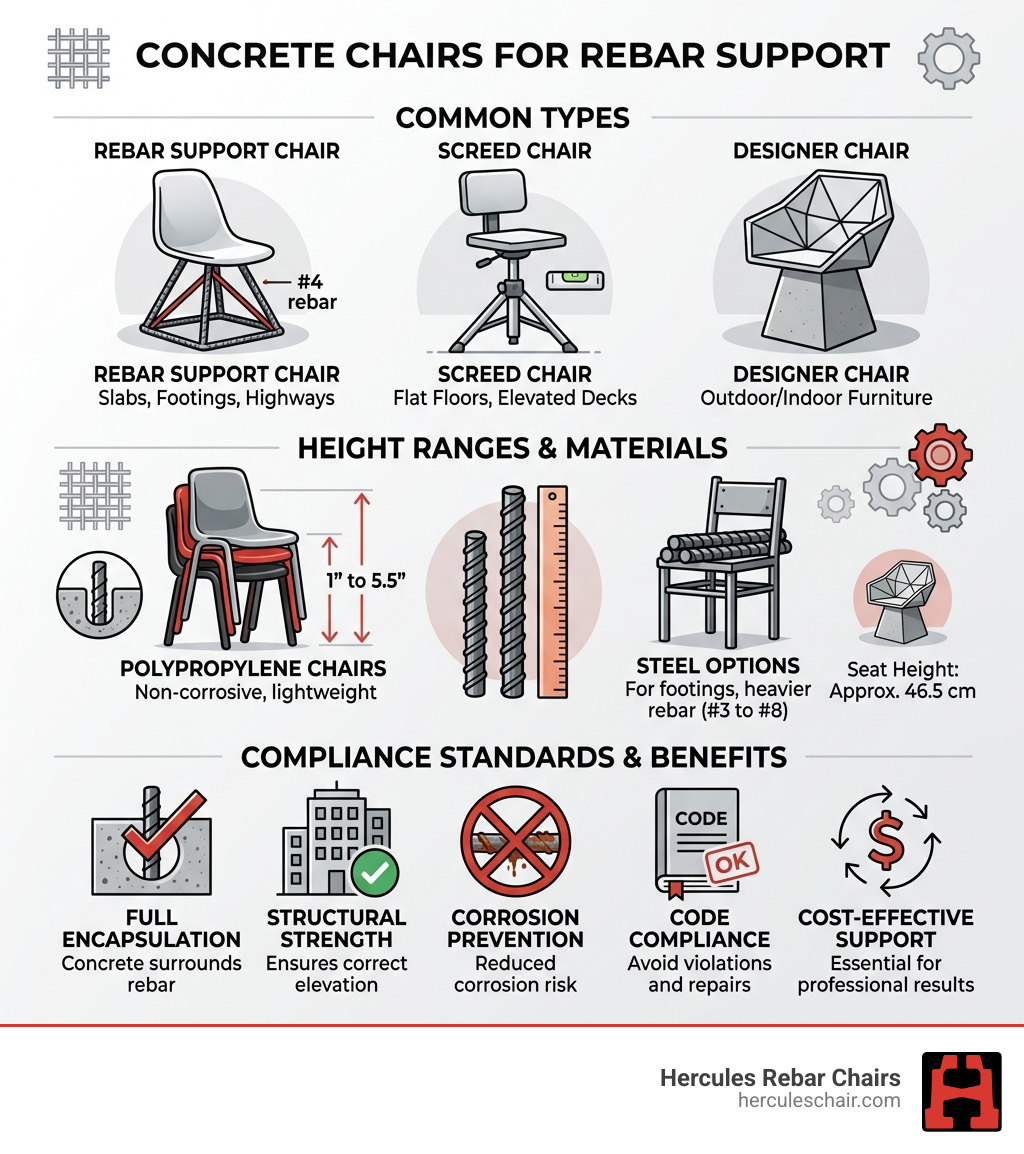
Here’s a quick look at the most common types:
| Type | Best For | Material | Typical Height Range |
|---|---|---|---|
| Rebar support chair | Slabs, footings, highways | Polypropylene or steel | 1″ to 5.5″ |
| Screed chair | Flat floors, elevated decks | Polypropylene | Adjustable |
| Designer concrete chair | Outdoor/indoor furniture | Die-cast aluminum + concrete base | Seat height ~46.5 cm |
For contractors buying in bulk, polypropylene rebar chairs are the most popular choice – non-corrosive, lightweight, and available at less than $0.50 per unit at volume. Steel options work well for footings and heavier rebar sizes (#3 to #8).
If rebar isn’t held at the right elevation, concrete can’t fully encapsulate it. That means reduced structural strength, corrosion risk, and potential code violations – problems that cost far more to fix than a bag of chairs. In my years as a structural engineer, I’ve seen how a simple oversight in chair selection can lead to catastrophic slab failure or expensive remedial work. Investing in the right support today prevents the cracking and shifting that often plagues poorly reinforced concrete years down the line.
I’m Jordan Harris, a licensed Professional Engineer and structural engineer with hands-on experience specifying concrete chair supports across large-scale concrete and steel projects. As part of the team behind Hercules Rebar Chairs – a product line with over 14 million units sold – I’ll walk you through exactly what to look for when buying in bulk.
The Versatility of the Concrete Chair in Modern Industry
When we talk about a concrete chair, we are usually referring to the unsung heroes of the construction site: the small spacers that keep reinforcement steel from sinking to the bottom of the form. However, the term has a dual life. In high-end architecture and interior design, it refers to stunning pieces of furniture that celebrate industrial aesthetics.

From the Job Site to the Living Room
In professional construction, a concrete chair (or rebar chair) is a technical tool. It ensures that the steel reinforcement stays in the “sweet spot” of the slab—usually the middle third—to provide maximum tensile strength. Without these supports, the rebar would simply rest on the subgrade, leading to “ghosting” on the surface or, worse, complete structural failure due to corrosion.
On the flip side, designers like Konstantin Grcic have revolutionized how we view these materials. The Chair_One – Magis S.p.A. is a prime example of this. Launched in the early 2000s, it features a shell made of die-cast aluminum with a soccer ball-like geometry, anchored by a heavy, transparent-coated concrete base. This type of concrete chair is found in museums and airports because the weight of the concrete provides incredible stability in public spaces.
Whether you are pouring a highway or outfitting a modern patio, the “concrete chair” represents a commitment to durability. In construction, it’s about holding up the skeleton of a building; in furniture, it’s about creating an immovable, artistic statement.
Essential Types and Material Benefits
Choosing the right support depends entirely on your project’s environment and load requirements. We often see contractors debating between plastic and steel, but as the industry moves toward April 2026, the shift toward high-performance polymers is undeniable.
Comparison of Support Materials
| Feature | Polypropylene Chairs | Annealed Steel Chairs |
|---|---|---|
| Corrosion Resistance | Excellent (Non-corrosive) | Moderate (Can rust if exposed) |
| Weight | Very Lightweight | Heavy |
| Load Capacity | Up to 1,000 lbs (High-end) | Very High |
| Typical Cost | ~$0.31 – $0.50 (Bulk) | ~$0.30 – $1.50 |
| Application | Slabs, Decks, Vapor Barriers | Footings, Heavy Rebar |
Material Benefits of the Polypropylene Concrete Chair
Polypropylene has become the industry standard for a reason. Unlike old-fashioned concrete “dobies” or wire chairs, plastic supports are completely non-corrosive. This is vital for the longevity of a slab. When a steel chair rusts, that oxidation can travel up into the reinforcement grid, causing “concrete cancer” or spalling. This phenomenon, technically known as chloride-induced corrosion, expands the volume of the steel, creating internal pressure that eventually blows the face off the concrete.
By using high-quality plastic rebar chairs, you eliminate this risk. Modern polypropylene is often medical-grade or high-impact, meaning it won’t shatter when a worker steps on the rebar grid during a pour. For more on how these materials work, check out Spacer Secrets: Unpacking the Role of Plastic Rebar Chairs.
Heavy-Duty Steel and Screed Support Systems
While plastic is king for most slabs, steel rebar chairs still hold a place in heavy footings. Annealed steel offers great ductility and can support #3 to #8 rebar sizes. Some designs even offer double rod capacity, allowing you to space two parallel bars exactly 6 inches apart.
Beyond rebar supports, there are specialized “screed chairs.” These are stay-in-place forms designed to hold screed rails (1.5″ to 2″ wide) at a precise elevation. A high-quality screed chair system can cover approximately 3,000 sq ft per bag of 100 chairs and support loads up to 1,000 lbs, which is essential for achieving “super flat” floors.
Technical Specifications and Compliance Standards
In construction, “close enough” isn’t good enough. Using a concrete chair that doesn’t meet height specifications can lead to a failed inspection or a weakened structure.
Sizing Your Concrete Chair for Maximum Stability
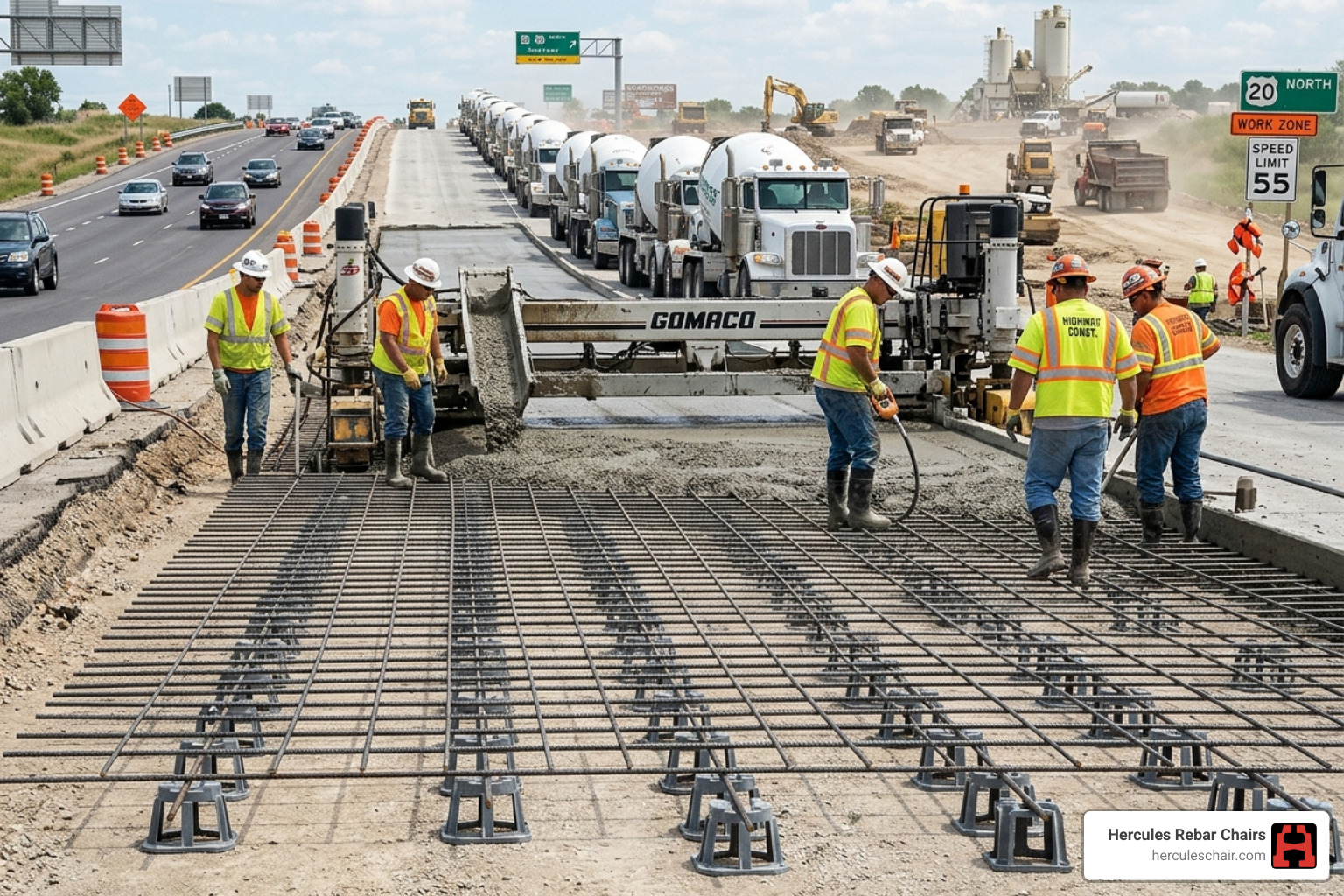
Height is the most critical specification. Most manufacturers offer a range from 1″ to 5.5″.
- 1″ to 2″ chairs: Typically used for thinner residential slabs or mesh reinforcement.
- 3″ chairs: The “gold standard” for footings and standard 6-inch slabs.
- 5.5″ chairs: Designed for heavy-duty highway paving and thick industrial foundations, often supporting bar sizes #5 and #6.
Spacing is equally important. For most applications, we recommend spacing chairs every 3 to 4 feet. If the rebar starts to sag between supports, you need more chairs. For a deeper dive into sizing, see Concrete Bar Chair Sizes for Every Project or our guide on How to Determine Bar Chair Sizes in 3 Easy Steps.
Meeting ACI and DOT Requirements
Professional results require adherence to strict standards. High-quality concrete chair supports should comply with:
- ACI 302.1R-04: Guide for Concrete Floor and Slab Construction.
- ASTM E1155: Standard Test Method for Determining Floor Flatness (FF) and Floor Levelness (FL) numbers.
- DOT Approvals: Many state Departments of Transportation (like Iowa DOT) maintain “approved products lists” for bridge and highway work.
Using compliant supports ensures that the rebar doesn’t shift during the “mud” placement, maintaining the structural integrity required by law. Furthermore, during high-volume pours where heavy machinery or multiple workers are traversing the grid, the lateral stability of the chair becomes paramount. A chair that meets ACI standards isn’t just about height; it’s about the structural rigidity to withstand the dynamic loads of a live construction site without collapsing or tilting. You can learn more about the necessity of these standards in Why Your Slab Needs Rebar Chair Supports.
Common Questions Regarding Rebar Supports
Do you leave rebar chairs in the concrete after the pour?
Yes! Whether they are made of polypropylene or steel, concrete chairs are designed to be “stay-in-place” forms. They become a permanent part of the slab. This is why using non-corrosive materials is so important – if the chair stays in there forever, you want to make sure it won’t cause rust issues ten years down the line.
What is the difference between a construction chair and a designer concrete seat?
A construction concrete chair is a small, functional tool (often red, orange, or grey) used to support rebar inside the concrete. A designer concrete chair is a finished piece of furniture where the concrete is visible and serves as the structural base or the seat itself. One is hidden inside the work; the other is the work itself!
How do I calculate the number of chairs needed for a 3,000 sq ft slab?
A good rule of thumb for standard slabs is one chair every 2 to 3 feet in a grid pattern. However, for specialized screed systems, a bag of 100 chairs often covers about 3,000 sq ft. Always check the manufacturer’s specific load capacity – if you are using heavy #8 rebar, you will need tighter spacing than if you are using light wire mesh. For instance, if you are working on a bridge deck in Alabama or a highway in California, the engineering specs might require a chair every 18 inches to account for the weight of the concrete pump hose and the crew. Over-supporting is always safer than under-supporting when it comes to structural reinforcement.
Conclusion
At the end of the day, a concrete chair is an investment in the future of your project. Whether you’re looking for the artistic stability of a Konstantin Grcic piece or the industrial-strength reliability of a Hercules Rebar Chair, quality matters.
At Hercules Rebar Chairs, we’ve seen over 14 million units sold across the USA—from the bridge decks of Alabama to the highways of California. Our signature red chairs are designed to save you time and money while ensuring your project remains 100% code compliant. When you’re ready to elevate your next pour with America’s #1 support, explore Our Products and see why professional contractors trust the Hercules name.