

Choosing Concrete Block Supports for Reliable Rebar Placement
Concrete block supports can lift reinforcing steel to the required cover depth, but they are not the best choice for every pour. For most slab, wall, and elevated work, choose a support based on the required rebar height, expected jobsite traffic, concrete cover, and whether it could damage a vapor barrier or form surface.
A quick rule of thumb:
- Use concrete block supports where a rigid, heavy-duty bearing point is needed and the specified support material allows them.
- Use non-corrosive rebar chairs or continuous bolsters when you need faster placement, consistent cover, lower handling weight, or protection for vapor barriers.
- Never use random broken block, brick, stone, or jobsite scraps as rebar supports. Their height, stability, and bond with the finished concrete can be inconsistent.
The key is not simply holding steel off the ground. Supports must keep the rebar grid at the planned elevation during placement, foot traffic, and concrete consolidation. A support that tips, sinks, or punctures a membrane can lead to lost cover and expensive corrections.
I am Jordan Harris, a Tennessee Professional Engineer with experience designing large concrete and steel projects and developing construction support products. In this guide, I will compare concrete block supports with modern rebar chairs so you can select reliable, code-conscious support for each pour.
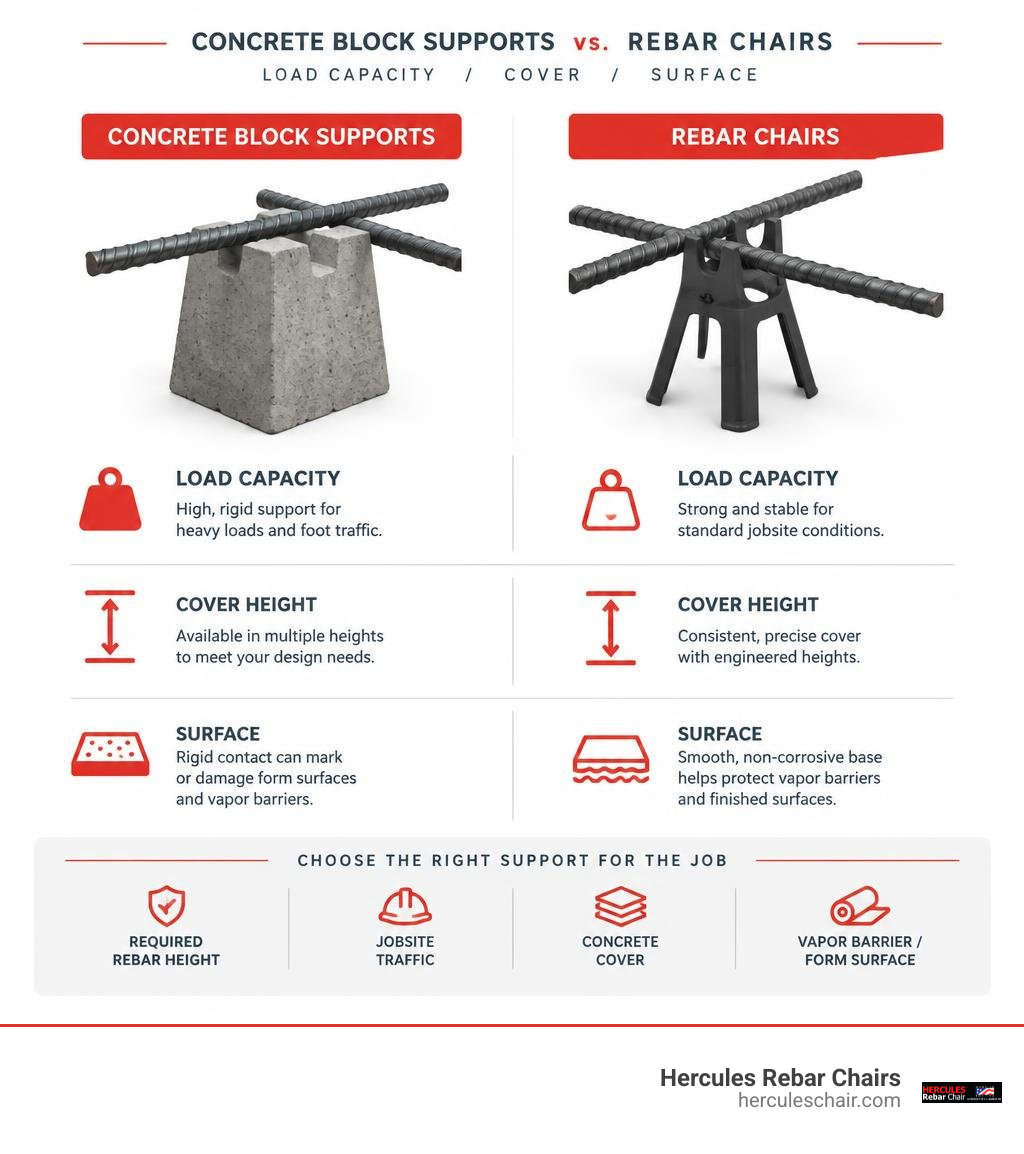
Basic concrete block supports vocab:
Overview of Primary Rebar Support Types for Concrete Construction
In reinforced concrete construction, maintaining precise clearance between steel bars and the formwork or subbase is vital for structural performance. If steel sits too close to the surface, moisture penetration leads to premature oxidation, spalling, and compromised load paths. Conversely, if reinforcement drops during placement, the tension capacity of the slab diminishes. Contractors rely on engineered reinforcing accessories, ranging from precast concrete units (often called dobies) to specialized manufactured chairs, to establish this clearance.
Selecting the right accessory requires evaluating durability, corrosion resistance, and total bearing performance. Specifying high-grade, durable concrete support products ensures the entire structural matrix maintains design integrity through rigorous placement and curing stages.
Heavy-Duty Rebar Chairs
Manufactured rebar chairs have transformed modern flatwork and vertical structural casting. Typically fabricated from high-strength, UV-stabilized recycled polypropylene or heavy-gauge wire, these units provide targeted point-load resistance without adding excessive weight to the framing package. Their wide base footprints spread loads across soft ground, subbase aggregates, and moisture barriers without puncturing delicate liners.
Contractors regularly implement dedicated rebar chairs and spacers to secure single or double rebar mats at defined elevations. Because premium polypropylene chairs will not corrode, chip, or create direct moisture pathways to the steel, they eliminate the rust-bleed issues common with unprotected steel supports or fractured masonry chunks.
Continuous Bolsters and Form Supports
When running extensive rebar grids across broad slab-on-grade applications, foundation mats, or elevated deck framing, continuous bolsters provide linear support along the entire length of the reinforcement line. These continuous runs minimize individual point-loading concentrations, allowing reinforcing bars to span smoothly without localized sagging.
To maintain continuous alignment across expansive structural spans, crews use concrete bolster chairs to establish uniform clearances across multi-directional layouts. When pouring walls, columns, or architectural elements, combining linear bolsters with specialized concrete form supports prevents form deflection while keeping internal rebar cages anchored in position.
Evaluating Concrete Block Supports vs. Modern Rebar Chairs
Choosing between precast concrete block supports and modern polymer rebar chairs involves weighing strength, installation speed, handling logistics, and subgrade interaction. Precast blocks (dobies), typically cast using 3,000 to 4,000 PSI concrete mixes, provide solid compressive stability and thermal expansion properties that naturally mirror the surrounding poured concrete matrix. However, their weight and handling requirements introduce notable labor challenges compared to lightweight manufactured alternatives.
| Feature / Metric | Precast Concrete Block Supports (Dobies) | Heavy-Duty Polymer Rebar Chairs |
|---|---|---|
| Average Unit Weight | 2.0 lbs to 40.0+ lbs (depending on size) | 0.1 lbs to 1.5 lbs (ultra-lightweight) |
| Material Base | 3000–4000 PSI precast concrete | UV-stabilized recycled polypropylene |
| Point Load Rating | 1,500 – 3,000+ lbs | 1,700 – 1,800+ lbs (break tests to 11,000 lbs) |
| Corrosion / Rust Bleed | Zero (if non-wire) / Risk if wire-tie rusts | Completely non-corrosive |
| Vapor Barrier Safety | Sharp edges can puncture thin membranes | Broad, flat, puncture-resistant base |
| Jobsite Handling Speed | Slower; heavy pallet loads, back fatigue | Fast; easily carried in bulk by single worker |
| Thermal Compatibility | 100% matched to surrounding concrete | Mechanically locked in consolidated paste |
| Moisture Absorption | 4% to 8% porosity | Non-absorptive polymer |
Understanding the trade-offs between traditional masonry blocks and modern polymer designs is essential before laying down steel. For a deep dive into block configurations, see our guide to concrete support blocks.

Key Advantages and Disadvantages of Concrete Block Supports
Precast concrete blocks offer unmatched material compatibility. Because their coefficient of thermal expansion matches the poured slab, internal stresses around the support zones remain minimal during thermal cycling. Furthermore, in massive footings, heavy bridge abutments, or deep civil caissons, concrete blocks provide exceptional raw compressive stability under heavy rebar bundles.
However, concrete blocks have distinct drawbacks. Standard concrete is porous, meaning moisture can travel through low-density precast units and reach reinforcing steel in aggressive soil environments. Transporting pallets of 40-pound blocks across rough terrain also increases labor demands and worker fatigue compared to modern alternatives.

Additionally, the rigid, angular corners of masonry blocks can tear vapor barriers beneath interior floor slabs. Once punctured, moisture vapor migrates into finished flooring systems, causing adhesive failures and mold issues. In contrast, engineered chairs feature flat, smooth-radiused bases that distribute loads without cutting protective liners, effectively preventing rebar sinking while preserving membrane integrity.
Performance Under Dynamic Construction Loads
A rebar support must do more than hold static steel; it must withstand dynamic jobsite loads. As pumping crews, ironworkers, vibrator operators, and concrete finishers move across the rebar mat during a pour, localized impact forces spike well above calculated dead loads.
Under heavy dynamic loading, inferior supports can shift, tilt, or shear. If a concrete dobie lacks embedded tie wires, ironworker foot traffic can easily dislodge it, dropping the rebar grid to the subgrade. Premium polymer chairs, with integrated snap-lock clips or broad cradle receivers, grip rebar securely, preventing bar dislocation during active aggregate displacement and mechanical consolidation. Selecting cost-effective concrete construction supports provides jobsite durability without exceeding budget limits.
Technical Considerations: Spacing, Load Capacity, and Code Compliance
Maintaining strict structural compliance requires adhering to standard design parameters established by the American Concrete Institute (ACI 318) and the Concrete Reinforcing Steel Institute (CRSI). State and municipal administrative codes also establish baseline blocking and support guidelines for foundation and structural elements, such as those found in state installation specifications and regional minimum blocking standards.
Inspectors verify that specified minimum clear distances are maintained throughout the pour. When designing reinforcement layouts, reviewing a practical guide to concrete chairs ensures your spacing layout conforms directly to these requirements.
Proper Installation and Spacing for Concrete Block Supports
Proper rebar grid installation depends on soil bearing capacity and rebar bar sizes (#3 through #8+). On compacted structural soil with a bearing capacity of 1,500 to 2,000 psf, supports are typically spaced on a 3-foot to 5-foot grid in both directions. Smaller bar sizes (#3 and #4) are more flexible and require tighter support spacing (around 3 to 4 feet on center) to eliminate mid-span deflection under foot traffic. Heavier bars (#5, #6, and above) can span 4 to 6 feet between supports.
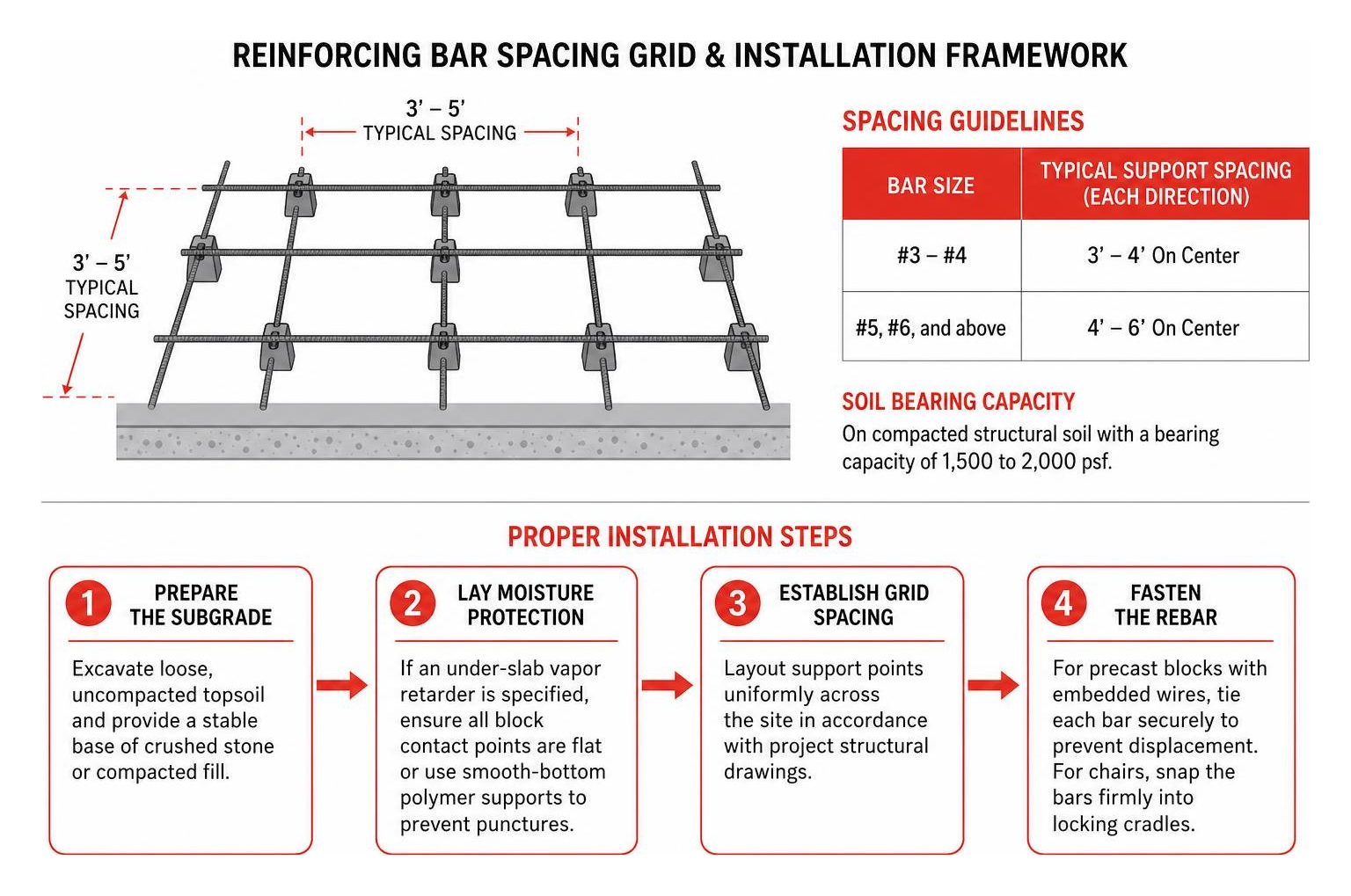
When setting concrete block supports:
- Prepare the Subgrade: Excavate loose, uncompacted topsoil and provide a stable base of crushed stone or compacted fill.
- Lay Moisture Protection: If an under-slab vapor retarder is specified, ensure all block contact points are flat or use smooth-bottom polymer supports to prevent punctures.
- Establish Grid Spacing: Layout support points uniformly across the site in accordance with project structural drawings.
- Fasten the Rebar: For precast blocks with embedded wires, tie each bar securely to prevent displacement. For chairs, snap the bars firmly into locking cradles.
- Inspect Prior to Pouring: Check the grid for bar sag, dislodged supports, or compressed base material before placing concrete.
Following these standardized installation steps and referencing an experienced contractor guide to support chairs helps ensure field layouts pass engineering inspections without delays.
Frequently Asked Questions About Rebar and Block Supports
How much weight can a standard concrete support hold?
A standard precast concrete support block manufactured with a 3,000 to 4,000 PSI concrete mix typically carries point loads between 1,500 and 3,000 pounds, depending on base surface area and curing quality. High-grade engineered polypropylene chairs match this capacity, providing working ratings of 1,700 to 1,800 pounds per unit with ultimate failure thresholds exceeding 9,000 to 11,000 pounds under independent testing.
When should you choose chairs over traditional masonry blocks?
Polymer chairs are preferred when installing slabs over vapor barriers, as their wide, rounded bases will not puncture moisture membranes. They are also ideal when installation speed, lightweight handling, and zero corrosion risk are critical project priorities. Traditional masonry blocks are best reserved for massive civil footings, deep unlined foundation excavations, or heavy structural mats where large-dimension precast units are explicitly called for by project engineers.
What building codes govern rebar clearance and supports?
Rebar placement and support tolerances are governed primarily by ACI 318 (Building Code Requirements for Structural Concrete) and CRSI (Manual of Standard Practice). In residential structures, the International Residential Code (IRC Chapter 4 & Chapter 6) dictates concrete cover, footing dimensions, and rebar clearance standards. Compliance requires maintaining specified clear cover (e.g., 3 inches for concrete cast against earth, 1.5 to 2 inches for exterior exposed elements) before, during, and after concrete consolidation.
Conclusion
Building strong, lasting concrete structures depends on maintaining proper rebar placement and concrete cover. While precast concrete block supports serve an important role in heavy civil footings and deep foundation mats, modern engineered chairs deliver superior speed, vapor barrier protection, and handling efficiency for slabs, walls, and elevated decks.
At Hercules Rebar Chairs (T.J. Harris Co.), we take pride in manufacturing America’s #1 concrete support accessories. With over 14 million distinct red-colored units sold across the United States, our supports are engineered to save time, reduce labor costs, and maintain strict code compliance on every pour.
To master rebar layouts, bar sizing, and support spacing for your next project, explore our comprehensive rebar placement guide today.