

Introduction
Concrete support products are the backbone of modern structural integrity. Without precise rebar elevation, dependable load distribution systems, and robust formwork systems, even the highest-grade mix design will fail to perform as engineered. Modern concrete structures demand exact positioning to satisfy building code compliance, control cracking, and guarantee decades of service life.
Navigating the full spectrum of support hardware requires matching structural demands with the proper equipment—from sub-inch elevation accessories to high-capacity temporary staging.
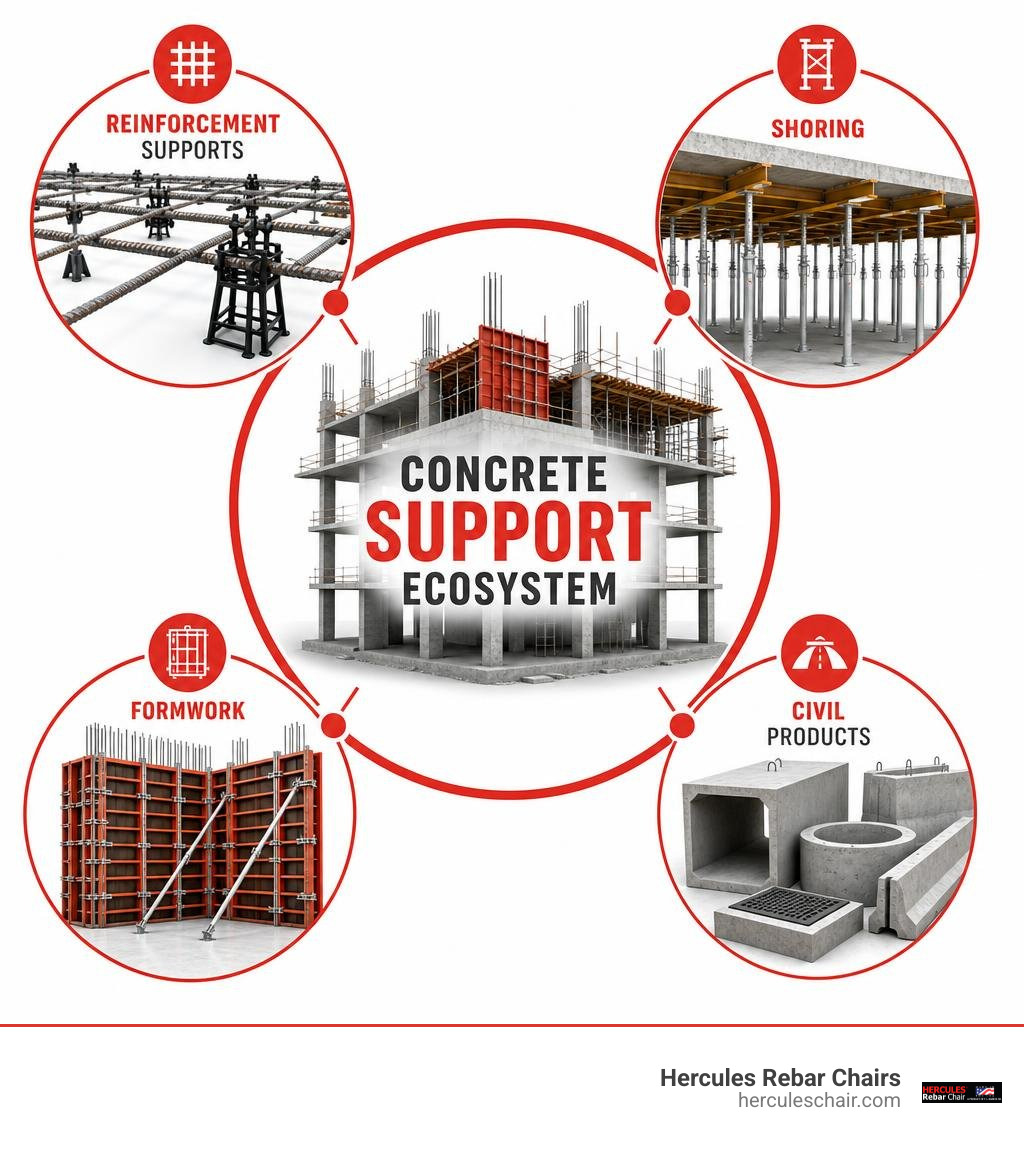
Core Types of Concrete Support Products for Modern Building
Contemporary commercial construction relies on an integrated network of temporary and permanent systems. These include shoring systems designed to carry wet concrete and dynamic construction loads, formwork panels engineered to shape columns and walls, and reinforcement positioning devices that keep steel cages stable under heavy foot traffic.
Understanding how these elements work together is critical; reviewing From Rebar to Mesh: Essential Concrete Reinforcement Products Explained provides valuable context on how tensile steel and elevation components interact. Every support system must provide verified load-bearing capacity to resist hydrostatic pressures, impact loads, and material weight during multi-story construction.
Essential Concrete Support Products for Slab and Wall Reinforcement
Maintaining specified concrete cover is non-negotiable for corrosion prevention and fire protection. If reinforcing steel sits too close to the surface, environmental moisture penetrates the matrix, leading to carbonation, chloride attack, rust expansion, and concrete spalling.
Contractors rely on specialized rebar chairs to suspend single bars or welded wire reinforcement at precise elevations above the subgrade or form face. For a comprehensive breakdown of spacing standards, see A Practical Guide to Concrete Chairs for Rebar. In addition to individual chairs, plastic spacers and wheel chairs stabilize vertical rebar cages inside narrow wall forms.
For continuous rebar runs or heavy mats, slab bolsters distribute heavy loads over broad contact patches to prevent punch-through into vapor barriers or soft insulation. Exploring What Are Concrete Bolster Chairs and Why Do You Need Them? helps clarify when continuous linear supports are superior to point-load chairs.
Advanced Formwork and Shoring Frameworks
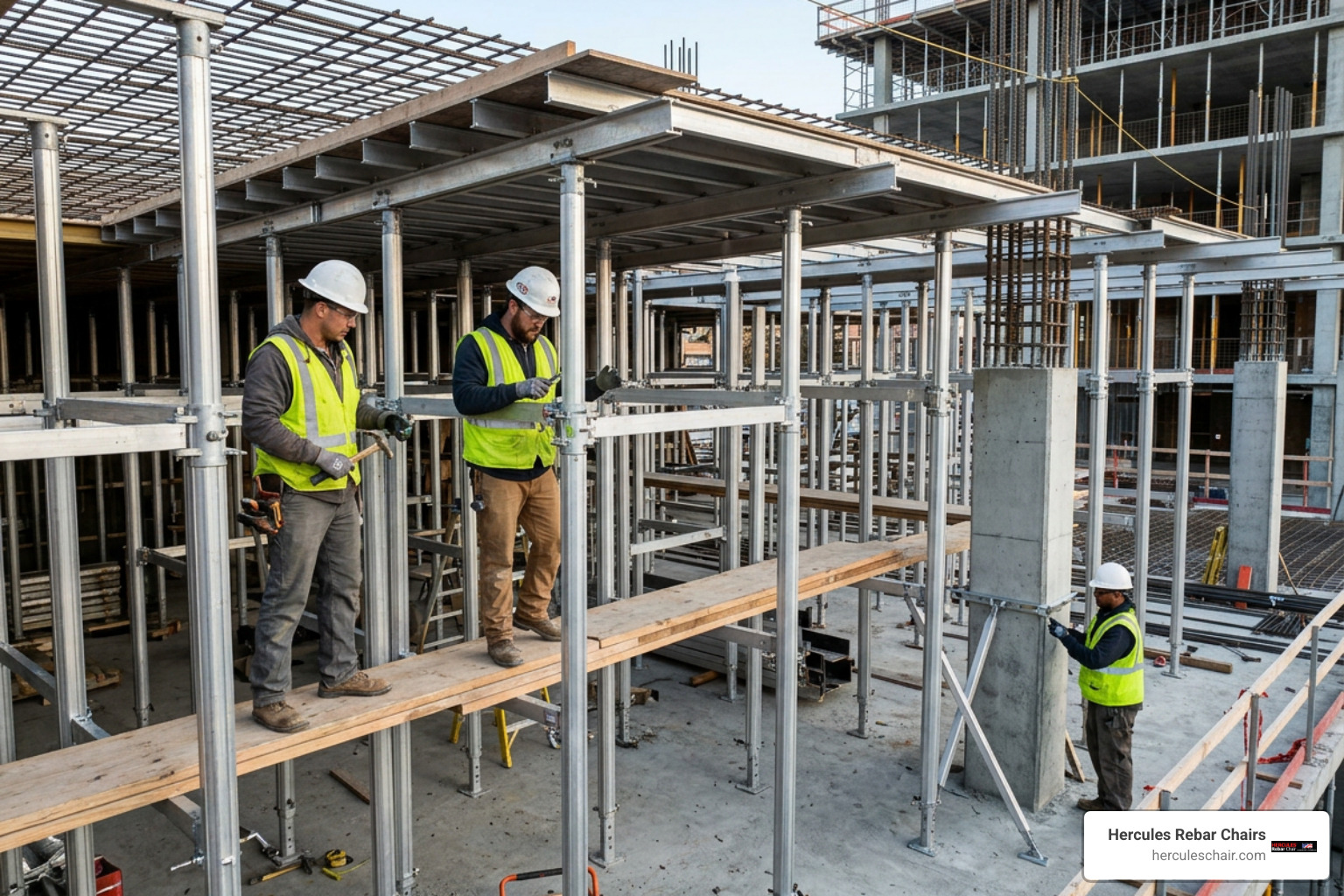
At the structural framing level, high-capacity modular systems replace labor-intensive timber builds. Today’s commercial jobsites utilize modular aluminum shoring, hydraulic self-climbing cores, flying tables, modular grid shoring, and lightweight handset panels to streamline pour cycles.
| Feature / Factor | High-Capacity Aluminum Shoring | Heavy-Duty Steel Formwork | Handset Modular Panels |
|---|---|---|---|
| Primary Material | Extruded Structural Aluminum | High-Strength Structural Steel | Aluminum Frame w/ Composite/Plywood |
| Typical Leg/Panel Capacity | Up to 22,000 lbs per leg | Up to 30,000+ lbs per leg / high lateral | 1,200 – 1,800 lbs/sq ft lateral pressure |
| Crane Dependency | Low to Moderate (Table fly optional) | High (Requires dedicated crane picks) | Low (Hand-set by 1–2 workers) |
| Assembly Speed | Rapid (Modular interlocking beams) | Moderate (Heavy bolted connections) | Fast (Quick-action panel clamps) |
| Best Application | Multi-story elevated slabs, high bays | Civil infrastructure, deep walls, bridges | Foundation walls, columns, light commercial |
| Labor Requirement | 2–3 worker crews | Crane crew + rigging specialists | 1–2 general laborers |
Selecting Heavy-Duty Concrete Support Products for Civil Infrastructure
Civil and infrastructure developments demand specialized concrete support products engineered for long-term earth retention, hydraulic management, and structural framing:
- Reinforced Concrete Pipe (RCP): Provides structural storm sewer conveyance, resisting heavy highway live loads (AASHTO HS-20/HL-93) and deep earth cover without structural deformation.
- Segmental Retaining Walls (SRW): Mortarless interlocking block systems engineered for critical soil stabilization, grade separation, and site optimization on sloping terrains.
- Precast Infrastructure Solutions: Pre-engineered utility vaults, catch basins, and box culverts supplied by regional precast facilities ensure consistent structural performance and rapid installation.
- Architectural Concrete Masonry Units (CMU): Load-bearing structural units that integrate thermal mass, structural support, and architectural finishes into a single building envelope assembly.
Comparing Shoring and Formwork: Performance, Safety, and Cost Efficiency
Selecting the right temporary support equipment directly affects schedule efficiency, worker safety, and the bottom line. Modern engineering focuses on high working loads, lightweight components, and minimal hardware complexity. For broader reinforcement positioning context alongside structural falsework, consult The Ultimate Guide to Rebar Chairs and Spacers.
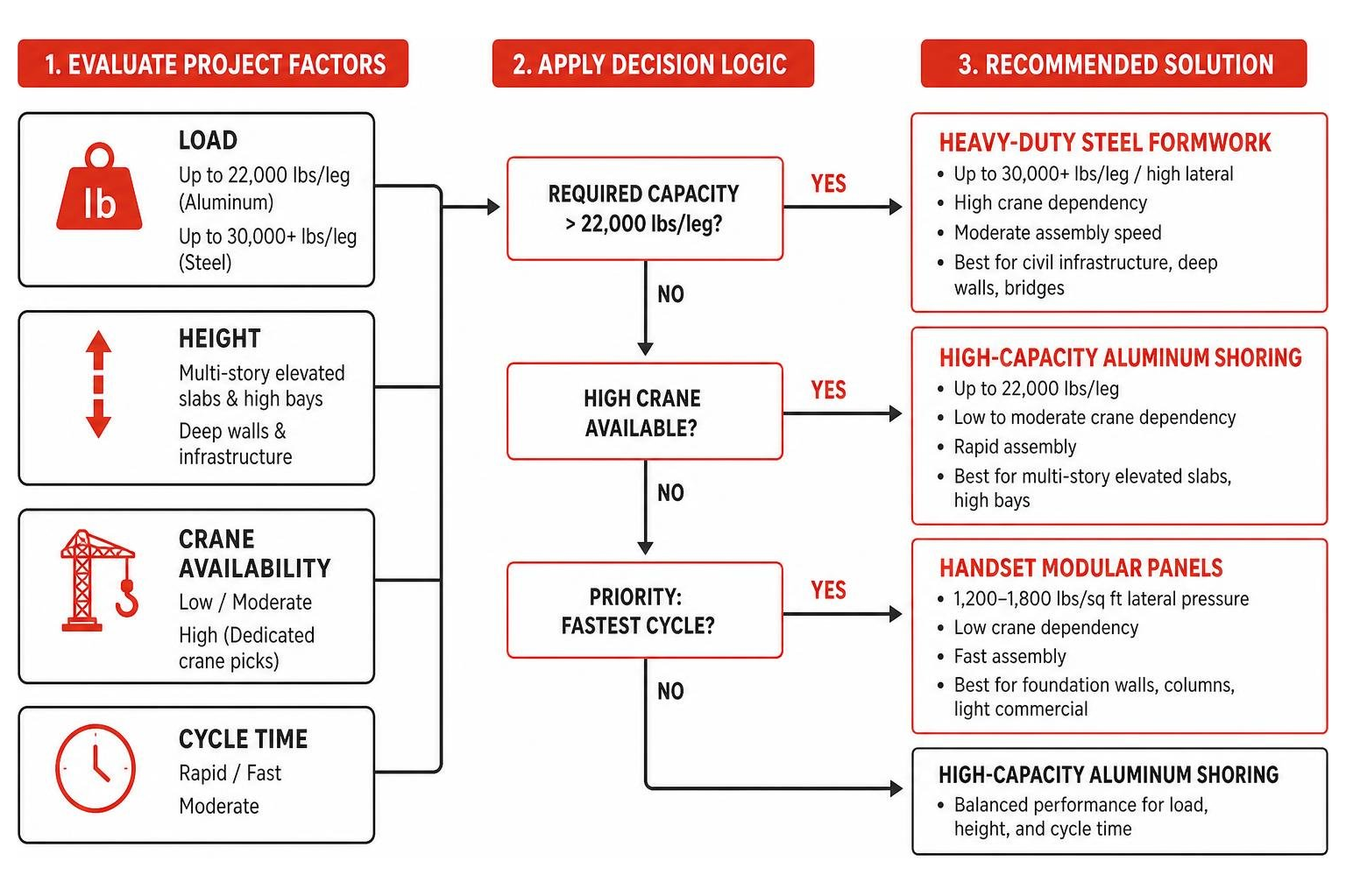
High-Capacity Aluminum Shoring vs. Modular Slab Grid Systems
High-load commercial applications require systems tailored to structural geometry:
- High-Capacity Post Shoring: Systems like Super Shore utilize high-strength aluminum alloys to deliver a safe working capacity of 22,000 lbs per leg. This massive strength makes them the premier choice for deep transfer slabs, bridge decks, and heavy civil falsework where concentrated loads exceed standard post limits.
- Modular Slab Grid Systems: Systems like Super Grid streamline elevated floor construction by relying on just three standard components: support posts, primary main beams, and interlocking secondary drop beams.
- Productivity Benefits: By minimizing loose hardware and small connectors, modular grids allow crews to erect, pour, and strip elevated formwork up to 30% faster than traditional timber stick-framing. Drop-head features permit early stripping of deck panels while primary post shores remain undisturbed, maintaining structural reshoring capacity while freeing up equipment for upper levels.
Hydraulic Core Systems vs. Crane-Dependent Formwork
On high-rise construction, the central elevator and stair core is the critical path. Traditional crane-dependent core forms require dedicated tower crane hooks for every vertical lift, causing severe bottlenecks during windy conditions or peak concrete placement hours.

Hydraulic self-climbing core systems (such as Super Core) incorporate integrated hydraulic cylinders that anchor directly into previously cured concrete. The entire core assembly—forms, interior working decks, concrete placing booms, and trailing safety screens—climbs smoothly to the next elevation independently of the tower crane.
This crane independence reduces crane hook time by up to 50%, enhances perimeter safety against severe wind loads at high elevations, and accelerates floor-to-floor cycle times. For exterior shear walls and straight runs, modular panel assemblies like Super Solo Form use lightweight 8′ × 8′ clamped panels to speed up assembly without heavy crane handling.
Reinforcement Supports and Masonry Essentials for Long-Term Durability
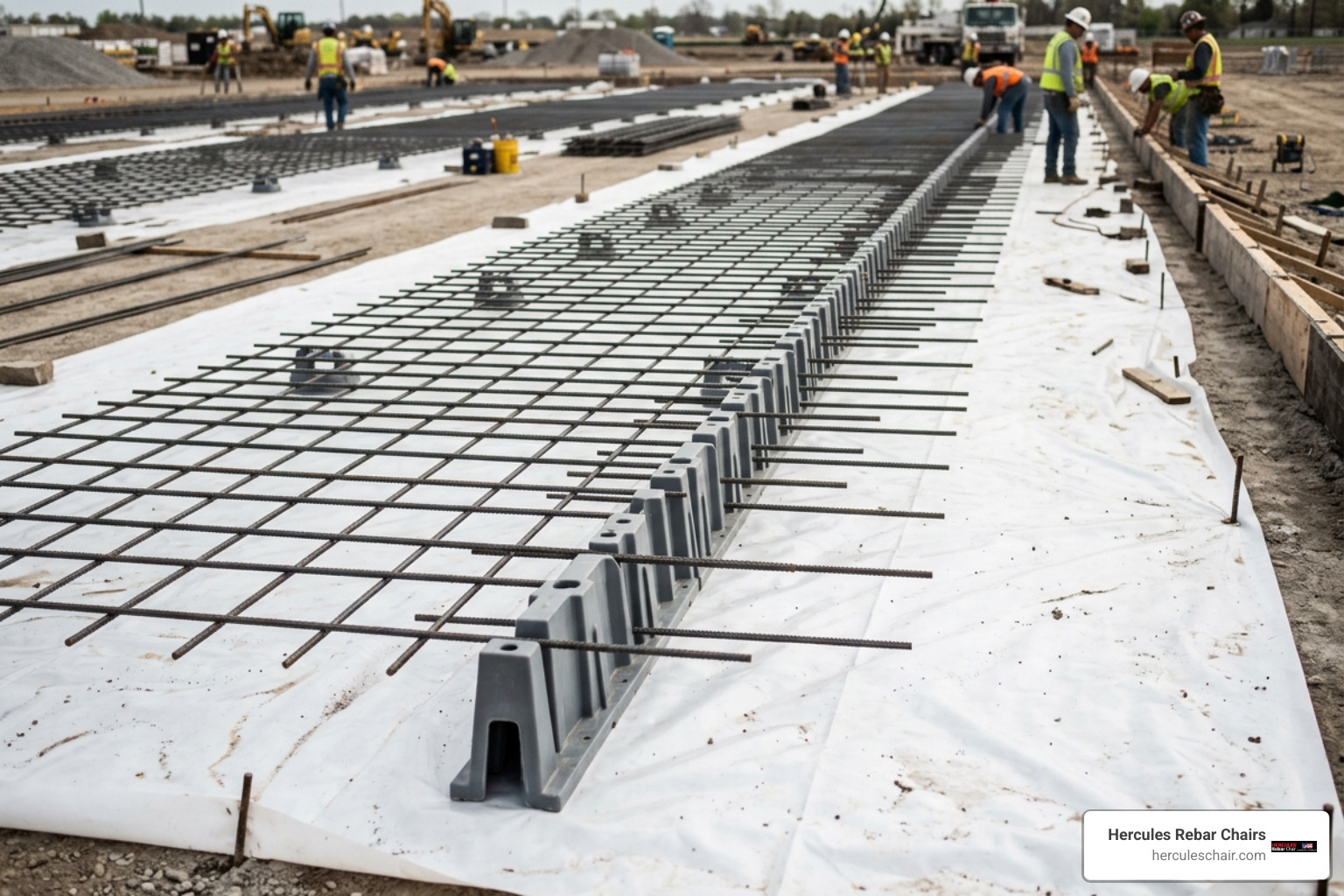
While shoring supports the structure temporarily, rebar supports and masonry products dictate the permanent service life of the building. Placing reinforcement at the correct height ensures the internal steel matrix absorbs tensile forces as calculated by the structural engineer.
To keep reinforcement stable under foot traffic and concrete placement, explore durable accessories in Support Your Slab with These Top-Rated Plastic and Steel Chairs.
Precision Rebar Chairs and Spacers for Commercial Slabs
Achieving exact concrete cover depth requires selecting rebar supports suited to the specific placement method:
- Slab on Grade: Rebar supports must feature wide, stable bases to prevent puncturing vapor barriers or sinking into compacted subbase soils.
- Elevated Suspended Decks: Learn the core principles of concrete cover in Elevate Your Concrete: Why Bar Chairs Are Essential for Strong Slabs. Supports must hold tight tolerances under heavy dynamic placement loads without bending.
- Pneumatically Applied Concrete (Shotcrete/Gunite): Specialized, point-contact supports are critical. Contractors building aquatic structures should review Top-Rated Rebar Chairs for Swimming Pool Construction to avoid shadow voids and ensure full concrete encapsulation.
- Corrosion Elimination: Unlike raw steel wire bolsters that can rust and cause surface staining, heavy-duty polypropylene rebar chairs are 100% non-corrosive and chemically inert.
Architectural Masonry Units and Retaining Wall Systems
Permanent site development and building envelope performance depend heavily on masonry engineering:
- Lightweight Concrete Masonry Units (CMU): Manufactured using lightweight expanded shale, clay, or slate aggregates, these units reduce overall dead loads on structural foundations while providing superior thermal resistance and fire ratings compared to standard heavyweight block.
- Carbon-Conscious Building: Specifying lightweight CMU reduces transportation emissions due to lower hauling weight and improves mason productivity by reducing physical fatigue on the wall line.
- Segmental Retaining Walls (SRW): Dry-stacked, pin-connected, or rear-lipped concrete retaining blocks provide flexible gravity or geogrid-reinforced earth retention structures. They accommodate natural site settlement, manage hydrostatic groundwater pressure via integrated drainage zones, and maximize usable buildable area for parking lots and commercial building pads.
Sourcing Strategies: Domestic Manufacturing and Regional Distribution Hubs
A reliable supply chain is critical to meeting aggressive construction schedules. Specifying concrete accessories from American-owned and operated manufacturers guarantees compliance with domestic material standards (including ASTM International and CRSI specifications) while eliminating international freight delays.
Understanding jobsite material dynamics is crucial; see Beyond the Mix: What Every Concrete Builder Needs to Know About Accessories for best practices.
Working with domestic suppliers backed by well-stocked regional distribution networks ensures quick-ship deliveries directly to the jobsite. Established distribution channels maintain localized inventories of critical construction supplies, helping contractors source verified forming and shoring hardware without costly delays.
Domestic manufacturing hubs provide direct access to engineering submittals, stamped load calculations, and tailored technical support—delivering peace of mind that every support component on your jobsite meets strict safety factors.
Frequently Asked Questions About Concrete Supports
What is the safe working load capacity of heavy-duty aluminum shoring?
Heavy-duty aluminum shoring systems, such as Super Shore, offer a safe working load capacity of up to 22,000 lbs per leg. This capacity is achieved through high-grade extruded aluminum alloys and engineered internal bracing, providing exceptional strength-to-weight ratios for high-reach civil slabs, heavy bridge decks, and thick transfer girders.
How do hydraulic core systems improve high-rise project timelines?
Hydraulic core systems use integrated hydraulic cylinders anchored into previously poured vertical walls to elevate the entire formwork and working platform assembly. Because the climbing process does not require a tower crane, concrete crews can cycle high-rise shear walls and elevator cores significantly faster, freeing up crane hook time for steel staging, MEP deliveries, and exterior framing.
Why are plastic rebar chairs preferred over traditional support methods?
Engineered plastic rebar chairs provide fixed, unyielding elevation heights and are completely non-corrosive. Unlike scrap brick or wood blocks—which are porous, violate building codes, and cause structural weak spots—or un-tipped steel wire chairs that can corrode to the slab surface, heavy-duty plastic chairs like those featured in Elevate Your Concrete Game with the Best Plastic Rebar Chairs for Sale will never rust, degrade, or spall concrete cover.
Conclusion
Every successful concrete pour relies on the strength and precision of its support systems. From heavy-duty modular shoring and self-climbing hydraulic cores down to the individual rebar chairs maintaining exact steel placement, concrete support hardware guarantees safety, code compliance, and structural longevity.
At Hercules Rebar Chairs (T.J. Harris Co.), we take pride in being America’s #1 trusted manufacturer of high-strength concrete supports. With over 14 million units sold across the United States, our signature red chairs are engineered to withstand the toughest jobsite conditions, save contractors valuable time and labor, and ensure strict adherence to engineering standards.
Ready to optimize your next commercial, civil, or residential pour? Explore our durable concrete support products and discover how our American-made solutions deliver unmatched strength, precision, and value to your jobsites.