

Pool Construction Rebar Chairs: The Fast Answer
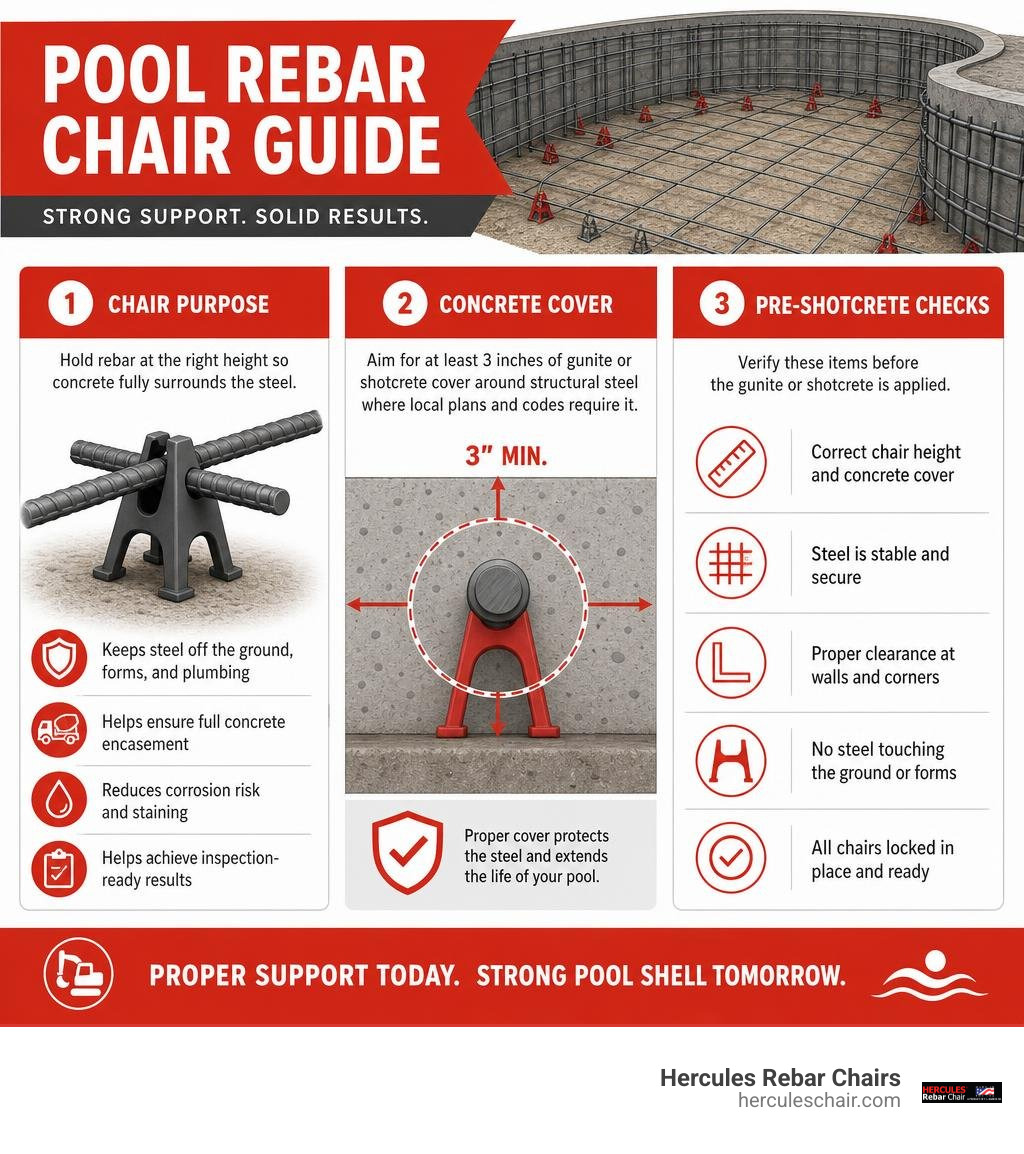
Pool construction rebar chairs are supports that hold reinforcing steel at the right height before gunite or shotcrete is applied. For a durable, inspection-ready pool shell, choose chairs that keep the rebar stable and fully surrounded by concrete – often with a target of at least 3 inches of gunite or shotcrete cover around structural steel where local plans and codes require it.
- Best material for wet pool environments: Heavy-duty plastic chairs, because they do not rust or corrode.
- Main job: Keep steel off crushed stone, soil, forms, and plumbing so shotcrete can fully encase it.
- What to verify before the shoot: Correct chair height, steady support, proper clearance at walls and corners, and no steel touching the ground or forms.
- Why it matters: Properly supported steel helps reduce corrosion risk, plaster staining, cracking, failed inspections, and costly repairs.
Steel crews may lay out and tie a rebar cage directly on the sub-base at first. That is not necessarily a problem during setup. But before gunite is shot, the steel must be lifted and held in its engineered position with reliable chairs, spacers, or approved concrete supports.
I am Jordan Harris, a Tennessee-licensed Professional Engineer with experience in large concrete and steel projects and in manufacturing rebar support systems. At T.J. Harris Company, I help develop dependable pool construction rebar chairs that make steel placement more consistent on critical concrete pours.
Pool construction rebar chairs terms you need:
Essential Role of Pool Construction Rebar Chairs in Structural Integrity
A concrete swimming pool shell undergoes continuous, severe physical stress. It must hold tens of thousands of gallons of water pushing outward while resisting earth movement, expansive soils, and hydrostatic pressure pushing inward. Concrete possesses incredible compressive strength, meaning it can withstand enormous pushing forces, but its tensile strength is surprisingly low. To withstand flexing, earth shifting, and water pressures without cracking, concrete relies entirely on its internal steel grid.
However, placing rebar into the excavation pool trench is only half the battle. If that steel rests flat against the sub-base or pressed up against wood forms, it cannot perform its reinforcing job. Pool construction rebar chairs elevate and suspend the steel grid directly within the middle of the concrete matrix, ensuring complete gunite encapsulation.

When shotcrete or gunite is sprayed pneumatically at high speeds, concrete must flow under, over, and entirely around every reinforcing bar. Maintaining proper positioning requires systematic support. As outlined in our guide on Rebar’s Armor: Understanding Concrete Cover and Its Critical Role, concrete cover acts as a structural defense mechanism. Furthermore, addressing concerns regarding Rebar directly on crushed stone. Gunite pool layout reveals that while crews routinely assemble rebar flat on the sub-grade during tying, inserting chairs before the concrete shoot is mandatory for long-term structural integrity.
Why Proper Steel Elevation Prevents Pool Rust and Cracking
Water chemistry in swimming pools introduces a constant threat of corrosion. If moisture reaches the embedded carbon steel rebar, oxidation occurs. Rusting steel expands up to six times its original volume, generating intense internal pressure known as spalling. This expansion cracks the dense concrete shell, telegraphing directly through the waterproof plaster interior as ugly brown rust stains.
To stop moisture ingress, building plans generally specify a full 3-inch encapsulation of dense gunite surrounding all structural steel. Proper elevation with non-corrosive rebar chairs locks the steel matrix into the center of the structural wall or floor slab, isolating the metal from water migration and preserving structural integrity for decades.
What Happens When Steel Rests Directly on the Ground?
When rebar rests flat on crushed stone, dirt, or mud during a concrete pour, three critical problems immediately occur:
- Incomplete Concrete Encapsulation: Shotcrete cannot penetrate beneath a steel bar resting directly on soil or gravel, leaving exposed steel surfaces along the floor of the pool.
- Moisture Siphon: Uncovered steel acts as an open pathway for sub-soil groundwater to migrate straight into the rebar grid, triggering accelerated rust.
- Pre-Pour Pre-Inspection Failures: Municipal building inspectors perform rigorous pre-pour checks. If they detect rebar touching the sub-base or forms, the project will fail inspection, delaying the pour and increasing labor costs.
Types of Supports: Evaluating Plastic, Metal, and Concrete Dobies
Choosing the right type of rebar support is crucial when building a gunite or shotcrete pool shell. Not all supports perform equally under the unique demands of heavy rebar grids and high-velocity pneumatically applied concrete.
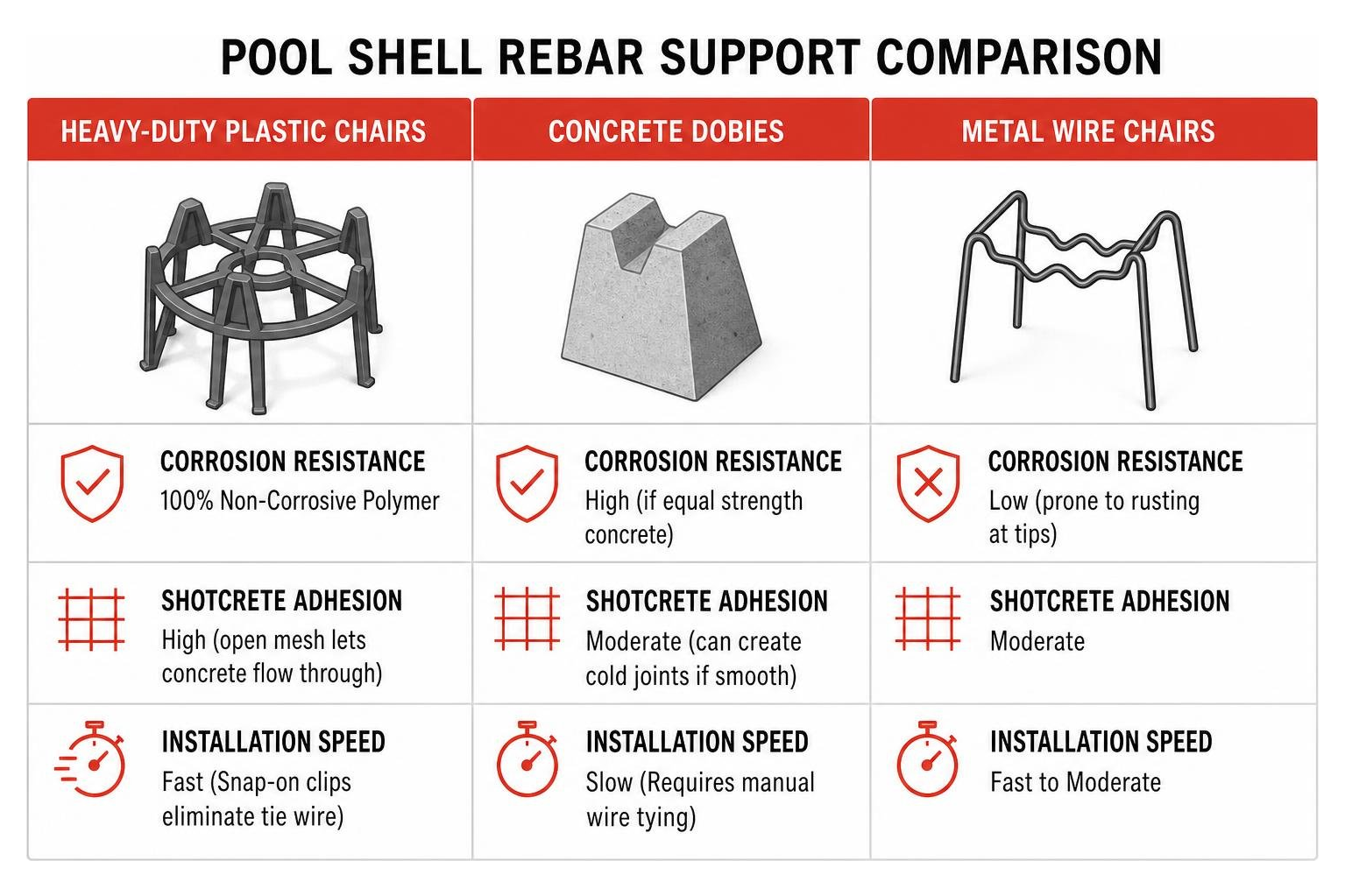
| Feature / Material | Heavy-Duty Plastic Chairs | Concrete Dobies | Metal Wire Chairs |
|---|---|---|---|
| Corrosion Resistance | 100% Non-Corrosive Polymer | High (if equal strength concrete) | Low (prone to rusting at tips) |
| Shotcrete Adhesion | High (open mesh lets concrete flow through) | Moderate (can create cold joints if smooth) | Moderate |
| Installation Speed | Fast (Snap-on clips eliminate tie wire) | Slow (Requires manual wire tying) | Fast to Moderate |
| Moisture Absorption | Zero Absorption | Varies (Cheap dobies absorb moisture) | Zero Absorption |
| Crushing Resistance | High (Engineered polymer designs) | Very High | High |
Heavy-Duty Plastic Supports and Pool Construction Rebar Chairs
In modern aquatic construction, high-density, non-corrosive plastic rebar chairs are widely considered the gold standard. Engineered from rugged polypropylene or HDPE, plastic chairs do not degrade when exposed to moisture, soil acids, or harsh chemical pool water.
At Hercules Rebar Chairs, our signature red chairs are specifically designed to streamline rebar grid setup. Featuring integrated snap-on clips, our chairs lock firmly onto #3, #4, and #5 rebar without requiring time-consuming tie wire. Their broad base designs prevent the chair legs from sinking into soft dirt or gravel sub-bases during installation. To select the ideal plastic chair height for your specific pool shell depth, check out How to Choose the Right Concrete Rebar Chair for Your Project.
Why Plastic Chairs Outperform Concrete Dobies and Bricks in Gunite Shells
Historically, pool builders relied on concrete dobies or leftover red clay brick fragments to prop up pool rebar. However, using bricks or inferior concrete blocks introduces major construction risks:
- Porosity Issues: Common bricks and low-grade concrete dobies absorb water at high rates, drawing moisture straight to the embedded rebar.
- Cold Joints and Shadowing: Thick, solid concrete blocks block high-velocity shotcrete streams, creating pockets of uncompacted aggregate behind the block called “shadows.”
- Inconsistent Heights: Broken brick fragments yield irregular spacing, leading to uneven steel depth across the pool shell floor.
Plastic rebar chairs solve these problems with open-frame, hollow designs that permit high-velocity shotcrete to fill all voids, encapsulating the chair and rebar seamlessly into a single solid monolithic shell. For a deeper breakdown of chair materials, read From Dobies to Double Mats: A Comprehensive Look at Rebar Chair Types and our detailed overview in Don’t Let Your Rebar Sink: A Guide to Concrete Chairs.
Sizing, Spacing, and Code Requirements for Swimming Pools
Pool shell construction is heavily regulated to protect property owners and satisfy local structural building codes. In almost all residential and commercial jurisdictions, codes require a minimum 3-inch concrete clearance between embedded reinforcing steel and the surrounding soil or outer formwork.

Structural engineers design rebar cages using specific bar sizes, most commonly #3 (3/8-inch), #4 (1/2-inch), and #5 (5/8-inch) deformed steel bars. Maintaining structural integrity requires keeping these heavy cages securely centered while crew members walk over the steel grid during setup. For detailed structural layout rules, review our Rebar Placement Guide. As highlighted in real-world discussions on Built started, steel completed, concrete next. Adding more chairs before concrete | Trouble Free Pool, adding supplementary chairs prior to the concrete pour ensures the grid stays stable under heavy worker foot traffic.
Placement Density Standards for Pool Construction Rebar Chairs
How many pool construction rebar chairs do you need, and where should they be placed? Placement density depends heavily on whether the project is residential or commercial:
- Residential Pools: Steel grids are typically laid out on 6-inch to 12-inch centers. Rebar chairs should be positioned every 3 to 4 feet along the grid in both directions, with extra chairs concentrated along slope transitions, steps, and deep-end walls.
- Commercial Pools: Due to heavier structural loads and larger rebar gauges (#5 and larger), commercial pool grids feature tighter spacing of 4-inch to 8-inch centers. Chair density increases to every 2 to 3 feet to prevent cage sagging under extreme weight.
Follow these step-by-step placement procedures when installing pool construction rebar chairs:
- Complete Grid Tying First: Assemble, bend, and tie the rebar matrix flat on the sub-grade floor or pool walls.
- Elevate Key Structural Sections: Begin at deep-end main drains and transition beams, slipping heavy-duty plastic chairs underneath every 3 feet.
- Snap Chairs Into Place: Push the snap-on clip of the chair directly onto the lower rebar grid intersection to hold both perpendicular bars simultaneously.
- Stagger Placement Patterns: Offset rebar chair rows in a diamond pattern across floor surfaces to distribute weight evenly and avoid continuous seam lines.
- Verify Edge Clearance: Wedge specialized side-form chairs or dobies along pool wall forms to guarantee 3 inches of side clearance.
For more information on sizing and spacing, consult The Ultimate Guide to Rebar Chairs: Types, Uses, and Sizing for Concrete Slabs.
Interfacing Supports with Plumbing, Skimmers, and Formwork
A swimming pool rebar cage is tied closely together with plumbing lines, main drains, skimmer buckets, light niches, and structural wooden forms.
- Plumbing Lines: PVC pipes for return lines and floor jets are routed directly through or beneath the steel rebar matrix. Rebar chairs must lift the steel grid off plumbing lines so that vibrating steel does not puncture plastic pipes during concrete shooting.
- Skimmers & Light Niches: Rebar must wrap tightly around skimmer cutouts without directly touching the plastic skimmer housing. Use non-conductive plastic wall spacers wedged between the skimmer form and the steel cage to preserve clearance.
- Wall Forms & Earth Bank: Where pool walls push against excavated dirt walls, side-form plastic spacer chairs clip onto vertical rebar to prevent the steel cage from leaning directly against raw soil.
Frequently Asked Questions about Pool Construction Rebar Chairs
Can homeowners add or adjust rebar chairs before the concrete pour?
Yes. Homeowners conducting a pre-pour walkthrough are encouraged to inspect the rebar cage before the nozzleman arrives. If you spot rebar touching crushed stone, resting flat against excavation dirt, or leaning directly onto a skimmer box, you can safely insert extra snap-on plastic rebar chairs beneath the steel. Just coordinate with your pool builder to ensure added supports maintain engineered height specifications.
What is the minimum concrete coverage required around pool rebar?
In most US building codes, structural steel in swimming pool shells requires a minimum of 3 inches of gunite or shotcrete encapsulation when concrete is cast against raw earth. For steel positioned against formed walls, a minimum clearance of 1.5 to 2 inches is standard unless local structural plans specify otherwise.
Why are plastic rebar chairs preferred over metal supports in pools?
Swimming pool concrete remains in permanent contact with moisture and underground water tables. Metal wire rebar chairs can rust at their base tips over time where they touch sub-base gravel. That rust travels upward along the chair legs and infects the main rebar grid. High-density plastic chairs never rust, offer zero water absorption, and remain stable when exposed to aggressive pool chemicals and soil moisture.
Conclusion
Building a swimming pool is a massive investment. Ensuring structural reliability comes down to doing the unseen details correctly right from the start. Elevating and securing your pool rebar grid with high-quality pool construction rebar chairs eliminates the risk of concrete spalling, plaster rust stains, sagging steel, and failed municipal inspections.
At Hercules Rebar Chairs, we are proud to be America’s #1 choice for dependable, American-made rebar supports, with over 14 million units sold across all 50 states. Our high-visibility red plastic rebar chairs deliver unmatched strength, non-corrosive durability, and rapid snap-on placement for both residential and commercial pool builds.
Ready to protect your concrete shell investment with proven rebar supports? Explore High-Quality Rebar Chairs for Your Pool Build and see how our chairs make your next concrete pour efficient, code-compliant, and built to last.