

Why Wholesale Concrete Supports Are the Smartest Buy for Serious Contractors
Wholesale concrete supports are the most cost-effective way for contractors to keep rebar properly positioned across large pours — without blowing the budget on materials.
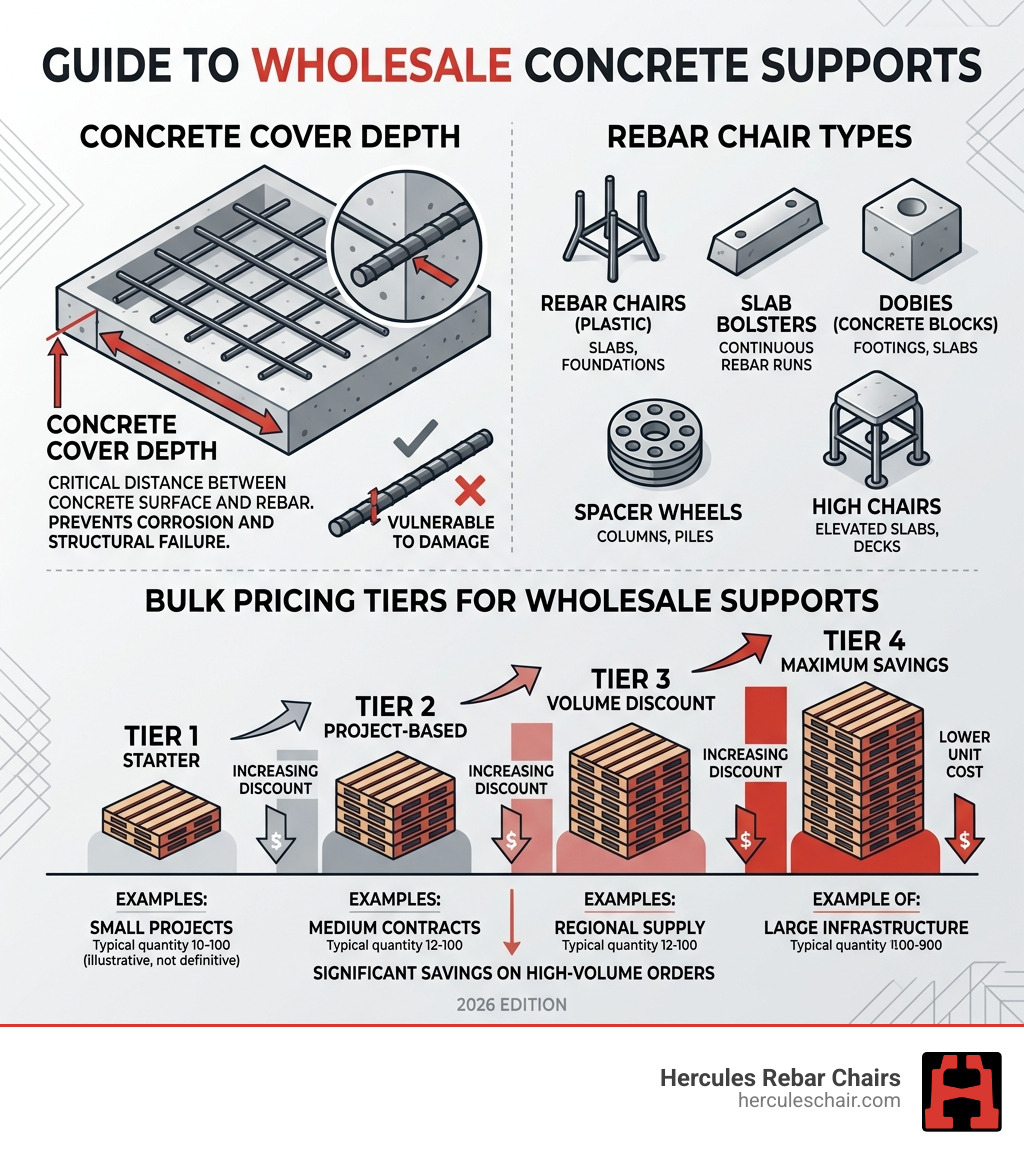
Here’s a quick look at the most common types and what to expect when buying in bulk:
| Support Type | Common Use | Typical Bulk Quantity |
|---|---|---|
| Rebar chairs (plastic) | Slabs, foundations | 500+ per pack |
| Slab bolsters | Continuous rebar runs | Sold by bundle or pallet |
| Dobies (concrete blocks) | Footings, slabs | 8,000+ per pallet |
| Spacer wheels | Columns, piles | Sold individually or in bulk packs |
| High chairs | Elevated slabs, decks | 50–500 per order |
Every concrete slab depends on one thing most people never see: the supports holding the rebar at exactly the right height before the pour. Get that wrong, and the steel ends up too close to the surface — leaving it vulnerable to corrosion, cracking, and long-term structural failure. Get it right, and you’ve got a slab built to last decades.
The challenge for contractors isn’t knowing why supports matter. It’s finding the right products at the right price — in the quantities a real job actually demands.
That’s exactly what this guide covers.
I’m Jordan Harris, a licensed Professional Engineer and co-owner of T.J. Harris Company, where I’ve helped bring over 14 million Hercules Chairs to job sites across the country — giving me a ground-level view of what contractors actually need from wholesale concrete supports. With that background in structural engineering and manufacturing, I’ll walk you through everything you need to make a smart bulk purchase.
Understanding the Role of Concrete Supports in Modern Construction
In construction, the “bones” of a building are only as strong as the reinforcement holding them together. Concrete is incredible under compression, but it’s notoriously weak under tension. That’s where rebar comes in. However, rebar doesn’t just “float” in the middle of a slab by magic. It requires precise positioning to ensure structural integrity.
When we talk about HOME | Hercules Rebar Chairs, we are discussing the critical tools that maintain the concrete cover. This is the distance between the outer surface of the concrete and the reinforcement steel. If the rebar is too high, it can pop through the surface; if it’s too low, it rests on the dirt, where moisture will eventually turn it into a rusted mess.
To prevent these disasters, industry standards like those from the Concrete Reinforcing Steel Institute (CRSI) and the American Concrete Institute (ACI) dictate exactly how much cover is required. For example, rebar in contact with the ground usually requires 3 inches of cover. Using high-quality wholesale concrete supports ensures that your project stays in full ACI compliance, protecting you from failed inspections and future lawsuits.
Why Proper Positioning Is Essential
Proper positioning isn’t just about passing an inspection; it’s about the physics of load distribution. When rebar is placed at the exact center of the tension zone, the slab can flex and support weight as designed. If the rebar shifts during the pour—a common issue when using flimsy or improvised supports—the structural capacity of the slab can drop significantly.
Beyond strength, there is the issue of corrosion. Steel rusts when exposed to oxygen and moisture. By ensuring the rebar is fully encased in the specified depth of concrete, you are creating a high-alkaline environment that chemically protects the steel. You can read more about Why Your Slab Needs Rebar Chair Supports to understand how these small plastic or metal tools prevent multi-million dollar structural failures.
Types of Wholesale Concrete Supports for Every Application

When you start looking at wholesale concrete supports, you’ll realize there is a specific tool for every possible scenario. Choosing the right one can save you hours of labor and thousands in material waste.
- Individual Rebar Chairs: These are the workhorses of the industry. They come in various heights to provide the exact cover needed for slabs-on-grade.
- Slab Bolsters: These are long, continuous supports used to hold up heavy mats of rebar or wire mesh. They are essential for bridge decks and large commercial floors.
- Mesh Supports: Specifically designed for thinner wire mesh (WWM), these prevent the mesh from being pushed to the bottom of the slab when workers walk on it during the pour.
- Spacer Wheels: Used primarily in vertical applications like columns or piers, these “roll” the rebar cage into the formwork, ensuring it remains centered.
For a deep dive into the specifics, check out Everything You Need to Know About Concrete Reo Chairs.
Specialized Wholesale Concrete Supports for Precast and Tilt-Up
The precast and tilt-up industries have their own unique requirements. In precast plants, speed and repeatability are key. Supports used here must be able to withstand high-vibration environments without shifting. Tilt-up walls, which are cast on the ground and then lifted into place, require supports that leave a minimal “footprint” on the finished face of the panel.
High-capacity chairs are often required for these applications. For instance, some heavy-duty plastic chairs are rated to hold up to 600 lbs each. This is crucial when you have thick, multi-layered rebar mats for heavy industrial foundations or elevated slabs.
Integrating Supports with Formwork
Stability during the pour is where many cheap supports fail. Imagine thousands of pounds of wet concrete being pumped into a form. The force is immense. Wholesale concrete supports must be designed to lock onto the rebar and stay upright even when hit by a concrete hose or vibrator.
In vertical forms, such as walls or columns, spacers are used to maintain clearance between the rebar and the form face. Without these, the rebar could lean against the plywood, leading to “ghosting” or exposed steel once the forms are stripped.
Material Science: The Advantages of High-Strength Plastic Supports
For decades, the industry relied on metal bolsters and concrete “dobies.” While they worked, they had flaws. Metal can rust (and that rust can travel into the slab), and concrete dobies are heavy, break easily, and are expensive to ship.
Today, advanced polymers have revolutionized the market. High-strength plastic supports offer several advantages:
- Non-Corrosive: They will never rust, ensuring the face of your concrete stays clean and stain-free.
- Thermal Compatibility: Quality plastics expand and contract at rates similar to concrete, preventing internal stress cracks.
- Lightweight: You can carry a bag of 500 plastic chairs easily, whereas 500 concrete dobies would require a forklift.
| Feature | High-Strength Plastic | Metal/Steel Supports | Concrete Dobies |
|---|---|---|---|
| Corrosion Resistance | Excellent (Never Rusts) | Poor (Can Rust) | Good |
| Load Capacity | Up to 600+ lbs | Very High | High |
| Cost-Efficiency | Best for Wholesale | Moderate | Low (Shipping costs) |
| Installation Speed | Fast (Snap-on) | Moderate (Requires Ties) | Slow |
Innovations in Support Technology
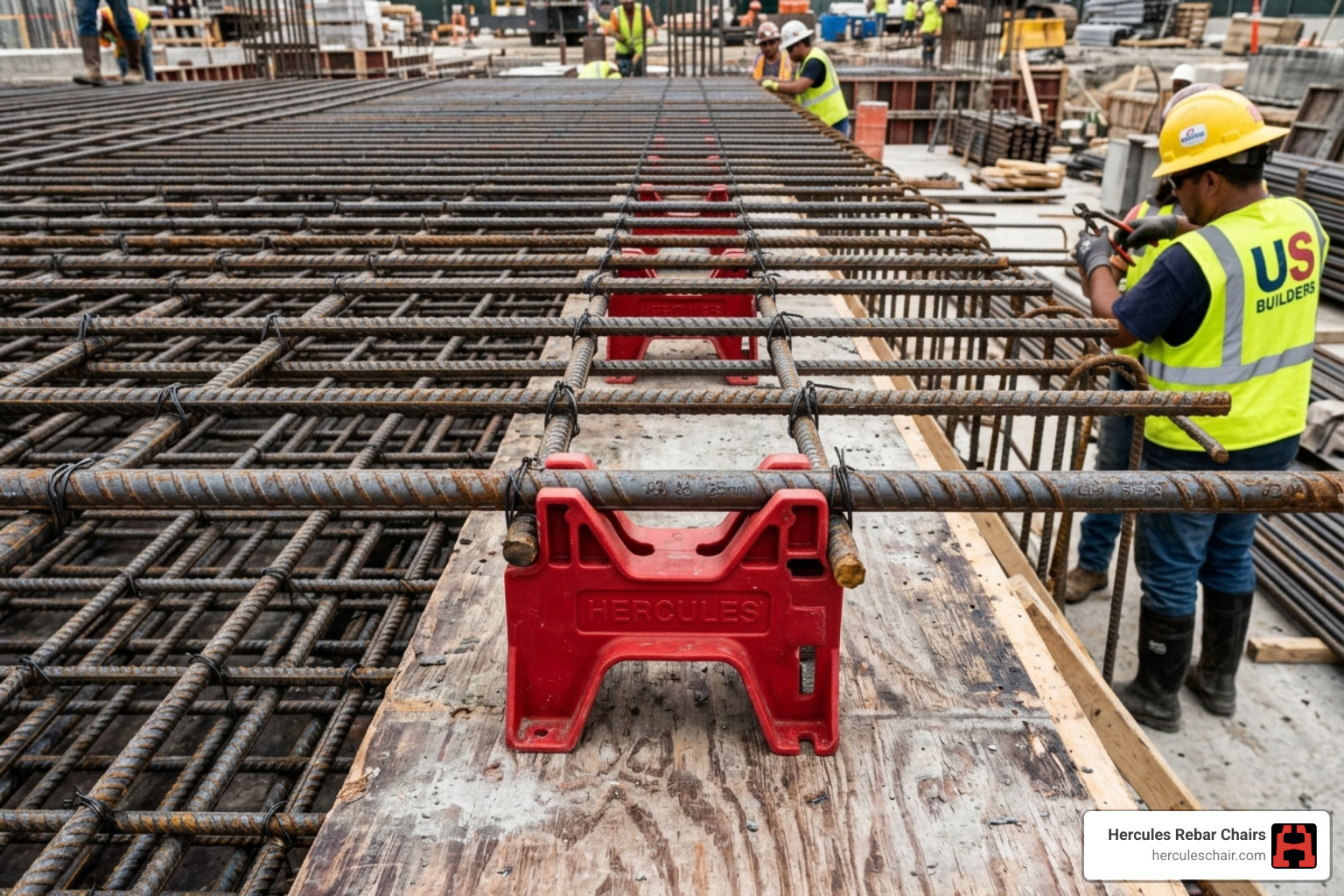
We’ve seen incredible leaps in how these products are engineered. Take our signature red Hercules Chairs, for example. We’ve designed them with a “point-of-contact” base. This means only a tiny fraction of the chair touches the formwork, making the support virtually invisible once the concrete is finished.
Furthermore, innovations like adjustable chairs allow a single SKU to provide multiple heights (e.g., a chair that works for both 2-inch and 3-inch cover). This is a game-changer for wholesale buyers who want to simplify their inventory. For more on the engineering behind these products, see Spacer Secrets Unpacking the Role of Plastic Rebar Chairs.
Strategic Buying: Why Sourcing Wholesale Concrete Supports Saves Money
If you are buying rebar chairs ten at a time from a big-box retail store, you are leaving money on the table. Wholesale concrete supports are designed for the professional who needs pallets, not pieces.
Buying in bulk offers:
- Lower Unit Cost: The price per chair drops significantly when you buy by the pallet.
- Consistency: You ensure that every chair on the job site is the same height and strength rating.
- Availability: Large-scale projects can consume thousands of chairs in a single day. Sourcing wholesale ensures you don’t run out mid-pour.
If you’re looking to stock up, you can Buy Rebar Chairs Wholesale Distributors to see how the logistics of bulk shipping can work for your business.
Bulk Quantities and Pricing for Wholesale Concrete Supports
When managing SKUs for a large project, you need to understand the math. For example, some wholesale bags of dobies can weigh over 3,000 lbs and contain over 8,000 pieces. In contrast, plastic chairs are often sold in boxes of 500 or 1,000.
Pricing usually scales with volume. A single high-strength plastic chair might cost pennies when bought by the tens of thousands, but that same chair could be triple the price at a retail outlet. Lead times are also a factor; while we keep a massive inventory, custom orders or massive infrastructure projects should be planned weeks in advance to ensure distribution center logistics align with your pour schedule.
Installation Best Practices and Safety Standards
Even the best wholesale concrete supports won’t help if they aren’t installed correctly. The general rule of thumb for rebar spacing is to place a support every 2 to 3 feet along the bar. However, this can vary based on the diameter of the rebar. Thinner rebar (#3 or #4) tends to sag, so you’ll need more chairs to keep it level.
Installation Steps:
- Layout: Lay out your rebar grid according to the structural plans.
- Placement: Snap the chairs onto the rebar intersections.
- Verification: Walk the grid. If the rebar deflects to the ground when you step on it, you need more supports.
- Tie-Down: In high-flow pours, use tie wire to secure the rebar to the chairs to prevent flipping.
Safety Features and OSHA Compliance
Safety isn’t just about the slab; it’s about the workers. Protruding rebar is a major impalement hazard. OSHA requires that all exposed rebar ends be covered with approved safety caps.
When you are ordering your wholesale concrete supports, you should always include a bulk order of rebar safety caps. These are usually bright orange and contain a steel plate to prevent a falling worker from being impaled. It’s a small investment that saves lives and prevents massive OSHA fines.
Essential Accessories for Concrete Reinforcement
A support system is only as good as its accessories. When you’re buying wholesale concrete supports, you’ll likely need these items as well:
- Tie Wire: Available in 16 or 17 gauge, this is used to lash rebar together. PVC-coated or galvanized wire is best for preventing rust.
- Expansion Joints: These allow concrete slabs to expand and contract without cracking. You’ll find these in foam, plastic, or fiber materials.
- Form Stakes: Whether steel or wood, these hold your forms in place against the pressure of the wet concrete.
- Slab Bolsters: For heavy-duty reinforcement, these provide a continuous line of support. You can learn more at What Are Concrete Bolster Chairs and Why Do You Need Them.
Frequently Asked Questions about Concrete Supports
How do I determine the correct spacing for rebar chairs?
Typically, chairs should be spaced every 24 to 36 inches. If you are using heavy rebar (like #5 or larger), you can push toward the 36-inch mark. For thinner mesh or #3 bar, stay closer to 24 inches to prevent sagging.
What is the difference between a slab bolster and an individual high chair?
A slab bolster is a long, continuous strip (usually 5 or 10 feet) that supports multiple bars at once. An individual high chair supports a single point or an intersection of two bars. Bolsters are great for speed on large flat surfaces, while chairs are more versatile for complex layouts.
Are plastic rebar chairs strong enough for heavy commercial slabs?
Absolutely. Modern high-strength plastic chairs, like those we manufacture, are engineered to hold over 600 lbs each. When spaced correctly, they can support the weight of heavy rebar mats and the construction crews walking on them during the pour.
Conclusion
At the end of the day, your reputation as a contractor is built on the durability of your work. Using subpar supports or trying to “pull up” rebar by hand during a pour (which never works, by the way) is a recipe for disaster.
At Hercules Rebar Chairs, we are proud to be America’s #1 choice for high-strength supports. With over 14 million units sold and a presence in nearly every state from Florida to Alaska, we know what it takes to support a successful project. Our signature red color isn’t just for branding; it makes it easy for inspectors to see that you’ve used the best supports available.
Whether you are doing a residential driveway or a multi-story commercial complex, our products ensure you stay code-compliant and on schedule. Ready to see the difference for yourself? Explore Our Products and find out why the pros choose Hercules.