

Why Footing Rebar Design Is the Most Critical Step in Any Concrete Build
Footing rebar design is the process of selecting, sizing, spacing, and detailing steel reinforcing bars within concrete footings to safely transfer structural loads into the ground.
Here’s a quick overview of what good footing rebar design requires:
| Design Element | Typical Requirement |
|---|---|
| Most common rebar size | #4 (1/2-inch diameter) |
| Standard spacing (residential) | 12 inches on center |
| Minimum concrete cover | 3 inches (cast against earth) |
| Minimum reinforcement ratio | 0.0018 × b × h (Grade 60) |
| Seismic zones (SDC D0–D2) | Min. one #4 bar at 48-inch intervals |
| Footing thickness governed by | Two-way (punching) shear |
Concrete is incredibly strong under compression — but it’s brittle under tension. When soil shifts, loads concentrate, or seismic forces hit, footings experience bending and pulling forces that plain concrete simply can’t handle. Rebar provides the tensile backbone that keeps the whole system from cracking, shifting, or failing.
The stakes are real. During the 1994 Northridge earthquake, properly reinforced foundations reduced structural damage by approximately 60% compared to unreinforced ones. The cost difference between a compliant footing and a failed foundation can exceed $200,000 per structure — making rebar design one of the highest-return decisions on any project.
This guide walks you through everything from basic sizing and spacing to shear calculations, seismic detailing, and field installation — so you can build foundations that last.
I’m Jordan Harris, a licensed Professional Engineer with a master’s degree in structural engineering and five years of hands-on experience designing large-scale concrete structures — including the footing rebar design decisions that make or break a foundation. As part of the T.J. Harris Company family, I now help contractors get rebar placement right from the ground up, and I’ll share exactly what that looks like in practice throughout this guide.
The Fundamentals of Footing Rebar Design
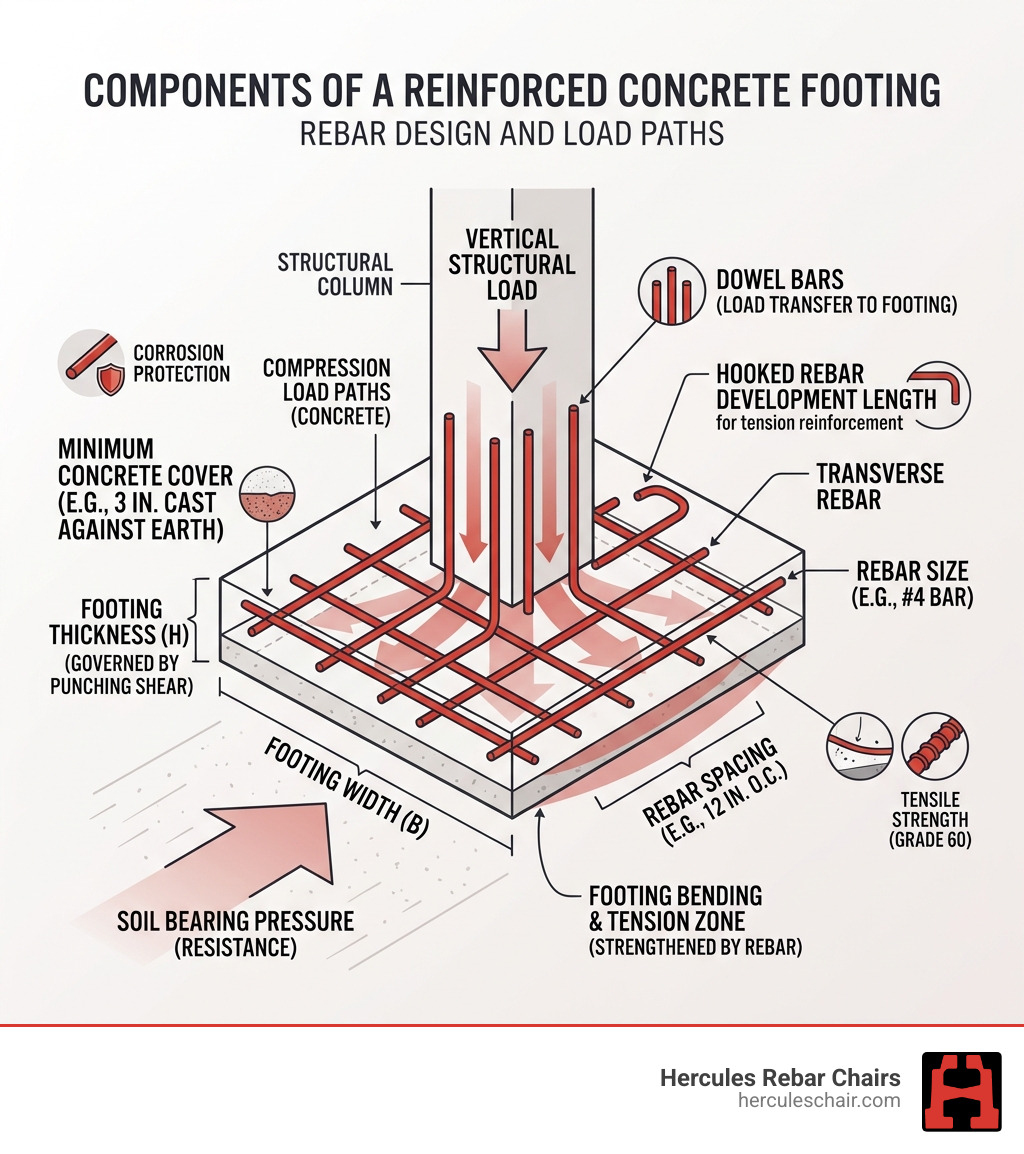
When we talk about footing rebar design, we are essentially creating a “steel skeleton” that works in harmony with concrete. Concrete is a superstar when it comes to being squeezed (compression), but it’s a bit of a lightweight when it comes to being pulled or bent (tension). Rebar steps in to provide that missing tensile strength.
In April 2026, the industry standard remains Grade 60 steel for most structural applications. “Grade 60” means the steel has a yield strength of 60,000 psi. This high-strength steel ensures that the foundation can flex slightly without snapping. However, the steel only works if it’s protected. That’s why we emphasize “concrete cover”—the distance between the rebar and the edge of the concrete. For footings cast directly against the earth, ACI 318 requires a minimum of 3 inches of cover to prevent the steel from rusting away.
Standard Sizes for Footing Rebar Design
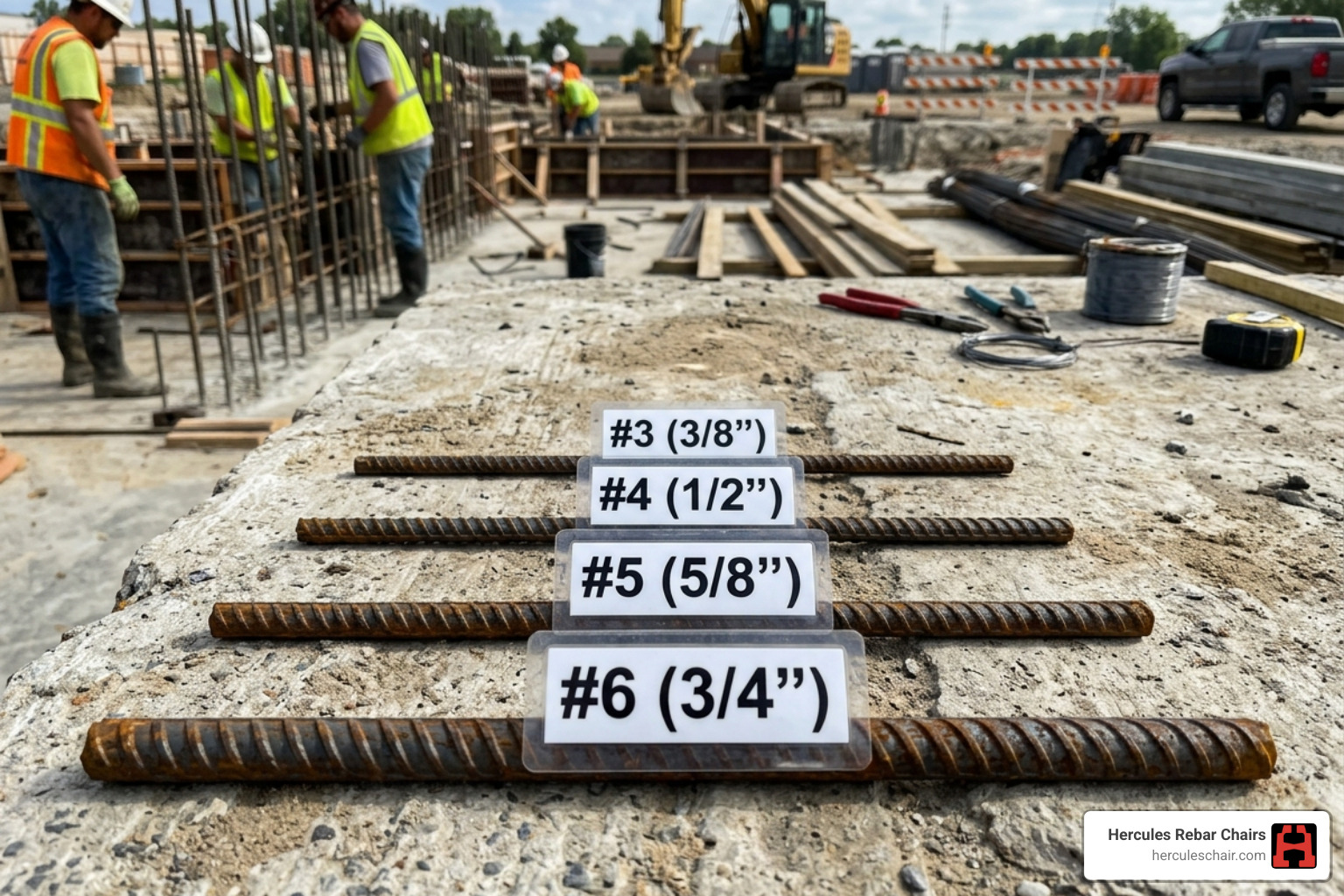
Selecting the right bar size is a balancing act between strength, workability, and cost. If you go too small, you need too many bars, which makes pouring concrete a nightmare. If you go too large, the bars become difficult to bend and cut on-site.
- #4 Rebar (1/2-inch): This is the “Goldilocks” of residential footing rebar design. It’s widely used because it’s strong enough for most home loads but light enough for a single worker to handle easily.
- #5 and #6 Rebar: These are more common in larger custom homes or commercial buildings where the loads are significantly higher.
A common Rebar Size & Spacing Guide for Concrete Footings suggests that for a standard 24-inch wide slab footing, two or three #4 bars laid horizontally are usually sufficient for residential needs. For a more precise look at how many bars you need, engineers often perform a Reinforcement Estimation of Spread Footing to calculate the exact weight of steel required.
Types of Footings and Their Reinforcement Needs
Not all footings are created equal. The footing rebar design must match the specific geometry of the foundation:
- Spread Footings: These are square or rectangular pads that support a single column. They require a “mat” of rebar in both directions.
- Continuous (Strip) Footings: These support a load-bearing wall. Rebar typically runs the length of the footing with shorter “temperature bars” running perpendicular.
- Stepped Footings: Used on sloped sites, these require careful detailing where the footing “steps” up or down. You can find more on this in this Stepped Footing Detail With Rebar & Concrete Calculation.
- Pile Caps: These are thick concrete blocks that sit on top of deep piles. Because they transfer massive loads, they often require very thick rebar (#8 or larger) and complex cages.
Structural Calculations: Shear, Flexure, and Soil Pressure
Designing a footing isn’t just about following “rules of thumb.” It involves serious math to ensure the concrete doesn’t crack under pressure. We look at two main types of loads: Service Loads (the actual weight of the building) and Factored Loads (the weight multiplied by a safety factor, usually 1.2 for dead loads and 1.6 for live loads).
The first step is sizing the footprint. We take the service load and divide it by the “allowable soil pressure” provided by a geotechnical engineer. If the soil can only hold 2,000 pounds per square foot (psf) and your column weighs 20,000 pounds, you need at least a 10-square-foot footing. For a deeper dive into these formulas, check out this Concrete Spread Footing Design — ACI 318 Reference.
Calculating Flexural Reinforcement in Footing Rebar Design
Flexure is just a fancy word for bending. Imagine the column pushing down in the middle of the footing while the soil pushes up on the edges—the footing wants to curl up like a potato chip. Rebar at the bottom of the footing stops this curling.
The “Factored Moment” (Mu) tells us how much bending force is present. We must ensure we provide enough steel area (As) to meet the minimum reinforcement ratio of 0.0018 times the gross concrete area. This isn’t just for strength; it’s for “shrinkage control.” As concrete cures, it gets hot and shrinks. Without that 0.0018 ratio of steel, the footing would develop “spiderweb” cracks before the house is even built. You can see a full calculation example in this Reinforced-Concrete-Square-Spread-Footing-ACI318-14 guide.
Addressing Eccentric Loading and Overturning
Life isn’t always perfectly balanced. Sometimes a column is at the edge of a footing, or a wind storm pushes on the side of a building. This creates “eccentric loading.”
When the eccentricity (e = Moment / Axial Load) is small (less than 1/6th the width of the footing), the pressure on the soil is still relatively even. But if the “overturning moment” is high, you might get a triangular pressure distribution. In extreme cases, one side of the footing could actually try to lift off the ground! This is why vertical dowels and seismic detailing are so important—they anchor the structure down. This WebStructural guide provides an excellent step-by-step on handling these moments.
Code Compliance and Seismic Detailing
If you are building in places like California, Alaska, or Washington, you are likely in a high-risk Seismic Design Category (SDC D0, D1, or D2). In these zones, the International Residential Code (IRC) and ACI 318-19 get much stricter.
Standard footing rebar design in these areas isn’t just about holding the building up; it’s about keeping it attached to the ground when the earth moves. For more specific regional requirements, professionals often refer to IR 18-5: Foundation Design and Detailing.
Critical Requirements for Footing Rebar Design in High-Risk Zones
As we mentioned earlier, reinforced foundations can reduce earthquake damage by 60%. In SDC D0-D2, the IRC R403.1.3 mandates at least one #4 bar placed vertically at maximum 48-inch intervals. These vertical bars must be hooked into the footing and extend up into the stem wall to create a continuous “chain” of strength.
In Arkansas or other regions following the 2021 Residential Code, you’ll find similar requirements for horizontal reinforcement to ensure the footing acts as a single, rigid unit during a tremor.
Development Length and Anchor Bolt Specifications
You can’t just stick a piece of rebar into concrete and expect it to hold. It needs “development length”—essentially enough “grip” inside the concrete so it won’t pull out. If the footing isn’t deep enough for a straight bar, we use standard hooks (90-degree or 180-degree bends).
Anchor bolts are another critical link. Per IRC R403.1.6, these must be embedded at least 7 inches into the concrete and spaced no more than 6 feet apart. In seismic zones, we also use 3x3x1/4 inch plate washers to ensure the bolts don’t pull through the wooden sill plate during a shake.
Installation Best Practices and Common Pitfalls
Even the most perfect footing rebar design on paper will fail if it’s installed poorly. The most common mistake? Letting the rebar sink to the bottom of the trench. If rebar is touching the dirt, it will corrode, expand, and eventually cause the concrete to “spall” (flake off), destroying your foundation.
Proper Support and Placement Techniques
To get the full strength of your design, the rebar must be suspended in the middle of the concrete pour. This is where high-quality concrete supports come in. We recommend using dedicated rebar chairs to maintain that critical 3-inch cover.
Using our identifiable red Hercules Rebar Chairs ensures you are meeting code requirements while saving time on the job site. Unlike “dobies” (concrete blocks) which can crack or tip, or plastic chairs that might collapse under the weight of a worker, our supports are designed for the rugged reality of a trench. For tips on where to place them, check out our Footer Stand Placement Guide.
Common Mistakes to Avoid in the Field
We’ve seen it all on job sites across the USA. Here are the top three “foundation killers” to avoid:
- Insufficient Cover: As we’ve hammered home, you need 3 inches of concrete between the steel and the earth. Don’t eyeball it. Use a 3 Bar Footer Stand to keep things precise.
- Dirty or Rusty Rebar: A little light “flash rust” is okay, but if the rebar is covered in mud, oil, or flaky rust, the concrete won’t bond to it. Clean it off before the pour!
- Improper Tying: Tying rebar doesn’t add structural strength—the concrete does that—but it does keep the bars from moving when the wet concrete hits them. Use saddle ties and ensure every intersection is secure.
For a deeper dive into installation, see our guide on How To Install Rebar In Footings The Right Way.
Frequently Asked Questions about Footing Design
Why is rebar necessary if concrete is so strong?
As we mentioned, concrete is like a giant stone—great at being stepped on, but easy to snap if you try to bend it. Soil isn’t perfectly flat or stable; it settles over time. Rebar allows the footing to span over “soft spots” in the soil without cracking. It also controls the width of cracks that inevitably form due to temperature changes.
What is the standard spacing for residential footing rebar?
For most standard homes, #4 bars spaced 12 inches on-center is the industry baseline. However, if you are building on expansive clay or loose sand, your engineer might reduce that spacing to 6 or 8 inches to provide more “stiffness” to the foundation.
How do I determine the required thickness of a footing?
While the International Building Code (IBC) sets a minimum thickness of 12 inches for most reinforced footings, the real answer usually comes down to two-way (punching) shear. This is the force of the column trying to “punch” a hole through the footing. If your footing is too thin, it will fail around the column before the rebar even gets a chance to help. We usually calculate the “effective depth” (d) by subtracting the 3-inch cover and half the bar diameter from the total thickness.
Conclusion
As we move through 2026, the building codes are only getting more rigorous. Whether you are in Alabama or Alaska, a solid footing rebar design is your best insurance policy against structural failure. A foundation is the one part of a building you can’t easily go back and “fix” later—once the concrete is poured, your design is set in stone.
At Hercules Rebar Chairs, we believe that “America’s #1” red chairs aren’t just about holding steel; they’re about peace of mind. With over 14 million units sold, we’ve helped thousands of contractors ensure their rebar stays exactly where the engineer intended. By following the design principles in this guide and using the right supports, you ensure code compliance and long-term structural integrity.
Ready to get your next project off the ground? Check out our Rebar Placement Guide to see how our chairs can save you time and money on your next pour. Don’t leave your foundation to chance—support it with the best.