

Choose a Durable Rebar Chair for Demanding Concrete Work
A rebar chair durable enough for a demanding pour holds reinforcement at the required elevation without crushing, shifting, or letting steel sag as crews place concrete. Hercules Rebar Chairs are heavy-duty, red rebar and mesh supports made in the USA and designed to help contractors keep reinforcement in position for slabs, footings, and other concrete work.
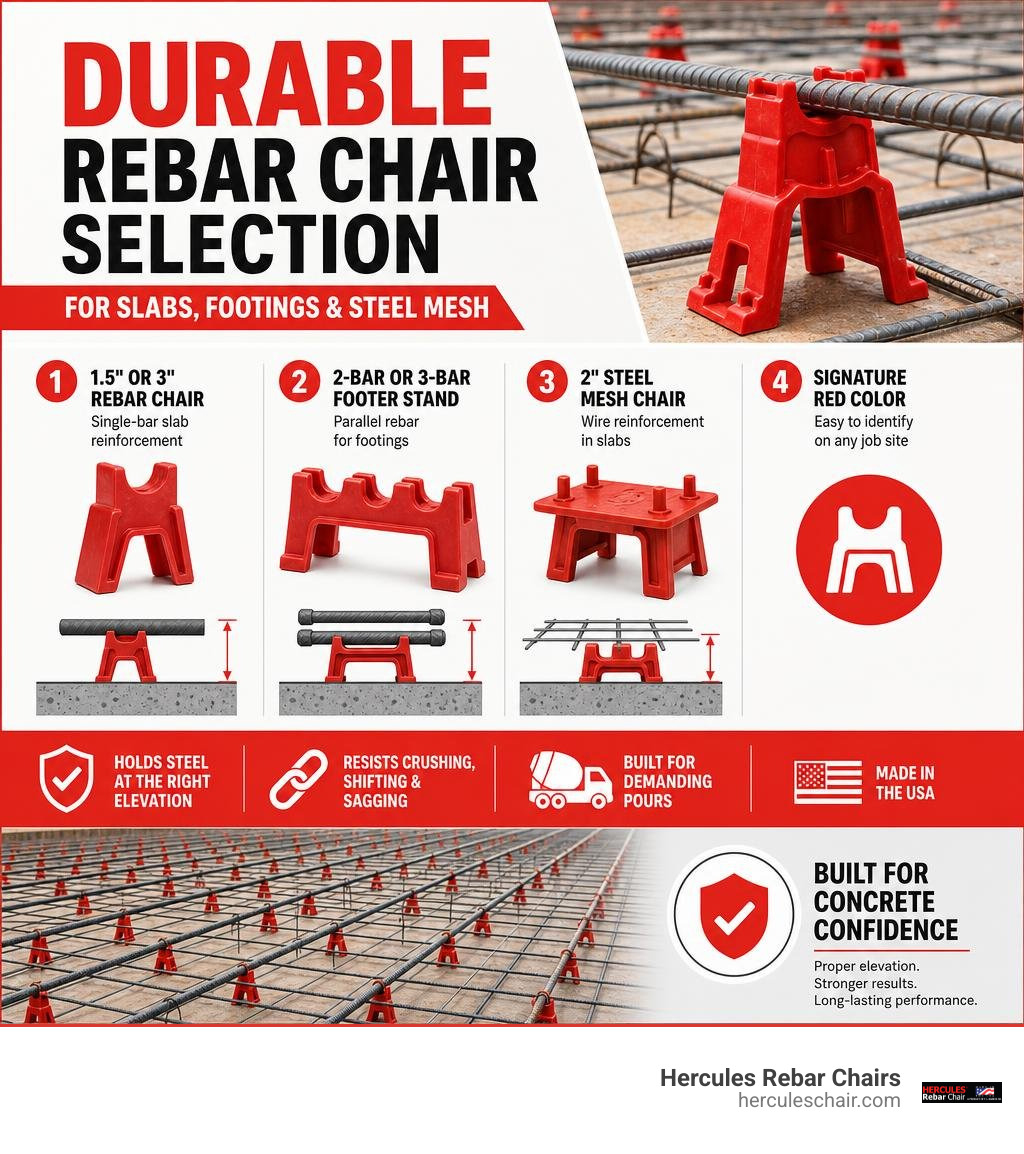
- Choose a 1.5-inch or 3-inch rebar chair for single-bar slab reinforcement at the needed height.
- Use a 2-bar or 3-bar footer stand when a footing needs parallel rebar held in a stable layout.
- Select a 2-inch steel mesh chair to keep wire reinforcement elevated in a slab.
- Look for the signature red color to quickly identify Hercules supports on a busy job site.
Proper steel elevation is not a minor detail. It affects concrete cover, inspection readiness, and the long-term performance of the finished work. Hercules has produced rebar support products for more than 25 years, with over 14 million chairs sold.
I am Jordan Harris, a Tennessee-licensed Professional Engineer with experience in large concrete and steel projects and in American manufacturing. I bring that structural perspective to what makes a rebar chair durable when a concrete pour cannot afford movement or failure.
Easy rebar chair durable word list:
Structural Engineering Criteria That Make a Rebar Chair Durable
When concrete trucks roll onto a site and pump lines start charging, your job site reinforcement faces intense dynamic forces. Workers walk across the grid, heavy hoses drag across rebar, and tons of dense concrete drop directly from chutes. If a support chair buckles or tilts under this pressure, your steel drops straight to the bottom of the slab. That single failure point compromises tensile strength, exposes steel to moisture, and invites premature corrosion.
To withstand these harsh job site conditions, engineered concrete supports must balance rigidity with toughness. A truly rebar chair durable design must maintain its height under impact while distributing point loads evenly across the subbase or vapor barrier. To understand how proper component design prevents job site failures, review A Contractor’s Guide to Concrete Support Chairs.
Load Capacity and Structural Design
The fundamental job of a concrete support is crushing resistance. When concrete is poured, static weight is only part of the equation; dynamic impact and foot traffic generate significant localized forces. Weak supports often snap at the cradle arms or split along stress points, dropping steel straight down into the dirt.
Our structural engineering focuses on wide-base load distribution and reinforced vertical legs. High-density plastic formulations provide high impact strength, ensuring the chair flexes slightly under shock without snapping or permanently deforming. By spreading heavy point loads across a broader surface area, our chairs prevent punctures in sub-slab vapor barriers while keeping rebar elevated exactly where structural plans specify. For additional details on matching chair geometry to slab depth, read The Ultimate Guide to Rebar Chairs: Types, Uses, and Sizing for Concrete Slabs.

Signature Red Color and 100% USA Manufacturing Standards
On a fast-moving job site covered in dust, gravel, and steel grids, visual clarity saves time and prevents costly mistakes. We manufacture our chairs in a signature bright red color. This distinctive shade provides immediate visual confirmation for site superintendents, crew leads, and building inspectors. A quick glance across the deck confirms that every support chair is clipped in place, properly spaced, and ready for inspection before the first truck arrives.

Every Hercules chair is manufactured 100% in the USA under strict quality control protocols. Overseas manufacturing can suffer from inconsistent resin blends, regrind contamination, and unpredictable structural strength. By keeping our manufacturing entirely domestic, we guarantee consistent raw material purity, exact dimensional tolerances, and reliable load performance across all 14 million chairs we produce.
Top Heavy-Duty Supports for Demanding Concrete Pours
Different concrete elements require dedicated reinforcement geometry. Using a single-bar chair inside a double-bar footing forces crews to improvised wire tying, wasting time and reducing stability. We design specialized supports tailored to specific structural applications, including single-bar slab chairs, multi-bar footer stands, and wide-base wire mesh chairs.
The table below outlines our core heavy-duty rebar supports, their target applications, and ideal concrete placements:
| Product Model | Target Reinforcement | Standard Clearance / Height | Recommended Applications |
|---|---|---|---|
| 1.5″ Rebar Chair (911) | #3 to #5 Single Rebar | 1.5 Inches | Slabs-on-grade, driveways, sidewalks, patio slabs |
| 3″ Rebar Chair (912) | #3 to #6 Single Rebar | 3.0 Inches | Heavy commercial slabs, thick industrial floors, bridge decks |
| 2-Bar Footer Stand (928) | Dual Parallel Rebar | 2.0 – 3.0 Inches | Residential and commercial strip footings, trench foundations |
| 3-Bar Footer Stand (924) | Triple Parallel Rebar | 2.0 – 3.0 Inches | Heavy structural footings, grade beams, retention walls |
| 2″ Steel Mesh Chair (944) | Welded Wire Mesh / Grid | 2.0 Inches | Pervious slabs, warehouse floors, elevated deck mesh |
Selecting a 3-Inch Rebar Chair Durable Model for Slabs
For thick concrete slabs requiring standard 3-inch clearance from the subgrade, our 3-inch Rebar Chair (Model 912) offers maximum vertical stability. Thick industrial slabs contain heavy rebar mats that exert massive downward force. Lesser supports bend under this weight, causing structural steel to sag toward the subbase.
Our 3-inch chair features robust legs and a secure top locking cradle that grips rebar tightly. This eliminates the need for manual wire ties in many standard applications, speeding up grid assembly. For thinner elevated slabs or driveways specifying 1.5 inches of clearance, our 1.5-inch Rebar Chair (Model 911) offers the exact same crushing resistance in a compact profile. To discover how proper chair selection eliminates mid-pour steel sag, explore Don’t Let Your Rebar Sag with These Support Tools.
Dedicated Footer Stands for Parallel Steel Configurations
Foundation footings present unique structural challenges. Placing two or three parallel lines of rebar inside a narrow trench typically requires tedious measurement and extensive wire tying to keep bars parallel during the pour.
Our 2-Bar Footer Stand (Model 928) and 3-Bar Footer Stand (Model 924) solve this problem entirely. These dedicated stands feature pre-spaced cradles engineered to hold parallel steel bars at precise structural distances without shifting. Crews simply drop the footer stands into the trench, snap the longitudinal rebar into place, and pour. The stable, wide base resists tipping even when concrete churns directly out of the chute. To learn more about heavy-duty foundation support in complex builds, read Heavy-Duty Rebar Chairs for Chemical and Power Plant Construction.
Heavy-Duty Mesh Chairs for Steel Wire Reinforcement
Welded wire mesh is notoriously difficult to support correctly during concrete placement. Standard chairs are designed for rigid steel bars; light wire mesh often slips off small cradles or sags between widely spaced supports, leaving steel mesh resting directly on the dirt.
Our 2-inch Steel Mesh Chair (Model 944) is designed specifically with broad attachment channels that securely clamp welded wire fabric. The wide base spreads weight across subgrades and poly vapor barriers, preventing the legs from poking holes through moisture membranes. Keeping wire mesh elevated at mid-depth ensures your concrete slab achieves its full design flexural strength without surface cracking. Learn how heavy-duty mesh supports improve structural outcomes in Hercules and Beyond: Heavy Duty 2-Inch Steel Mesh Chairs.
Time-Savings, Code Compliance, and Customer Proof
In concrete construction, time spent adjusting steel during a pour is money lost. Modern building codes require exact concrete coverage around structural steel to protect against internal shearing and external corrosion. Using heavy-duty, engineered supports streamlines job site labor while ensuring strict code compliance.
Ensuring Building Code Compliance and Correct Concrete Cover
Building codes across all 50 U.S. states enforce strict requirements for structural concrete cover. The American Concrete Institute (ACI) specifies exact minimum clearances between reinforcing steel and exposed earth or formwork. For example, steel cast against permanently exposed earth typically requires a full 3 inches of concrete cover.
| Concrete Exposure Condition | Standard Code Minimum Cover | Recommended Support Chair |
|---|---|---|
| Cast against & permanently exposed to earth | 3.0 Inches | 3″ Rebar Chair (912) / Footer Stands |
| Exposed to earth or weather (Slabs/Walls) | 1.5 to 2.0 Inches | 1.5″ Rebar Chair (911) / 2″ Mesh Chair (944) |
| Slab on grade with vapor barrier | 1.5 to 2.0 Inches | 1.5″ Rebar Chair (911) / 2″ Mesh Chair (944) |
Failing to maintain these structural clearances can lead to failed site inspections, costly structural remediations, or premature concrete spalling. Using certified, high-strength elevation supports guarantees your steel stays fixed at the required height throughout the pour. For a detailed breakdown of inspection requirements and elevation tools, see Compliant Rebar Elevation Chairs for Professional Results.
Contractor Benefits and Long-Term Labor Savings
Manual wire tying and makeshift supports like bricks or wooden blocks waste valuable field labor. Loose rocks crumble under pressure, while wooden scrap absorbs water, rots over time, and creates direct paths for moisture ingress.
Our snap-in chair design enables workers to secure rebar grids in a fraction of the time required by traditional tie wire. The secure lock tops hold rebar firmly in place, allowing crews to walk across the assembly without knocking steel out of alignment. By eliminating manual wire tying at every intersection and avoiding pour-day rebar adjustment, contractors save significant labor hours on every project. Discover practical ways to protect your concrete placement from sinkage in Don’t Let Your Rebar Sink: A Guide to Concrete Chairs.
How Field Feedback Proves a Rebar Chair Durable Over Decades
Over the past 25 years, contractors across the nation have trusted Hercules Rebar Chairs for their most critical concrete pours. With over 14 million units sold, our track record demonstrates proven performance across residential footings, commercial slabs, highway bridges, and industrial structures.
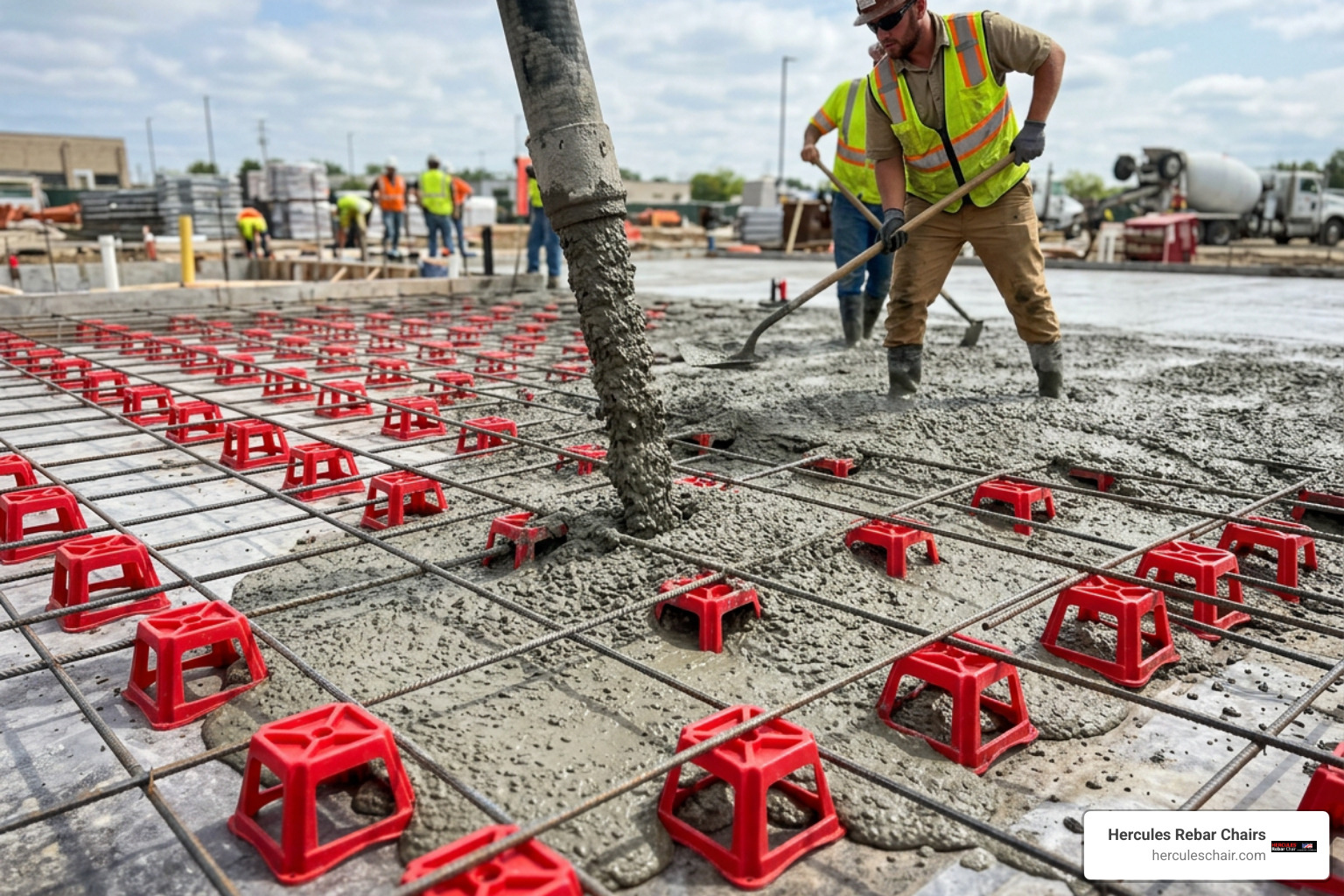
Field feedback from commercial contractors consistently highlights our chairs’ resistance to crushing, ease of snap-in installation, and high visibility under job site conditions. When heavy concrete pours demand absolute structural reliability, our engineered red chairs perform without failure. Read more about our performance heritage in Why Hercules Chairs Are the Heavyweight Champions of Rebar Support.
Frequently Asked Questions About Heavy-Duty Concrete Supports
Why is signature red coloring important when selecting rebar chairs?
Our signature red color provides instant visual identification on active job sites. It allows superintendents, contractors, and building inspectors to quickly verify from a distance that rebar and wire mesh are properly elevated with genuine Hercules chairs before concrete placement begins.
How do rebar chairs assist with local building code compliance?
Rebar chairs maintain exact structural clearance between reinforcing steel and the subbase or formwork. By holding steel firmly at the designated height during heavy pours, they ensure the finished concrete meets ACI standards for protective cover and structural strength.
Why does 100% USA manufacturing matter for rebar supports?
Domestic manufacturing guarantees consistent resin quality, strict dimensional accuracy, and superior impact strength. Unlike imported plastic chairs that may break under load due to variable materials, our 100% USA-made supports deliver predictable crushing resistance on demanding pours.
Conclusion
Choosing a rebar chair durable enough for heavy concrete placement protects your structural integrity, keeps projects on schedule, and ensures compliance with building standards. With over 25 years of engineering experience, 100% USA manufacturing, and over 14 million chairs sold, Hercules Rebar Chairs represent America’s top choice for reliable steel reinforcement support.
To explore more insights on selecting steel supports, read The Strong Silent Type: Choosing the Best Steel Rebar Chairs for Your Project and check out Support Your Slab with These Top-Rated Plastic and Steel Chairs.
Ready to outfit your next pour with the strongest red supports on the market? Explore 2-Inch Steel Mesh Chairs and discover our full line of heavy-duty concrete placement tools.