

Why Rebar Chairs for Coastal Areas Need Extra Protection
For coastal slabs, choose non-metallic plastic rebar chairs or other corrosion-resistant supports that hold steel at the specified concrete cover without puncturing the vapor barrier. Use wide-footed supports on sand or soft subgrade, reduce spacing where the rebar grid is heavy, and verify every chair stays upright before the pour.
Salt-laden air, wet soil, and chloride-bearing water can reach reinforcement through concrete over time. Once steel corrodes, the expanding rust can crack and spall the slab. Properly selected rebar chairs for coastal areas keep the rebar off the ground, maintain cover, and help create the dense concrete barrier that slows moisture and salt intrusion.
Jordan Harris is a licensed Tennessee PE with civil and structural engineering experience on large concrete and steel projects, plus hands-on product-development experience at Hercules Rebar Chairs. In this guide, I will help you compare rebar chairs for coastal areas and select supports that remain stable through demanding pours and harsh marine exposure.
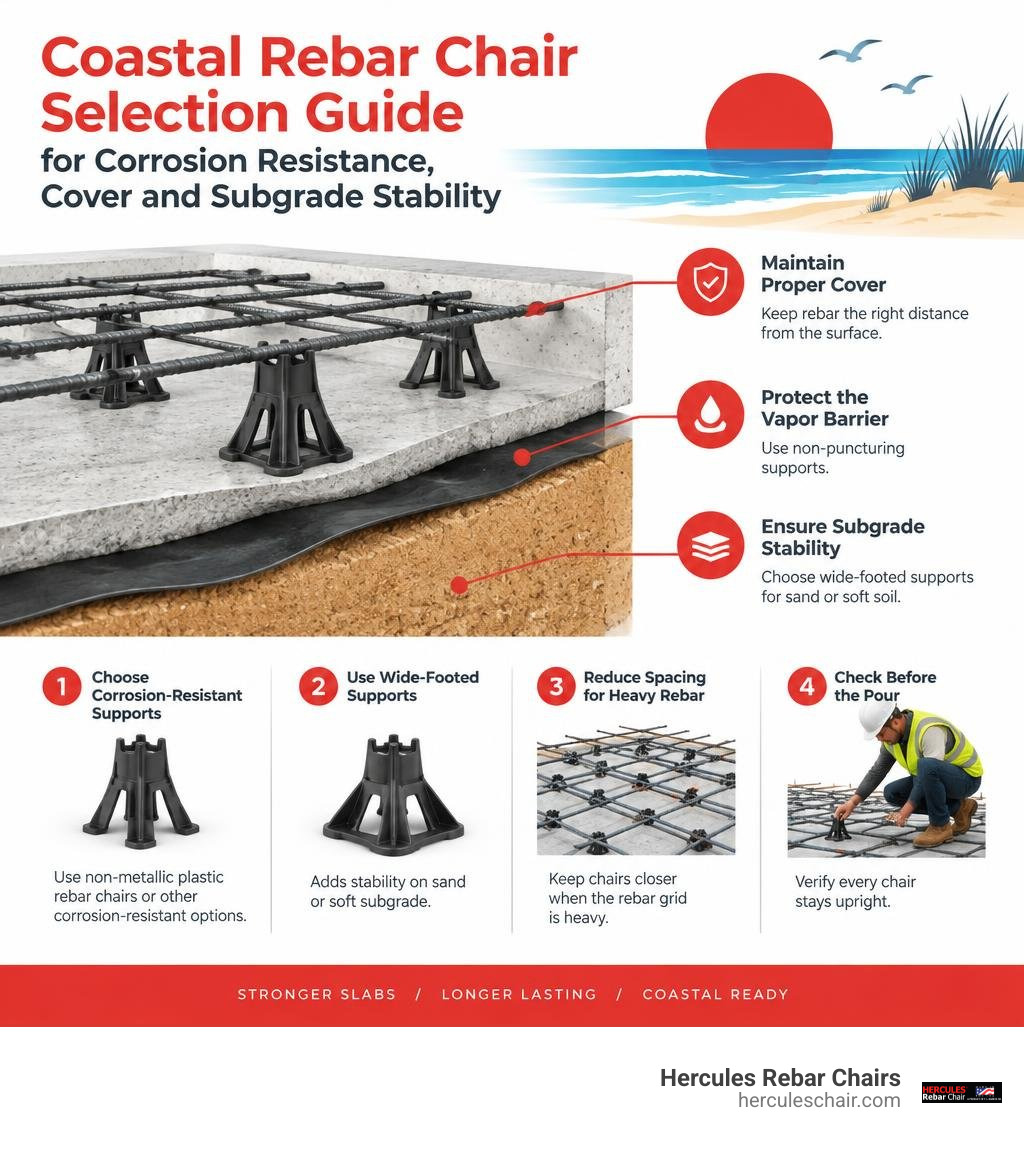
Rebar chairs for coastal areas vocab to learn:
Understanding Corrosion Risks in Coastal Concrete Slabs
Building along the coastline provides incredible views, but it presents some of the most aggressive environmental challenges in modern construction. When concrete is poured near the ocean, it faces a continuous onslaught of moisture, airborne sea salt, high humidity, and fluctuating water tables. Ensuring your structural reinforcement remains intact for decades requires understanding how these coastal elements interact with your slab from day one.
Moisture and Chloride Penetration in Marine Environments
Concrete is naturally porous. On microscopic levels, it contains networks of capillary pores that allow water vapor and dissolved chemicals to migrate inward. In marine environments, wind-driven salt spray and brackish groundwater deposit chloride ions onto concrete surfaces. Over time, these chlorides penetrate the concrete matrix via diffusion and capillary suction.
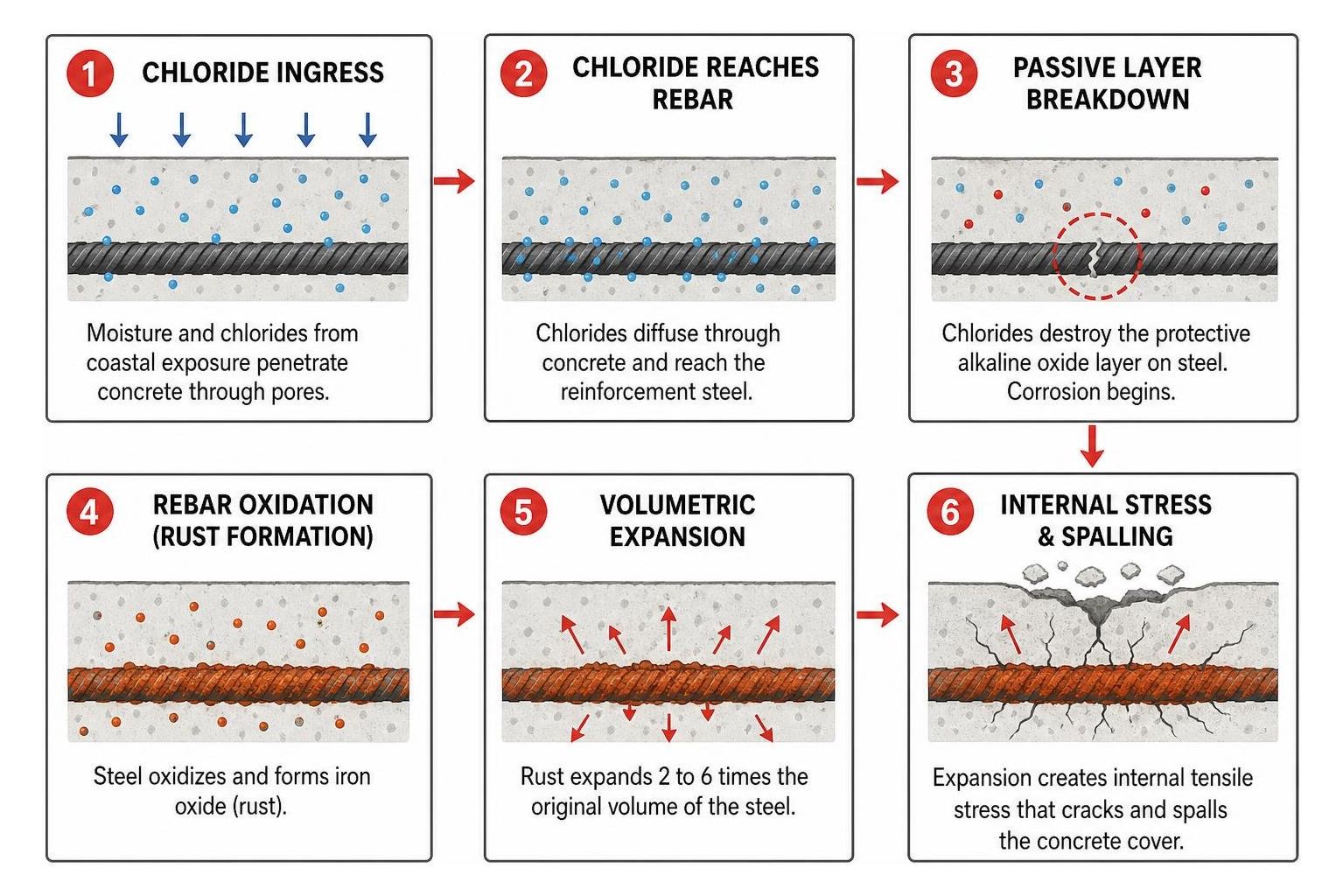
When chloride concentrations reach the reinforcement steel, they destroy the passive alkaline oxide layer that naturally protects carbon steel inside cured concrete. Once this protective barrier breaks down, oxidation accelerates rapidly:
- Chloride Attack: Dissolved chlorides penetrate micro-pores and attack the steel surface.
- Volumetric Expansion: As steel oxidizes, iron oxide (rust) expands to 2 to 6 times the original volume of the steel.
- Internal Tensile Stress: This substantial expansion generates immense radial pressure exceeding the tensile strength of the surrounding concrete.
- Cracking and Spalling: Delamination occurs, manifesting as surface cracks, rust bleeding, and eventual structural spalling.
Maintaining adequate concrete slab rebar cover is the first line of defense against this destructive cycle. Proper concrete depth acts as a physical barrier that delays chloride migration toward your steel. If reinforcement is positioned too low—or if it sags onto the subgrade during the pour—chlorides quickly reach the metal, causing catastrophic failure long before the building’s design lifespan ends.
Comparing Chair Materials: All-Plastic vs. Metal Supports
The rebar chairs supporting your grid must withstand the same harsh marine conditions as the slab itself. Standard uncoated steel wire chairs provide virtually zero protection against rust. If plain wire feet contact the ground or sit close to the bottom surface, moisture wicks up through the steel legs, creating direct pathways for rust to enter the structural grid.
When selecting plastic and steel supports, contractors working in coastal zones generally evaluate three categories:
- 100% Non-Metallic Polymer Chairs: Made from heavy-duty polypropylene or high-density polymers, all-plastic supports are completely inert to saltwater, chlorides, and subgrade moisture. Because they contain zero ferrous metal, they eliminate rust bleed-through and cannot corrode.
- Plastic-Tipped Steel Wire Chairs: These wire chairs feature dipped plastic coatings on the feet to prevent exposed metal at the bottom of the slab. While effective for interior architectural slabs, any scratch, tear, or pinhole in the coating allows moisture to wick up the steel leg.
- Galvanized Wire Chairs: Galvanized supports offer a sacrificial zinc coating that delays corrosion under typical residential conditions. However, in continuous marine exposure or aggressive salt fog, zinc depletes rapidly when exposed to high chloride levels, eventually allowing base steel oxidation.
To see how specialized polymers excel in high-salt outdoor environments, consider how marine-grade material durability relies on premium non-corrosive plastics to endure constant salt spray without degradation. For marine foundations, all-plastic chairs deliver absolute peace of mind against corrosion.
Best Types of Rebar Chairs for Coastal Areas
Selecting the ideal support geometry depends on the foundation design, soil profile, and structural load requirements. Below is a comparison of support types engineered for demanding coastal slabs:
| Support Type | Material Composition | Primary Coastal Application | Key Advantage | Load Rating |
|---|---|---|---|---|
| Heavy-Duty Plastic Chairs | 100% Non-Corrosive Polymer | Slab-on-grade, residential patios, grade beams | Zero rust risk, stable wide bases | High (Up to 1,000+ lbs) |
| Multi-Level Stack Chairs | High-Impact Polypropylene | Double rebar mats, seismic/hurricane slabs | Holds two mats accurately without shifting | Extreme Heavy-Duty |
| Continuous Slab Bolsters | Solid Engineered Polymer | Soft sand subgrades, large commercial pours | Continuous load displacement, cannot tip | High Continuous Load |
Heavy-Duty Plastic Rebar Chairs for Coastal Areas
For standard coastal residential foundations, commercial slabs, and grade beams, heavy-duty all-plastic chairs represent the gold standard. When choosing the right concrete rebar chair, non-metallic construction ensures that support points never become corrosion conduits.
Our signature red Hercules Rebar Chairs are manufactured from robust, non-corrosive polymers designed to carry heavy foot traffic and concrete discharge without deflecting. With over 14 million units sold across the United States, we have engineered our chairs to maintain rigid structural dimensions across broad temperature ranges. They will not become brittle in coastal winter freezes or soften under blistering coastal summer heat, ensuring reliable elevation throughout the placement process.
Multi-Level Stack Chairs for High-Wind and Seismic Zones
Coastal construction in hurricane alleys and seismic zones often demands engineered double rebar mats. These two-layer reinforcement configurations provide the lateral shear resistance and flexural ductility required to withstand intense wind uplift and earth movement.
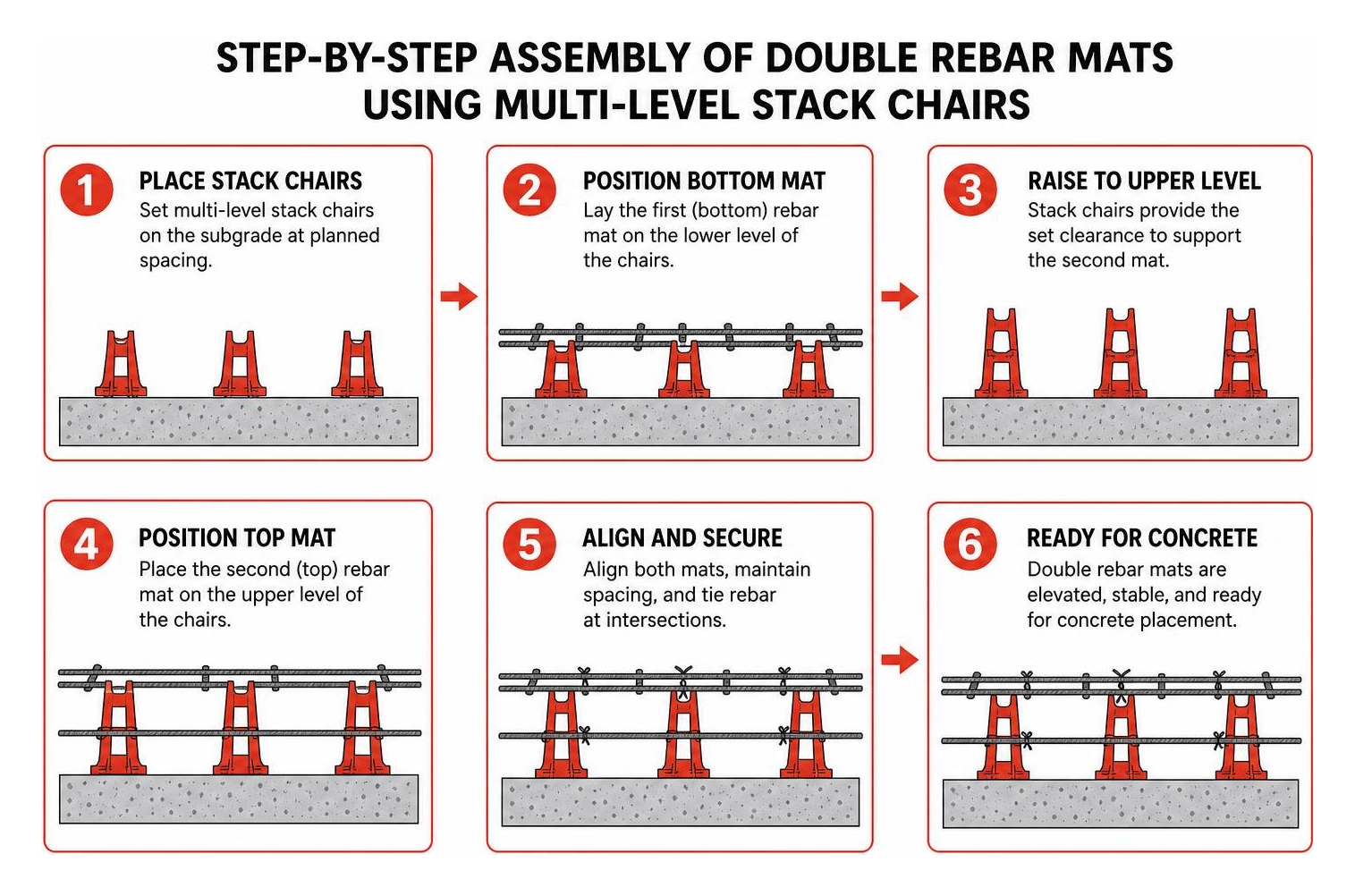
Elevating two distinct layers of heavy rebar (#4 to #8 bars) requires specialized supports. Multi-level stack chairs allow ironworkers to position the bottom layer at the exact code-required cover depth while elevating the second, upper grid at the specified intermediate clearance. Using dedicated heavy-duty construction rebar supports prevents upper mats from sagging under worker foot traffic, eliminating the need for unstable, ad-hoc wire tying or unstable jobsite shims.
Continuous Slab Bolsters for Unstable Coastal Subgrades
Building over coastal sands, silts, or loosely compacted shell base creates unique subgrade challenges. Individual small-footprint chairs can sink into soft soil under dynamic placement loads, causing the entire reinforcement grid to settle toward the dirt.
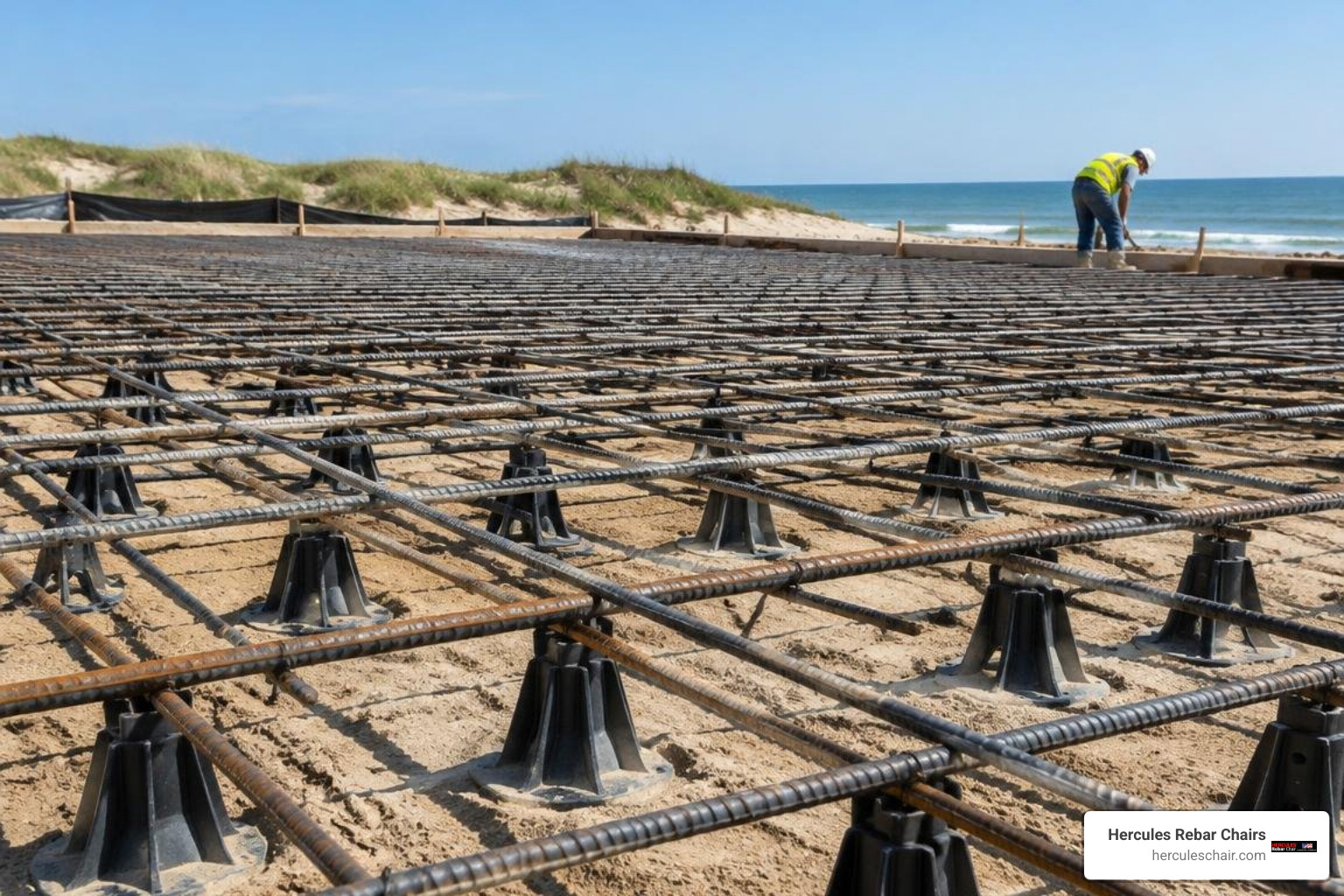
Continuous slab bolsters solve this issue by distributing point loads along a broad, linear footprint. If your site team is focused on preventing rebar from sinking into subgrade, continuous composite runners provide uniform load displacement. They are ideal for coastal tiny home slabs, modular foundations, and expansive utility flatwork where rapid installation and non-tipping stability are mandatory.
Installation Best Practices for Marine and Salt-Exposed Slabs
Achieving a durable coastal slab requires pairing top-tier supports with meticulous jobsite installation practices. Even premium rebar supports cannot protect a structure if they are improperly spaced or incorrectly sized.
Determining Concrete Cover Depth and Chair Sizing
Concrete cover—the clear distance between embedded reinforcing steel and the outer surface of the cured concrete—is your primary defense against moisture migration. According to ACI 318 standards and coastal building codes:
- Concrete Cast Against and Permanently Exposed to Earth: Minimum 3.0 inches (75 mm) of cover.
- Concrete Exposed to Earth or Weather (Coastal Slabs): Minimum 2.0 inches (50 mm) for #6 through #18 bars, and 1.5 to 2.0 inches for #5 bars and smaller.
- Submerged or High-Splash Marine Zones: Often engineered to 3.0 inches or greater of dense, low-permeability concrete cover.
Reviewing recommended concrete cover guidelines ensures you select chair sizes matching your project’s engineering drawings. For instance, a 6-inch structural coastal slab requiring 2.5 inches of bottom cover necessitates a 2.5-inch chair profile rather than an arbitrary scrap block.
Spacing and Grid Configuration of Rebar Chairs for Coastal Areas
Chairs must be arranged in a uniform matrix that prevents rebar deflection during the pour. Rebar sag between chairs reduces effective concrete cover, creating vulnerable localized thin spots where chlorides can attack the steel.
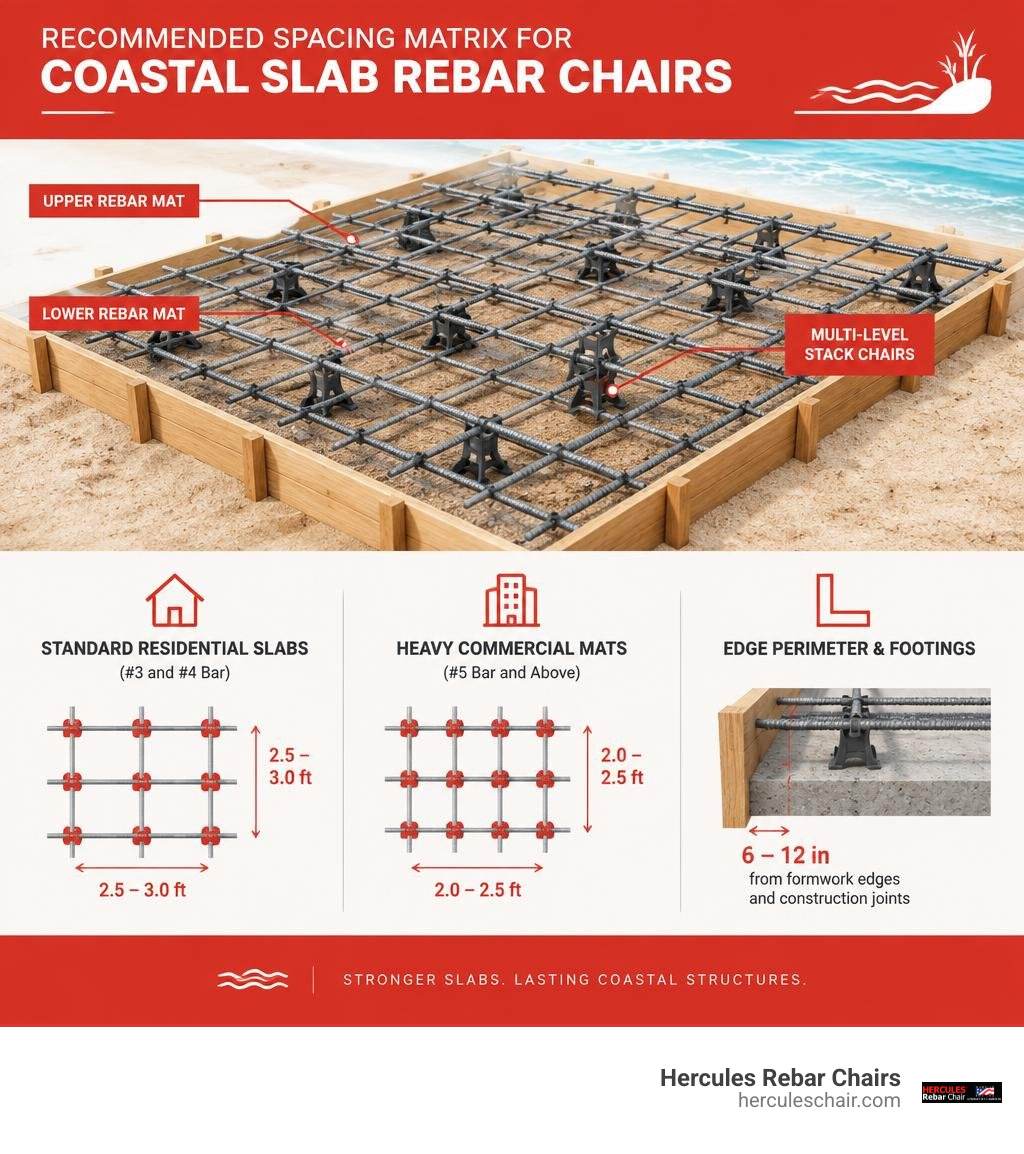
Follow these spacing rules to ensure compliance:
- Standard Residential Slabs (#3 and #4 Bar): Place chairs every 2.5 to 3.0 feet along the bar runs in both directions.
- Heavy Commercial Mats (#5 Bar and Above): Space chairs 2.0 to 2.5 feet apart to carry heavy crew traffic and pumping hose drag.
- Edge Perimeter and Footings: Position supports within 6 to 12 inches of all formwork edges and construction joints.
Maintaining strict adherence to rebar chair code requirements ensures the grid holds its position when pump crews discharge heavy concrete mixes.
Protecting Poly Vapor Barriers on Sandy Coastal Subgrades
A 10-mil or 15-mil poly vapor retarder is critical for preventing ground moisture and salts from migrating upward into the slab. However, sharp wire chairs or narrow-point plastic legs can easily puncture these sheets when workers step on the steel. A single puncture compromises the entire barrier, allowing subgrade moisture to wick directly into the foundation.
To protect the vapor barrier:
- Select Wide-Base Chairs: Use non-metallic chairs equipped with integrated, wide-footing flat bases that disperse downward pressure.
- Add Base Plates on Pure Sand: When placing reinforcement over loose beach sand, snap chairs into dedicated sand plates or wide base discs.
- Use Smooth Profiles: Ensure all chairs and concrete rebar spacers and chairs have smooth, radiused edges that won’t pierce plastic sheeting during foot traffic.
Pre-Pour Inspection and Quality Assurance Protocols
Conducting a thorough pre-pour quality assurance inspection is vital on coastal jobsites. Once the concrete truck arrives, fixing displaced reinforcement becomes nearly impossible.

Before calling for concrete delivery, run through this coastal inspection checklist:
- [ ] Cover Depth Verification: Measure clear cover from the subbase and side forms to the rebar using a tape or depth gauge. Ensure it matches code specs.
- [ ] Chair Stability Check: Walk the grid. Ensure no chairs have tipped over, skewed sideways, or detached from snap-lock clips.
- [ ] Vapor Barrier Audit: Inspect the poly membrane for punctures, tears, or stretching caused by chairs or steel drops. Patch any voids with approved vapor tape.
- [ ] Subgrade Condition: Verify that soft coastal sands beneath the chairs have not settled, washed out, or eroded from pre-pour rainfall.
- [ ] Tie Wire Trimming: Clip all tie wire ends away from forms and downward surfaces. Exposed wire ends act as corrosion conduits.
Frequently Asked Questions About Coastal Rebar Supports
What is the minimum concrete cover required for coastal slab reinforcement?
Under ACI 318 standards, concrete cast directly against and permanently exposed to earth requires a minimum of 3 inches of clear cover. Slabs exposed to coastal weather, sea spray, or brackish conditions generally require 2 to 3 inches of cover, depending on rebar diameter and specific environmental exposure classifications. Always verify requirements against local municipal coastal building codes and project structural drawings.
Why are 100% plastic rebar chairs preferred over steel in coastal zones?
All-plastic chairs are manufactured from synthetic polymers that are chemically inert. Unlike steel wire chairs, polymer supports cannot rust, pit, or oxidize when exposed to salt-laden air, high humidity, or chloride-heavy soil. They eliminate unsightly rust bleed-through on exposed soffits and prevent corrosion pathways from reaching the inner reinforcement grid.
How do you prevent rebar chairs from sinking into loose coastal sand during a pour?
To prevent sinking on soft sand or uncompacted subgrades, use chairs with integrated wide-flange base plates or install continuous plastic slab bolsters. These broad designs displace structural point loads across a wide surface area, keeping the reinforcement grid at its specified elevation even under the heavy weight of fresh concrete and placement crews.
Conclusion
Protecting coastal concrete slabs against corrosive salt air, saturated subgrades, and chloride penetration requires a comprehensive approach to reinforcement support. By utilizing 100% non-corrosive, heavy-duty polymer chairs, engineering adequate concrete cover, and strictly following subgrade protection guidelines, you safeguard your structural foundations against premature failure.
At Hercules Rebar Chairs, we manufacture rugged, American-made polymer concrete supports engineered to meet rigorous structural codes and withstand punishing jobsite conditions. Whether you are building coastal residential flatwork, elevated hurricane-zone slabs, or commercial marine facilities, our distinct red supports deliver proven reliability. Explore our complete guide to rebar chair types and sizing to select the right supports for your next coastal build.