

The Hidden Components That Hold Your Concrete Together
Concrete rebar spacers are small but critical devices used to hold reinforcing steel at the correct distance from the formwork before and during a concrete pour.
Quick answer – what you need to know:
- What they do: Keep rebar at the right depth inside a concrete pour, ensuring proper concrete cover
- Why it matters: Correct cover prevents corrosion, meets building codes, and protects structural integrity
- Main types: Wheel spacers, linear/bar spacers, point spacers, and chairs – made from plastic, concrete, or metal
- Cover range: Typically 20 mm to 100 mm depending on the application and code requirements
- Key standard: BS 7973 in the UK; equivalent standards apply in other regions
Once concrete is poured, spacers are permanently embedded in the structure. You never see them again – but they quietly determine how long the whole structure lasts.
Get the spacing wrong, and rebar can rust, concrete can crack, and the entire structure can be compromised. Get it right, and the reinforcement does exactly what it was designed to do for decades.
I’m Jordan Harris, a licensed Professional Engineer with a master’s degree in structural engineering and five years of hands-on experience designing large-scale concrete projects. My work now at Hercules Rebar Chairs gives me a front-row seat to how concrete rebar spacers perform in the real world – what works, what fails, and why the details matter.
For readers who want a technical reference on how reinforced concrete protects embedded steel, the American Concrete Institute is a widely recognized industry resource.
Concrete rebar spacers basics:
What are Concrete Rebar Spacers?
At the simplest level, Concrete rebar spacers are support devices that keep reinforcing steel exactly where the engineer intended it to be while concrete is placed, vibrated, and finished.
That sounds basic. It is not.
Rebar naturally wants to shift. Workers walk on it. Pump hoses drag across it. Fresh concrete pushes against it. Without spacers, bars can sink to the bottom of a slab, lean against formwork in a wall, or drift out of position in a beam or column. When that happens, the concrete cover becomes uneven, and the structure loses durability where it matters most.
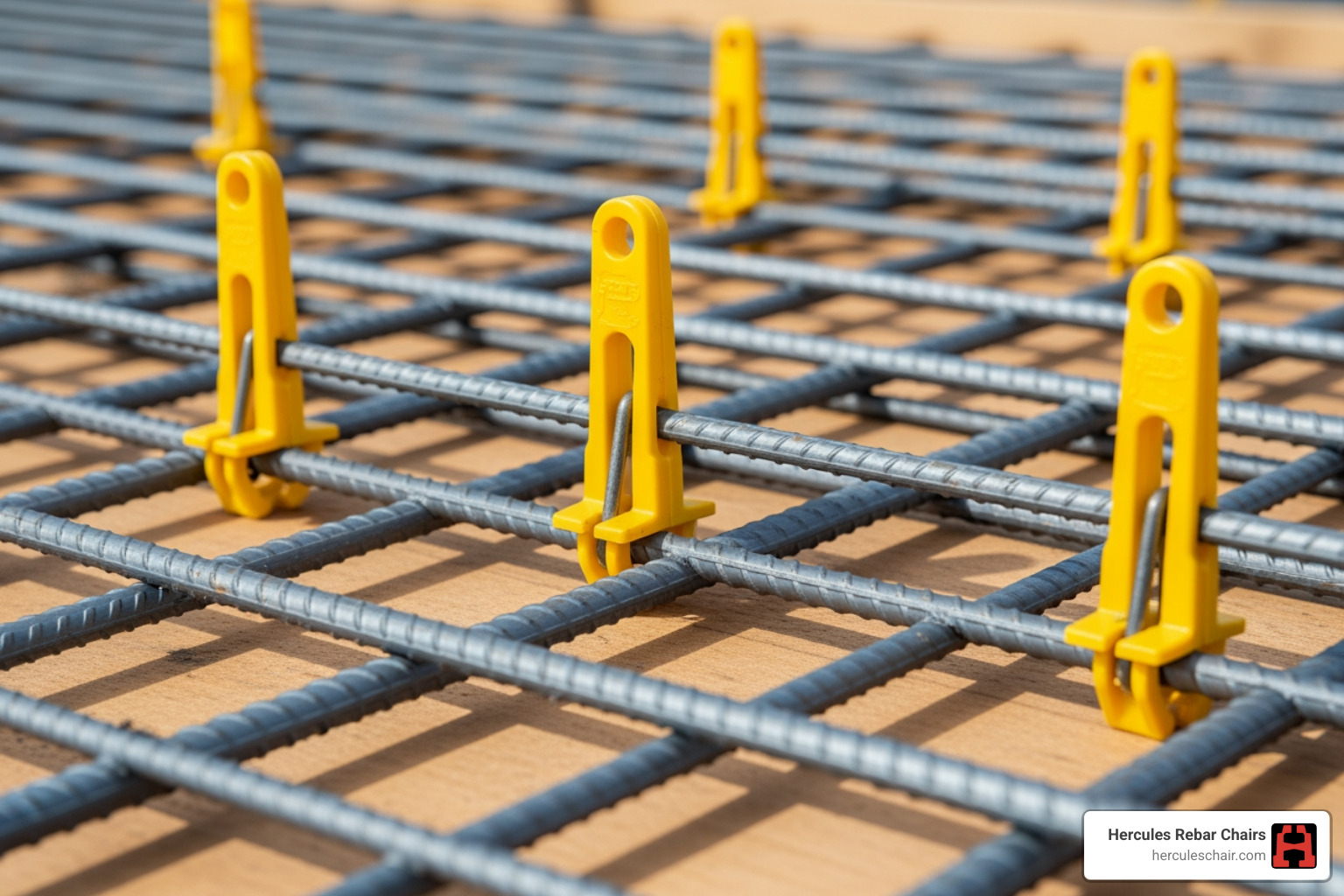
Their primary function is to maintain:
- Correct distance between steel and formwork
- Uniform concrete cover around reinforcement
- Reinforcement rigidity during placement
- Consistent structural performance across the pour
In practical terms, spacers help prevent three expensive problems:
- Corrosion from insufficient cover
- Weak or inconsistent structural behavior from misplaced steel
- Surface defects, rust staining, or poor finish quality
This is why spacers are used across slabs, walls, beams, columns, precast units, pipe, and foundation cages. If the project includes reinforced concrete, some kind of support device is almost certainly involved.
For a broader primer on support options, see our guides to Everything You Need to Know About Concrete Reo Chairs and Keep Your Rebar Up: A Guide to Concrete Support Blocks.
Types and Materials of Rebar Support Devices
Not all spacers do the same job. The right choice depends on where the reinforcement sits, how much load it carries before the pour, what finish is required, and what environmental exposure the concrete will face.
The main categories are:
- Wheel spacers
- Chairs
- Linear or bar spacers
- Point spacers or blocks
- Specialty supports for double mats, vertical cages, or mesh
Here is the quick comparison.
| Type/material | Best use | Key strengths | Possible drawbacks |
|---|---|---|---|
| Plastic wheel spacers | Walls, columns, cages, precast | Fast to clip on, lightweight, rust-free, good 360-degree cover | Higher thermal movement than concrete |
| Plastic chairs | Slabs, mesh, light commercial work | Quick setup, consistent elevation, easy handling | Must be sized and spaced correctly to avoid punch-in or movement |
| Concrete spacers/blocks | Heavy-duty slabs, infrastructure, exposed or durability-focused work | Similar behavior to surrounding concrete, strong compression, fire resistant | Heavier, slower to place, can chip in handling |
| Metal spacers/bolsters | Some slab and precast applications | High load capacity, rigid support | Can rust, may telegraph or stain concrete if poorly detailed |
| Linear/bar spacers | Long runs under mesh or bars | Continuous support, helpful on soft subgrade | Less flexible in complex layouts |
| Wheel spacers | Vertical or circular cover control | Uniform side cover, easy cage attachment | Must fit the bar size and cover requirement precisely |
If you want a deeper tour of support options, our articles From Dobies to Double Mats: A Comprehensive Look at Rebar Chair Types and Sitting Pretty: Everything You Need to Know About Rebar Supports break that down further.
A few project examples help make the categories clearer:
- Wheel spacers are common on vertical rebar in walls, drilled shafts, columns, and cages because they maintain cover around the side of the steel.
- Chairs are common in slabs because they hold mesh or bar mats at a fixed height above the base.
- Linear spacers are useful where long, even support is needed under reinforcement.
- Concrete blocks or dobies are often chosen when durability, fire performance, or material compatibility is a priority.
Plastic Concrete Rebar Spacers
Plastic spacers are popular because they are easy to handle, clip on quickly, and do not rust. Many wheel spacers also include molded teeth or grips that lock onto rebar securely. That makes them especially useful for walls, beams, columns, cast-in-place work, and prefabrication.
They also come in many shapes:
- Wheels for vertical cover
- Snap-on chairs for mesh and slab reinforcement
- Stackable chairs for varying elevations
- Clips and holders for specialty layouts
Their advantages include:
- Lightweight and fast to install
- Resistant to rust and moisture
- Consistent manufactured dimensions
- Useful for both rebar and welded mesh
But plastic has tradeoffs too. One of the most important is thermal movement. Research shows plastic can expand and contract about 10 to 15 times more than concrete. Over time, especially with major temperature swings or accelerated curing, that difference can affect the bond zone around the spacer. In aggressive environments, that may create tiny pathways where moisture or chlorides can move more easily.
That does not mean plastic spacers are “bad.” It means they should be chosen thoughtfully. In many standard slab and wall applications, they perform very well when properly selected and installed. For a closer look, see Spacer Secrets: Unpacking the Role of Plastic Rebar Chairs.
Heavy-Duty Concrete Rebar Spacers
Concrete spacers are often preferred where long-term durability is the top priority. Because they are made from cementitious material, they behave more like the surrounding concrete once embedded.
That matters in three key ways:
- They bond more naturally with the pour
- Their thermal movement is much closer to the concrete around them
- They can improve watertightness and reduce differential movement concerns
Modern concrete spacers are often made from fibre reinforced concrete, which improves crack resistance. The research also highlights some strong performance data for quality concrete spacers:
- Compression strength around 50 N/mm2
- Water penetration less than 3 mm
- Fire resistance to EN13501-1:2002 Class 1A
- Some products exceed BS 7973 requirements
Some concrete spacers include plastic clips for convenience. Where that design is used, the plastic is incorporated only shallowly into the spacer body, with research citing about 5 mm embedment, so the concrete body still does the real structural work.
Concrete spacers are especially useful in:
- Heavy-duty slabs
- Infrastructure and foundation work
- Precast components
- Exposed or corrosive environments
- Projects with high fire-performance requirements
For more slab-focused selection advice, visit our Rebar Slab Support Complete Guide.
Ensuring Proper Concrete Cover and Code Compliance
Concrete cover is the thickness of concrete between the surface of the finished member and the nearest reinforcement. Spacers are what make that thickness happen in the field instead of only on paper.

Why is proper cover so critical?
- It protects steel from moisture, oxygen, and chlorides
- It improves fire resistance by insulating reinforcement
- It helps the steel and concrete act together structurally
- It supports service life and reduces early repairs
Too little cover is the classic problem. Rebar ends up too close to the surface, then corrosion begins, expands, cracks the concrete, and starts the never-fun cycle of patching, sealing, and explaining budgets.
Too much cover is not ideal either. It can reduce effective reinforcement depth and change structural performance, especially in thinner elements.
The research notes common cover ranges from 10 mm to 100 mm, with many practical spacer products covering 20 mm to 100 mm. In the U.S., exact cover requirements depend on project drawings, exposure conditions, and applicable standards. The key takeaway is simple: use the specified cover, not the “looks-about-right” cover.
BS 7973 is often referenced as a benchmark for spacer performance. It focuses on characteristics such as:
- Dimensional accuracy
- Stability under load
- Suitability for the application
- Durability during placement
Research also mentions KOMO-certified spacer products and concrete spacers that exceed BS 7973 performance requirements. Even when your project is governed by U.S. standards rather than BS 7973, those quality benchmarks still help evaluate product reliability.
Our own philosophy is straightforward: support devices should make code compliance easier, not harder. That is one reason contractors choose visible, easy-to-identify supports like our red chairs. If crews can recognize the right product quickly, they are less likely to grab the wrong support from a mixed pallet at 6:15 a.m. before coffee has fully done its job.
For more on why support devices matter in slabs, see Elevate Your Concrete: Why Bar Chairs Are Essential for Strong Slabs.
Installation Best Practices for Construction Projects
Even the best spacer is only as good as its placement. A premium support tossed into the wrong spot is still the wrong support in the wrong spot.
Here are the installation basics we recommend.
1. Match the spacer to the application
Use the shape that fits the geometry:
- Slabs and mesh: chairs, slab supports, or point spacers
- Walls and columns: wheel spacers
- Beams: chairs, side spacers, or beam-specific supports
- Precast and cages: wheels, clips, or rigid concrete spacers
Wheel-style products are frequently used in vertical work, such as walls and columns, to ensure consistent side cover. For drilled shafts and cage applications, specialized heavy-duty spacer wheels are often required to handle the weight and movement of the reinforcement during insertion.
2. Choose the correct cover size
The spacer height or wheel offset must match the required cover on the drawings. Common sizes range from 20 mm to 100 mm, but project specs always win.
Check:
- Required cover depth
- Rebar size
- Form orientation
- Aggregate size and concrete flow
- Exposure condition
3. Use enough spacers
Under-spacing supports is one of the most common mistakes. Reinforcement then sags between support points or gets kicked out of place during traffic and pouring.
Research-based placement guidance includes:
- For clip-on slab spacers, a staggered grid at about 600 to 800 mm centers is common
- Minimum quantity for standard slabs can be about 0.5 spacers per m2
- Heavy-duty or structural slabs may need 0.75 to 1 spacer per m2
- Add more at edges, openings, laps, and congested reinforcement zones
As always, engineering drawings and project specifications override generic spacing rules.
4. Secure them so they stay put
Spacers should not slide, topple, or detach during placement. Best practices include:
- Clip wheels firmly to the bar size they are designed for
- Seat chairs fully on firm substrate or formwork
- Tie reinforcement where required so the cage acts as a unit
- Add extra supports where workers will traffic the mat
- Check alignment again before and during the pour
5. Consider the substrate
On soft subgrade, a narrow-foot spacer can sink. On uneven formwork, a rigid support can rock. Match the base condition to the support footprint. If the subgrade is soft, use supports with more bearing area.
6. Re-check before concrete placement
We like a final walk-through right before the pour. Look for:
- Broken chairs or chipped blocks
- Missing spacers at laps and edges
- Tilted wheel spacers
- Reinforcement touching forms
- Areas where pump hose traffic may displace the steel
Common mistakes to avoid:
- Using the wrong spacer height
- Mixing spacer types without considering load and finish
- Installing too few supports
- Letting workers walk directly on unsupported reinforcement
- Assuming one spacer type works everywhere
- Ignoring exposure conditions in corrosive or high-moisture environments
For more practical slab guidance, read How to Use Concrete Slab Spacers for a Perfect Pour.
Frequently Asked Questions about Rebar Supports
How do I choose the right spacer size?
Start with the specified concrete cover. That is the number that matters most.
Then check:
- Rebar diameter
- Whether the steel is horizontal or vertical
- Load on the spacer before the pour
- Surface finish requirements
- Environmental exposure
- Whether the support is for mesh, single bars, or double mats
For slab mesh, the spacer height generally matches the required bottom cover. For vertical cages, wheel spacer size sets the side cover. The spacer also needs to fit the actual bar size securely. Some wheel spacers, for example, are made for smaller bars only.
If you need a more general support selection overview, our Sitting Pretty: Everything You Need to Know About Rebar Supports guide is a good next step.
Why are concrete spacers better for fire safety?
Concrete spacers can offer an advantage in fire-exposed applications because they are made from a material similar to the surrounding concrete. Research cited concrete spacers with fire resistance rated to EN13501-1:2002 Class 1A.
That means they:
- Do not soften like plastic can under extreme heat
- Maintain material compatibility with the host concrete
- Help preserve cover integrity in severe temperature conditions
This does not automatically make concrete spacers the right answer for every project, but in high fire-performance environments, they are often worth serious consideration. Our From Dobies to Double Mats: A Comprehensive Look at Rebar Chair Types article explains where each support type fits best.
What are the risks of using the wrong spacer?
Using the wrong spacer can cause much bigger problems than most people expect.
Potential risks include:
- Inadequate cover and early corrosion
- Differential movement between spacer and concrete
- Rust staining if inappropriate metal supports are placed in the cover zone
- Rebar displacement during the pour
- Bleeding or segregation issues in poorly supported deep sections
- Reduced structural performance from misplaced reinforcement
- Costly repairs, rejected inspections, or both
One underappreciated issue is long-term durability. If a spacer does not bond well or moves very differently from the concrete around it, that small mismatch can become a weak point over time. This is one reason spacer material selection matters as much as spacer shape.
For more on the consequences of poor support selection, see Rebar Slab Support Complete Guide.
Conclusion
Concrete rebar spacers may be small, but they do an outsized job. They hold steel in the right place, maintain concrete cover, reduce corrosion risk, support code compliance, and help reinforced concrete perform the way it was designed to perform.
The right spacer depends on:
- The type of element
- Required cover
- Rebar layout
- Load during placement
- Exposure and durability demands
- Fire and finish requirements
At Hercules Rebar Chairs, we build support solutions to make that job easier in the field. As America’s #1, with 14 million units sold, we focus on strong, easy-to-identify supports that save time, help crews stay compliant, and keep reinforcement where it belongs.
If you are ready to choose supports that work as hard as your crew does, explore our Buy Rebar Chairs and Concrete Supports page.
And if there is one final lesson to remember, it is this: concrete is strong, steel is strong, but only if the steel stays where it is supposed to be. That little spacer under the bar? It is doing more heavy lifting than it gets credit for.