

Why Concrete Slab Spacers Are Critical to a Strong, Lasting Pour
Concrete slab spacers are small but essential devices that hold rebar or mesh at the correct height inside a concrete form before and during a pour. Here’s the quick answer to how they work:
How to use concrete slab spacers:
- Prepare and level your subgrade or formwork
- Select the spacer height that matches your required concrete cover (typically 3/4 in. to 2 in.)
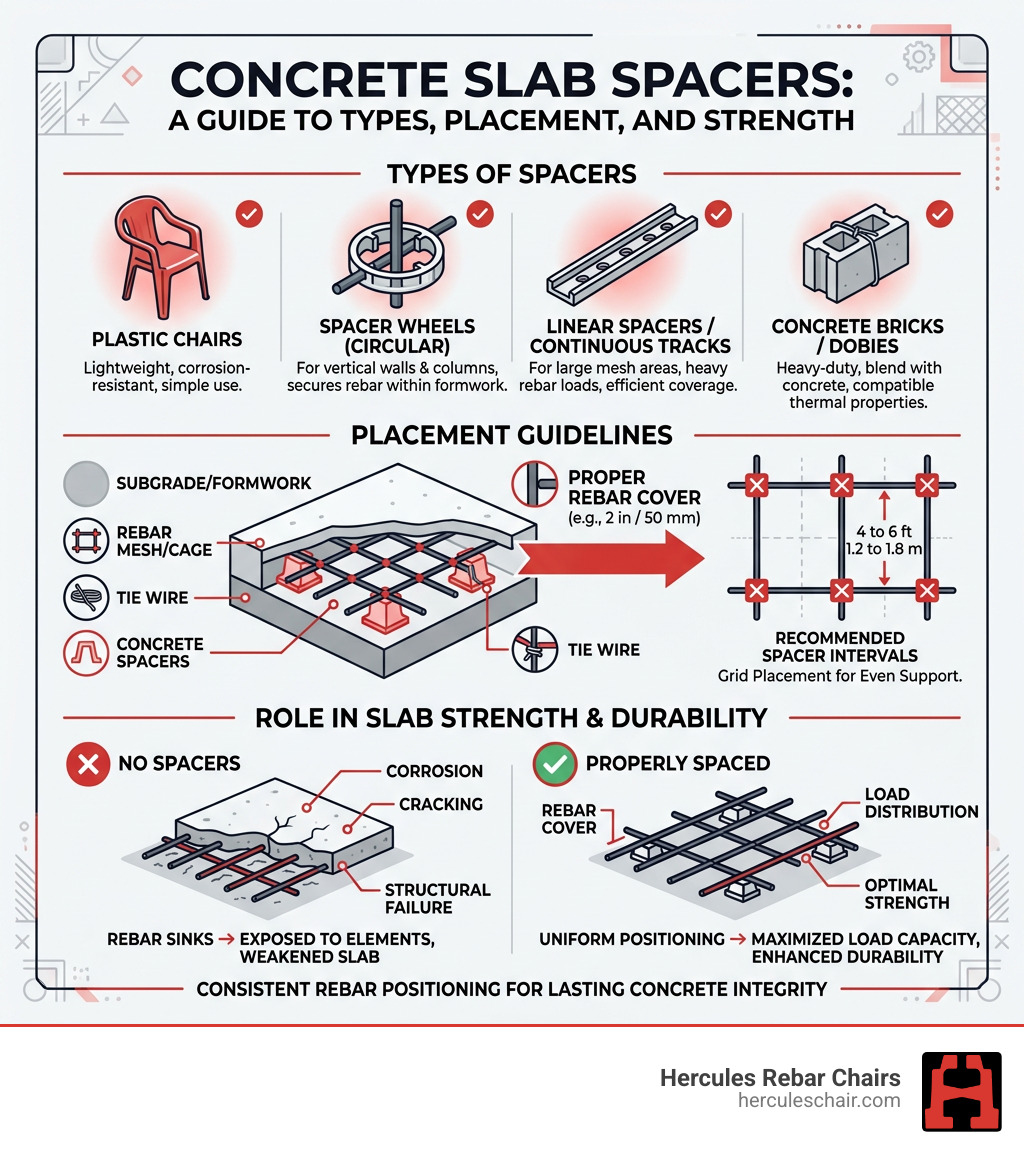
- Place spacers at regular intervals across the form (usually every 4 to 6 feet)
- Set rebar or mesh on top of the spacers
- Tie rebar as needed, then pour concrete
Without spacers, rebar sinks to the bottom of the slab. That means no protective concrete cover, which leads to corrosion, cracking, and structural failure — often within years, not decades.
The stakes are real. A slab poured without proper rebar positioning can fail under load, crack prematurely, or corrode from the inside out — problems that are expensive and sometimes impossible to fix after the fact.
I’m Jordan Harris, a licensed Professional Engineer with a master’s in structural engineering and hands-on experience designing large-scale concrete projects. At Hercules Rebar Chairs, I work every day on concrete slab spacer solutions that help contractors get it right the first time, on every pour.
Understanding the Different Types of Concrete Slab Spacers
When you step onto a job site, you’ll notice that not all concrete slab spacers look the same. Some look like little plastic towers, while others look like wheels or long serrated tracks. Choosing the right one isn’t just about what’s in the back of the truck; it’s about matching the tool to the specific demands of your slab.
Rebar Chairs (The Workhorse)
The most common type of concrete slab spacers are rebar chairs. These are individual “stools” designed to cradle a single piece of rebar or a section of wire mesh. These are often bright red and built to withstand the weight of a crew walking over the reinforcement grid. To understand the nuances of these tools, you can dive into spacer-secrets-unpacking-the-role-of-plastic-rebar-chairs.
Spacer Wheels
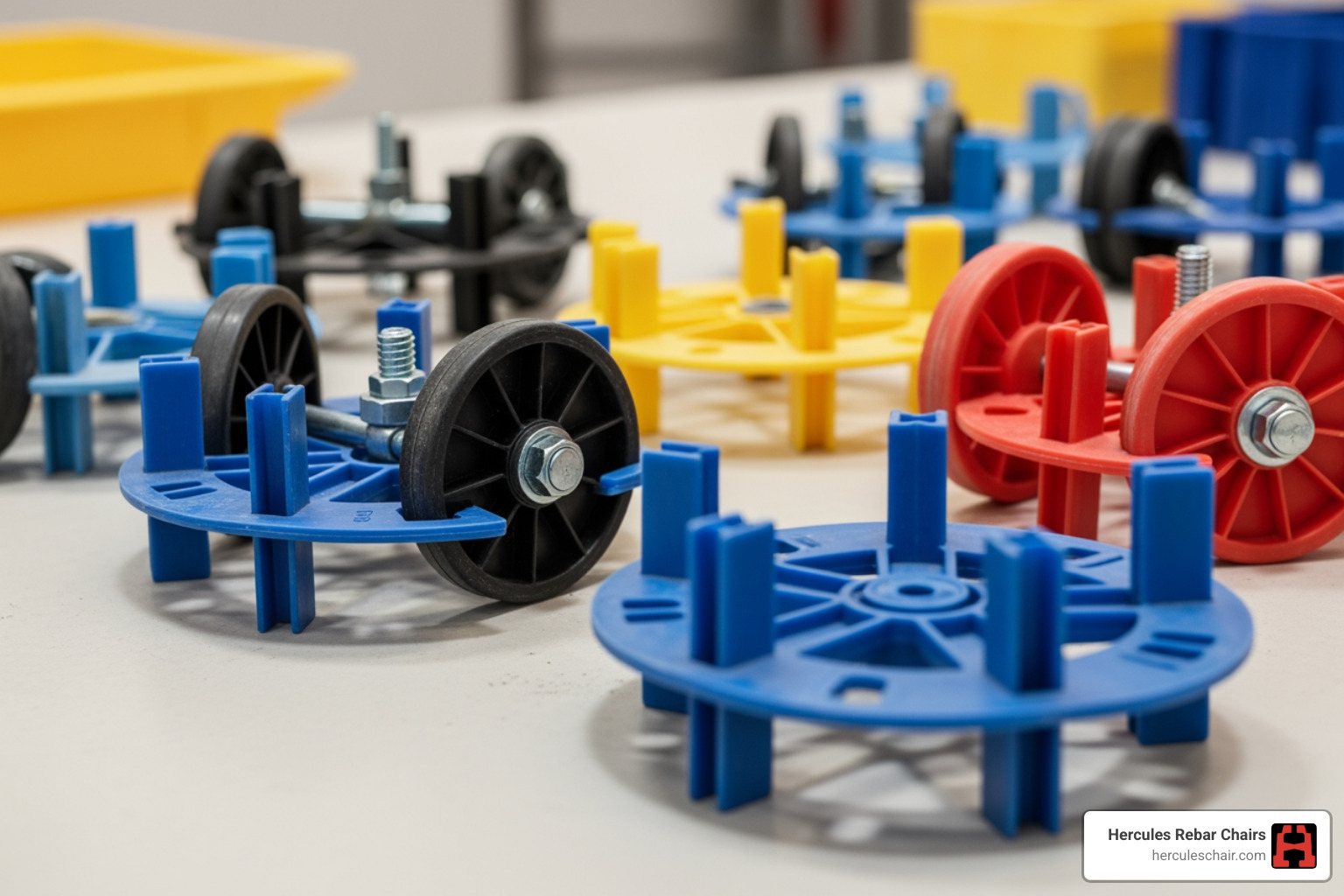
If you are working on vertical applications like walls or columns—or even certain precast elements—spacer wheels are your best friend. These clip onto the rebar and roll against the formwork, ensuring the steel stays perfectly centered. They often feature “teeth” to grip the bar tightly so they don’t slide down during the vibration of the pour.
Concrete Bolsters
For heavy-duty industrial slabs or projects where you have long runs of heavy rebar, bolsters provide continuous support. Instead of supporting a single point, a bolster supports a line. You can learn more about these heavy-lifters in our guide on what-are-concrete-bolster-chairs-and-why-do-you-need-them.
To help you decide between the different materials available, check out this comparison:
| Feature | Plastic Spacers (Polymer) | Concrete Spacers (Dobies) |
|---|---|---|
| Weight | Lightweight & easy to carry | Heavy & bulky |
| Bonding | Mechanical grip | Chemical & material bond |
| Corrosion | Non-corrosive | Non-corrosive |
| Installation | Fast (often clip-on) | Slower (requires tying) |
| Cost | Very cost-effective | More expensive |
For a deeper dive into the specific varieties, take a comprehensive look at rebar chair types.
Selecting Rebar Concrete Slab Spacers for Reinforcement
The primary job of a Rebar spacer is to maintain “concrete cover.” This is the distance between the edge of the steel and the exterior surface of the concrete. If the cover is too thin, moisture and oxygen reach the steel, causing it to rust. As steel rusts, it expands, which literally blows the concrete apart from the inside.
Recent Scientific research on cement-based spacers highlights that the material of the spacer must be compatible with the pour. While cement-based spacers bond seamlessly, high-quality plastic chairs—like the ones we manufacture—are designed with a “minimal footprint.” This means the concrete flows around them so completely that there is no path for water to seep in.
You want a spacer with high load-bearing capacity. You don’t want your “chairs” collapsing the moment a 200-pound finisher steps on the rebar grid. High-quality spacers elevate your concrete by ensuring that the reinforcement stays exactly where the engineer intended it to be.
How to Choose the Right Rebar Spacer Size and Material
Choosing a spacer is a bit like the “Goldilocks” story—you don’t want it too tall, or the rebar will poke out the top of the slab; you don’t want it too short, or the rebar will sit in the dirt. You need it just right.
Finding the “Goldilocks” Zone
The height of your concrete slab spacers depends entirely on the thickness of your slab and the “cover” requirement specified in your blueprints. For a standard 4-inch residential driveway, you usually want the rebar in the middle or slightly above. This typically means using a 1.5-inch or 2-inch chair. For more help on this, check out the-goldilocks-guide-to-concrete-bar-chair-sizes-not-too-big-not-too-small.
If you’re unsure how to calculate this, we’ve simplified the process into 3 easy steps. Common sizes include:
- 1/2 inch to 3/4 inch: Ideal for thin toppings or specific precast panels.
- 1 inch to 1.5 inches: The standard for most sidewalks and light patios.
- 2 inches and up: Used for heavy foundations, commercial slabs, and structural footings.
Material Science: Plastic vs. Fibre-Reinforced
In the past, people used rocks or broken bricks. Please, for the love of your foundation, don’t do that! Rocks move, and bricks absorb water.
Modern concrete slab spacers are typically made from ABS plastic or fibre-reinforced concrete. Scientific research on fibre-reinforced concrete shows that these materials handle the stresses of industrial construction far better than traditional wood wedges or makeshift supports.
Our chairs are made from heavy-duty, UV-resistant plastic. This means they won’t get brittle if they sit out on the job site in the Alabama or Arizona sun for a week before the pour. They offer high compressive strength, meaning they won’t flatten under the weight of #4 or #5 rebar.
Step-by-Step Installation Guide for Concrete Rebar Spacers
Proper installation is the difference between a slab that lasts 50 years and one that settles and cracks in five. Here is how we recommend doing it.
1. Subgrade Preparation
Before the spacers even come out of the bag, your subgrade must be compacted and level. If the dirt is soft, the spacers will simply sink into the ground under the weight of the concrete. In cases of very soft soil or sand, you might need “sand plates” or spacers with a wide base to distribute the load.
2. Determine Spacing Intervals
How many concrete slab spacers do you need? A common mistake is using too few. If the rebar “swags” or bows between the chairs, it isn’t being supported correctly.
- For light rebar (#3), place a chair every 2 to 3 feet.
- For heavier rebar (#4 or #5), you can often go 4 feet between chairs.
- For wire mesh, you need them closer together—usually every 2 feet—because mesh is flexible and prone to being pushed down.
For more details on layout, refer to the-ultimate-guide-to-rebar-chairs-types-uses-and-sizing-for-concrete-slabs.
3. Placing and Securing
Snap the rebar into the cradle of the chair. Most of our chairs feature a “snap-in” design that holds the bar tight. If you are using “dobies” (concrete blocks), you will need to use tie wire to secure the bar to the block. For a comprehensive look at these blocks, see our guide to concrete support blocks.
Installing Rebar Concrete Slab Spacers in New Pours
When the cement truck arrives, things move fast. This is when your choice of concrete slab spacers is truly tested.
In a “slab-on-ground” pour, the wet concrete is heavy and exerts significant downward force. If your spacers are poorly placed, they can tip over. This is why we design our chairs with a wide, stable base. Whether you are pouring a foundation for a new home in Texas or a precast element in a factory setting, structural stability is non-negotiable.
During the pour:
- Watch your feet: Try not to step directly on the rebar where there isn’t a chair nearby.
- Monitor the chairs: Have one crew member keep an eye on the grid to ensure no chairs have shifted or tipped as the concrete is spread.
- Vibrate carefully: If using a mechanical vibrator, avoid hitting the chairs directly, which can dislodge them.
Frequently Asked Questions about Rebar Slab Spacers
We get a lot of questions from DIYers and pros alike about how these little tools perform in the real world.
Can I use plastic spacers for heavy-duty foundations?
Absolutely. In fact, in many cases, they are preferred. While people worry about the “load capacity,” our heavy-duty plastic chairs are engineered to support hundreds of pounds each.
One common concern is the “thermal expansion” difference between plastic and concrete. While it’s true that plastic expands more than concrete, the volume of a single spacer is so small that it has a negligible effect on the slab. Furthermore, high-quality plastic spacers are designed to allow concrete to bond tightly around them, maintaining code compliance and ensuring a watertight seal. This is a technique often used in the Design and Construction of Segmental Concrete Bridges.
Do I need different spacers for different weather?
Concrete behaves differently in the freezing winters of Alaska than it does in the humid summers of Florida. However, your spacers should be consistent. You want a material that is resistant to rot, UV rays, and chemical corrosion. Plastic is excellent for this because, unlike wood or metal scraps, it will never decay or rust inside your slab.
Can I just “pull up” the mesh during the pour instead of using spacers?
This is a common “old school” trick called “hooking.” The finisher tries to pull the wire mesh up into the wet concrete with a hook. Don’t do this. Research shows this is almost never effective; the mesh just sinks back down the moment you step away. Using concrete slab spacers is the only way to guarantee the mesh stays in the top third of the slab where it belongs.
Conclusion
At the end of the day, a concrete pour is an expensive investment. Whether you are a contractor in California or a homeowner in Ohio, you want that slab to last a lifetime. Using concrete slab spacers is the simplest and most cost-effective insurance policy you can buy for your concrete.
At Hercules Rebar Chairs, we take pride in being America’s #1 choice for reinforcement supports. With over 14 million units sold, we’ve helped thousands of builders ensure code compliance and structural longevity. Our signature red chairs are easy to spot and even easier to use, saving you time and money on every project.
Ready to start your next project with the right support? Check out Our Products to find the perfect fit for your next pour. We manufacture right here in the USA, supporting jobs and infrastructure from coast to coast. Let’s build something that lasts—together.