

Why Getting Garage Slab Thickness Right Can Save You Thousands
Garage slab thickness is one of the most important decisions you’ll make before a single yard of concrete is poured. Get it right and you have a floor that lasts decades. Get it wrong and you’re looking at cracking, settlement, and costly repairs.
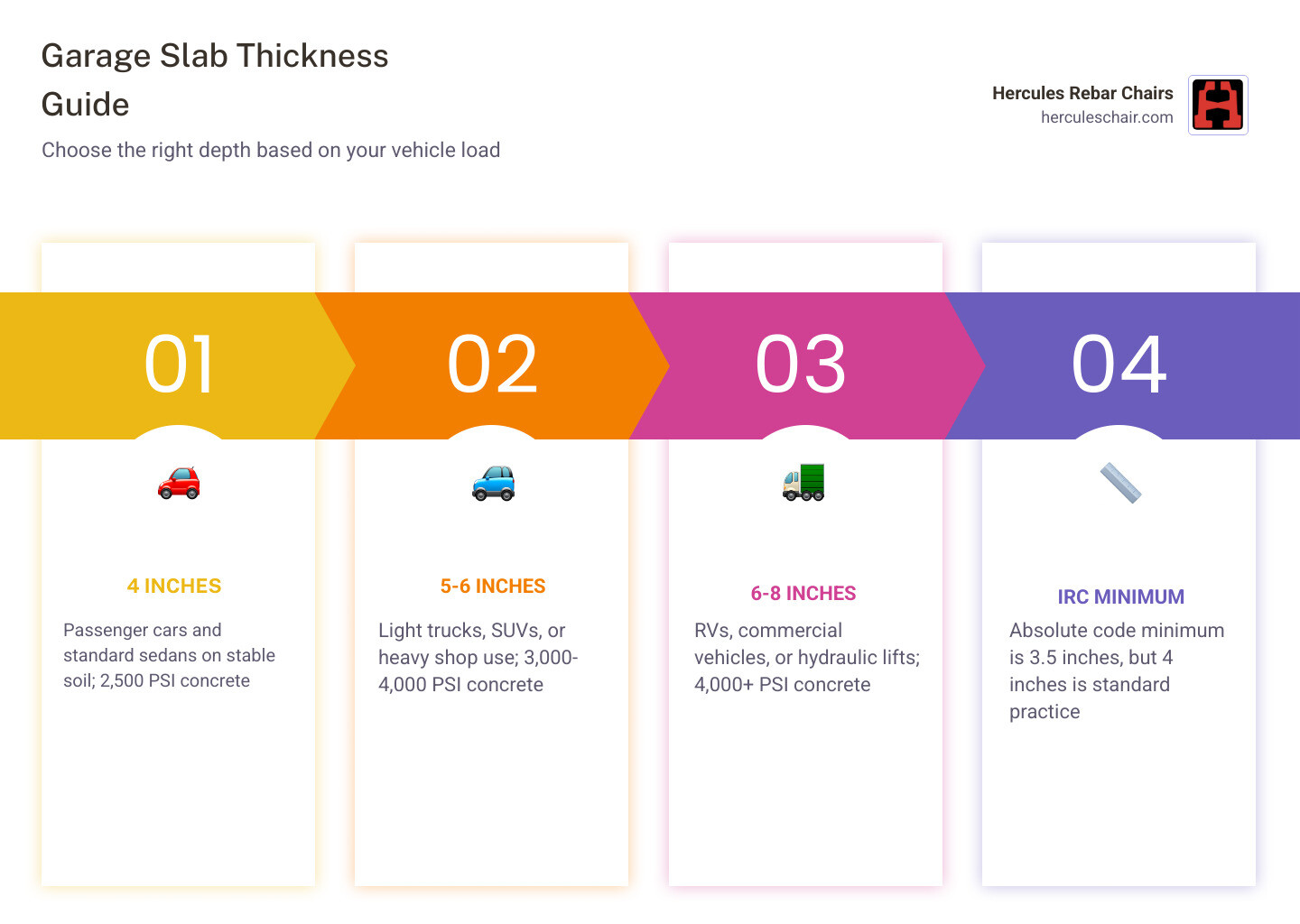
Quick answer — recommended garage slab thickness by use:
| Use Case | Minimum Thickness | Concrete Strength |
|---|---|---|
| Passenger cars (standard residential) | 4 inches | 2,500 PSI |
| Light trucks, SUVs, heavy shop use | 5-6 inches | 3,000-4,000 PSI |
| RVs, commercial vehicles, lifts | 6-8 inches | 4,000+ PSI |
Note: IRC 2024 Section R506.1 sets the absolute minimum at 3.5 inches, but most contractors pour to 4 inches to account for subgrade variation.
Search interest in this topic has surged 35% in the past year — and it’s easy to see why. Contractors report that 25% of their 2026 service calls involve slabs poured thinner than 4 inches. Those thin slabs crack, heave, and fail prematurely, turning a one-time savings into a five-figure repair bill.
The stakes are real. A properly specified slab doesn’t just hold your car — it has to handle concentrated tire loads, chemical exposure, freeze-thaw cycles, and decades of daily use without flinching.
I’m Jordan Harris, a licensed Professional Engineer with a background in structural and concrete design, and as part of my work at T.J. Harris Company, I’ve spent years thinking about what makes concrete slabs — including garage slab thickness — perform reliably in the field. In the sections ahead, I’ll walk you through exactly how to spec your slab correctly the first time.
Garage slab thickness terms you need:
Standard Garage Slab Thickness and Building Code Requirements
When we talk about building a garage, we aren’t just making a “suggestion” on how deep the concrete should go. We have rules to follow. The International Residential Code (IRC) and the American Concrete Institute (ACI) provide the framework that keeps our structures standing and our floors from turning into a jigsaw puzzle of cracks.
According to the IRC 2024 Slab-on-Grade Requirements, the absolute minimum thickness for a residential slab-on-grade is 3.5 inches. However, if you ask any veteran contractor in 2026, they’ll tell you that 4 inches is the industry standard. Why the discrepancy? It’s all about the margin of error. If you aim for exactly 3.5 inches and your subgrade is off by just half an inch, you’ve suddenly got a 3-inch slab that’s destined for failure.
In fact, 85% of U.S. residential garages are built using a 4-inch specification. This provides enough depth to support standard vehicles while allowing for minor variations in the ground below. For those looking at more robust construction, many homeowners opt for monolithic pours, where the slab and the perimeter footings are poured at the same time, creating a single, continuous unit of strength.
Why 4 Inches is the Residential Garage Slab Thickness Benchmark
For the vast majority of homeowners, a 4-inch slab is the “Goldilocks” zone—just right for cost and performance. If you’re parking a Honda Civic or a Ford Fusion, a 4-inch slab poured with 2,500 PSI concrete is more than sufficient.
At this thickness, the concrete is perfectly capable of handling the static load of a 4,000-pound car. Interestingly, a standard car only exerts about 0.5% to 1% of the concrete’s total compressive strength. So why do we worry? It’s not the weight of the car sitting still; it’s the movement, the potential for soil to shift, and the concentrated pressure of the tires.
On stable, well-compacted soil, a 4-inch slab is highly cost-effective. You might even find that your 4-inch slab might not need rebar if the ground is exceptionally firm, though we almost always recommend some form of reinforcement to prevent the inevitable shrinkage cracks from widening.
When to Increase Garage Slab Thickness to 6 Inches
While 4 inches is the standard, it isn’t the ceiling. There are several scenarios where we strongly advise bumping that garage slab thickness up to 6 inches:
- Heavy Vehicles: If you drive a heavy-duty pickup truck (like an F-350) or own an RV, you are dealing with significantly higher axle loads. The Portland Cement Association found in a 2025 study that 4-inch slabs subjected to regular loads exceeding 5,000 pounds per axle had 28% higher crack rates.
- Vehicle Lifts: Planning on installing a two-post or four-post lift? You’ll need the extra “meat” in the concrete to anchor those posts. Most lift manufacturers require a minimum of 4 to 6 inches of reinforced concrete to ensure the bolts don’t pull out under the stress of a suspended vehicle.
- Future-Proofing: If you’re building your “forever” shop, 6 inches gives you the freedom to change your mind later. You can move in a heavy CNC machine, a welding table, or a large tractor without worrying about “punching through” the floor.
When moving to a 6-inch slab, we also recommend stepping up the concrete strength to 4,000 PSI. This combination ensures your floor is Slab-Tastic and ready for anything you throw at it. For more specialized needs, you can even reference Parking Garage Slab Thickness by Load Class to see how commercial standards compare to your home project.
Critical Factors Influencing Slab Durability and Performance
Thickness is only one part of the equation. You could pour a foot of concrete, but if you pour it on top of a swamp, it’s still going to sink.
| Feature | 4-Inch Slab | 6-Inch Slab |
|---|---|---|
| Typical Lifespan | 20-30 Years | 40-50+ Years |
| Max Axle Load | < 5,000 lbs | 10,000+ lbs |
| Best Use | Standard Cars | Trucks, RVs, Shop Tools |
| Crack Resistance | Moderate | High |
In cold climates, the stakes are even higher. American Concrete Institute (ACI) data from 2025 shows that inadequate concrete depth causes 40% more failures in regions with heavy freeze-thaw cycles. When the ground freezes and expands (heaving), a thin slab simply doesn’t have the structural “backbone” to resist snapping.
Beyond climate, soil type is a major player. Expansive soils—like the heavy clays found in parts of Texas or the Midwest—expand when wet and shrink when dry. This constant movement is a slab’s worst enemy. To combat this, proper subgrade preparation is non-negotiable. We recommend a minimum 4-inch layer of clean, granular fill (gravel) compacted to at least 95% Proctor density. This creates a stable “table” for your concrete to sit on.

Another critical component is the vapor barrier. IRC 2024 requires a minimum 6-mil polyethylene vapor retarder under all residential slabs. This prevents moisture from the ground from seeping up through the porous concrete, which can cause “dusting,” delamination of floor coatings, and that musty “old garage” smell.
To ensure your slab remains Slab Strong, you must address these environmental factors before the truck arrives.
Reinforcement Options for Every Garage Slab Thickness
Concrete is incredibly strong when you push on it (compression), but it’s surprisingly weak when you try to pull it apart (tension). That’s where reinforcement comes in.
- Wire Mesh: Often used in 4-inch slabs, welded wire mesh helps hold the concrete together after a crack forms. It’s the “budget” option, but it can be tricky to keep at the correct height during the pour.
- Fiber Reinforcement: Tiny synthetic or steel fibers are mixed directly into the concrete. This provides “three-dimensional” reinforcement and is excellent for reducing plastic shrinkage cracks.
- Rebar (#3 or #4): For 6-inch slabs or any floor expecting heavy loads, steel rebar is the gold standard. A typical grid of #3 rebar on 24-inch centers significantly increases the slab’s structural integrity.
The secret to effective reinforcement isn’t just having the steel—it’s where the steel sits. Reinforcement placed at the bottom of the slab does almost nothing to prevent surface cracks. It needs to be in the “middle third” of the slab depth. This is where Rebar Slab Support becomes vital.
Using tools like concrete mesh chairs or slab bolster chairs ensures your steel stays exactly where the engineers intended, rather than being stepped on and pushed to the dirt during the pour.
Cost Analysis and Long-Term Value of Thicker Concrete
“How much is this going to cost me?” It’s the question every homeowner asks. While prices vary by region, we can look at some 2026 benchmarks to get an idea of the investment.
In Phoenix, AZ, for example, a standard 4-inch slab typically runs about $4.50 per square foot. If you’re looking at a standard 24×24 two-car garage (576 sq ft), the base cost for a 4-inch slab is roughly $2,600.
But what about the upgrade?
- For a 30×40 shop, upgrading from 4 inches to 6 inches usually adds about $1,100 to $1,500 to the total bill.
- On a larger 1,800 sq ft project, the upcharge for those extra two inches is approximately $2,500.
When you consider that a 6-inch slab lasts 50% longer under heavy use compared to a 4-inch slab (according to 2025 National Ready Mixed Concrete Association research), the ROI is clear. You are paying a small fraction more upfront to potentially double the lifespan of your floor.
Repairing a failed slab is significantly more expensive than pouring it right the first time. Minor crack repairs can cost $500 to $1,500, while major structural failures or a complete replacement can easily reach $8,000 to $15,000. Using a Concrete Garage Floor Calculator can help you estimate your specific material needs, and learning how to calculate rebar for slab the right way will ensure you don’t over-order (or under-order) your steel.
Frequently Asked Questions about Garage Slabs
Is 4 inches of concrete enough for a garage floor?
Yes, for 85% of residential applications, 4 inches is perfectly adequate. If you are parking standard passenger cars and SUVs on stable soil, and you include proper reinforcement and a compacted base, a 4-inch slab will serve you well for decades. However, if you plan on using heavy machinery, car lifts, or parking an RV, you should consider 6 inches.
What happens if a garage slab is poured too thin?
A slab poured thinner than the 3.5-inch code minimum is a recipe for disaster. You will likely see “alligator cracking” (small interconnected cracks), settlement where the car tires sit, and potentially even structural failure where the concrete chunks begin to lift or shift. Furthermore, a thin slab is much more susceptible to frost heave in cold climates, with failure rates 40% higher than properly thickened slabs.
Do I need rebar in a 4-inch garage slab?
While not always strictly required by code for every residential garage, we highly recommend it. At the very least, wire mesh or fiber reinforcement should be used. Steel rebar is the best way to ensure that when the concrete inevitably shrinks and tries to crack, those cracks stay tight and don’t create trip hazards or allow moisture to penetrate to the subgrade.
Conclusion
At the end of the day, your garage floor is the foundation of your hobbies, your storage, and your vehicle’s safety. Choosing the right garage slab thickness is the first step, but ensuring that slab is built to code is the second.
At Hercules Rebar Chairs (T.J. Harris Co.), we believe that every slab deserves a solid foundation. We are proud to be America’s #1 choice for concrete supports, with over 14 million units sold. Our iconic red chairs are designed to save you time and money while ensuring your rebar stays exactly where it needs to be for full code compliance.
Don’t let your hard work go to waste by letting your reinforcement sink into the mud. Whether you’re a DIYer learning how to master garage slab rebar placement or a pro looking for the best rebar chairs in Texas, we have the tools to help you succeed.
Ready to build a slab that lasts? Check out our Complete Rebar Placement Guide and make sure your next project stands the test of time.