

Why Garage Slab Rebar Placement Determines Your Project’s Success
Garage slab rebar is the steel reinforcement grid placed within concrete to handle tensile forces, control crack width, and preserve structural integrity under vehicle loads. Whether you’re pouring a residential garage floor or preparing for a vehicle lift installation, understanding proper rebar placement is the difference between a slab that lasts decades and one that cracks within months.
Quick Answer: What You Need to Know About Garage Slab Rebar
- Primary Function: Rebar handles tension and holds cracked concrete together—it doesn’t prevent cracks, but controls their width and prevents vertical offset
- Recommended Size: #4 rebar at 12-18″ on center for standard garage slabs; #4 at 12″ o.c. for lift installations
- Minimum Thickness: 6 inches for vehicle lifts, 4 inches for standard residential use (though 6″ is preferred)
- Critical Placement: Position rebar in the middle third of the slab using chairs—never let it rest on the base
- Cost: Steel rebar is inexpensive (~$5 per 20-foot stick), making proper reinforcement affordable insurance
The research is clear: over 90% of wire mesh ends up lying at the bottom of slabs during tearouts, rendering it completely ineffective. Meanwhile, properly supported rebar continues working even after cracks appear, holding the slab together and preventing structural failure. The key isn’t whether to use rebar—it’s understanding how to position it correctly.
Your sub-base preparation matters just as much as the steel itself. Poor compaction leads to settlement cracks that no amount of reinforcement can fix. The concrete mix quality, curing process, and strategic placement of control joints all work together with your rebar grid to create a durable, crack-resistant garage floor.
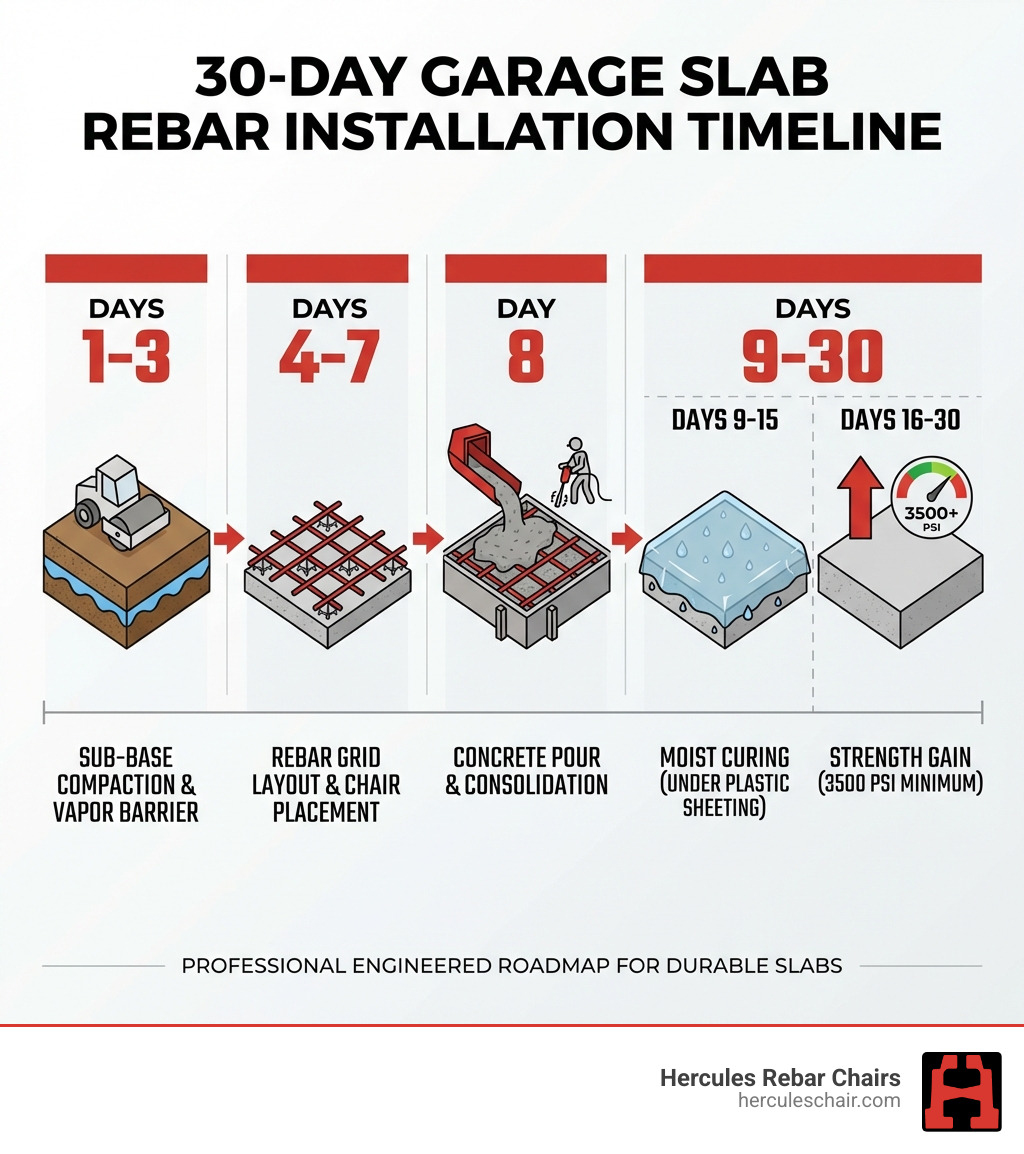
I’m Jordan Harris, a licensed Professional Engineer with five years of structural engineering experience on large-scale concrete projects, and I currently work with T.J. Harris Company developing rebar support systems—including designing solutions for proper garage slab rebar placement that contractors trust on job sites nationwide. This guide condenses decades of engineering principles and real-world concrete experience into a practical 30-day roadmap you can follow on your next project.
Comparing Reinforcement: Steel Rebar, Wire Mesh, and Fiber
When we talk about garage slab rebar, we are looking at the “skeleton” of your floor. However, steel bars aren’t the only way to reinforce concrete. Choosing the right material depends on your budget, the intended load, and how much you hate looking at cracks.
| Feature | Steel Rebar | Welded Wire Fabric (WWF) | Fiber Additives | Fiberglass (GFRP) Rebar |
|---|---|---|---|---|
| Primary Strength | High Tensile/Structural | Shrinkage/Temperature | Micro-crack Control | High Tensile/Corrosion |
| Ease of Placement | Moderate (Needs Chairs) | Difficult (Often Sinks) | Very Easy (In Mix) | Easy (Lightweight) |
| Cost | Low-Moderate | Low | Very Low | Moderate-High |
| Structural Integrity | Excellent | Fair | Poor | Excellent |
There is a long-standing Expert debate on rebar vs. mesh in the construction world. Many old-school contractors swear by wire mesh because it’s cheap and fast. But here is the dirty secret: in nearly 90% of slab tearouts, that wire mesh is found lying flat on the dirt. If it’s not in the middle of the concrete, it’s doing exactly nothing.
Fiber additives are great for controlling those tiny “spiderweb” shrinkage cracks that happen in the first 48 hours, but they don’t provide structural integrity once a real crack occurs. For a garage that needs to hold a 4,000-pound SUV (or a 10,000-pound truck), garage slab rebar is the gold standard because it handles the bending forces that concrete simply can’t. If you do choose mesh for a lighter project, check out our More info about mesh chairs to make sure it actually stays where it belongs.
Cost-Benefit Analysis of Garage Slab Rebar Options
We often get asked if rebar is “overkill” for a residential garage. Think of it this way: #4 rebar (1/2 inch thick) costs about $5 for a 20-foot stick. For a standard 24×28 garage, you might spend $300 to $500 on steel. Compared to the thousands of dollars you’re spending on concrete and labor, that’s incredibly cheap insurance.
In the long run, unreinforced 4-inch slabs over 10 feet in any direction will crack. Without rebar to hold those cracks tight, they will widen, allow moisture to seep into the sub-base, and eventually cause the slab to shift or “fault” (where one side becomes higher than the other).
To maximize your investment, you need to Learn how to determine bar chair sizes correctly. Using the wrong chair height means your rebar is too high (showing through the surface) or too low (rotting in the dirt). Our Hercules chairs save you labor costs because they snap into place quickly, ensuring you don’t spend all day fiddling with loose wires.
The Role of Fiberglass vs. Traditional Steel
Fiberglass (GFRP) rebar is the “new kid on the block,” and it’s making waves for a few reasons. First, it doesn’t rust. If you live in a state like Michigan or Minnesota where road salt is a fact of life, corrosion resistance is a huge deal. Traditional steel can rust if moisture reaches it, expanding and causing the concrete to “spall” or flake off.
Fiberglass is also incredibly light—about one-fourth the weight of steel. A #3 fiberglass bar actually has the tensile strength of a #4 steel bar, meaning you can get more strength with a thinner, lighter product. However, it can’t be bent in the field; you have to order pre-bent corners. For most DIYers and pros, our Guide to rebar placement applies to both materials, but steel remains the most common choice due to its availability and lower initial price point.
The Foundation of Success: Sub-base Prep and Vapor Barriers
Before a single piece of garage slab rebar is laid, we have to talk about the dirt. You can put enough steel in a slab to build a bridge, but if the ground underneath it moves, the slab will crack.
Soil Compaction and the “Sheepsfoot” Secret
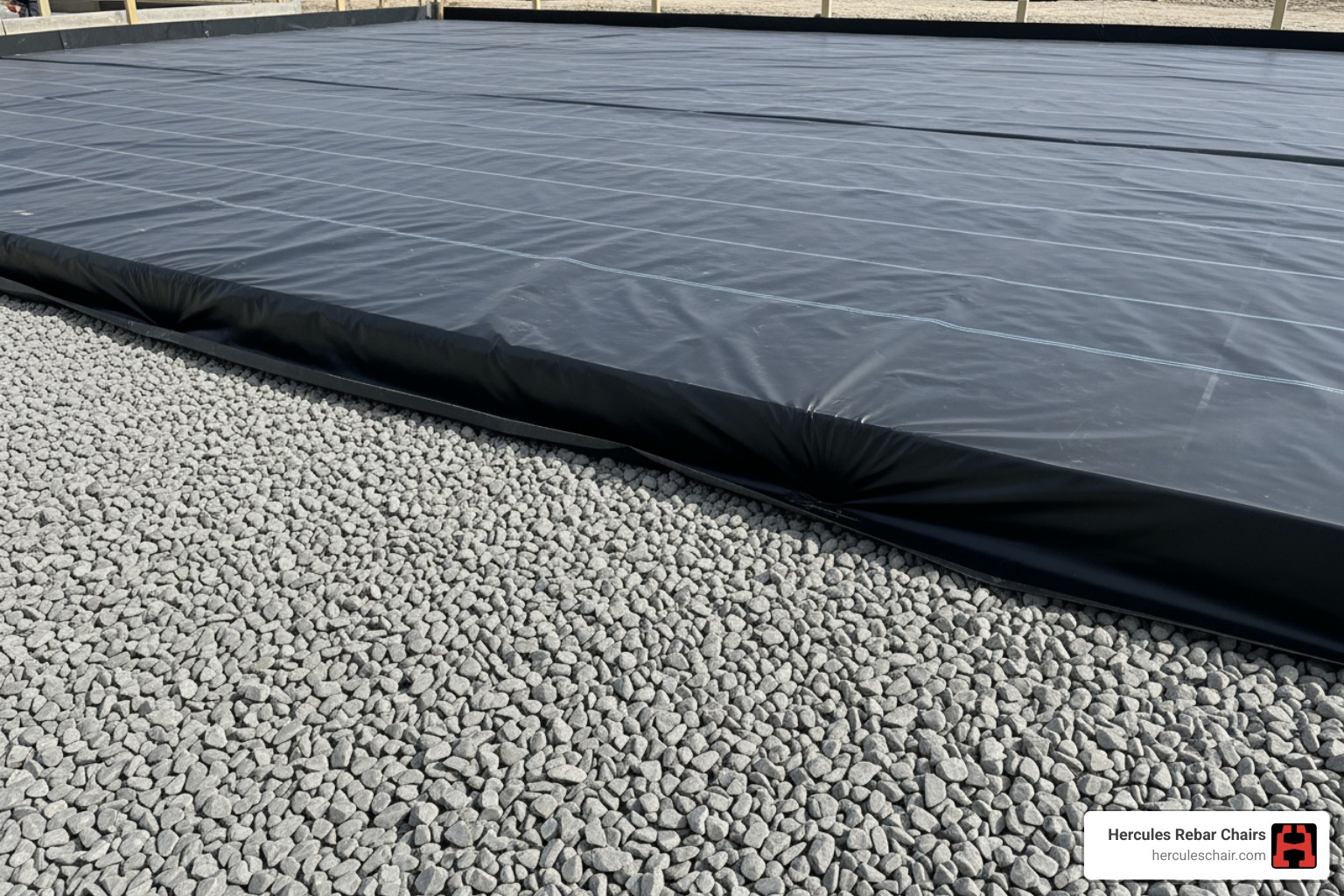
We recommend removing all topsoil and replacing it with at least 4 inches of compactible gravel or crushed stone. Use a vibrating plate compactor or, for larger projects, a sheepsfoot roller. A quick field test: squeeze a handful of the base material. It should hold its shape without dripping water. If the base is spongy, your slab is doomed before you even start.
The Vapor Barrier: More Than Just Plastic
A vapor barrier is a heavy-duty plastic sheet (usually 10-mil or 15-mil) laid over the gravel. Many people think it’s optional for unheated garages, but we disagree. Without it, moisture from the ground wicks up through the concrete, bringing salts with it. This creates that white, “fuzzy” powder called efflorescence and can eventually cause your garage slab rebar to corrode.
It also acts as a “slip sheet,” allowing the concrete to shrink and move slightly during the curing process without getting snagged on the rough gravel. This reduces internal tension and keeps your floor smoother. To keep everything stable, Expert tips for a stronger slab suggest overlapping your vapor barrier seams by at least 6 inches and taping them shut. And remember, you’ll need to Why support blocks are essential to keep your rebar from puncturing that expensive plastic.
Engineering for Heavy Loads: Garage Slab Rebar for Vehicle Lifts
Are you planning to install a 2-post or 4-post lift? This is where standard residential codes aren’t enough. Most lift manufacturers require a minimum of 6 inches of concrete thickness, often with a 3,000 to 4,000 PSI rating.
For these high-load areas, we recommend #4 garage slab rebar spaced at 12 inches on center (o.c.) in a grid pattern. This creates a much stronger “mat” that prevents the lift’s heavy base plates from “punching through” the slab.
Lift Installation Requirements:
- Slab Thickness: 6 inches minimum (Standard 4-inch slabs are too thin for most 2-post lifts).
- Rebar Spacing: #4 bars at 12″ o.c. in the area where the lift will be bolted.
- Anchor Embedment: You need enough depth for wedge anchors to “bite” into the concrete. Wedge anchors work by putting the surrounding concrete under compression.
- Reinforcement Placement: Keep rebar at least 2 inches away from where you plan to drill your anchor holes to avoid hitting the steel with your masonry bit.
Even if you aren’t installing a lift today, it’s worth adding extra steel now. It’s much cheaper than trying to thicken a slab later. If you’re wondering When a 4-inch slab needs rebar, the answer is “almost always” if you want to avoid structural settlement.
Proper Spacing and Depth for Garage Slab Rebar
The most common mistake we see is rebar being pushed to the bottom of the slab by the weight of the workers during the pour. Rebar only works if it is “wrapped” by the concrete.
- The Middle-Third Rule: For a 6-inch slab, your rebar should be sitting 2 to 3 inches from the bottom. This places it in the “tension zone” where it can do the most work.
- Edge Cover: Keep the steel at least 2 to 3 inches away from the edges of the slab to prevent moisture from reaching the ends of the bars and causing rust.
- Grid Spacing: For a standard garage, an 18-inch grid is typical. For heavy trucks or lifts, tighten that to a 12-inch grid.
Mastering rebar placement for lasting concrete requires using dedicated supports. Don’t use “dobies” (concrete blocks) or random rocks; they don’t bond well with the new concrete and can create weak spots. Our Hercules chairs are designed to be “invisible” once the concrete is cured, ensuring a perfectly uniform slab.
Best Practices for Installation and Curing
The 30-day master plan isn’t just about the steel—it’s about how the concrete matures. Concrete doesn’t “dry”; it cures through a chemical reaction called hydration.
The Pour Day
On the day of the pour, make sure your concrete mix is right. We recommend a 3500 PSI minimum mix with 5-7% air entrainment (especially in freeze-thaw states like Ohio or Pennsylvania). Ask the driver for a “low slump” mix (around 4 inches). If the concrete is too watery, it will be easy to spread but will shrink excessively and crack.
Using superplasticizers is a great way to make the concrete flow easily without adding extra water. While the workers are pouring, they should be walking between the rebar grid, not on it. This is why The importance of bar chairs for strong slabs is so critical—they keep the steel at the right height even if someone accidentally steps on a bar.
The Curing Process
- Day 1: Saw-cut your control joints. These should be cut to a depth of 25% of the slab (1.5 inches for a 6-inch slab). This tells the concrete exactly where to crack so it stays in a straight, hidden line.
- Days 2-7: Keep it wet! Cover the slab with plastic sheeting or spray it with water several times a day. This slows down the evaporation and allows the concrete to reach its full strength.
- Days 8-28: The slab will continue to harden. Avoid parking heavy vehicles on it until at least day 14, and wait the full 28-30 days before installing a vehicle lift or applying an epoxy coating.
Frequently Asked Questions about Garage Slab Rebar
Does rebar prevent concrete from cracking?
No. Let’s be honest: all concrete cracks. We like to say there are two types of concrete: concrete that is cracked and concrete that hasn’t cracked yet. Garage slab rebar is there to handle the tension once the crack happens. It keeps the two sides of the crack from pulling apart or shifting vertically. Without rebar, a small crack becomes a trip hazard; with rebar, it stays a tight, hairline fracture.
Is a vapor barrier always necessary for a garage?
In our professional opinion, yes. Even in a “dry” climate, moisture moves through the soil. A vapor barrier prevents “fuzz” (efflorescence), keeps your tools from rusting in a damp environment, and is absolutely necessary if you ever plan to paint or epoxy the floor. Adhesives will not stick to a slab that is constantly exhaling moisture from the ground.
How do I choose the right chair size for my slab?
Follow the “Goldilocks” rule. If your chair is too tall, the rebar will be too close to the surface and cause “ghosting” or rust spots. If it’s too short, the rebar is essentially sitting in the dirt. For a 4-inch slab, a 2-inch chair is perfect. For a 6-inch slab, we recommend a 3-inch chair. Check out The Goldilocks guide to bar chair sizes for a detailed breakdown by slab thickness.
Conclusion
Mastering garage slab rebar placement is about more than just laying down some steel. It’s about the synergy between a well-compacted base, a high-quality vapor barrier, and the proper elevation of your reinforcement. By following this 30-day roadmap, you ensure that your garage floor isn’t just a place to park—it’s a structural asset built to last a lifetime.
At Hercules Rebar Chairs, we take pride in being America’s #1 choice for concrete supports. With over 14 million units sold across the USA, from the heat of Arizona to the freezes of Maine, our red chairs are the industry standard for ensuring code compliance and saving time on the job site. Don’t leave your reinforcement to chance. Explore our full product line today and see why pros choose Hercules.
Ready to start your project? Master your project with our Rebar Placement Guide and get the job done right the first time!