

Choose Plastic Concrete Spacers That Hold Cover Through the Pour
Plastic concrete spacers hold rebar or wire mesh at the specified height so wet concrete can fully surround the steel. They are a fast, non-corrosive choice for many slabs, especially where light weight and quick placement matter. For higher-load, fire-critical, corrosive, or high-movement work, compare them with concrete spacers that use plastic clips: the concrete body better matches the surrounding pour while the clip keeps reinforcement in place.
The right spacer is not just about getting steel off the ground. It protects the required concrete cover, which can range from 10 mm to 100 mm depending on the design. Consistent cover helps limit moisture reach, reduce corrosion risk, and keep reinforcement where the engineer intended.
Plastic options are easy to handle and install, but plastic expands and contracts far more than concrete – roughly 10 to 15 times as much. That difference can matter where temperatures, curing conditions, water exposure, or structural demands are severe.
I am Jordan Harris, a Tennessee PE with civil and structural engineering experience on large concrete and steel projects, and I now help develop dependable jobsite support products at T.J. Harris Company. In this roundup, I will help you compare plastic concrete spacers with hybrid and concrete alternatives so you can select support that fits your next pour.
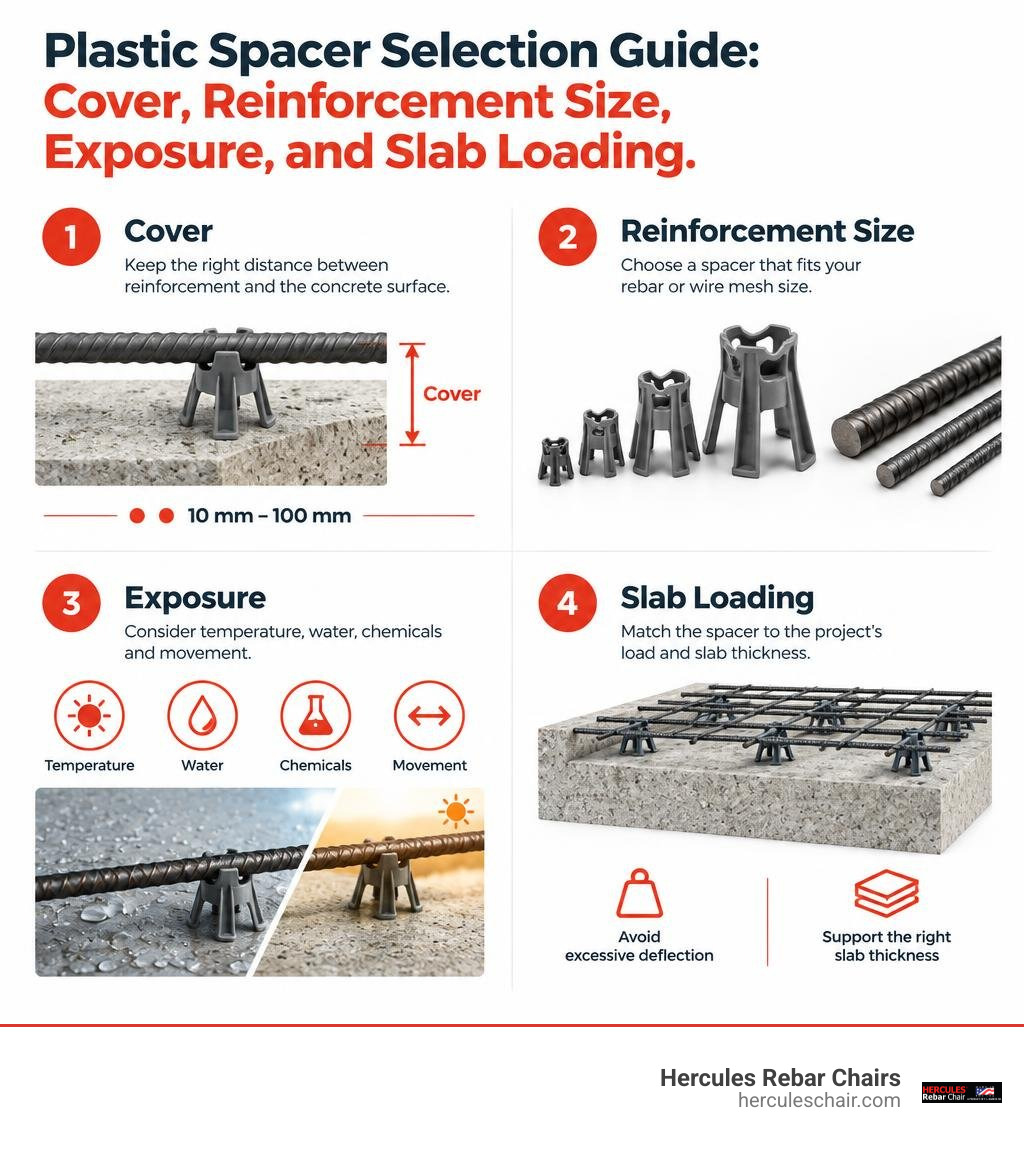
Know your plastic concrete spacers terms:
Rebar Spacers and Their Structural Function

When pouring reinforced concrete, steel reinforcement must remain completely suspended within the matrix to function properly. If rebar sags onto formwork or sinks into subgrade dirt, it exposes structural steel to external elements. This triggers premature oxidation, surface spalling, and compromised load capacities. Rebar spacers maintain specified concrete cover depth across the slab or vertical wall.
Reinforcement supports fall into two primary mechanical categories:
- Point Spacers: Individual chairs, wheels, and clip-on blocks designed to support single intersection points or individual bars. These minimize surface contact against the formwork.
- Linear Spacers: Continuous tracks, H-section profiles, or dimensional composite strips that run along formwork to support entire mesh grids or heavy cages continuously.
Maintaining uniform cover depth protects rebar from moisture, carbonation, and chemical attack. For specialized industrial work like utility duct installations, purpose-built components such as HDPE duct bank spacers maintain strict alignment under demanding utility specs. For a deeper understanding of spacer geometries, consult the ultimate guide to rebar chairs and spacers to see how formwork contact impacts finish quality.
Comparing All-Plastic and Hybrid Plastic Concrete Spacers
Choosing the right spacer requires balancing speed, load requirements, and thermal expansion properties.
| Feature / Metric | All-Plastic Spacers | Concrete Spacers with Plastic Clips | Solid Concrete Blocks / Chairs |
|---|---|---|---|
| Material Base | 100% Polypropylene or Non-PVC Plastic | Fiber-Reinforced Concrete Core + Poly Clip | 100% High-Strength Concrete |
| Bonding Performance | Mechanical aggregate interlock only; no chemical bond | 100% homogeneous monolithic concrete bond | Full chemical and physical concrete bonding |
| Thermal Expansion | 10× to 15× higher than concrete | Identical to poured concrete mix | Identical to poured concrete mix |
| Fire Resistance | Lower; potential melt path at extreme temperatures | High; protective concrete core insulates reinforcement | Maximum structural fire resistance |
| Installation Speed | Rapid snap-on placement | Rapid clip-in; eliminates manual tie wire | Slower; requires manual tie-wire fastening |
| Common Uses | Light commercial, precast panels, domestic flatwork | Heavy structural slabs, bridge decks, water tanks | Civil foundations, marine structures, deep footings |
To explore standard concrete blocks, review our practical guide to concrete chairs for rebar to match mix designs to site requirements.
Advantages of Pure Plastic Concrete Spacers
Pure plastic spacers excel when installation speed, lightweight handling, and zero corrosion risk are top priorities. Carrying heavy bags of concrete chairs across wide formwork tables creates unnecessary fatigue. In contrast, thousands of plastic chairs can be hauled across a jobsite with minimal effort. This makes product handling and transport straightforward.
Plastic elements are completely inert to rust. If a spacer touches the outer face of an architectural precast panel, it will never cause rust staining. Selecting high-grade non-PVC plastics improves environmental safety while resisting cracking during cold-weather pours. Contractors looking to speed up deck preparations can elevate your concrete game with the best plastic rebar chairs for sale, keeping labor costs low on large-format floor projects.
Concrete Spacers with Integrated Plastic Clips
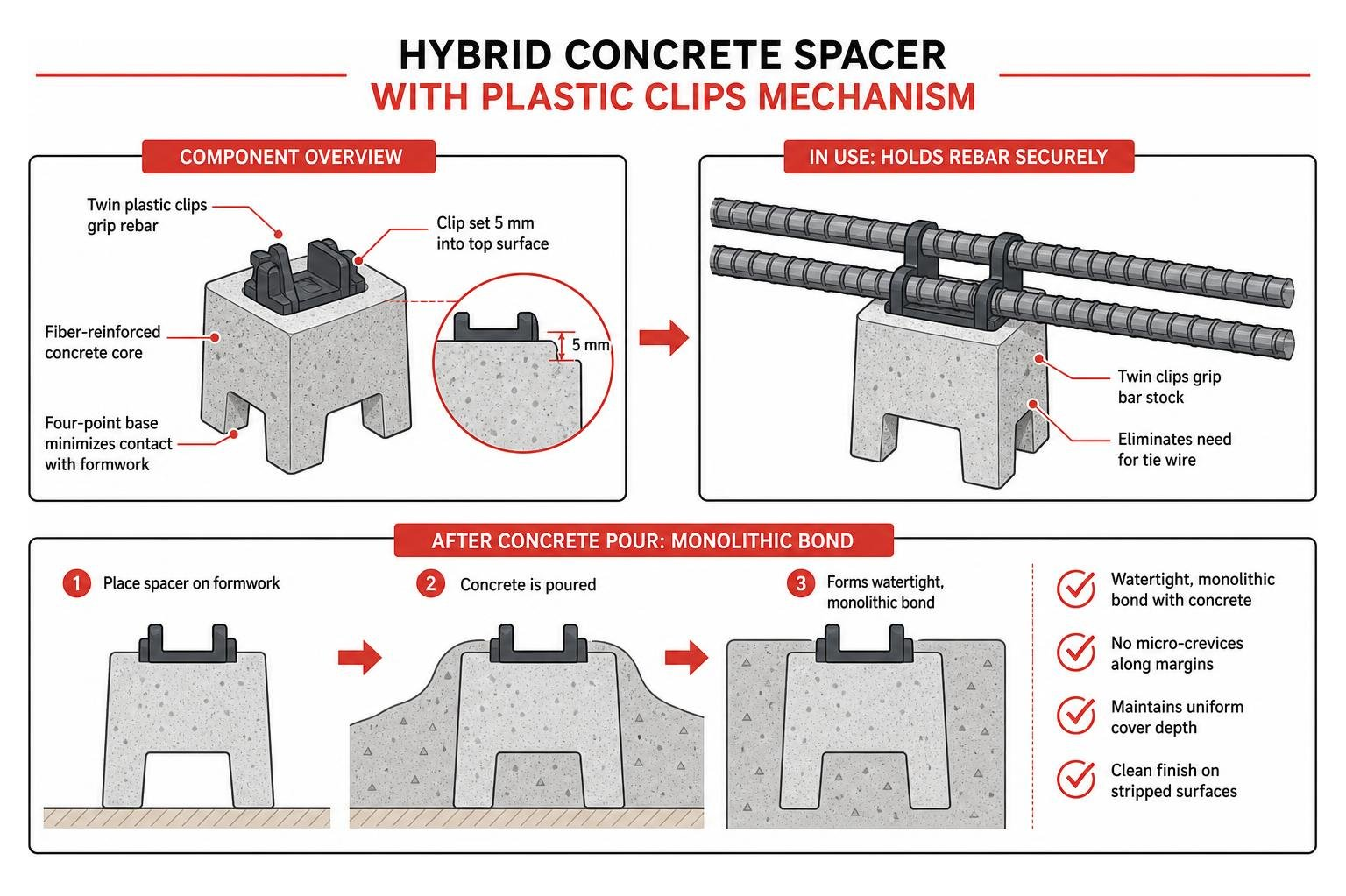
Hybrid spacers combine the structural strengths of concrete with the snap-on speed of polymer chairs. These supports feature a heavy-duty, fiber-reinforced concrete body topped with an integrated plastic clip mechanism. The clip is set into the top surface of the block at a depth of merely 5 mm.
This shallow clip depth ensures that almost the entire volume of the spacer is solid concrete. When the pour occurs, the wet concrete forms a watertight, monolithic bond with the spacer body. This eliminates micro-crevices along structural margins.
The top twin clips grip bar stock directly, eliminating the need to tie steel with wire. The four-point base design minimizes contact points with formwork, maintaining clean lines on stripped surfaces. For more on how clipped systems simplify slab assembly, check our analysis on spacer secrets unpacking the role of plastic rebar chairs.
Key Specifications for Plastic Concrete Spacers
Selecting the right support depends on bar sizes, mesh styles, and target cover:
- Cover Dimensions: Standard single-cover and multi-cover plastic chairs provide cover heights ranging from 10 mm to 50 mm, with heavy civil chairs reaching up to 100 mm.
- Mesh & Rebar Grip Capacity: Standard pure plastic mesh clips accommodate mesh spacings of 21 mm and 38 mm, seating cover depths from 10 mm to 25 mm. Hybrid concrete spacers with plastic clips support heavier structural rebars and wire mesh ranging from 8 mm to 16 mm in diameter.
- Standard Hybrid Cover Heights: Hybrid clip units come in six standardized metric cover increments: 20 mm, 25 mm, 30 mm, 35 mm, 40 mm, and 50 mm.
- Packaging Volumes: Standard pack sizes range from 215 to 600 units per bag or carton, depending on spacer height.
How to Calculate Spacer Quantities and Grid Layouts
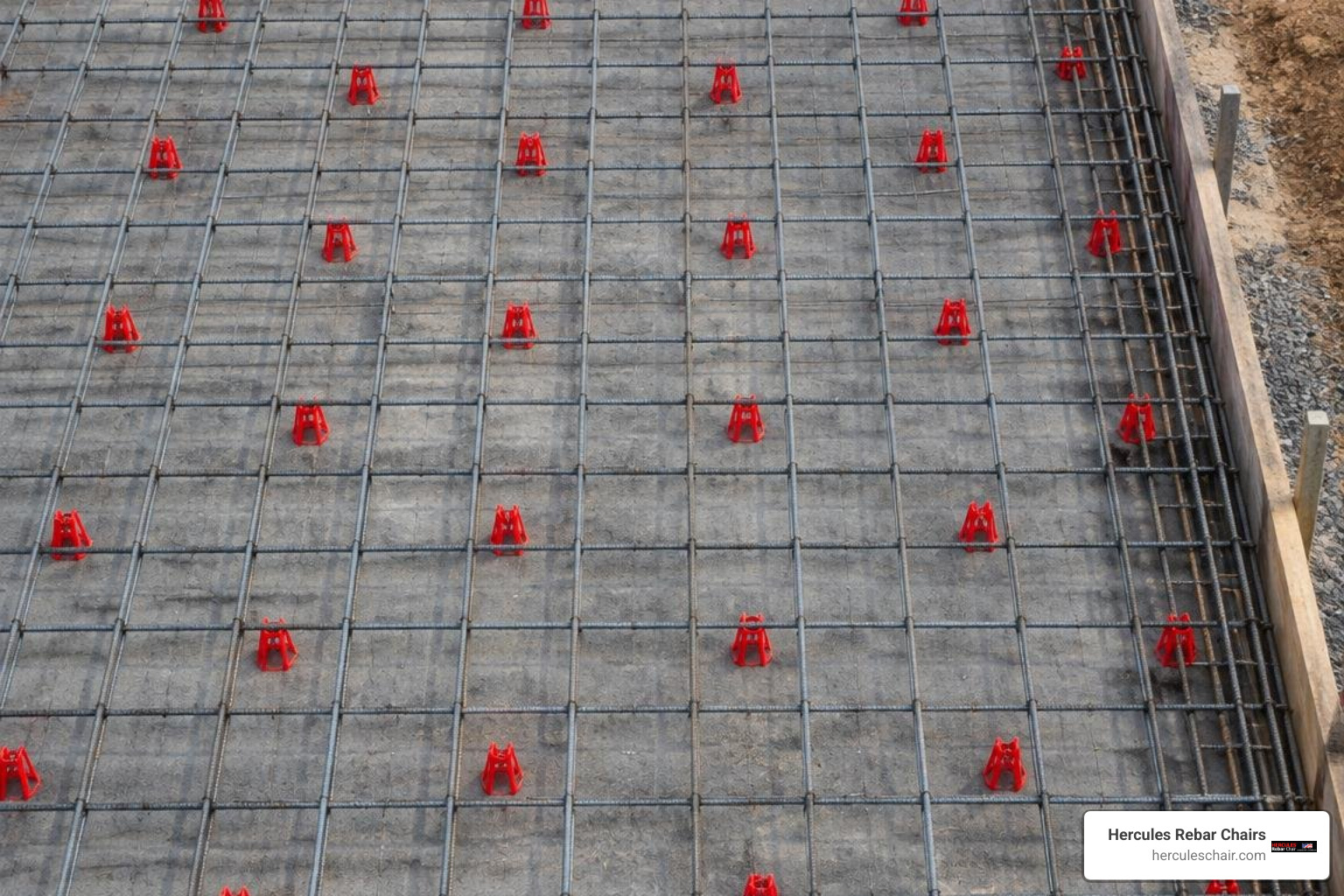
Correct spacing ensures steel reinforcement will not deflect under the weight of wet concrete, pump hoses, or working crew foot traffic.
Follow this framework to calculate total spacer counts for your pour:
- Calculate Slab Area: Determine the total surface area in square meters ($m^2$).
- Apply Layout Density: Multiply the area by the slab’s load factor (0.5 for light commercial; 0.75–1.0 for structural).
- Account for Reinforcement Laps and Edges: Add 10% to 15% extra units to support sheet overlaps, slab perimeters, and internal penetrations.
- Confirm Grid Pitch: Arrange spacers in a staggered diamond grid spaced 600 mm to 800 mm apart on center.
For step-by-step layout walk-throughs, read how to use concrete slab spacers for a perfect pour to avoid grid sagging during pump operations.
Installation Best Practices and Quality Standards
Consistent placement prevents rebar displacement and ensures code compliance:
- Follow Rigid Placement Centers: Set spacers along a staggered grid at 600 mm to 800 mm centers to distribute reinforcement weight evenly.
- Support Overlaps and Splices: Place extra chairs directly under mesh laps and bar splices where reinforcement weight doubles.
- Reinforce Edges and Openings: Place supports 100 mm to 150 mm away from slab edges, form borders, blockouts, and sleeve penetrations.
- Ensure Clean Formwork Contact: Check that point feet or hybrid bases rest flat on stable vapor barriers or oiled formwork without punching through.
- Verify Code Compliance: Ensure your chosen supports meet regional build criteria, such as BS7973 standards for reinforcement spacing and KOMO quality certifications.
To balance plastic supports with steel-wire options on large sites, see how to support your slab with these top rated plastic and steel chairs or browse our concrete rebar spacers complete guide. Sourcing chairs across North American operations is also simple with reliable regional vendors, as seen when you compare Arkansas plastic spacers suppliers.
Frequently Asked Questions About Rebar Spacers
How many spacers are needed per square meter or mesh sheet?
For standard light commercial flatwork, plan for a minimum of 0.5 spacers per square meter, or 4 to 6 spacers for every 3.6 m × 2.0 m mesh sheet. For heavy structural decks, increase density to 0.75 to 1.0 spacer per square meter (6 to 8 spacers per 3.6 m × 2.0 m sheet) to maintain steel elevation under active load.
How do plastic spacers perform in corrosive or seismic environments?
Pure plastic spacers will not rust, making them useful in surface exposures prone to moisture. However, in aggressive chemical or marine environments, high-performance hybrid concrete spacers are preferred. Their concrete body bonds with the pour, preventing corrosive chemicals from tracking along plastic seams. In seismic zones subject to dynamic shifting, fiber-reinforced hybrid blocks prevent rebar slippage during movement.
Why does the thermal expansion rate of plastic matter in concrete?
Plastic has a thermal expansion coefficient 10 to 15 times higher than that of concrete. In settings with wide temperature swings, large plastic components expand and contract much faster than the surrounding concrete. This can form micro-fractures and tiny gaps along spacer edges, allowing moisture and chlorides to reach the internal steel. Using low-profile plastic chairs or concrete spacers with 5 mm shallow clips avoids these thermal pathways.
Conclusion
Selecting the right spacer protects cover depth, prevents corrosion, and speeds up slab preparation. Whether you need fast snap-on pure polymer chairs or hybrid concrete blocks with integrated clips, matching your support hardware to the pour ensures long-term structural durability.
At Hercules Rebar Chairs (a division of T.J. Harris Co.), we build high-strength rebar chairs trusted on jobsites nationwide. Known across the United States for our signature red supports and over 14 million units sold, we help contractors save labor hours while meeting code requirements. Ready to secure your reinforcement layout? Buy rebar chairs built for dependable performance on every pour.