

Why Footing Rebar Placement Determines Whether Your Foundation Lasts or Fails
Footing rebar placement is the process of positioning steel reinforcing bars inside a concrete footing trench at the correct depth, spacing, and orientation before the concrete is poured. Done right, it gives your foundation the tensile strength concrete can’t provide on its own.
Here’s a quick overview of the key requirements:
| Factor | Standard Requirement |
|---|---|
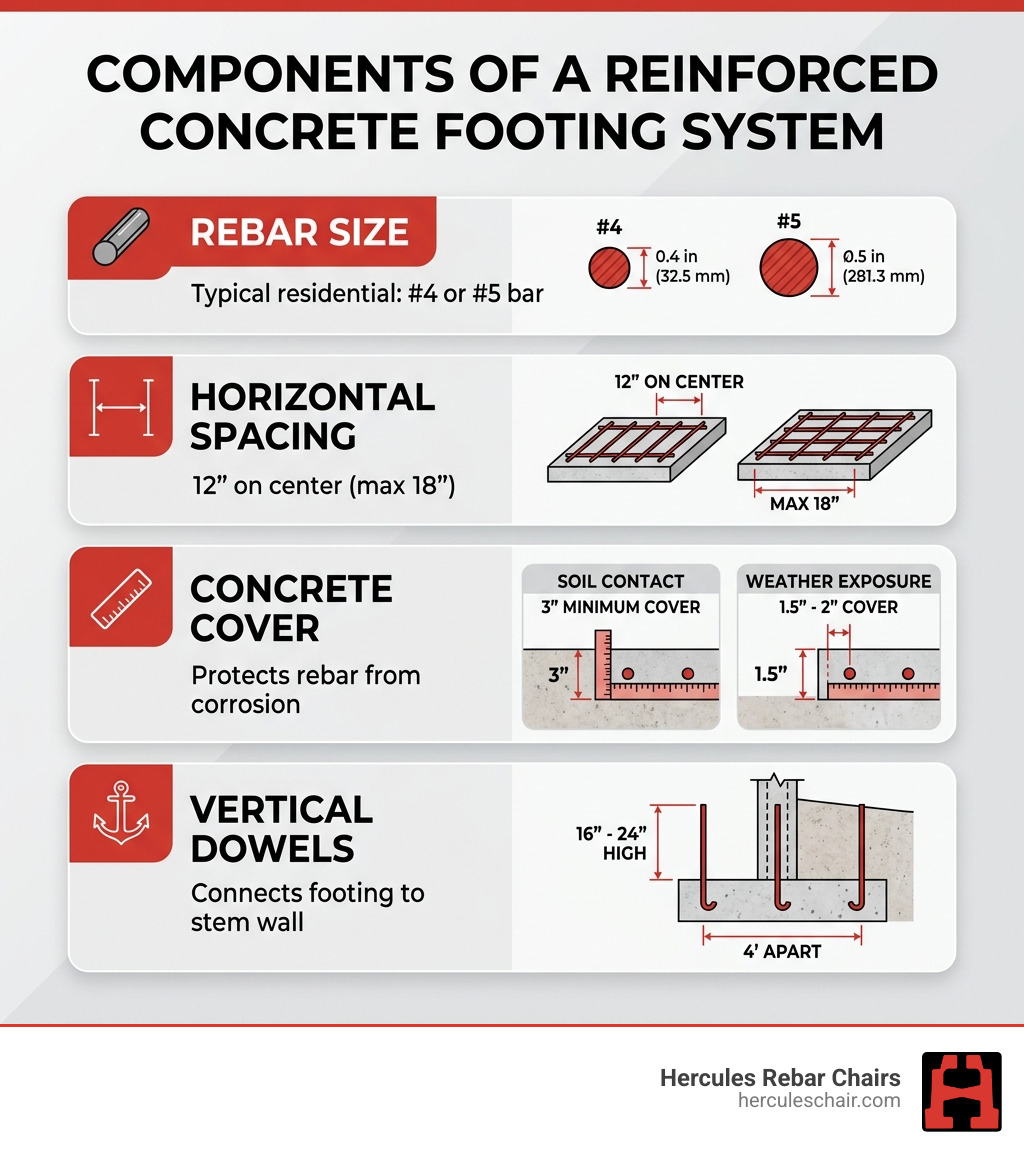
| Rebar size (residential) | #4 or #5 bar |
| Horizontal spacing | 12 inches on center (max 18 inches) |
| Concrete cover (soil contact) | 3 inches minimum |
| Concrete cover (weather exposure) | 1.5 inches (#5 and smaller), 2 inches (#6 and larger) |
| Bar placement | Bottom mat first, main bars along shorter span |
| Vertical dowels | #4 or #5 bars, 16-24 inches high, 4 feet apart |
The stakes are real. Concrete is strong under compression but has only about 10% of that strength when pulled or bent. Without rebar, a footing can crack, shift, or fail under load. Shift a bar by just half an inch in a 6-inch slab and you can lose 20% of its load-carrying capacity. Skip proper concrete cover and corroding steel can expand 2-3 times its original size, cracking the footing from the inside out.
This guide walks you through every step — from sizing and spacing to elevation and tying — so your footings are built to last and ready for inspection.
I’m Jordan Harris, a licensed Professional Engineer with a master’s degree in structural engineering and five years of hands-on experience designing large-scale concrete projects — experience I now apply directly to developing rebar support solutions that make footing rebar placement faster, more consistent, and fully code-compliant. Let’s get into it.
Footing rebar placement helpful reading:
The Structural Role of Rebar in Concrete Foundations
When we talk about the “skeleton” of a building, we aren’t just being poetic. In concrete, steel rebar is exactly that—a hidden frame that provides the necessary “muscle” to keep the structure from snapping. Concrete is an incredible material when it comes to compressive strength (pushing forces), but it is notoriously brittle when it comes to tensile strength (pulling or stretching forces).
Without proper footing rebar placement, a footing is essentially a large, heavy rock. If the soil underneath settles unevenly—which it almost always does—the concrete will try to bend. Since it can’t bend, it snaps. Steel rebar compensates for this fatal flaw by absorbing those tensile stresses. It also plays a vital role in crack control and settlement resistance, ensuring that if a small crack does form due to temperature changes or moisture, the steel holds the pieces together so the crack doesn’t become a structural failure.
For more in-depth engineering theory, you can check out this Rebar in Concrete Footings: The Ultimate Guide for a Solid Foundation or our own deep dive into Foundation Strong: Mastering Rebar Placement for Lasting Concrete.
Material Selection: Carbon Steel vs. Corrosion-Resistant Options
Not all steel is created equal. Depending on where you are building—whether it’s the humid coasts of Florida or the rocky terrain of Arizona—the type of rebar you choose matters. In the United States, Grade 60 (60,000 psi yield strength) is the standard for most residential and commercial projects.
| Rebar Type | Best Use Case | Corrosion Resistance |
|---|---|---|
| Carbon Steel (Black Bar) | Standard residential, dry climates | Low |
| Epoxy-Coated | Marine environments, bridges, high-salt areas | Up to 1,700x higher than carbon |
| Galvanized | Wastewater plants, agricultural, 50-100 year lifespan | 40x higher than carbon |
| Stainless Steel | Critical infrastructure, high-salt exposure | 1,500x higher than carbon |
| GFRP (Fiberglass) | MRI rooms, chemical plants, non-magnetic needs | Immune to corrosion |
While carbon steel is the most affordable, it is prone to “oxide jacking.” This happens when moisture reaches the steel, causing it to rust. Because rust expands to 2-3 times the size of the original metal, it creates internal pressure that literally “jacks” the concrete apart. In high-moisture states like Washington or Louisiana, investing in coated bars or ensuring a perfect 3-inch concrete cover is non-negotiable.
Step-by-Step Guide to Footing Rebar Placement
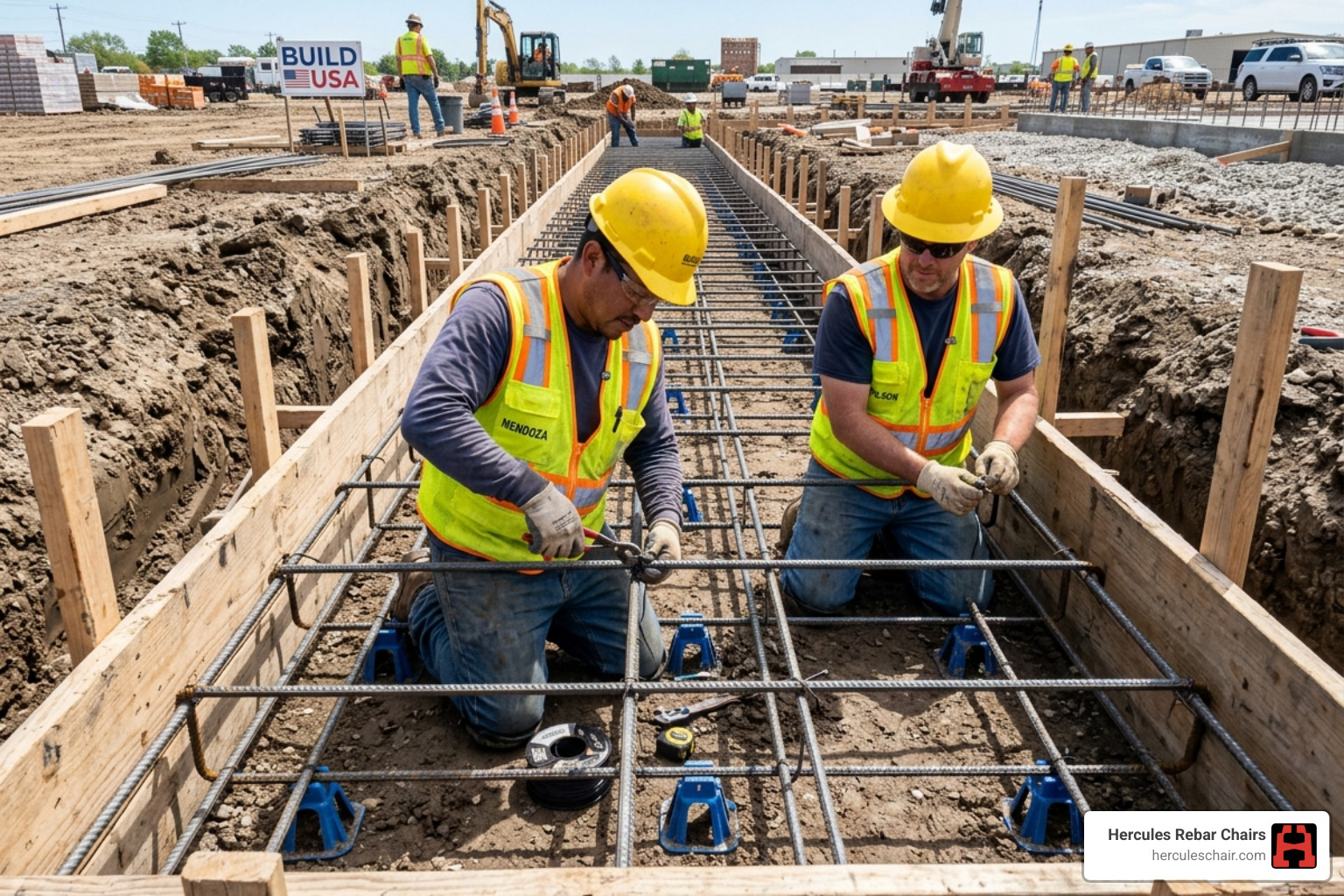
Proper footing rebar placement starts long before the concrete truck arrives. It begins with a clean, compacted trench. If you lay rebar on loose soil, the weight of the wet concrete will push the steel down, potentially losing your required clearance.
- Excavation & Compaction: Dig to the depth specified by your local building code (usually 12 inches below the frost line). Compact the soil thoroughly to prevent future settlement.
- Layout: Mark your longitudinal (long) and transverse (short) bar positions based on your structural drawings.
- Elevation: This is where most mistakes happen. You cannot simply lay the rebar on the dirt. You must use supports to hold the steel in the middle-to-lower third of the footing.
- Tying: Secure the intersections so the cage doesn’t shift when the heavy concrete starts flowing.
For a visual walkthrough, our Rebar Placement Guide offers a great starting point for beginners and pros alike.
The Correct Sequence for footing rebar placement
There is a specific “order of operations” for a bottom mat of reinforcement. Think of it like weaving a basket—the order determines the strength.
- Step 1: Main Bars First. Place the main reinforcement bars along the shorter span of the footing. In structural engineering, the shorter span is typically where the highest tension occurs.
- Step 2: Distribution Bars. Lay the distribution bars at right angles (perpendicular) to the main bars along the longer span.
- Step 3: Secure the Grid. Once the grid is established, ensure the spacing is uniform—usually 12 inches on center.
Following this sequence ensures the steel is positioned exactly where the engineering math says the tension will be highest. You can find a more detailed breakdown in our Step-by-Step Guide to Mastering Your Rebar Placement.
Calculating Materials for footing rebar placement
Don’t be the person who runs out of rebar halfway through the job. To calculate your needs:
- Perimeter Length: Measure the total linear footage of the footing.
- Bar Count: Multiply the length by the number of parallel bars required (e.g., two #4 bars for a standard residential strip footing).
- Lap Length: You can’t just butt two bars together. You must overlap them. A good rule of thumb is 40 times the diameter of the bar. For a #4 bar (1/2 inch), that’s a 20-inch lap.
- Waste Factor: Add 10% for bends, corners, and off-cuts.
For more tips on getting your material list right, see How to Install Rebar in Footings the Right Way.
Technical Specifications: Size, Spacing, and Concrete Cover
In the U.S., we follow the ACI 318 (Building Code Requirements for Structural Concrete) and the IRC (International Residential Code). For most homes in states like Texas, Ohio, or Pennsylvania, #4 (1/2″) or #5 (5/8″) rebar is the standard.
The general rule for spacing is 12 inches on center (OC), with a maximum allowable spacing of 18 inches. If you are building on poor soil or a heavy multi-story structure, an engineer might specify 6-inch or 8-inch spacing to handle the extra load. For more on these regulations, check out this Building Code Foundation Requirements: A Complete Guide.
Concrete Cover and Environmental Protection
Concrete cover is the distance between the edge of the steel and the exterior surface of the concrete. This is your primary defense against rust.
- 3-inch minimum: This is required for any concrete cast against and permanently exposed to earth (soil).
- 1.5 to 2 inches: Required for concrete exposed to weather but not directly against the soil.
If your rebar is too close to the edge, moisture and oxygen will seep through the concrete’s pores, leading to “oxide jacking.” This expansion can reduce a structure’s load capacity by 20% if the bars are misplaced by as little as half an inch. Maintaining this clearance is a top priority for any inspector. You can read more about these requirements at Placement of Rebar in Footings: Horizontal and Vertical Rebars – Civil Engineer DK.
Vertical Dowels and Structural Continuity
Vertical dowels are the “connectors” that tie your footing to your foundation walls. Without them, the wall could slide off the footing under the pressure of backfilled soil.
- Shape: These should have an L-shaped bend at the bottom to anchor them deep into the footing.
- Height: They typically extend 16-24 inches above the footing.
- Spacing: Usually spaced 4 feet apart around the perimeter.
Supporting and Tying Rebar for Structural Integrity
Tying rebar isn’t about structural strength—the concrete does the holding once it hardens. Tying is about stability during the pour. When thousands of pounds of wet concrete hit that trench, the rebar wants to move. We use 16-gauge black annealed wire to keep everything in place.
Common tie types include:
- Snap Tie: The simplest, used for horizontal mats.
- Saddle (U) Tie: Great for securing bars at intersections to prevent sliding.
- Figure-Eight Tie: Used for heavy mats or where extra rigidity is needed.
For a deep dive into these techniques, see A Practical Guide to Rebar Footing Stands.
Elevating Rebar with Hercules Rebar Chairs
At Hercules Rebar Chairs (T.J. Harris Co.), we believe that “close enough” isn’t good enough for foundation work. We are America’s #1 provider of rebar supports, with over 14 million units sold. Our chairs are easily identifiable by their signature red color, which makes it easy for building inspectors to see from a distance that your steel is properly supported.
Using our chairs saves you time and money. Instead of fumbling with heavy concrete “dobies” or unstable bricks that can crack and create pathways for moisture, our high-strength plastic chairs snap onto the rebar and stay put. They ensure full code compliance by maintaining that critical 3-inch clearance from the soil.
Learn more about your options in The Ultimate Guide to Footer Stand Options and how to place them in our Footer Stand Placement Guide.
Support Options for Different Footing Types
Different footings require different support configurations. We’ve designed specialized stands to handle various needs:
- 2-Bar Footer Stands: Perfect for standard residential strip footings where two parallel bars are required. Check out the 2 Bar Footer Stand for specs.
- 3-Bar Footer Stands: Designed for wider footings or commercial applications requiring extra reinforcement. See the 3 Bar Footer Stand for details.
Common Mistakes in footing rebar placement and How to Avoid Them
Even seasoned pros can slip up. Here are the “deadly sins” of footing rebar placement:
- Soil Contact: Never let the rebar touch the dirt. It will rust, and it will fail.
- Wet Setting: This is the practice of “stabbing” vertical dowels into wet concrete after it’s poured. This creates air pockets and poor bonding. Always tie your dowels to the horizontal cage before pouring.
- Insufficient Cover: Thinking 1 inch of cover is “fine.” It’s not. Stick to the 3-inch rule for soil contact.
- Shifting Bars: If you don’t tie your intersections securely, the force of the concrete pour will push your rebar into a pile at one end of the trench.
- Flaky Rust: While light surface rust is okay (it actually helps the bond), flaky, pitted rust is a sign of structural damage. If it’s flaking off, the bar belongs in the scrap heap, not your foundation.
For more on avoiding these pitfalls, see The Importance of Proper Placement of Steel Reinforcement in Concrete Footings.
Frequently Asked Questions about Footing Rebar
What is the standard rebar size for residential footings?
For most one- and two-story homes in the USA, #4 (1/2 inch) rebar is the industry standard. For larger homes or those on expansive clay soils (common in states like Oklahoma or Missouri), #5 (5/8 inch) bars are often required.
How far apart should rebar be in a concrete footing?
Standard residential spacing is 12 inches on center. However, building codes allow for up to 18 inches maximum spacing unless a structural engineer specifies otherwise for heavy loads or poor soil conditions.
Why must rebar be elevated off the bottom of the footing?
Rebar must be completely encased in concrete to work. If it sits on the soil, moisture from the ground will cause the steel to corrode. Furthermore, rebar provides tensile strength; to do this effectively, it needs to be positioned in the tension zone (the bottom third of the footing) but still fully surrounded by concrete.
Conclusion
Mastering footing rebar placement is the difference between a building that stands for a century and one that develops structural issues in a decade. By following the correct sequence, maintaining proper concrete cover, and using high-quality supports like our Hercules Rebar Chairs, you ensure your foundation is inspection-ready and structurally sound.
We are proud to manufacture our supports right here in the USA, helping contractors from Maine to California build stronger foundations every day. Don’t leave your structural integrity to chance—use the red chairs that pros trust.
For more information or to stock up for your next project, see More info about Hercules Rebar Chairs.