

Why Rebar Chair Airport Runway Selection Is a Critical Structural Decision
Choosing the right rebar chair for an airport runway is one of the most consequential decisions a concrete contractor can make on an airfield paving project. A single point of failure in your reinforcement support system can compromise concrete cover, throw dowel bars out of alignment, and trigger early-age cracking that grounds aircraft and closes runways — costing airports millions in operational disruptions.
Here is a quick-reference summary of what you need to know:
| Factor | Key Requirement |
|---|---|
| Pavement thickness | 16–20 in. (large commercial); 5–12 in. (general aviation) |
| Concrete cover | 50–60 mm minimum in aggressive airport environments |
| Chair materials | Plain steel, hot-dipped galvanized, or epoxy-coated |
| Standards compliance | FAA and CRSI specifications |
| Flexural strength target | 600–700 psi at 28 days |
| Joint spacing (transverse) | 15–20 ft (commercial); 8–15 ft (general aviation) |
| Tall dowel basket heights | 3/4 in. to 6 in., standard 5 ft length |
| Traffic opening threshold | Minimum 550 psi flexural strength |
Airport concrete pavements face a uniquely demanding combination of stresses: extreme dynamic loads from heavy aircraft, chemical attack from de-icing agents, and tight construction windows that leave no room for rework. The stakes are high. Airports simply cannot afford poorly performing pavements — frequent maintenance increases the risk of gate closures and reduces takeoff and landing capacity.
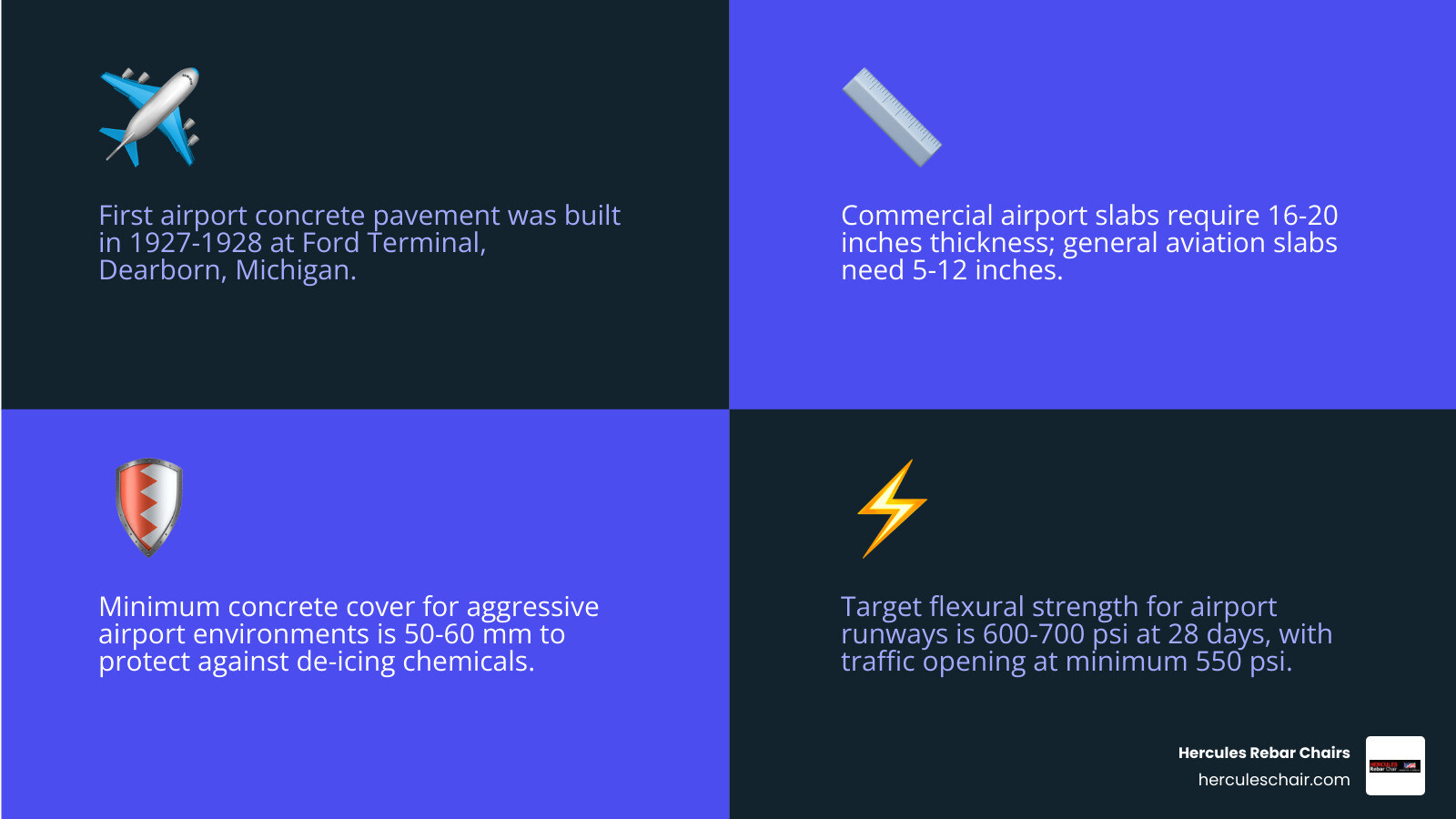
It is worth noting that airport concrete paving has a long history. The first airport concrete pavement was constructed during 1927 and 1928 at the Ford Terminal in Dearborn, Michigan — and the industry has been refining best practices ever since.
I’m Jordan Harris, a licensed Professional Engineer and the author of this guide. My background in structural engineering on large-scale concrete projects, combined with my work developing the Hercules Chair rebar support system, gives me a practical, code-grounded perspective on rebar chair airport runway applications. This guide will walk you through everything you need to select, specify, and install the right support system for your airfield paving project.
Structural Requirements for a Rebar Chair Airport Runway Project
When we talk about airfield paving, the scale of the materials is vastly different from commercial warehouse slabs or standard highway pavements. The structural design of airport runways, taxiways, and aprons must accommodate massive aircraft wheel loads, high tire pressures, and severe temperature fluctuations.
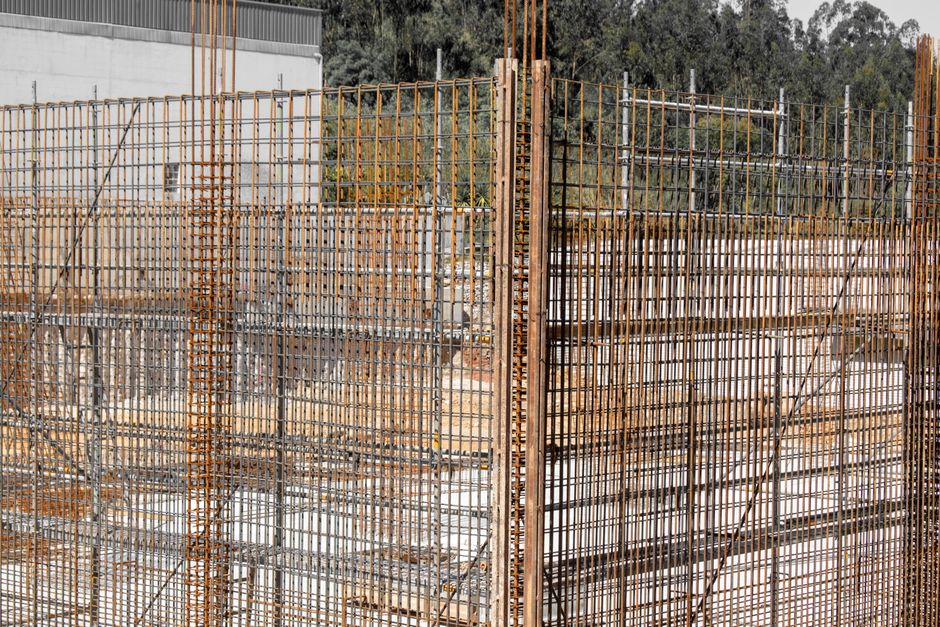
For larger commercial airports, pavement thickness typically ranges from 16 to about 20 inches. For general aviation airports, slab thickness is lighter but still substantial, ranging from 5 to 12 inches. Supporting heavy reinforcement grids in these exceptionally thick concrete slabs requires heavy-duty rebar supports that will not buckle, slip, or sink under the weight of the steel and the pressure of the placing equipment.
Without highly stable, load-bearing supports, the heavy rebar mesh can easily sag, reducing the structural capacity of the slab and leading to premature failure. For a comprehensive look at the mechanics of reinforcing deep slabs, read our Rebar Slab Support Complete Guide.
FAA and CRSI Standards for Rebar Chair Airport Runway Applications
To guarantee structural safety and longevity, airport paving projects are governed by strict federal and industry standards. In the United States, the Federal Aviation Administration (FAA) outlines rigid design and construction standards, while the Concrete Reinforcing Steel Institute (CRSI) dictates the performance and material specifications for reinforcement supports.
Under CRSI specifications, the wire diameter and structural design of metal supports must meet specific classification standards to prevent deformation. When dealing with the heavy reinforcing bars used in airfield slabs—often #6, #8, or even larger rebars—standard lightweight residential chairs simply cannot be used.
Instead, contractors must use heavy-duty, CRSI-compliant metal or plastic supports that are engineered to hold their shape under intense load. To ensure your project meets federal guidelines, you can Learn more about rebar chair code compliance to prevent costly inspection failures.
Managing Slab Thickness and Concrete Cover in Airfield Pavements
Maintaining the correct concrete cover is paramount to preventing structural degradation. Concrete cover acts as a protective shield for the embedded steel reinforcement, keeping moisture, oxygen, and corrosive chemicals away from the metal. In aggressive airport environments—where pavements are constantly exposed to water, de-icing salts, and fuel spills—the recommended concrete cover typically ranges from 50 to 60 mm (approximately 2 to 2.4 inches).
If the rebar chairs are too short or sink into the subbase during the pour, the concrete cover is reduced. This exposes the steel to rapid corrosion, leading to rust expansion, concrete spalling, and eventually, structural failure.
Additionally, the concrete mix design for runways is incredibly demanding. Concrete flexural strength is typically specified to be between 600 and 700 psi at 28 days. Achieving this strength requires a precise mix:
- A 1% increase in air content in concrete results in about a 5% reduction in compressive strength, meaning consolidation must be flawless.
- Typical mixes incorporate Class F fly ash at dosages between 15 and 25 percent by mass of cementitious materials.
- Slag cement dosages typically range between 25 and 50 percent of the total cementitious materials to improve durability and chemical resistance.
Selecting the correct rebar chair height and load capacity ensures that the reinforcement remains exactly where the designers intended, preserving the integrity of this high-performance concrete mix. Discover how to avoid common sizing mistakes by reading our guide on How to choose the right concrete rebar chair.
Mitigating Early-Age Distress and Ensuring Load Transfer
Rigid concrete pavements expand and contract with temperature and moisture changes. To control where the concrete cracks, engineers design joint systems. Transverse joint spacing for commercial runways is typically set between 15 and 20 feet, while longitudinal joint spacing ranges from 12.5 to 20 feet. For general aviation airports, joint spacing is tighter, ranging from 8 to 15 feet.
At these joints, load transfer mechanisms—specifically dowel bars—are used to transfer wheel loads from one slab to the next. If these dowels are misaligned even slightly, they can lock the joint, preventing horizontal movement and causing severe stress concentrations. This is where high-quality supports play a crucial role in maintaining load transfer efficiency.
Preventing Cracking and Spalling from Curling and Warping Stresses
Early-age pavement distresses like cracking and spalling can occur within 72 hours or less of concrete placement. These cracks are primarily driven by curling and warping stresses:
- Curling is caused by temperature differentials between the top and bottom of the concrete slab (e.g., a hot afternoon sun heating the surface while the subbase remains cool).
- Warping is caused by moisture differentials between the top and bottom of the slab.
These stresses force the corners of the concrete slabs to lift or curl. If the embedded steel reinforcement mesh is not held precisely at its designated design height, it cannot effectively resist these early-age bending stresses, leading to immediate cracking. To ensure your reinforcement grid is perfectly positioned to fight these forces, check out our Read our comprehensive rebar placement guide.
Supporting Tall Dowel Baskets and Joint Alignment
To secure dowel bars at construction joints prior to the concrete pour, contractors rely on welded dowel basket assemblies. In thick airport runways, taxiways, and aprons, standard-height baskets are insufficient. Instead, we use tall dowel baskets.
These specialized assemblies are domestically manufactured to meet strict CRSI and FAA standards. They are typically available in heights from 3/4″ to 6″ with a standard length of 5′.
The primary engineering requirement for these baskets is that they must hold the dowel bars precisely at the vertical midpoint of the pavement thickness. If a runway is 18 inches thick, the dowel must sit exactly 9 inches from the bottom. Any deviation reduces load transfer efficiency and can cause the joint to crumble.
A great example of the long-term success of robust joint reinforcement is found in major European transit hubs, such as the Case study on Warsaw Chopin Airport runway renovation, where advanced reinforcement alignment was used to ensure the pavement could withstand over 30 years of heavy traffic.
Material Selection and Corrosion Resistance in Airport Environments
Airfield pavements are highly aggressive environments for structural steel. Runways are routinely treated with chemical de-icing compounds to prevent ice formation. These chemicals—including urea, sodium acetate, potassium acetate, glycols, and chlorides—are highly corrosive. When they seep through the concrete’s micropores, they accelerate the oxidation of steel reinforcement.
| Material / Coating | Corrosion Resistance | Structural Rigidity | Best Suited For |
|---|---|---|---|
| Plain Steel | Low | High | Dry, non-corrosive interior pavements |
| Epoxy-Coated | Moderate to High | High | Standard runways with de-icing exposure |
| Hot-Dipped Galvanized | High | High | Coastal airports and wet climates |
| Non-Metallic (GFRP) | Excellent (Immune) | High (Flexible) | Electromagnetic sensitive zones |
Steel, Epoxy-Coated, and Galvanized Supports
To combat corrosion, the metal accessories used in airport runways must be carefully selected based on their protective coatings:
- Plain Steel: Standard untreated steel supports. They are highly rigid but offer no protection if moisture or de-icing salts reach them.
- Epoxy-Coated: These supports feature a protective polymer barrier. However, if the epoxy coating is nicked or scratched during transport or installation, the underlying steel can corrode rapidly.
- Hot-Dipped Galvanized: Offering superior durability, galvanized supports feature a zinc coating that provides sacrificial protection against rust, even if scratched.
Selecting the right material for your support chairs is just as important as selecting the right rebar coating. To explore our range of high-durability, project-specific supports, Discover heavy-duty rebar chairs for harsh environments.
Selecting a Rebar Chair Airport Runway Solution for Electromagnetic Sensitive Zones
While steel is the traditional choice for runway reinforcement, modern airports face a unique challenge: electromagnetic interference (EMI). Traditional steel rebar and metal chairs can distort radio signals and cause magnetic interference near highly sensitive airport navigation facilities. These include:
- Instrument Landing Systems (ILS): Specifically glide slope antennas and localizers.
- VOR/DVOR Stations: Very High Frequency Omnidirectional Range systems.
- Air Traffic Control Radar Towers.
To prevent signal distortion and guarantee flight safety, international aviation guidelines (such as ICAO Annex 10 and Annex 14) restrict the use of ferromagnetic materials within defined critical and sensitive zones around navigation aids. In these specific areas, engineers specify Glass Fiber Reinforced Polymer (GFRP) rebar and non-metallic fiberglass dowels.
GFRP is completely non-magnetic, non-conductive, and electromagnetically transparent. Beyond its electrical properties, GFRP is highly resilient:
- It is 75% lighter than steel (1/4 the weight), which significantly cuts freight and installation costs.
- It has an impressive tensile strength of 1000 to 1200 MPa (compared to steel’s 500 to 600 MPa).
- It is completely immune to corrosion from de-icing chemicals and aviation fuel, offering a 100-year service life.
To learn more about how composite reinforcement is transforming modern airfield designs, you can read the latest Research on GFRP for sustainable airfield infrastructure and review this Study on fiberglass dowels and rebars for runways.
These non-corrosive, non-magnetic technologies have been successfully deployed in major international projects, including the Mae Fah Luang Chiang Rai Airport – Renovation & Expansion and the Brussels Airport, Brussels, Belgium – Bekaert.com upgrades, proving that modern composite materials are a highly reliable choice for high-traffic aviation infrastructure.
Installation Best Practices and Slipform Paving Challenges
Airport runways are typically paved using one of two methods: fixed-form paving or high-speed slipform paving. In slipform paving, a massive paving machine moves continuously along the runway, extruding, consolidating, and finishing the concrete in a single pass.
This process places immense physical pressure on the pre-tied rebar grids and the chairs supporting them. If the chairs are not robust enough, or if they are improperly secured, the moving concrete mass will push them over, resulting in misplaced reinforcement and structural non-compliance.
Overcoming Displacement Challenges During Slipform Paving
As the slipform paver moves forward, the head of concrete in front of the machine exerts a massive downward and forward force. This dynamic pressure can cause weak rebar chairs to buckle or slip. To prevent displacement:
- Use Heavy-Duty, Wide-Base Chairs: Chairs must have a wide footprint to distribute the load and prevent them from sinking into the subbase or tipping over.
- Secure Every Junction: Rebar must be securely tied to the chairs using heavy-gauge tie wire.
- Optimize Chair Spacing: Spacing must be tight enough to prevent the rebar from sagging under the weight of workers and the concrete flow.
To ensure your crew is using the best techniques to secure reinforcement under high-pressure conditions, consult The ultimate guide to rebar chairs and spacers. For additional insights into specific types of heavy-duty supports, you can also explore:
- Why Hercules Chairs Are the Heavyweight Champions of Rebar Support
- The Ultimate Guide to Rebar Chairs, Types, Uses, and Sizing for Concrete Slabs
- The Ultimate Guide to Mesh Chairs
- Compliant Rebar Elevation Chairs for Professional Results
Quality Control, Test Strips, and Acceptance Testing
Before full-scale paving begins on an FAA-regulated project, contractors must implement a comprehensive Quality Management Plan (QMP). A critical step in this plan is the construction of a test strip.
The test strip is a trial run of the paving operation, typically 300 to 500 feet long. It allows engineers to verify:
- The performance of the concrete mix and consolidation around the rebar and dowels.
- That the rebar chair airport runway supports hold their position perfectly under the slipform paver.
- That the concrete core samples show no honeycombing or void spaces.
Once the concrete is poured, acceptance testing begins. Most airport authorities require that the pavement not be opened to construction traffic or aircraft until test specimens have attained a minimum flexural strength of 550 psi. Using high-quality, stable supports ensures that the structural integrity of the slab is uniform from the first foot of the test strip to the final foot of the runway.
Frequently Asked Questions about Airport Runway Rebar Chairs
Why is electromagnetic neutrality important for runway reinforcement?
Traditional steel reinforcement can interfere with sensitive airport navigation equipment, such as Instrument Landing Systems (ILS) and radar towers. In these designated zones, non-conductive, non-magnetic materials like GFRP rebar and fiberglass dowels are required to ensure clear signal transmission and flight safety.
How do rebar chairs prevent early-age cracking in thick airport slabs?
By holding the heavy steel reinforcement mesh at the precise design height, rebar chairs ensure that the steel is positioned to resist curling and warping stresses. These stresses are caused by temperature and moisture differences within the first 72 hours of concrete placement.
What are the standard heights and lengths for tall dowel baskets?
Tall dowel baskets are typically domestically manufactured to CRSI standards. They are available in heights from 3/4″ to 6″ and come in standard lengths of 5 feet. They are designed to hold dowel bars perfectly at the vertical midpoint of thick runway slabs to ensure proper load transfer between concrete joints.
Conclusion
When building pavements designed to handle the world’s heaviest aircraft, there is no room for compromise. Every component of your reinforcement system must be engineered for maximum strength, stability, and code compliance.
At Hercules Rebar Chairs, we manufacture the strongest concrete supports in the industry. As America’s #1 choice with over 14 million units sold, our iconic red chairs are designed to save you time and money on-site while ensuring absolute compliance with structural codes. Whether you are paving a general aviation runway or a heavy-duty commercial taxiway, our heavy-duty supports provide the reliable elevation your project demands.
Ready to secure the rest of your reinforcement system? Upgrade your project with high-quality rebar couplers to ensure seamless, code-compliant steel connections from end to end.