

Why Rebar Couplers Belong on Every Serious Concrete Project
Rebar couplers are mechanical devices that connect two pieces of reinforcing bar (rebar) end-to-end, creating a continuous load path through the joint without relying on concrete for strength.
Quick answer — the top rebar coupler types contractors use in 2026:
| Coupler Type | How It Works | Best For |
|---|---|---|
| Taper Threaded | Tapered threads on bar ends; bars rotate together | Column/wall bars with free rotation |
| Parallel Threaded | Upset bar ends, straight threads, screws into coupler | High-strength structural connections |
| Bolt-On (Shear-Bolt) | Serrated rails grip bar when bolts shear at set torque | No bar-end prep, fast field installs |
| Grouted Sleeve | Non-shrink grout fills sleeve around bar ends | Precast connections, limited access |
| Weldable | One end welds to steel, other end threads to rebar | Steel-to-concrete transitions |
Traditional lap splicing relies on concrete to transfer load between bars. Rebar couplers eliminate that dependency entirely. That matters most when space is tight, loads are high, or seismic performance is required.
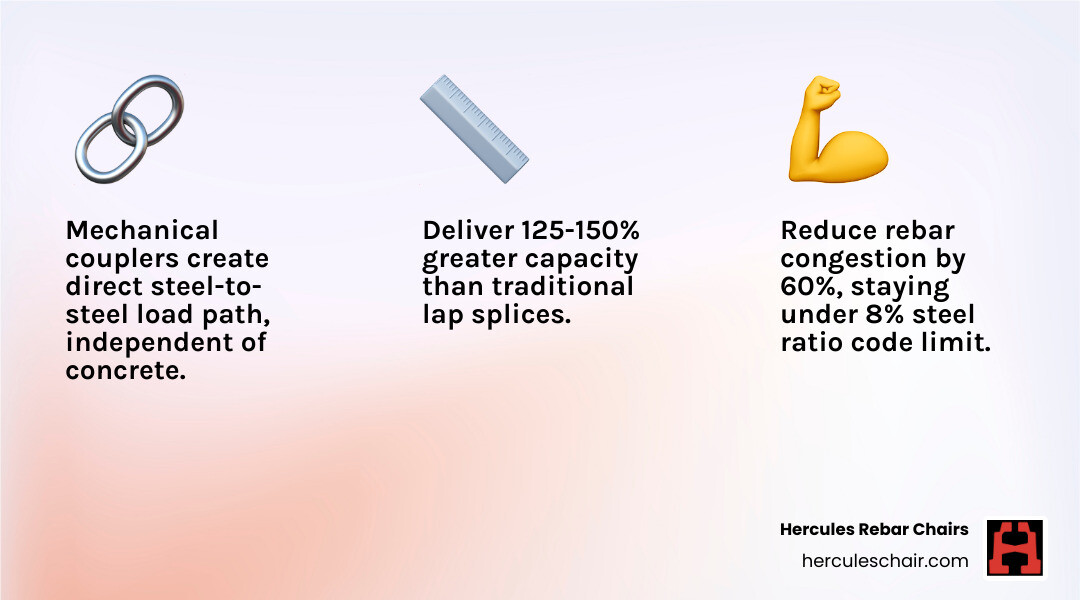
The numbers back this up. Mechanical splices can deliver 125% to 150% greater capacity than typical lap splices. They also make it far easier to keep the total steel ratio under the 8% maximum required by building codes — something that’s nearly impossible to achieve with lapping in heavily reinforced sections.
Whether you’re working on a high-rise, a bridge widening, or a precast connection detail, the right coupler system can reduce congestion, cut labor time, and keep your project on schedule.
I’m Jordan Harris, a licensed Professional Engineer with a background in large-scale concrete and structural projects, and I work daily with rebar support systems at T.J. Harris Company — so I understand exactly what contractors need when it comes to reliable rebar couplers in the field. Let’s break down the top-rated options so you can choose the right system for your next pour.
Understanding Rebar Couplers and Their Role in Modern Construction
In reinforced concrete, the bond between steel and stone is everything. However, as we move further into April 2026, the demands on our infrastructure are higher than ever. We aren’t just building boxes; we are building resilient, high-capacity structures that must withstand seismic events and heavy live loads. This is where rebar couplers step in to replace the “old way” of overlapping steel.
A rebar coupler functions as a mechanical splice. Unlike a lap splice, which requires a specific length of overlap so the surrounding concrete can transfer the load from one bar to the next, a coupler creates a direct, physical connection. This ensures a continuous load path that remains independent of the concrete’s condition. If the concrete cracks or degrades over time, the steel reinforcement remains a single, unified skeleton.
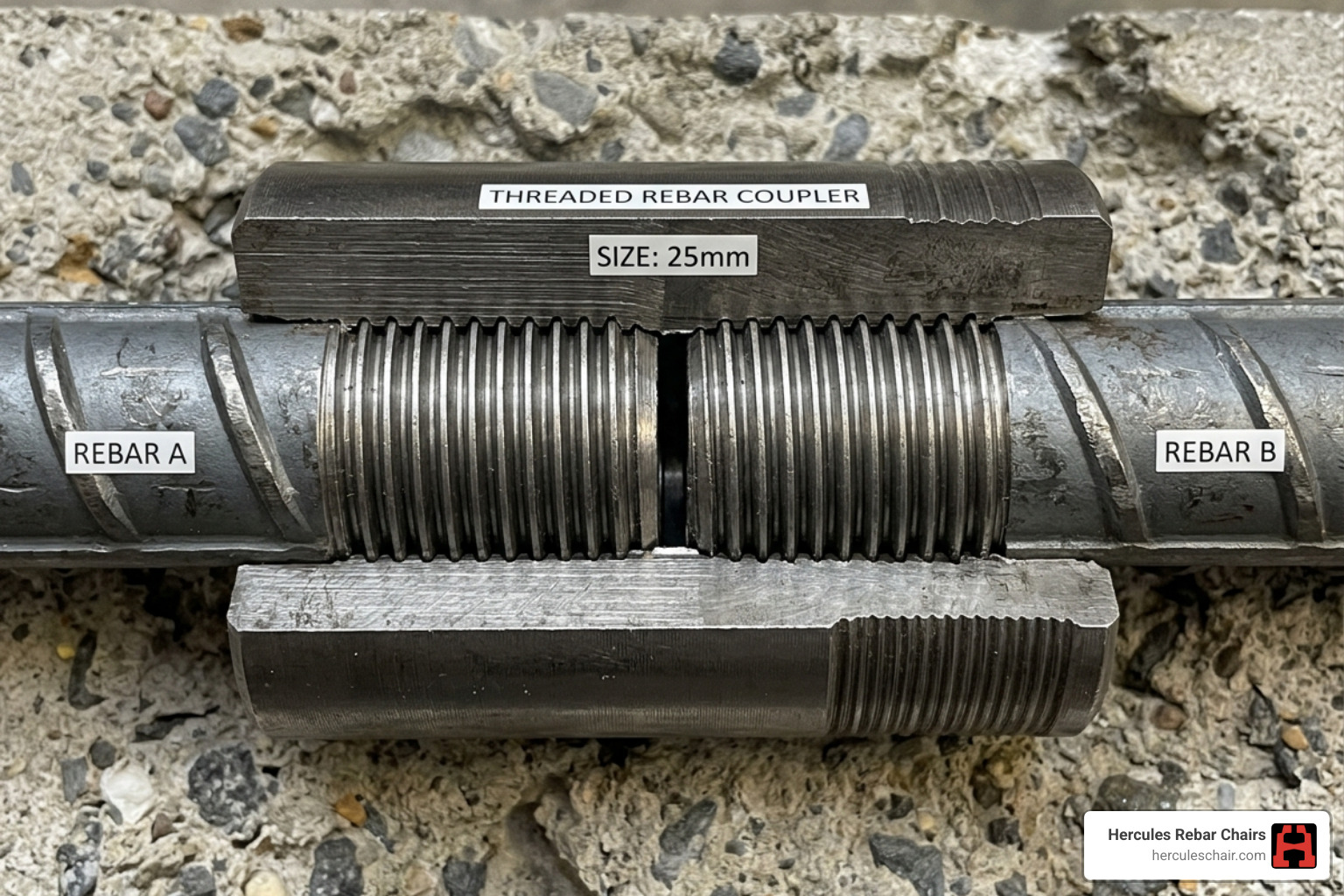
This mechanical continuity is vital for seismic resistance. During an earthquake, concrete can undergo extreme stress, potentially losing its grip on lapped bars. Mechanical couplers maintain the ductility of the reinforcement, allowing the structure to absorb energy without a catastrophic failure at the splice point. Furthermore, by using couplers, we can achieve a “Type 2” splice, which is designed to develop the full specified tensile strength of the spliced bar, often exceeding 125% of the yield strength.
For a deeper dive into how these systems integrate into your overall reinforcement strategy, check out Rebar Couplers: Your Ultimate Guide to Connecting Steel Strong.
Main Types of Mechanical Splicing Systems
Choosing the right rebar couplers depends entirely on your project’s constraints. Do you have a threading machine on-site? Can the bars be rotated? Is the rebar already cast in a wall?
Here is a breakdown of the primary systems used across the USA today:
| Feature | Threaded (Parallel/Taper) | Bolt-On (Shear-Bolt) | Grouted Sleeve |
|---|---|---|---|
| Bar End Prep | Required (Threading/Upsetting) | None | None |
| Installation Speed | Moderate | Fast | Slow (Cure time) |
| Profile Size | Slim | Large | Large |
| Seismic Rated | Yes | Yes | Yes |
| Rebar Sizes | #4 to #18 | #4 to #18 | #5 to #18 |
Taper Threaded rebar couplers
Taper threaded systems, such as the widely recognized Tapercoup or LENTON styles, are favorites for their cross-threading prevention. Because the threads are cut at an angle, the coupler easily catches the bar and tightens quickly. These are remarkably slim profile connectors, which is a huge advantage when you need to maintain specific concrete cover requirements in thin walls or columns.
The primary requirement for a standard taper coupler is that at least one bar must be able to undergo axial rotation to screw into the sleeve. These are commonly used for column bars, shear walls, and future extensions.
Bolt-On and Shear-Bolt rebar couplers
If you are in a situation where you cannot thread the rebar—perhaps during a repair or when working with fixed bars that cannot rotate—bolt-on rebar couplers like the Bar Lock system are the gold standard. These utilize lock-shear bolts and serrated rails that grip the rebar securely.
The beauty of this system is that it requires no bar end prep. You don’t need a threading machine or a cold-press. You simply slide the coupler over the bars and tighten the bolts with a standard impact wrench. Once the bolt heads shear off at a predetermined torque, you have an instant visual torque verification that the connection is secure.
For more on choosing between these mechanical tools, see A Comprehensive Guide to Comparing Rebar Connection Tools.
Key Advantages of Couplers Over Traditional Lap Splicing
We often get asked why a contractor should spend money on rebar couplers when “lapping is free.” The truth is, lapping isn’t free—it costs you in steel weight, labor, and space.
- Superior Strength: Mechanical splices are designed to reach 125% to 150% of the yield strength of the bar. Lap splices are limited by the strength of the bond with the concrete.
- Code Compliance: Building codes generally limit the steel ratio in a column to 8%. When you lap bars, you effectively double the amount of steel at the splice point. In a heavily reinforced column, you might hit that 8% code limit just by lapping, making it impossible to pour concrete through the cage. Couplers eliminate this overlap, providing up to 60% space saving in congested areas.
- Sustainability: Using couplers can lead to a 90% reduction in CO2 emissions compared to lapping. This is because you are eliminating the “waste” steel used in the overlap. Over a large project, saving several feet of steel on every vertical bar adds up to tons of reduced carbon footprint.
- Congestion Relief: By removing hooks and long laps, you make it much easier for the concrete to flow around the reinforcement, reducing the risk of honeycombing and structural voids.
To learn more about the technical differences between these methods, read Splice It Right: Your Handbook to Mechanical Lap and Dowel Bar Splicers.
Installation Standards and Performance Criteria
When we talk about rebar couplers, we aren’t just talking about “pipe fittings” for steel. These are highly engineered components that must meet rigorous standards. In the United States, we look to several key governing bodies:
- ACI 318: The American Concrete Institute’s building code requirements for structural concrete.
- ASTM A615 / A706: Standards for the rebar itself, ensuring the coupler is compatible with the grade of steel.
- IAPMO / ICC-ES: Evaluation reports (like ER-319) provide third-party verification that a coupler system performs as claimed.
- DOT Approvals: Many state Departments of Transportation, such as Caltrans, maintain “Authorized Material Lists” that specify which couplers can be used on highway and bridge projects.
Performance testing for these systems is intense. They undergo cyclic load testing to simulate seismic activity, fatigue resistance tests for bridges, and monotonic tension/compression tests to ensure they won’t slip or break under extreme pressure. Most quality rebar couplers are available for the full range of bar sizes, from the small #4 used in residential slabs to the massive #18 bars used in nuclear containment structures and bridge piers.
Frequently Asked Questions about Rebar Splicing
How do rebar couplers contribute to project cost savings?
While the individual unit price of a coupler is higher than a piece of wire for tying a lap, the overall project savings are significant. You’ll see a massive labor reduction because workers aren’t struggling to maneuver 40-foot bars with 6-foot laps. Productivity gains come from faster cycling of floor pours and reduced crane time, as lighter cages are easier to lift. Plus, you eliminate the material waste of the overlap steel.
Can rebar couplers be used for repair and retrofit projects?
Absolutely. In fact, they are often the only solution for repairs. If a bar has been cut too short or if you are widening a bridge and need to connect to existing reinforcement, positional couplers or shear-bolt couplers (like Bar Lock) allow you to create a high-strength connection without having to chip away massive amounts of concrete to expose a lap length. They are perfect for structural rehabilitation and connecting new slabs to old walls.
What tools are required for installing mechanical couplers?
It depends on the system.
- Threaded Systems: Require a threading machine or cold-press equipment (often done at the fabrication shop) and a torque wrench for final tightening on-site.
- Bolt-On Systems: Only require a standard impact driver or wrench.
- Quick Wedge Systems: May use a specialized hydraulic swaging tool that can complete up to 100 splices per hour.
Conclusion
At Hercules Rebar Chairs, we know that the strength of your finished pour depends on the integrity of your reinforcement. Whether you are managing the steel ratio in a high-rise column or ensuring seismic safety in a bridge pier, rebar couplers provide the reliability that traditional lapping simply cannot match.
As “America’s #1” choice for concrete supports, we have seen over 14 million units of our products sold to contractors who value speed, safety, and code compliance. Our iconic red color identification ensures that inspectors know exactly what they are looking at on your job site. While we focus on providing the strongest rebar chairs in the industry to keep your steel at the right height, we are proud to support the professionals who use top-tier splicing solutions to build the future.
Ready to secure your next project? Explore our range of supports and splicing accessories at Our Products / Splicer and see why we are the trusted name in concrete construction across all 50 states.