

Why Concrete Reinforcement Tools Make or Break Your Slab
Concrete reinforcement tools are the equipment and accessories used to place, secure, support, and splice steel rebar and wire mesh inside concrete structures — ensuring the finished slab, beam, or column has the strength to carry real loads.
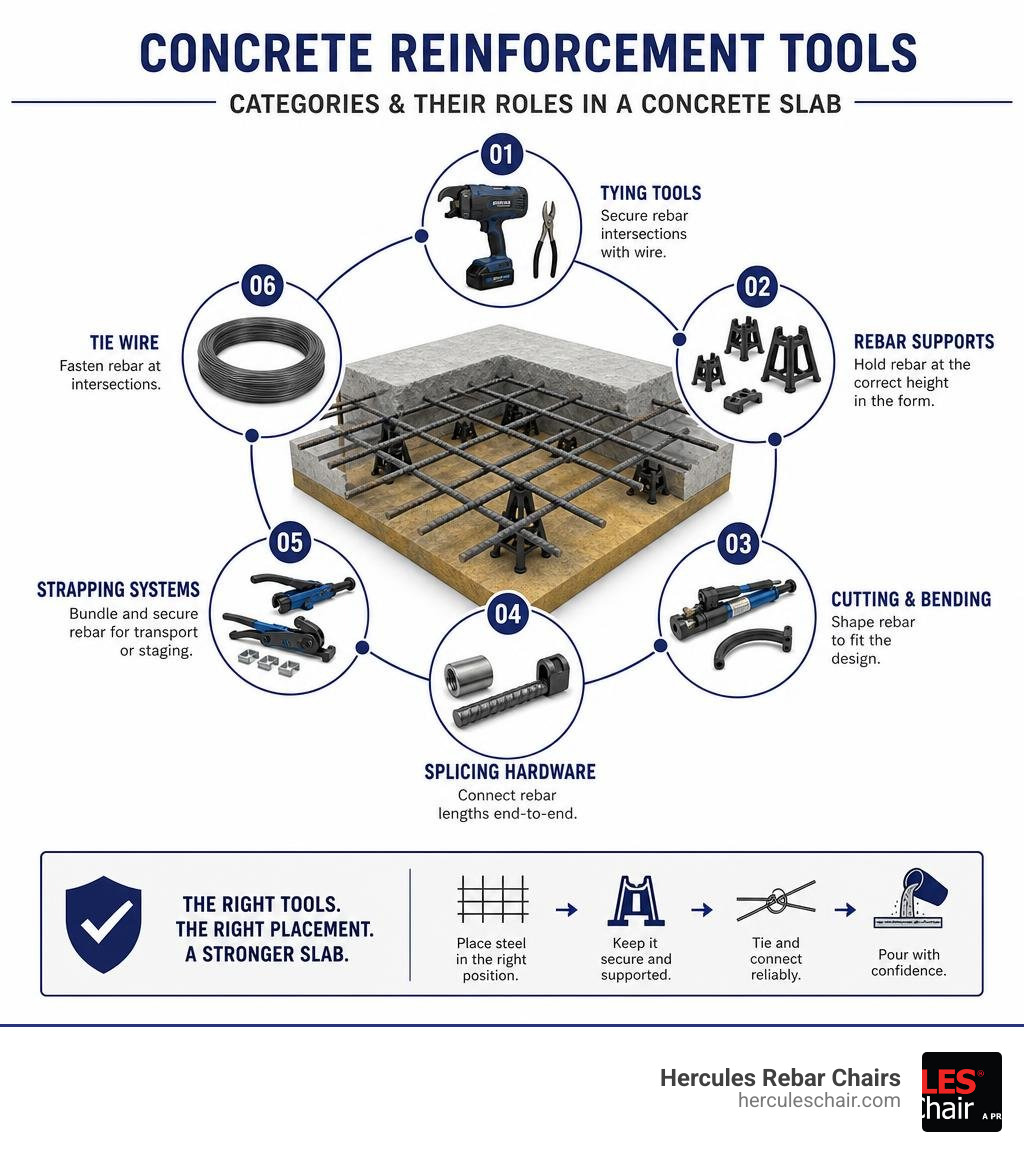
Here’s a quick overview of the main categories:
| Tool Category | Examples | Primary Purpose |
|---|---|---|
| Tying tools | Battery-powered tie guns, manual pliers | Secure rebar intersections with wire |
| Rebar supports | Chairs, high chairs, bolsters, spacers | Hold rebar at the correct height in the form |
| Cutting & bending | Hydraulic benders, claw cutters | Shape rebar to fit the design |
| Splicing hardware | Mechanical couplers, lap splice bars | Connect rebar lengths end-to-end |
| Strapping systems | Tensioners, crimpers, sealers | Bundle and secure rebar for transport or staging |
| Tie wire | 19-gauge, 21-gauge, poly-coated, galvanized | Fasten rebar at intersections |
Concrete is incredibly strong under compression — but its tensile strength is only about 10% of its compressive strength. That’s the core problem. Without reinforcement placed precisely in the tension zone, a slab can crack or fail under load. Improper rebar placement is one of the most common causes of structural concrete failures, which makes choosing and using the right tools far more than a convenience — it’s a safety issue.
Every tool in this guide exists to solve one or more parts of that problem: getting steel into the right position, keeping it there, and connecting it reliably before the concrete is poured.
I’m Jordan Harris, a licensed Professional Engineer in Tennessee with a master’s degree in structural engineering and five years of hands-on experience designing large-scale concrete projects. Today I help lead T.J. Harris Company, where we engineer and manufacture concrete reinforcement tools and rebar support systems — including the Hercules Chair, with over 14 million units sold across the country. In the sections below, I’ll walk you through every major tool category so you can make faster, smarter decisions on your next pour.
Concrete reinforcement tools basics:
Essential Concrete Reinforcement Tools for Modern Construction
When you step onto a job site in June 2026, the contrast between old-school grit and modern efficiency is obvious. For decades, reinforcing ironworkers (often called rodbusters) relied almost entirely on manual muscle to bend, cut, and tie steel. While manual expertise remains the foundation of the trade, modern power tools have completely changed how high-volume projects are executed.
The choice between manual and power-operated tools directly impacts your project’s bottom line, scheduling, and labor safety. Selecting the right gear not only boosts daily productivity but also prevents the small installation errors that can lead to catastrophic structural failures down the road.
Handheld Concrete Reinforcement Tools and Manual Accessories
For quick adjustments, tight spaces, or residential pours, manual tools are still indispensable. Every rodbuster’s belt features a trusty pair of spring-loaded rebar pliers (used for twisting and cutting tie wire in one fluid motion) and a manual tie wire reel.
When rebar needs to be cut or adjusted on-the-fly, manual claw cutters and heavy-duty manual bending bar tools (sometimes called hickey bars) allow workers to make precise, on-site modifications.
However, manual tying is notoriously tough on the body. To bridge the gap between exhausting manual twists and expensive battery-powered guns, mechanical tiers offer an elegant compromise. A prime example is the Wacker Neuson DF16 mechanical tier. This clever, fully mechanical device operates without batteries or charging. It wraps and twists a single tie wire in an upright, ergonomic motion, letting workers tie up to 1,000 tight, uniform knots per hour without the repetitive hand-twisting that causes carpal tunnel syndrome.
Power-Operated Concrete Reinforcement Tools for High-Volume Projects
On commercial slabs, highway bridges, and precast plants, manual tools simply cannot keep pace with tight modern schedules. This is where battery-powered and electric-hydraulic tools shine.
Battery-powered rebar tying guns have revolutionized steel tying. Utilizing advanced dual-wire feeding, tools equipped with MAX USA TwinTier technology can complete a secure, double-wrapped tie in less than half a second. These tools pull the wire tight and cut it with minimal waste, reducing tie wire consumption and keeping the overall tie height incredibly low. A shorter tie height means you need less concrete cover to protect the steel from exposure.
For shaping heavy-duty steel on-site, manual hickey bars give way to electric hydraulic rebar benders. These portable machines, powered by high-torque electric motors, can bend thick rebar (up to #6 or 3/4-inch diameter) from 0 to 90 degrees in under five seconds. Combined with rapid electric rebar cutters, these power tools turn what used to be a grueling multi-man chore into a fast, single-operator task.
Rebar Support Systems and Placement Accessories

You can have the strongest steel and the tightest ties on Earth, but if your reinforcement grid sinks to the bottom of the form during the concrete pour, its structural value drops to zero. To resist bending forces, rebar must be suspended precisely within the concrete’s tension zone. This requires dedicated rebar support systems.
Choosing the right supports ensures consistent concrete cover (the thickness of the concrete surrounding the steel), maintains proper slab depth, and guarantees long-term structural stability. For a deep dive into how these systems function, check out The Ultimate Guide to Rebar Chairs.
Types of Rebar Chairs and Slab Supports
Rebar supports come in several distinct shapes, each engineered for specific structural environments:
- Bar Chairs: Individual towers designed to support a single intersection of rebar. They are perfect for elevated decks and slab-on-grade applications. For more on their critical role, read Elevate Your Concrete: Why Bar Chairs Are Essential for Strong Slabs.
- High Chairs: Taller support structures used in thick slabs or multi-mat concrete foundations to hold the upper layer of steel reinforcement at the correct height.
- Slab Bolsters: Continuous, linear support systems that support multiple parallel bars simultaneously. They speed up prep work on wide slabs. You can learn more in our Slab Bolster Chairs Guide.
- Concrete Reo Chairs: Heavy-duty plastic or concrete supports designed to handle high-load reinforcement grids. Read our Concrete Reo Chairs Overview for a complete breakdown of their applications.
For a comprehensive look at how these elements work together, refer to our Rebar Slab Support Complete Guide.
Comparing Support Options: High Chairs, Mesh Supports, and Plastic Spacers
Contractors must choose the right support material based on the subbase and reinforcement type:
- Plastic Rebar Chairs: Lightweight, highly durable, and completely immune to rust. High-quality plastic chairs (like our signature red Hercules Chairs) feature wide, stable bases that won’t puncture vapor barriers or sink into soft subgrades.
- Concrete Dobies: Precast concrete blocks used primarily on heavy civil projects. While strong, they are heavy, brittle, and can occasionally create weak points if they do not bond perfectly with the poured concrete matrix.
- Space Wheels (Side Form Spacers): Circular plastic wheels that snap onto vertical rebar grids (like those in columns or shear walls) to maintain a consistent distance from the formwork.
- Mesh Chairs: Specifically designed with wide, stable bases and unique clips to hold flexible welded wire mesh in place without letting it sag.
To weigh your options, explore our guide From Dobies to Double Mats, read The Ultimate Guide to Mesh Chairs, and check out our detailed support overviews in Sitting Pretty: Everything You Need to Know About Rebar Supports and Chair-ish Your Concrete: A Deep Dive into Rebar Support Systems.
Advanced Splicing, Strapping, and Material Selection
Managing a modern job site requires a solid understanding of how steel segments are connected, bundled, and selected based on environmental demands.
Mechanical Couplers vs. Traditional Lap Splicing
When rebar lengths aren’t long enough to span a structure, they must be spliced. Historically, contractors relied on lap splicing (overlapping two parallel bars and tying them together). Today, mechanical couplers (like the Bar Lock series) are widely preferred for high-stress applications.
| Feature | Traditional Lap Splicing | Mechanical Couplers |
|---|---|---|
| Steel Usage | High (requires significant overlap lengths) | Low (end-to-end alignment saves steel) |
| Rebar Congestion | High (doubles the steel volume at splice points) | Low (maintains a slim, consistent profile) |
| Structural Capacity | Relies on concrete bond; can slip under extreme tension | Full mechanical connection; exceeds 125% of yield strength |
| Installation Speed | Moderate (requires manual tying and overlapping) | Fast (secured quickly with impact wrenches or bolts) |
| Code Compliance | Subject to strict lap length calculations | Simplifies structural code compliance (ACI 318 Type 1 & 2) |
Steel Strapping Systems for Securing Rebar Bundles
Before rebar even reaches the forms, it must be safely transported and organized. Steel strapping systems are critical for securing heavy rebar bundles during transit and staging.
These systems rely on a suite of specialized tools:
- Tensioners: Pull the steel strapping tight around the rebar bundle.
- Crimpers and Sealers: Compress metal seals onto the overlapping strap ends to lock the tension in place.
- Dispensers: Keep heavy coils of steel strapping organized and prevent dangerous tangles on the job site.
Properly strapped bundles ensure transport safety and prevent loose steel from shifting, which can damage the bars or injure ground crews.
Material Selection: Epoxy, Galvanized, and Stainless Steel
Selecting the right reinforcement material depends entirely on the structure’s environmental exposure and required design life:
- Carbon Steel (Black Rebar): The industry standard for indoor or protected environments. It is highly cost-effective but susceptible to rust if moisture penetrates the concrete.
- Epoxy-Coated Rebar: Coated with a protective epoxy barrier to prevent moisture and chloride ions from reaching the steel. It is commonly used in bridge decks and parking garages, though workers must handle it carefully to avoid scratching the coating.
- Galvanized Steel: Hot-dip galvanized to provide sacrificial zinc protection. It offers excellent corrosion resistance and can tolerate minor scratching during installation.
- Stainless Steel: The gold standard for longevity. It is virtually immune to rust and chemical attack, making it ideal for marine structures, chemical plants, and high-consequence infrastructure. However, its high initial cost limits its use to highly corrosive environments.
Best Practices for Handling, Storage, and Rebar Positioning
Even the highest-grade reinforcement materials can fail if they are neglected on-site or positioned incorrectly during the pour. Proper site management is key to protecting your materials and maximizing slab strength.
On-Site Storage and Corrosion Prevention
To keep your steel in top condition before it is cast into concrete, follow these storage best practices:
- Elevate the Steel: Never store rebar directly on the ground. Use heavy wooden dunnage (blocks of wood) to elevate bundles above mud, standing water, and dirt.
- Use Protective Tarping: Cover stored rebar with heavy-duty, breathable tarps to protect it from rain and dew while preventing condensation buildup underneath.
- Minimize Handling Damage: When moving epoxy-coated or galvanized steel, use padded nylon slings instead of bare chains to avoid scraping off the protective coatings.
- Keep Formwork Clean: Before placing steel, ensure your formwork is clean and treated with appropriate release agents. For more on formwork prep, see our guide on Essential Concrete Formwork Accessories.
Maximizing Slab Strength with Proper Rebar Elevation
Proper rebar elevation is the single most critical factor in preventing structural failures. Rebar that sags or shifts during a pour compromises the load-bearing capacity of the slab.
To ensure your steel stays exactly where the structural engineer intended:
- Use Rigid Supports: Avoid flimsy, DIY wire supports that bend under the weight of foot traffic. Opt for heavy-duty plastic chairs with wide bases that won’t tip over.
- Space Supports Correctly: Do not skimp on chairs. Spacing supports too far apart causes the rebar to sag between chairs, reducing the effective depth of the reinforcement.
- Secure the Intersections: Tie rebar firmly to its chairs to prevent the grid from shifting as concrete is poured and vibrated.
While some contractors believe that adding fibers (steel or synthetic) to the concrete mix allows them to skip traditional rebar, this is a dangerous misconception. Under ACI 318 standards, fiber-reinforced concrete is excellent for controlling plastic shrinkage cracking, but it does not replace structural steel rebar for carrying tensile loads. For true structural strength, there is no substitute for a properly engineered rebar grid supported at the correct elevation.
Frequently Asked Questions about Concrete Reinforcement
What is the difference between 19-gauge and 21-gauge tie wire?
The primary difference is wire thickness and structural capacity:
- 19-Gauge Wire: Thicker and stronger. It is the standard choice for tying larger rebar sizes (such as #5 to #9 combinations) where maximum joint rigidity is required.
- 21-Gauge Wire: Thinner and more flexible. It is ideal for smaller rebar combinations, wire mesh, and light-duty applications. It is easier to bend and twist, which helps maximize battery life when used in automatic tying guns.
Both gauges are available in black annealed, poly-coated (for epoxy-coated rebar), and galvanized finishes to match your project’s corrosion resistance needs.
How do battery-powered tying tools improve job site safety?
Manual rebar tying requires repetitive, forceful twisting of the wrist while bent over in a stooped posture. Over time, this leads to high rates of musculoskeletal injuries, wrist strain, and lower back fatigue among rodbusters.
Battery-powered tying tools allow workers to complete ties in a fraction of a second with a simple pull of a trigger. When paired with extension handles, these tools let workers tie rebar grids while standing completely upright, dramatically reducing back strain and keeping crews safer and more productive.
Where can contractors source reliable reinforcement tools and accessories?
Contractors can source professional-grade tools and accessories through national concrete accessory distributors, local construction supply yards, or directly from manufacturers. When selecting a supplier, look for companies that offer:
- In-Stock Inventory: To avoid costly project delays.
- Flexible Delivery Options: Including local pickup and fast nationwide shipping.
- Technical Support: To help you select code-compliant accessories for your specific project requirements.
Conclusion
At the end of the day, a concrete structure is only as strong as the steel inside it — and that steel is only as reliable as the tools and supports holding it in place.
At Hercules Rebar Chairs (T.J. Harris Co.), we manufacture the strongest, most reliable plastic rebar chairs and concrete supports in the construction industry. Proudly recognized as America’s #1 concrete support manufacturer, we have sold over 14 million units to contractors who refuse to compromise on speed, safety, or structural integrity.
Our signature red chairs are engineered to save you time and money on the job site while ensuring absolute code compliance. Ready to elevate your next concrete project? Buy Hercules Rebar Chairs today and give your steel the support it deserves.