

Rebar Coupler Types: Which One Fits Your Project?
Threaded couplers join prepared bar ends and suit planned, repeatable splices. Bolted or swaged couplers grip bars without threading their ends, making them useful for repairs and field work. Grouted sleeves connect bars across precast concrete sections, but the grout must cure before the connection can carry its design load.
Each type joins rebar end to end without the overlap needed for a lap splice. The best choice depends on the bar size, required strength, access for installation, and project code.
I’m Jordan Harris, a Tennessee-licensed structural engineer who spent five years working on large concrete and steel projects. That experience guides how I compare rebar coupler types for structural performance and practical use on site.
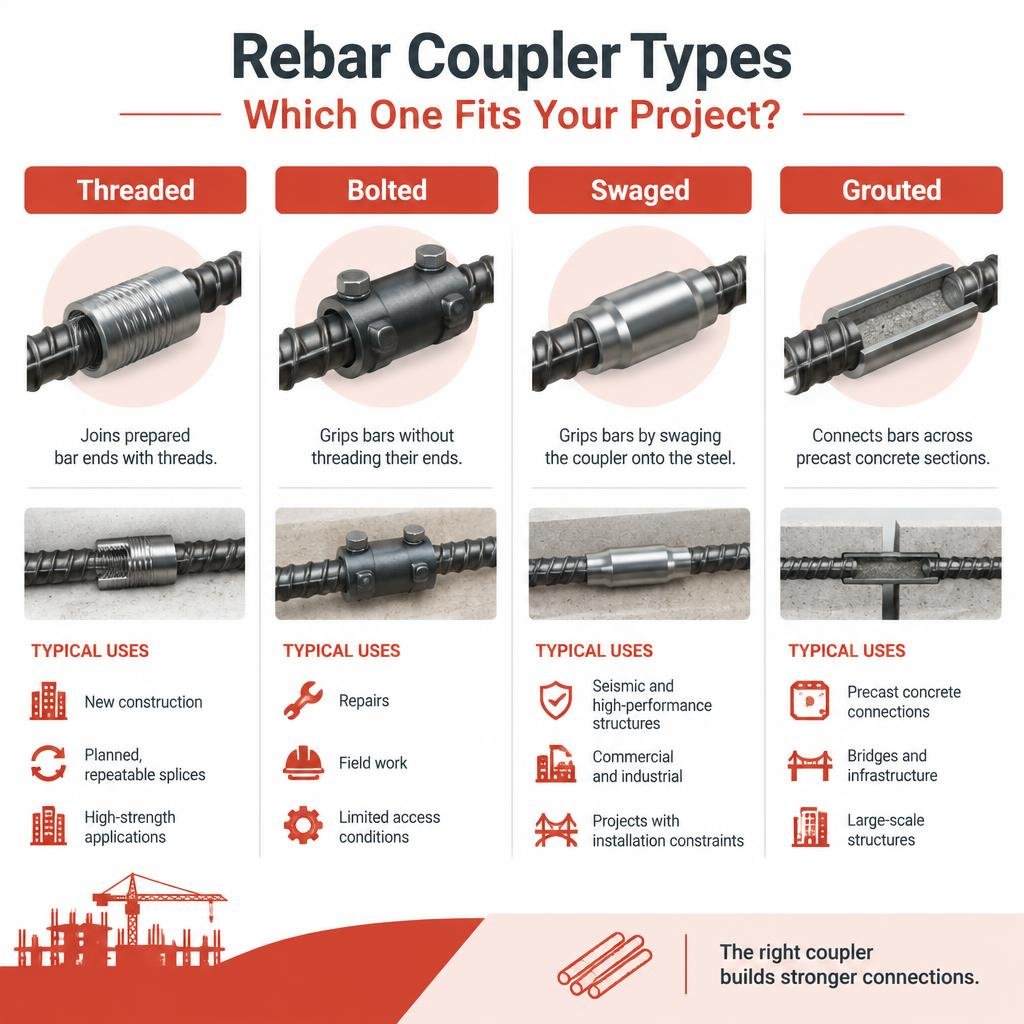
Quick rebar coupler types definitions:
What Is a Rebar Coupler and Why Use Mechanical Splicing?
A rebar coupler is a specialized mechanical connector designed to join two reinforcing steel bars end-to-end, establishing a seamless, continuous path for internal tension and compression forces. In traditional reinforced concrete design, structural engineers historically relied on lap splices—overlapping two steel bars alongside each other inside the formwork—to transfer loads through the surrounding concrete paste via friction and bonding.
While lap splicing remains common for lighter residential pours, it introduces severe structural limitations as projects scale up. Lap splices do not transfer forces directly from bar to bar. Instead, they depend entirely on the integrity of the surrounding concrete cover. If the concrete cracks, experiences thermal shock, or sustains seismic damage, that bond quickly deteriorates.
Mechanical splicing changes the dynamic by creating a direct physical connection. By taking concrete bond dependency out of the equation, couplers preserve structural continuity even if the concrete cover spalls away.
Furthermore, standard building codes explicitly restrict lapping large bars. For instance, major structural provisions like Eurocode 2 generally prohibit lap splices for bars with diameters exceeding 32 mm (roughly #10 or #11 rebar in North American sizing) unless strict, complex conditions are met. Lapping massive steel bars creates excessive reinforcement congestion, forming dense “steel forests” where aggregate cannot pass, leading to dangerous honeycomb voids and poor compaction.
By eliminating the massive bulk of overlapping steel, mechanical splices free up cross-sectional space within the forms, ensure optimal concrete consolidation, and allow structural members to maintain an ideal steel ratio below 8%. For a deeper foundation on mechanical connections, check out our comprehensive guide to bar splices and review industry technical reports like the REBAR COUPLER SYSTEMS.pdf) bulletin.
Comprehensive Guide to the Main Rebar Coupler Types

Understanding the distinctions among different coupler categories is crucial for every site superintendent and structural designer. Splicing systems fall into distinct categories based on their internal connection principles, whether they require bar-end preparation, and their specific field applications.
| Coupler Category | Connection Principle | Bar End Preparation Required | Best Project Suitability | Key Advantage |
|---|---|---|---|---|
| Parallel Threaded | Precision matching external/internal threads | Peeling, forging, or cold rolling | High-rise columns, continuous mat foundations, civil infrastructure | Compact profile, super-strength joint capacity |
| Taper Threaded | Tapered interlocking threads | Tapered thread cutting | Beams, general construction, shear walls | Rapid engagement without cross-threading risks |
| Shear-Bolt / Bolted | Mechanical embedment via shear-off bolts | None (saw-cut or sheared end) | Retrofits, structural repair, bridge widening, pile extensions | No prefabrication or specialized threading machines needed |
| Grouted Sleeve | High-strength non-shrink grout matrix | None or minimal | Precast columns, modular wall panels, segmental bridges | Absorbs construction tolerances across precast joints |
| Cold-Extruded (Swaged) | Hydraulic plastic deformation onto rebar ribs | None | Deep foundations, nuclear power plants, bridge piers | High fatigue resistance on any standard ribbed bar |
| Weldable Sleeves | Structural weldment to steel plates/sections | Factory or field welding on one side | Steel-concrete composite towers, connection plates | Direct load transfer from rebar to structural steel columns |
Threaded Rebar Coupler Types: Parallel, Tapered, and Roll-Threaded
Threaded couplers represent the global workhorse of modern concrete construction. These systems feature internal machining designed to mate with precision-cut or rolled threads applied to the tips of the reinforcement bars.
- Parallel Threaded Couplers: These sleeves use constant-diameter internal threads. High-performance varieties often incorporate upset forging or cold forging, where the bar ends are hydraulically enlarged before threading. This ensures that the cross-sectional area at the root of the thread remains equal to or greater than the original nominal bar diameter, completely preventing joint weakness.
- Roll-Threaded Couplers: Instead of cutting metal away, a specialized threading machine cold-rolls the bar’s outer ribbing into uniform threads. This preserves the steel’s grain structure, enhances yield strength, and delivers outstanding tensile capacity.
- Tapered Threaded Couplers: Featuring cone-shaped matching profiles, tapered systems allow the continuation bar to spin freely into the sleeve until the final few turns, which can then be secured with a simple torque wrench. This tapered geometry virtually eliminates the risk of cross-threading on busy job sites.
To learn more about why these threaded units dominate modern high-rise jobs, explore our guide on threaded rebar couplers as industry standards, or read up on choosing a rebar coupling machine to master shop and field fabrication.
Non-Threaded and Bolted Rebar Coupler Types for Field Splicing
When working on existing structures, unexpected design changes, or urgent retrofits, you rarely have the luxury of sending installed reinforcement out to a fab shop for threading. That is where non-threaded and bolted couplers shine.
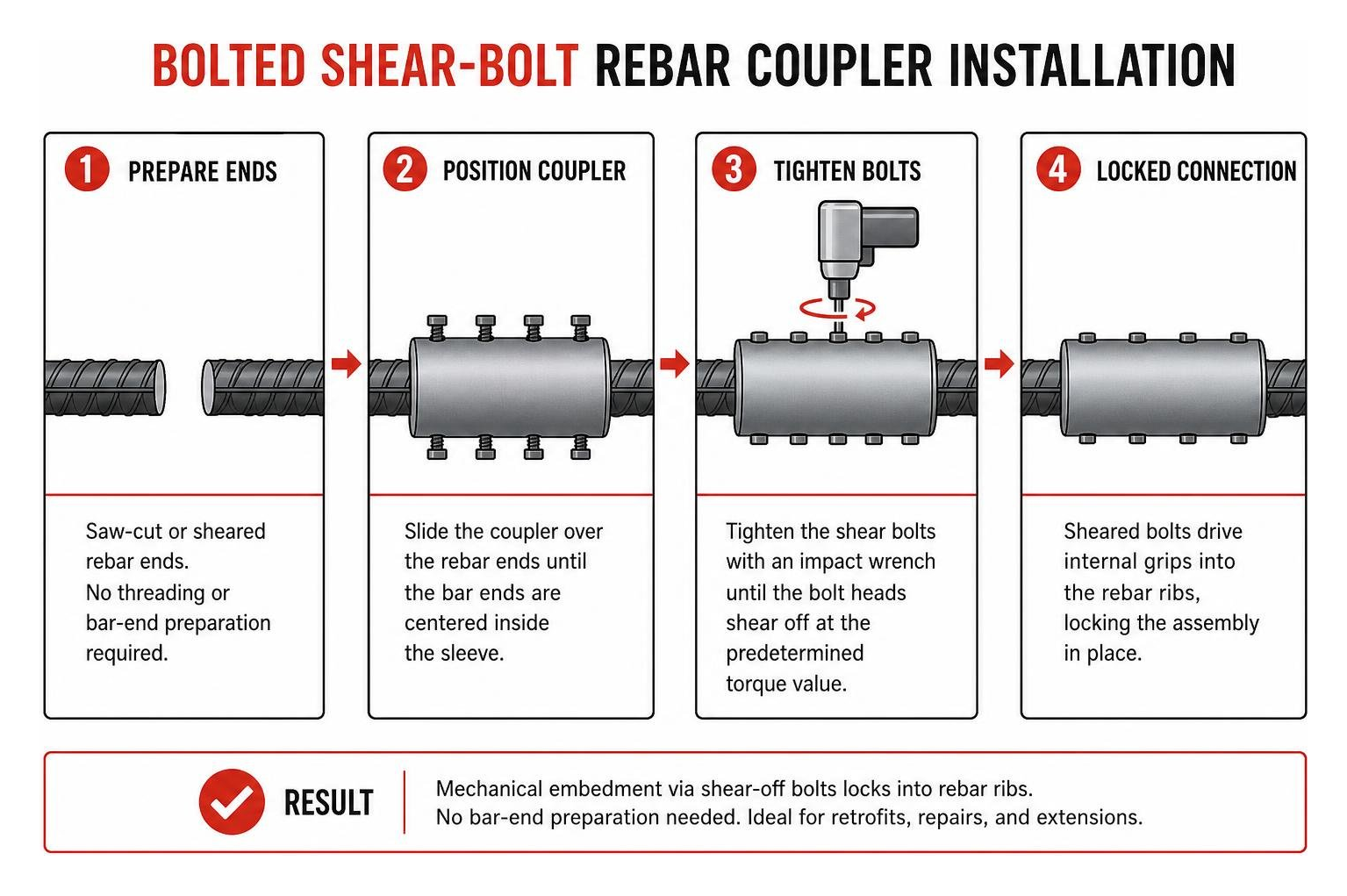
These sleeves slip directly over plain, sheared, or flame-cut rebar ends. High-grade, specially engineered shear bolts line the exterior of the sleeve. Installers tighten these bolts with an impact wrench until the bolt heads shear off at a predetermined torque value. As the bolts bite down, they drive internal saddle grips directly into the steel rebar ribs, locking the assembly permanently in place.
Bolted couplers meet exceptionally rigid slip criteria—often keeping residual slip below 0.10 mm (0.0039 in). Because they require zero bar-end preparation, they are indispensable for structural repair, pile extensions, and bridge retrofits. Discover top-tier options in our article on high-performance bolted couplers, and review certified options on the Caltrans Authorized Materials List.
Grouted Sleeve and Precast Connection Couplers
Precast concrete construction demands splicing systems that easily absorb subtle crane-positioning and casting tolerances. Grouted sleeves are hollow cylindrical steel castings embedded inside precast columns, beams, or shear wall panels.
During erection, the continuation dowel from the lower cast panel slides into the open sleeve of the upper module. Once aligned, crews inject a specialized, ultra-high-strength, non-shrink cementitious grout into the sleeve port. As the grout cures, internal cast ribs transfer tension and compression stresses from one bar, through the hardened grout matrix, into the outer sleeve and across to the adjacent bar. This provides full seismic ductility without requiring workers to weld or thread components in cramped field joints. Dive into the details with our contractor guide to sleeves and couplers.
Swaged, Cold-Extrusion, and Specialty Couplers
For extreme industrial loads, fatigue environments, and complex connection geometries, several specialty mechanical couplers provide targeted engineering solutions:
- Cold-Extrusion (Swaged) Couplers: A seamless, ductile steel sleeve is placed over the rebar joint and compressed using a portable hydraulic press. The massive hydraulic force deforms the sleeve plastically, causing the steel to interlock tightly with the rebar’s external ribs. Cold extrusion involves no heat or open flame, preserving the parent bar’s metallurgical temper.
- Positional Couplers: When neither reinforcing bar can be rotated—such as in heavily prefabricated rebar cages or pre-tied foundation mats—positional couplers solve the problem. They utilize a multi-part sleeve or dual right-hand and left-hand internal threads, drawing both bar ends tightly together as only the central collar turns.
- Transition Couplers: These stepped sleeves feature two distinct internal diameters, allowing seamless structural continuity when stepping down column sizes (such as connecting a #11 bar to a #9 bar on upper structural levels).
- Weldable Couplers: Fabricated from certified, weldable structural carbon steel, these sleeves are factory-welded to structural steel columns, embedded plates, or sheet piles, allowing standard reinforcement bars to thread directly into the structural steel framework.
For a broader look at high-strength mechanical connections, read our breakdown of durable mechanical couplers for reinforcement.
Rebar Couplers vs. Lap Splicing vs. Welding
Choosing between mechanical couplers, traditional lap splices, and field welding directly influences your project’s bottom line, installation schedule, and structural safety.

Material Consumption and Steel Waste
Lap splicing consumes massive quantities of redundant steel. Building codes typically require lap lengths amounting to 40 to 60 times the nominal bar diameter. On a 32 mm (#10) bar, a single lap splice burns through roughly 1.3 to 2 meters (4.2 to 6.5 feet) of extra rebar. Across a high-rise tower, switching from laps to couplers can reduce total steel tonnage by up to 30% to 45% in column lines.
Installation Speed and Productivity
Welding reinforcement steel requires certified structural welders, slow pre-heating cycles, and rigorous non-destructive post-weld inspection. Furthermore, field welding shuts down entirely during rain, high winds, or freezing temperatures. In contrast, mechanical splices install rapidly with standard hand or hydraulic tools regardless of weather conditions. Quick-action wedge and bolted systems can achieve up to 100 splices per hour per crew.
Structural Performance and Load Capacity
Top-tier mechanical couplers create “super-strength” connections. For straight threaded systems, joint tensile strength frequently exceeds 1.1 times the standard tensile strength of the parent steel bar. In destructive laboratory testing, true Grade I mechanical splices force ductile failure to occur out in the parent rebar body rather than at the joint, guaranteeing zero compromise in overall structural ductility.
Compare these techniques further with our analysis on Rebar Coupler vs Lapping and see how mechanical couplers maintain steel continuity.
Performance Standards, Certification, and Seismic Considerations
Because mechanical splices serve as primary structural links, they are governed by demanding national and international regulatory standards:
- ACI 318 (Building Code Requirements for Structural Concrete): Dictates Type 1 mechanical splices (capable of developing at least 125% of the specified yield strength of the bar) and Type 2 splices (which must develop both 125% of yield strength and the full specified tensile strength of the reinforcement, mandatory in seismic plastic hinge zones).
- BS 8597 & CARES Certification: The benchmark UK and European standard evaluating static tensile strength, high-cycle fatigue, and residual slip performance. For example, B500C rebar features a characteristic strength of 575 MPa and a tensile-to-yield ratio of 1.15. Couplers certified under CARES TA1-A, TA1-B, or TA1-C undergo systematic proof-testing to guarantee compatibility.
- European Assessment Documents (EAD): Establishes rigorous testing protocols including static tensile resistance, high-cycle fatigue spanning 2 million load cycles, and low-cycle reverse seismic loading. When correctly installed, the working life of standard mechanical couplers is formally rated for a 100-year design lifespan.
In high-seismic zones (such as California, the Pacific Northwest, or major fault zones across the United States), maintaining post-yield ductility is non-negotiable. Full-capacity “bar-break” couplers ensure that when severe ground motions force building frames into inelastic deformation, energy dissipates safely through plastic yielding of the rebar rather than a brittle rupture inside the splicing sleeve. To dive deeper into engineering requirements, see why engineers specify rebar joint couplers.
Key Factors When Selecting a Coupler for Your Project
Selecting the right mechanical coupler requires matching your project’s physical constraints with its structural performance criteria:
- Nominal Bar Diameter: Standard threaded and cold-extruded couplers handle bars from 12 mm (#4) up to 40 mm (#11) or 50 mm (#14/#18). For bars under 20 mm, conventional laps or continuity strip systems might suffice, but for anything 25 mm (#8) and larger, mechanical splicing is virtually always the superior choice.
- Bar Rotation Constraints: Determine early whether your continuation bar can rotate freely. If you are dropping a pre-tied steel cage into place where neither bar can turn, you must specify positional, bridging, or shear-bolt couplers rather than standard threaded systems.
- Dynamic Fatigue and Seismic Risk: Projects exposed to repetitive dynamic loading—such as railway bridges, wind turbine foundations, and seismic frames—require Type 2 or fatigue-rated mechanical splices tested up to 2 million cycles.
- Site Access and Speed Demands: If you have an on-site bar-processing depot, upset-forged parallel threading offers the lowest unit cost and fastest hookup. If you are retrofitting existing columns or doing deep foundation tie-ins with no power access, bolted or hydraulic swaged couplers save labor and avoid delays.
For practical installation advice, review how to install rebar couplers correctly and our step-by-step walkthrough on finding compatible steel reinforcement couplers.
Frequently Asked Questions About Rebar Couplers
What is the strongest type of rebar coupler?
The strongest systems are upset-forged, cold-rolled parallel threaded couplers and hydraulic cold-extrusion sleeves certified as Grade I / Type 2 mechanical splices. These achieve “bar-break” performance, meaning the joint exceeds 110% to 125% of the parent rebar’s ultimate tensile strength. In pull tests, the steel bar will neck down and snap in its main body while the coupled joint remains intact.
Can rebar couplers connect bars of different diameters?
Yes. Transition couplers (also called reducer couplers) are specifically engineered with different internal thread sizes or step-down sleeve diameters at each end. They are commonly used in high-rise construction to transition vertical column reinforcement from heavy bars at the lower levels (such as #11 / 36 mm) down to lighter bars on upper stories (such as #9 / 28 mm) while maintaining an unbroken axial load path.
When are lap splices prohibited in favor of couplers?
Major building codes, including Eurocode 2 and ACI 318, strictly prohibit or heavily penalize lap splicing for large-diameter bars (typically bars larger than 32 mm / #10 or #11). Lap splices are also banned in designated plastic hinge regions of special seismic moment frames, where high-strain cyclic reversing loads demand the unbroken structural ductility of Type 2 mechanical couplers.
Conclusion
Mechanical rebar couplers have revolutionized modern reinforced concrete construction. By establishing direct end-to-end load paths, eliminating reinforcement congestion, preventing thousands of pounds of steel waste, and guaranteeing full structural ductility, they outperform traditional lap splices in every measurable engineering category.
Whether you are erecting a seismic-resistant high-rise, assembling precast bridge piers, or executing a fast-track foundation pour, matching the right coupler type to your structural demands protects your schedule and structural integrity.
At Hercules Rebar Chairs (T.J. Harris Co.), we take immense pride in supporting the concrete construction industry across all 50 states. As America’s #1 choice with over 14 million units sold, our signature red rebar chairs and precision accessories ensure your reinforcement stays rock-solid, fully code-compliant, and perfectly positioned for every pour. Ready to streamline your reinforcement workflow? Explore our high-performance rebar splicing solutions today.