

The Right Rebar Coupling Machine Can Save You Time, Steel, and Money
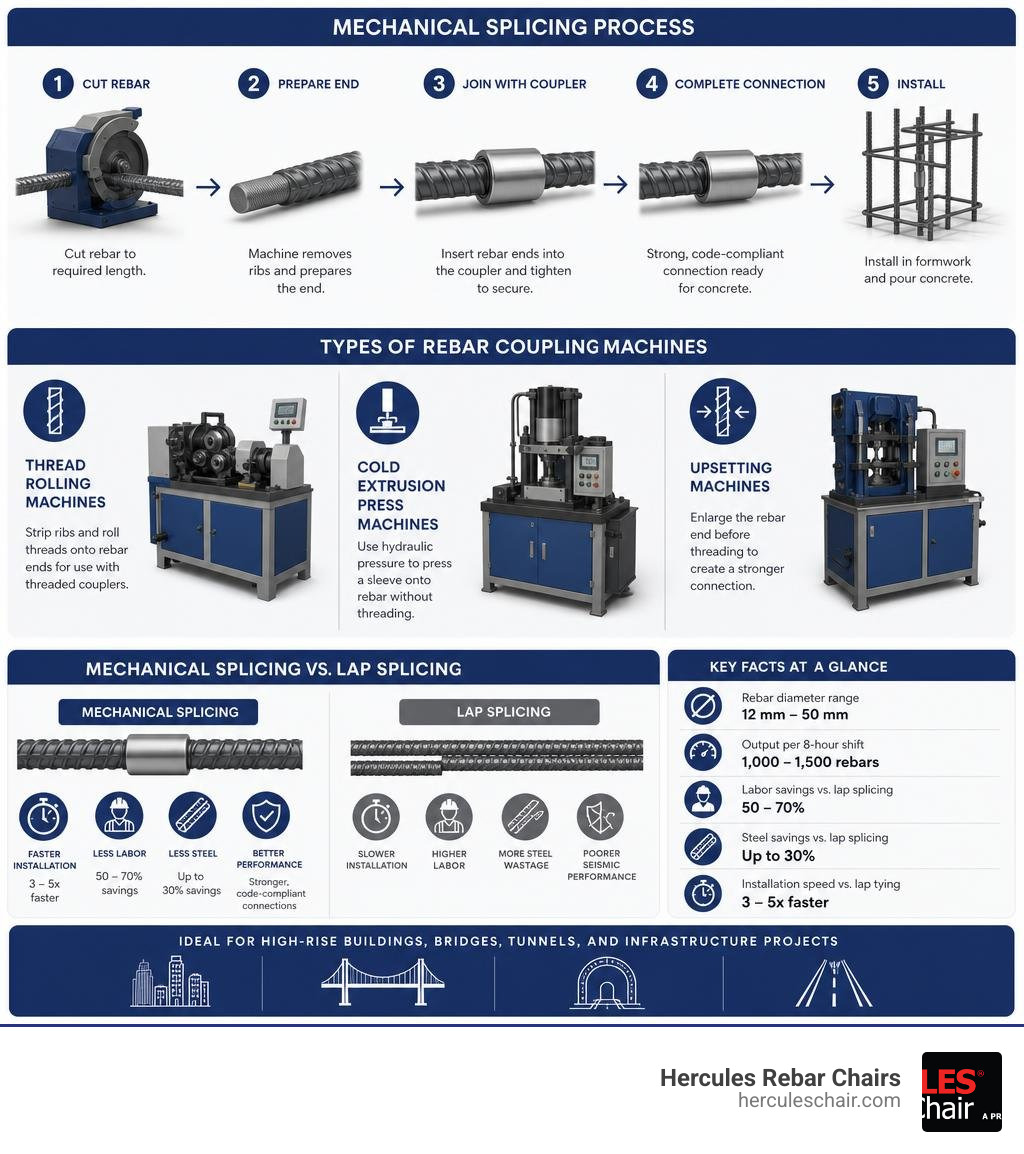
A rebar coupling machine is equipment used to mechanically join reinforcing steel bars end-to-end — replacing slower, costlier methods like lap splicing and welding. Here’s a quick summary of what you need to know:
What types of rebar coupling machines exist?
- Thread rolling machines — strip ribs and roll threads onto rebar ends for use with threaded couplers (most common)
- Cold extrusion press machines — use hydraulic pressure to press a sleeve onto rebar without threading
- Upsetting machines — enlarge the rebar end before threading to create a stronger connection
Key facts at a glance:
| Factor | Figures |
|---|---|
| Rebar diameter range | 12 mm – 50 mm |
| Output per 8-hour shift | 1,000 – 1,500 rebars |
| Labor savings vs. lap splicing | 50 – 70% |
| Steel savings vs. lap splicing | Up to 30% |
| Installation speed vs. lap tying | 3 – 5x faster |
These machines are used across high-rise buildings, bridges, tunnels, and infrastructure projects worldwide — anywhere structural rebar connections need to be fast, reliable, and code-compliant.
Traditional lap splicing wastes rebar, slows crews down, and performs poorly in seismic zones. Mechanical splicing solves all three problems. But picking the wrong machine for your project — or buying from a supplier with poor after-sales support — can cost you more than you save.
That’s where this guide comes in.
I’m Jordan Harris, a licensed Professional Engineer with a background in large-scale concrete and steel construction, and today I work with T.J. Harris Company developing rebar support solutions — so understanding how a rebar coupling machine fits into a real-world concrete workflow is something I deal with directly. In the sections ahead, I’ll walk you through every major machine type, the specs that matter, and how to choose the right equipment for your project.
What is a Rebar Coupling Machine and How Does It Work?
At its core, a rebar coupling machine is a specialized piece of industrial equipment engineered to prepare the ends of reinforcing steel bars (rebar) so they can be joined together using mechanical couplers.
In traditional concrete reinforcement, engineers rely on lap splicing—overlapping two parallel bars and tying them with wire—to transfer tension and compression forces between the steel. While simple, lap splicing relies entirely on the surrounding concrete to transfer those forces. If the concrete degrades or experiences seismic stress, the splice can fail.
Mechanical couplers, on the other hand, create a continuous steel pathway. The force is transferred directly from one bar to the next through a high-strength steel sleeve. This mechanical link ensures superior structural stability, even in high-stress or seismic environments. To understand the wider context of these mechanical systems, check out Splice It Right Your Handbook to Mechanical Lap and Dowel Bar Splicers.
The Core Mechanics of a Rebar Coupling Machine
How does a rebar coupling machine prepare the steel? The process depends on the specific technology used, but the most common method—parallel thread rolling—follows a precise, automated sequence:
- Rib Peeling (or Stripping): Standard rebar has raised deformations (ribs) designed to grip concrete. To thread the bar, these ribs must first be removed. The machine uses a set of high-speed cutting blades to peel away the outer ribs on the end of the bar, creating a smooth, perfectly cylindrical surface.
- Thread Rolling: Once peeled, the bar end is pressed through thread rolling wheels. Instead of cutting into the steel (which would weaken it by reducing its cross-sectional area), the rolling wheels use extreme pressure to cold-form parallel threads directly onto the steel surface.
- Sleeve Assembly: The threaded rebar ends are then screwed into a matching mechanical coupler sleeve, creating a seamless, high-strength connection.
For high-volume projects, an Automatic rebar threading and coupler machine can automate this entire cycle, completing a single rebar end in as little as 15 to 20 seconds.
Supported Rebar Diameters and Material Specifications
Modern rebar coupling equipment is highly versatile, designed to handle a wide range of structural demands. Standard machines typically support rebar diameters ranging from 12 mm to 50 mm (roughly #4 to #18 US rebar sizes).
The machines are engineered to work with high-strength reinforcing steel grades commonly used across the United States, such as ASTM A615 (deformed carbon-steel bars) and ASTM A706 (low-alloy steel bars for seismic applications). Because the thread-rolling process cold-works the steel rather than cutting it, the tensile strength of the threaded connection often exceeds the nominal ultimate strength of the parent bar itself.
Key Types of Rebar Coupling Equipment
Selecting the right rebar coupling machine depends heavily on your project’s structural requirements, budget, and labor constraints. The industry relies on three primary processing methods:
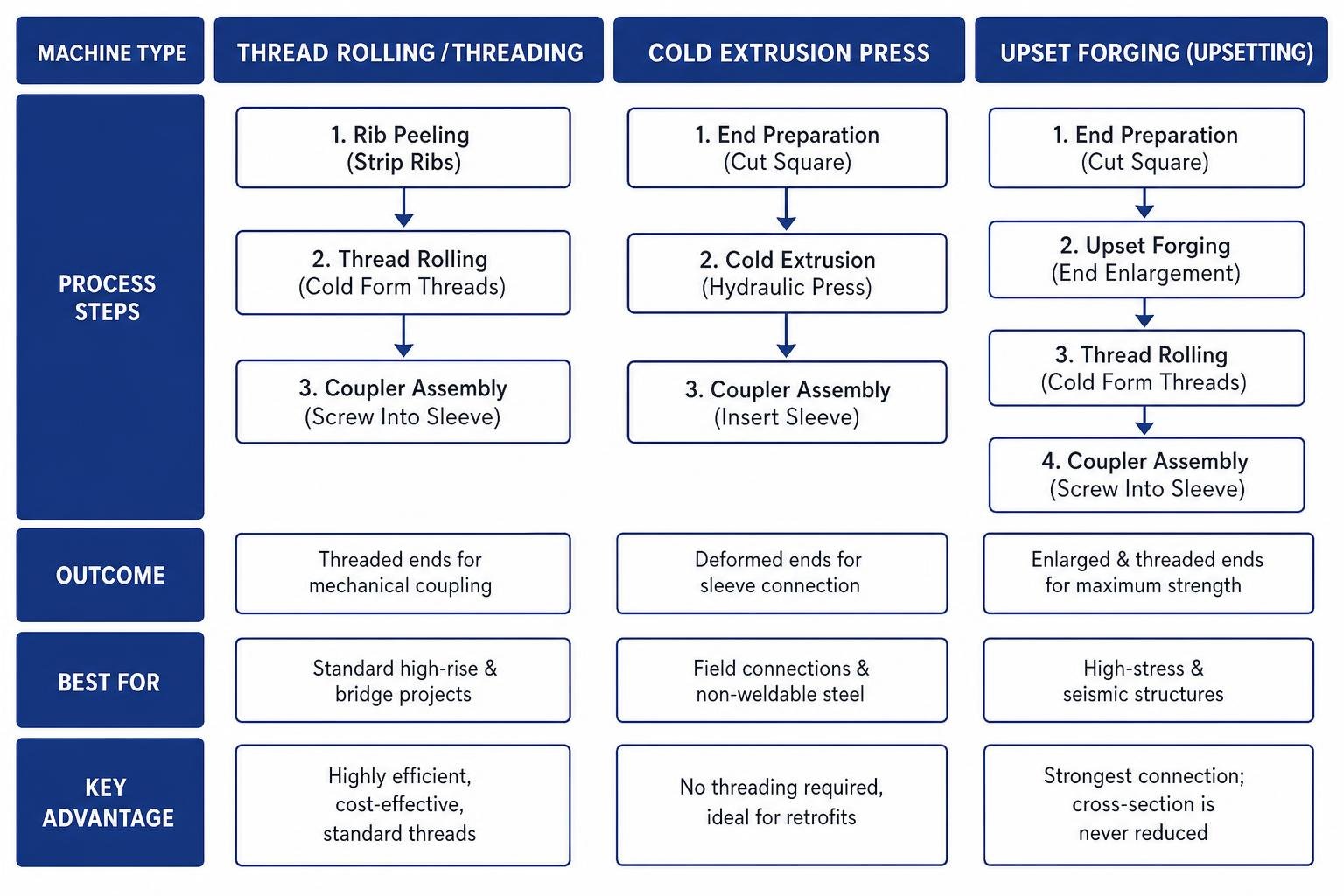
| Machine Type | Threading Method | Best For | Key Advantage |
|---|---|---|---|
| Thread Rolling / Threading | Rib-stripping followed by cold thread rolling | Standard high-rise & bridge projects | Highly efficient, cost-effective, standard threads |
| Cold Extrusion Press | No threads; hydraulic sleeve deformation | Field connections & non-weldable steel | No threading required, ideal for retrofits |
| Upset Forging (Upsetting) | Hydraulic end-enlargement before threading | High-stress & seismic structures | Strongest connection; cross-section is never reduced |
Thread Rolling and Threading Machines
Thread rolling machines are the workhorses of the modern job site. These systems utilize parallel thread technology to prepare the rebar ends. By stripping the concrete-gripping ribs and immediately rolling threads in a single, continuous step, they maintain the integrity of the steel core.
The pitch of the threads is carefully calibrated based on the bar size—typically a 2.5 mm pitch for 16–22 mm rebar and a 3.0 mm pitch for 25–40 mm rebar. This tight tolerance ensures minimal clearance (often ≤0.1 mm) when screwed into the coupler sleeve. You can explore these systems further by looking at a standard rebar coupler and threading machine.
Cold Extrusion Press Machines
When threading isn’t an option—such as when working with existing rebar in a retrofit or dealing with steel that cannot be easily threaded—cold extrusion is the go-to solution.
Instead of threading the bar, a Rebar Coupler Machine | Steel Bar Cold Extrusion Press Machine uses a high-pressure hydraulic pump (often generating up to 60 MPa of pressure) and specialized hydraulic pliers. The operator slips a seamless steel sleeve over the overlapping rebar ends and activates the press. The machine squeezes the sleeve, cold-deforming the steel so that it tightly grips the rebar’s ribs. This creates a highly secure, threadless mechanical connection.
Upset Forging and Upsetting Machines
For projects with the most stringent structural demands, engineers often specify upset forged parallel thread connections. In standard threading, even cold-rolling can slightly reduce the effective shear plane of the bar. Upsetting solves this.
Before any threads are rolled, the rebar end is placed into an upsetting machine. Using a massive nominal forging force (often up to 2500 KN), the machine hydraulically compresses the end of the bar, physically enlarging its diameter. Once the end is “upset,” threads are rolled onto this thickened section. Because the threaded portion is now thicker than the rest of the bar, the connection point is guaranteed to be stronger than the base metal itself. To see this heavy-duty gear in action, review the details of a Stronger Concrete Builds With Our Upsetting Machine | Rebar Factory.
Why Mechanical Splicing Beats Traditional Lap Splicing and Welding
If you’ve spent any time on a concrete pour, you know that managing rebar congestion is a constant headache. Traditional lap splicing requires overlapping bars by up to 30 to 40 times their diameter, creating dense cages of steel that make it incredibly difficult for concrete to flow smoothly.
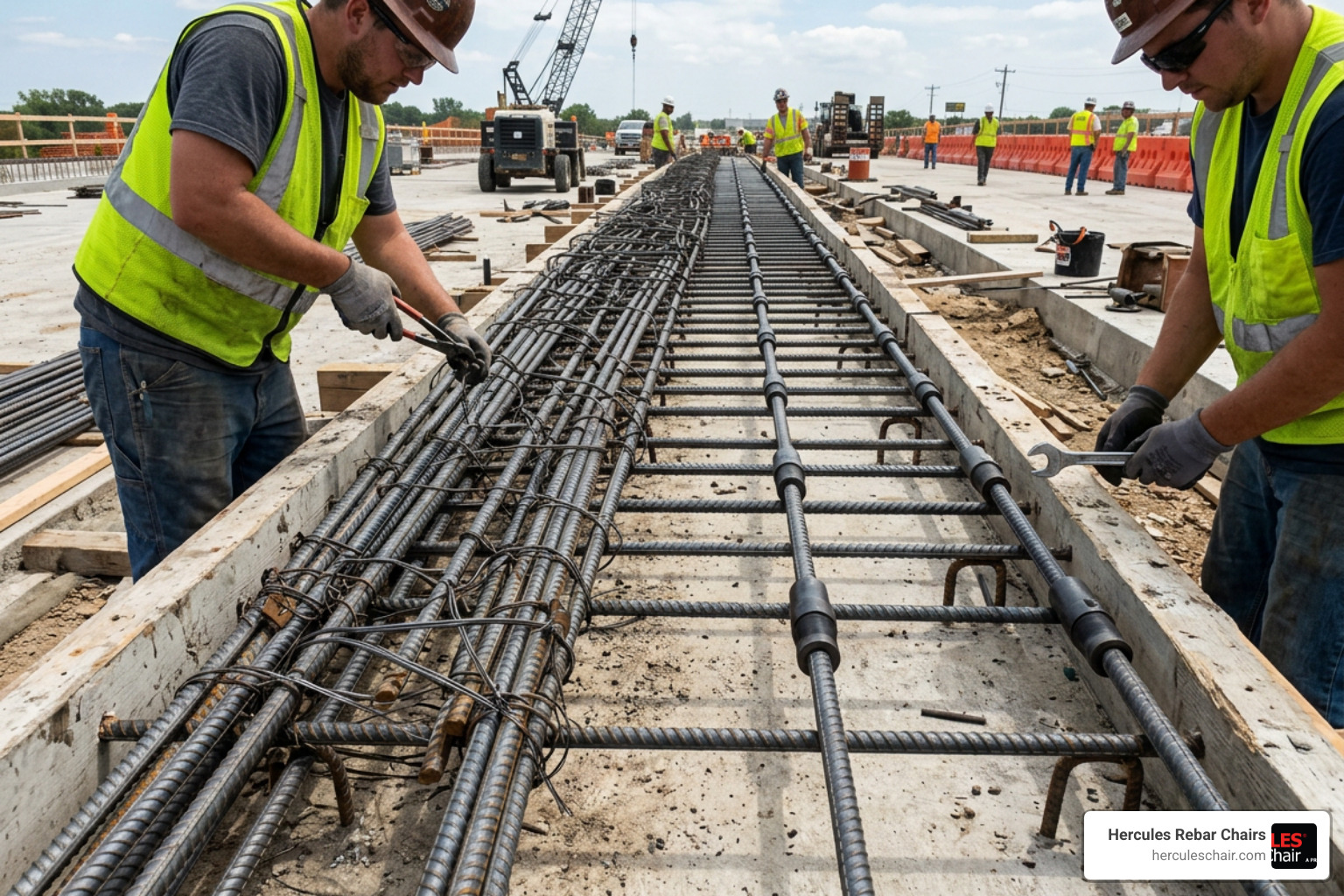
Mechanical couplers solve this structural and logistical bottleneck. By connecting bars end-to-end, you eliminate the overlap entirely. For a detailed breakdown of how these couplers streamline your setup, see Splicing Made Simple with These Top Rated Rebar Couplers.
Economic and Structural Advantages of a Rebar Coupling Machine
Investing in a rebar coupling machine isn’t just about structural peace of mind; it’s a massive win for your bottom line.
- Up to 30% Steel Reduction: Eliminating lap overlaps means you buy, ship, and place significantly less steel. On a multi-story high-rise or a long-span bridge, this can translate to thousands of tons of saved rebar.
- 50% to 70% Labor Cost Savings: Tying lap splices is tedious, back-breaking work. Operating a threading machine and spinning on couplers requires fewer hands and less manual effort.
- 3–5x Faster Installation: Rebar coupler installation is 3 to 5 times faster than lap tying and 2 to 4 times faster than welding.
- Seismic Resilience: Unlike lap splices, which rely on concrete integrity, mechanical splices maintain load transfer even if the surrounding concrete cracks or spalls during an earthquake. To understand why this has become the modern benchmark, read Threaded Rebar Couplers and Why They Are the Industry Standard.
On-Site Mobile Units vs. Factory-Based Pre-Threading
When planning your project, you’ll need to decide whether to process your rebar in a centralized factory or set up a mobile processing unit directly on-site.
Factory pre-threading is excellent for standard, highly repetitive designs where logistics are predictable. However, for projects with tight schedules or custom, fast-changing field requirements, on-site mobile threading units are incredibly efficient.
Setting up a mobile unit—which typically requires a flat 20 m x 20 m area for the machine and raw material storage—allows your crew to thread and fit rebars on demand. Many modern mobile setups are completely self-supporting, including their own energy and cooling water supplies, giving you maximum field flexibility. To compare the tools required for these different environments, check out A Comprehensive Guide to Comparing Rebar Connection Tools.
Key Specifications, Safety, and Compliance Standards
When shopping for a rebar coupling machine, you can’t just look at the price tag. You need to evaluate the technical specifications to ensure the equipment can keep up with your crew while maintaining strict safety and quality standards.
Technical Specifications of Threading Equipment
A standard heavy-duty thread rolling machine typically features:
- Motor Power: A robust 4 kW to 7.5 kW 3-phase motor (typically running on 380V to 415V).
- Weight and Portability: Approximately 400 kg (880 lbs) for standard threaders, while massive upsetting machines can weigh upwards of 1300 kg (2860 lbs).
- High-Output Rollers: Premium machines use thread rolling wheels made of ultra-durable Cr12MoV alloy, capable of processing 5,000 to 8,000 high-strength bars before needing replacement or repair.
- Precision Control: Look for machines with built-in limit switches that control thread length, ensuring a thread length error of less than ±0.5 mm.
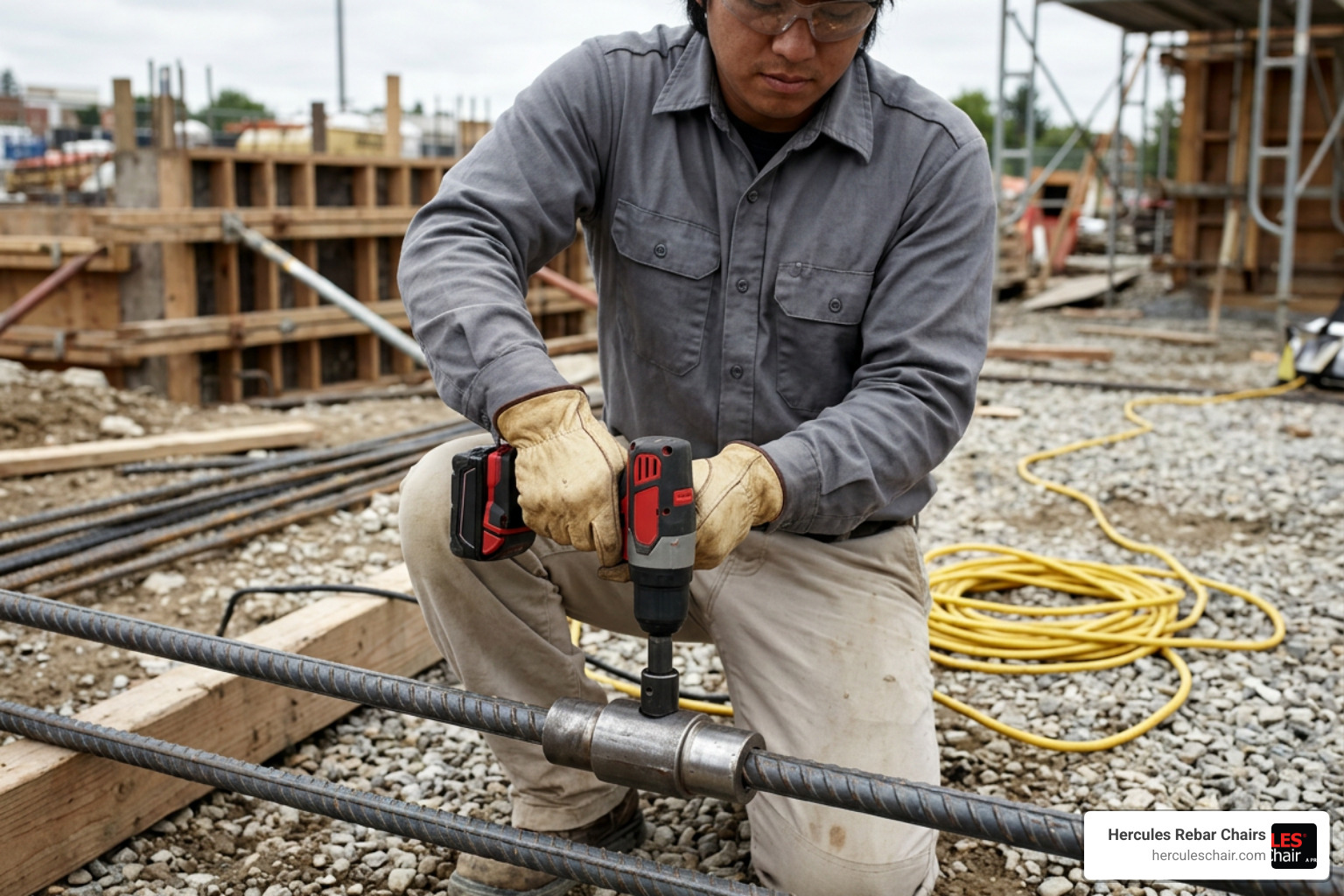
To ensure these connections are tightened to exact engineering specifications in the field, crews pair these machines with specialized assembly tools like an Electric rebar coupler torque wrench – Rebar Coupler Pro.
International and National Standards
Every mechanical splice used in US infrastructure must comply with strict building codes. When selecting a machine and its corresponding couplers, ensure they meet:
- ACI 318 (American Concrete Institute): Requires Type 1 or Type 2 mechanical splices depending on seismic design categories.
- ASTM A615 / A706: Material and elongation standards for the reinforcing steel.
- ISO 15835: International standard governing mechanical splices for reinforcement steel.
- CE Certification: Ensuring electrical and mechanical safety compliance for the machinery itself.
For a deep dive into the engineering math and load-testing requirements behind these standards, consult the mechanical rebar coupler technical manual.
Frequently Asked Questions about Rebar Coupling Equipment
What is the typical cost and lead time for a rebar coupling machine?
While a single machine is a capital investment, it typically pays for itself within the first few major projects through steel and labor savings. Lead times vary: if the manufacturer has raw materials in stock, machines can ship in 5 to 10 days; custom orders or out-of-stock configurations generally take 15 to 20 days. Most equipment suppliers have a Minimum Order Quantity (MOQ) of just 1 set for machinery, though the corresponding coupler sleeves usually have an MOQ of 1,000 pieces. For more details on budgeting for these systems, see The Contractors Guide to Rebar Couplers and Sleeves.
How do you verify the quality of a processed rebar thread?
Quality control in the field is vital. Operators should regularly inspect processed ends using:
- A Ring Gauge: To verify the outer diameter of the rolled thread.
- A Go/No-Go Thread Gauge: To ensure the thread pitch is accurate and that the coupler sleeve will screw on smoothly without excessive wiggle room (clearance should be ≤0.1 mm, meeting standard 6g thread accuracy).
What accessories are needed alongside a rebar coupling machine?
To keep your production line running smoothly, you will need:
- Replacement Thread Rolling Dies & Cutting Blades: To replace worn parts and maintain crisp thread profiles.
- PVC Thread Protection Caps: To protect threaded rebar ends from rust, dirt, and physical damage before the concrete pour.
- Electric Torque Wrenches: To guarantee every coupler is tightened to the engineer’s exact torque specifications.
Conclusion: Building a Solid Foundation
Whether you are constructing a high-rise in Texas, a highway bridge in Georgia, or a transit tunnel in California, choosing the right rebar coupling machine is a game-changer for your project’s efficiency and structural integrity. By transitioning from outdated lap splices to high-precision mechanical connections, you save steel, slash labor costs, and build structures designed to stand the test of time.
At Hercules Rebar Chairs (T.J. Harris Co.), we know what it takes to build strong. As America’s #1 manufacturer of concrete supports—with over 14 million of our signature red rebar chairs sold across the United States—we are dedicated to helping you save time, save money, and stay fully code-compliant on every single pour.
Ready to elevate your structural connections? Take the next step in your concrete journey by reading our comprehensive guide: Rebar Couplers Your Ultimate Guide to Connecting Steel Strong.