

What You Need to Know Before Pouring a Concrete Slab
Concrete slab pouring is a project most intermediate DIYers and contractors can tackle successfully — if they plan ahead and follow the right steps.
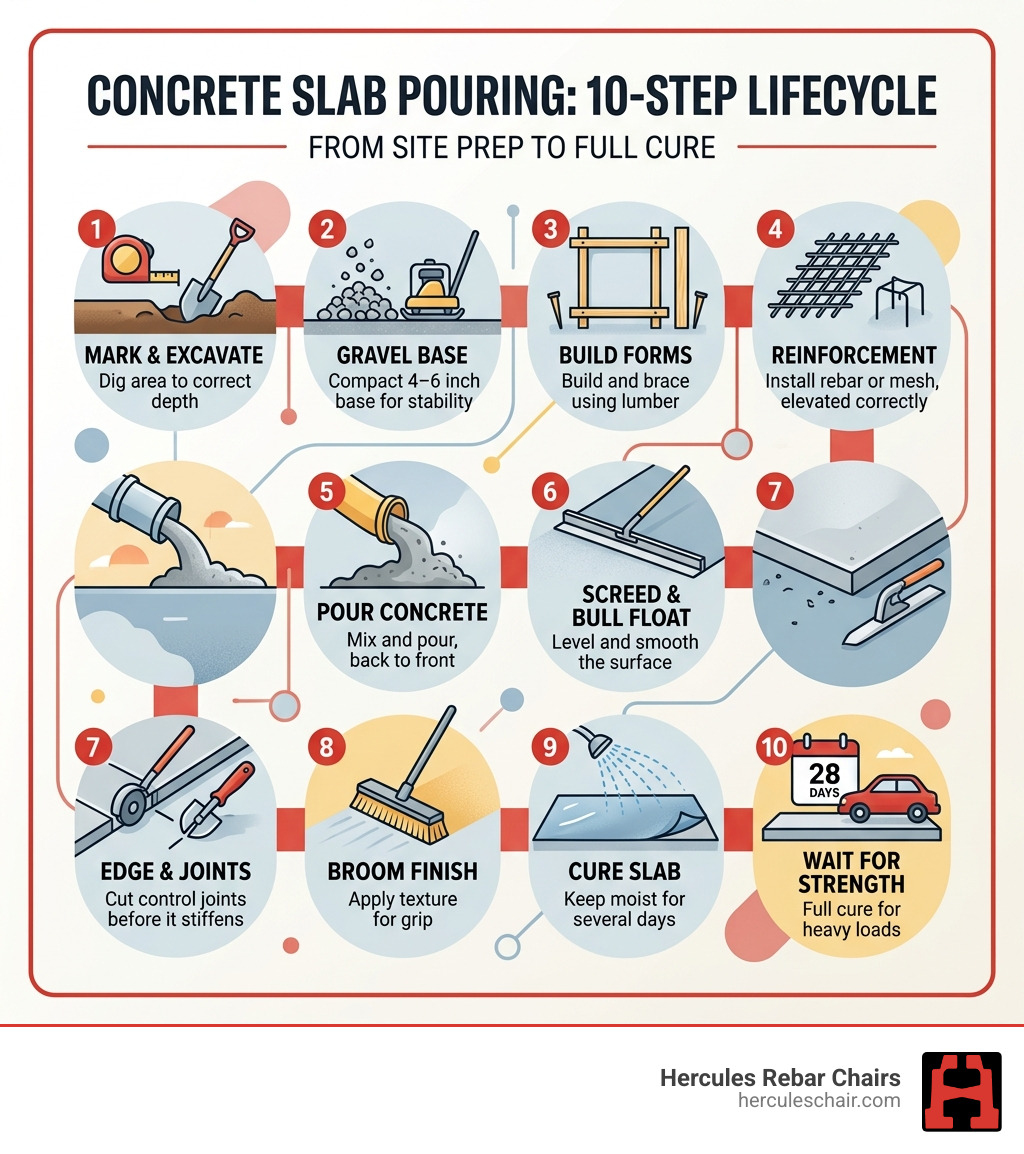
Here’s the quick overview:
- Mark and excavate the area to the correct depth
- Compact a 4–6 inch gravel base for drainage and stability
- Build and brace your forms using straight lumber and stakes
- Install reinforcement (rebar or wire mesh) elevated to the correct depth
- Mix and pour concrete starting from the back and working forward
- Screed and bull float to level and smooth the surface
- Edge and cut control joints before the concrete stiffens
- Apply a broom finish for grip and texture
- Cure the slab by keeping it moist for several days
- Wait 28 days for full strength before heavy loads
A few things to keep in mind before you start:
- Most residential slabs (patios, walkways, shed floors) need 4 inches of concrete thickness
- Driveways typically require 5–6 inches
- A 10×10 ft slab at 4 inches thick needs roughly 56 bags of 80 lb concrete
- Properly cured concrete can be up to twice as strong as concrete that dries without moisture control
- Once the pour starts, there is no starting over — preparation is everything
I’m Jordan Harris, a licensed Professional Engineer with a master’s degree in structural engineering and hands-on experience designing large-scale concrete projects, and I now apply that expertise at T.J. Harris Company to help contractors get concrete slab pouring right from the reinforcement up. In this guide, I’ll walk you through every step — from site prep to curing — so your slab comes out level, strong, and built to last.
Easy concrete slab pouring glossary:
Planning and Site Preparation for Concrete Slab Pouring
Before we even touch a bag of cement, we have to talk about the “foundation of the foundation.” In April 2026, the trend in residential construction is moving toward ultra-durable outdoor living spaces, and that durability starts underground. A slab is only as good as the ground it sits on. If you pour over soft, organic soil or uneven dirt, your beautiful new patio will eventually resemble a jigsaw puzzle of cracks.
Marking and Excavation
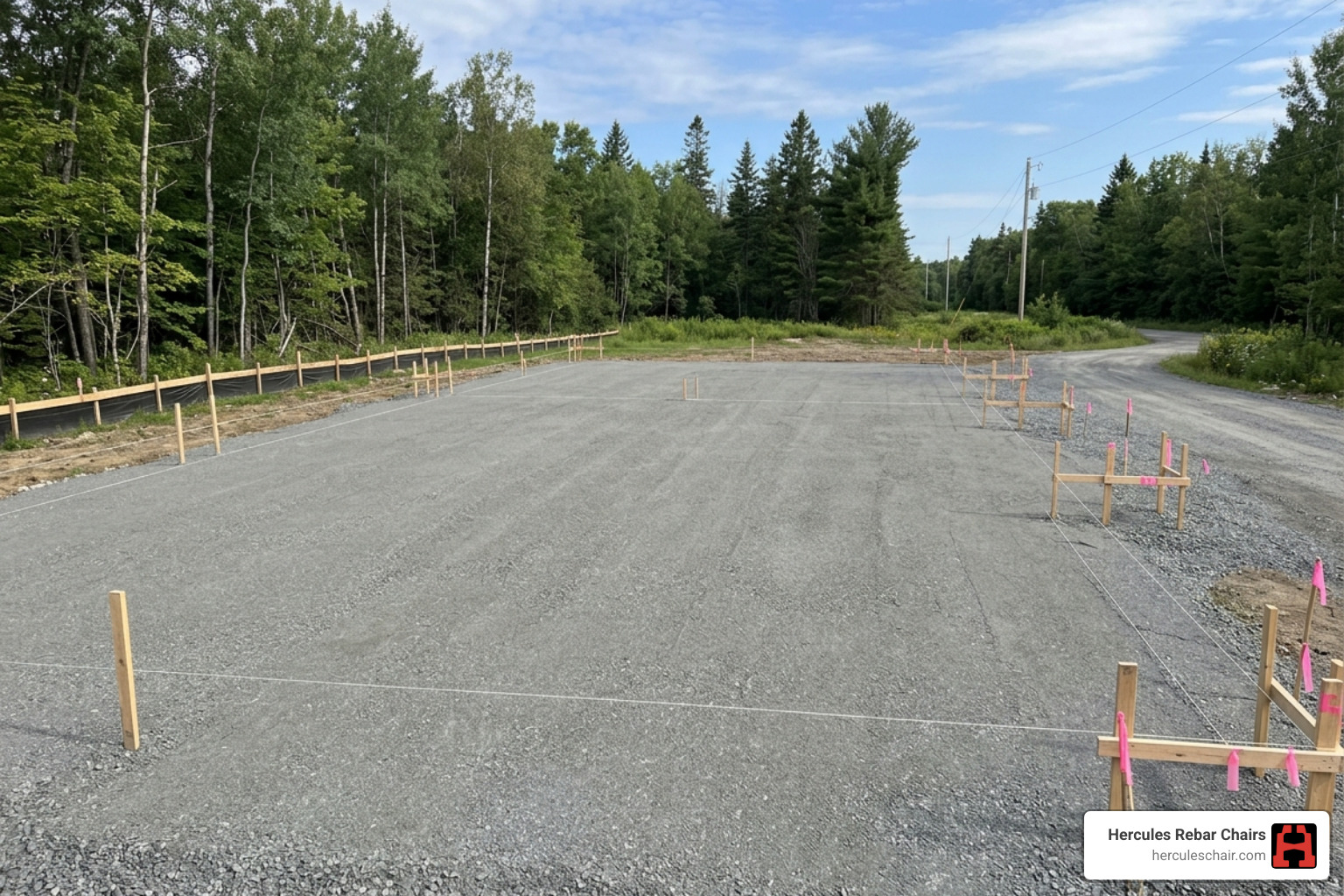
Start by marking your perimeter. We recommend using batter boards and string lines to ensure your angles are perfectly square. Use the 3-4-5 triangle method: measure 3 feet along one side and 4 feet along the adjacent side; the diagonal between those points must be exactly 5 feet.
Once marked, it’s time to dig. For a standard 4-inch residential slab, you’ll typically need to excavate about 8 to 10 inches deep. This allows for 4 to 6 inches of compacted gravel and 4 inches of concrete. Don’t forget to call your local utility marking service before you dig! Striking a gas or water line is a quick way to turn a “Slab Happy” weekend into a neighborhood-wide headache.
Subgrade and Drainage
Remove all grass, roots, and topsoil. You want to reach “virgin” soil that hasn’t been disturbed. Once the dirt is clear, use a plate compactor to firm up the subgrade. If the soil stays soft or “spongy,” you may need to dig deeper and add more base material.
Crucially, you must account for drainage. We always recommend a slope of 1/8 inch to 1/4 inch per foot away from any structures (like your house or garage). This prevents water from pooling against your foundation. For more technical details on setting these levels, check out How to Build a Concrete Slab.
The Gravel Base
We cannot stress this enough: do not pour concrete directly on dirt. Concrete is porous; it absorbs moisture. A 4-to-6-inch layer of well-compacted gravel (often called “crusher run” or 3/4-minus) provides a stable platform and allows water to drain away, preventing the soil from eroding beneath your slab. Compact this gravel in “lifts” of 2 inches at a time for maximum density. To ensure your reinforcement is planned correctly for this base, see How to Calculate Rebar for Slab the Right Way.
Essential Tools and Material Calculations
Nothing kills the momentum of concrete slab pouring faster than running out of mud three-quarters of the way through the job. Because there is no “reset button” once concrete begins to set, your math must be spot on.
The 10% Rule
When calculating your concrete needs, always add a 10% waste buffer. This accounts for spillage, slight variations in excavation depth, and the “oops” factor.
| Slab Size | Thickness | Approx. 80lb Bags (incl. 10% buffer) |
|---|---|---|
| 10′ x 10′ | 4 inches | 62 Bags |
| 10′ x 10′ | 6 inches | 93 Bags |
| 20′ x 20′ | 4 inches | 244 Bags |
| 20′ x 20′ | 6 inches | 366 Bags |
An 80 lb bag of high-strength concrete mix typically yields 0.6 cubic feet. If you are doing a large project, like a 20×20 driveway, you are looking at over 200 bags. At that point, we usually suggest calling a ready-mix truck. If you go the DIY bag route, a portable mixer is your best friend.
Tools for Success
You will need a specific “kit” for a professional finish:
- PPE: Safety glasses, alkali-resistant gloves (concrete is caustic!), and rubber boots.
- Forming Tools: Circular saw, drill, 3-inch screws, and a sledgehammer.
- Pouring Tools: Wheelbarrow, shovels, and a concrete rake (come-along).
- Finishing Tools: A straight 2×4 for screeding, a bull float for the initial smooth, a magnesium hand float for detail work, and an edger.
For a deeper dive into garage-specific projects, read How to Master Garage Slab Rebar Placement in 30 Days. You can also find a great tool checklist at How to Pour a Concrete Slab.
Building Forms and Reinforcement Strategies
Your forms are the “mold” for your project. If they aren’t strong, the weight of the wet concrete (which is roughly 150 lbs per cubic foot) will cause them to bow or “blow out.”
Use straight 2×4 or 2×6 lumber for your forms. Drive wooden or steel stakes every 2 to 3 feet along the outside. For extra security, add “kickers”—diagonal braces that transfer the outward pressure of the concrete into the ground. Once your forms are set, double-check your strings and levels. A common pro tip is to coat the inside of the forms with a release agent (even vegetable oil works in a pinch) to make them easier to remove later.
Mastering Reinforcement for Concrete Slab Pouring
This is where many DIY projects fail. Some people think they can just “pull up” wire mesh as they pour. Truthfully? That never works. The mesh ends up at the bottom of the slab, where it provides zero structural benefit.
To prevent cracks from widening and to handle temperature-related expansion, you need steel. For slabs under 5 inches, wire mesh is common; for anything thicker or load-bearing (like a driveway), rebar is the standard.
The “Upper Third” rule is critical. Reinforcement must sit in the middle to upper third of the slab’s thickness to be effective. This is why Why Your Slab Needs Rebar Chair Supports is such a vital concept. At Hercules Rebar Chairs, we manufacture the industry’s most trusted supports to solve this exact problem. Our identifiable red chairs ensure your rebar stays exactly where it belongs during the pour, saving you time and ensuring code compliance. We’ve sold over 14 million units because they work.
For a comprehensive layout guide, see our Rebar Placement Guide and learn more about achieving a durable finish in Slab Strong: Mastering Rebar Placement for Durable Concrete.
The Pour: Mixing and Placing Techniques
The day of the pour should be a “team sport.” Even for a small patio, having two or three extra sets of hands is the difference between a smooth finish and a disaster.
Mixing to Perfection
If you’re using bagged mix, aim for a “peanut butter” consistency. If the mix is too runny (soupy), the concrete will be weak and prone to shrinking and cracking. If it’s too dry, it won’t consolidate around your reinforcement. For an 80 lb bag, you generally need about 3.5 quarts of water, but add it slowly.
The Strategy
Always start pouring at the furthest corner or back of the slab and work your way toward your exit point. Use a concrete rake to spread the mud, ensuring it fills all corners and completely encases your rebar chairs. Don’t overfill, but keep the level slightly higher than the forms so you have material to “screed” off. For more placement tips, check out How to Place Rebar Like a Pro and Pro Tips: How to Pour a Concrete Slab | DIY Concrete Slab Guide.
Professional Finishing for Concrete Slab Pouring
Once the concrete is in the forms, the clock starts ticking.
- Screeding: Use a long, straight 2×4. With one person on each side, use a sawing motion to pull the board across the top of the forms. This levels the concrete and knocks down high spots.
- Bull Floating: Immediately after screeding, use a bull float. Push it away with the front edge slightly raised, and pull it back with the back edge slightly raised. This pushes the large aggregate down and brings the “cream” (the fine cement paste) to the surface.
- The Wait: Now, you wait. “Bleed water” will rise to the surface. Do not touch the concrete until this water disappears. If you work it while wet, you’ll weaken the surface.
- The Thumbprint Test: Press your thumb into the concrete. If you can only indent it about 1/4 inch and your thumb stays clean, it’s time for final finishing.
- Edging and Joints: Use an edging tool to create a rounded perimeter (this prevents chipping) and a groover to cut control joints. Control joints should be spaced 2 to 3 times the thickness of the slab in feet (e.g., every 8 to 12 feet for a 4-inch slab).
- Broom Finish: For outdoor slabs, pull a specialized concrete broom across the surface to create a non-slip texture.
For more on getting that perfect level, see How to Use Concrete Slab Spacers for a Perfect Pour.
Curing, Troubleshooting, and Cost Analysis
The pour might be done, but the chemistry is just beginning. Concrete doesn’t “dry”—it cures through a chemical reaction called hydration.
The Hydration Process
If concrete loses its water too fast, it becomes brittle. To get maximum strength, you must keep it moist. We recommend covering the slab with 4-mil plastic sheeting or wet burlap for at least 3 to 7 days. Properly cured concrete can be up to twice as strong as uncured concrete! While you can usually walk on it after 48 hours, wait a full 28 days before driving a vehicle onto it.
Troubleshooting Common Issues
- Cracking: Usually caused by skipping control joints or a poor gravel base.
- Dusting/Scaling: Often the result of overworking the surface while bleed water was still present.
- Uneven Surfaces: Caused by poor screeding or forms that shifted during the pour.
Cost Analysis: DIY vs. Pro
Pouring a 10×10 (100 sq ft) slab yourself typically costs between $400 and $800 in materials (concrete, gravel, lumber, rebar chairs). Hiring a professional for the same job can cost anywhere from $1,200 to $2,500 depending on your location and site access. Doing it yourself saves money, but it requires significant physical labor and attention to detail.
For a full breakdown of reinforcement costs and techniques, consult the Rebar Slab Support Complete Guide and our Step-by-Step Guide to Mastering Your Rebar Placement.
Frequently Asked Questions about Concrete Slab Pouring
Can I pour concrete directly on dirt?
Technically, you can, but you shouldn’t. Dirt shifts, holds moisture, and can erode. Without a compacted gravel base, your slab will eventually settle unevenly, leading to structural cracks. A 4-inch gravel base is the industry standard for a reason—it provides a stable, self-draining foundation.
How thick should my concrete slab be?
For residential walkways and patios, 4 inches is the standard. For driveways or pads intended to hold heavy equipment or hot tubs, we recommend 5 to 6 inches. If you’re curious about when you can skip the heavy steel, read Why Your 4-inch Slab Might Not Need Rebar (and When It Does).
What is the ideal weather for pouring concrete?
The “Goldilocks” zone for concrete is between 60°F and 80°F. If it’s too hot, the concrete sets too fast, making it hard to finish. If it’s below 50°F, the chemical reaction slows down significantly. Never pour if a freeze is expected within 48 hours, and always have plastic ready in case of a surprise rain shower. Learn more about protecting your mesh in various conditions here: Elevate Your Slab with Concrete Mesh Chairs.
Conclusion
There is a unique sense of satisfaction that comes from standing on a perfectly smooth, level concrete slab that you poured yourself. It’s a permanent addition to your home that, if done correctly, will last for decades.
At Hercules Rebar Chairs, we believe the secret to a “Slab Happy” project is in the details you can’t see once the concrete is dry. Using high-quality, USA-made supports ensures your reinforcement stays in the “power zone” of the slab, preventing future failures and keeping you in compliance with building codes. Whether you are a weekend warrior or a seasoned pro, our red chairs are designed to make your job faster, easier, and stronger.
Ready to start your project? Use our tools to ensure you have exactly what you need:
- The Ultimate Guide to Rebar Chairs: Types, Uses, and Sizing for Concrete Slabs
- Calculate your project needs with the Hercules Rebar Chair Estimator
Happy pouring!