

Why Every Builder Needs a Rebar Chair Footer for Footings
A rebar chair footer for builders is a plastic support stand that holds rebar at the correct height inside a concrete footing trench before and during the pour. Here’s what you need to know right away:
- What it does: Lifts rebar off the ground to maintain a 3-inch clearance, protecting steel from moisture and corrosion.
- Who needs it: Any contractor pouring concrete footings with #4 or #5 rebar.
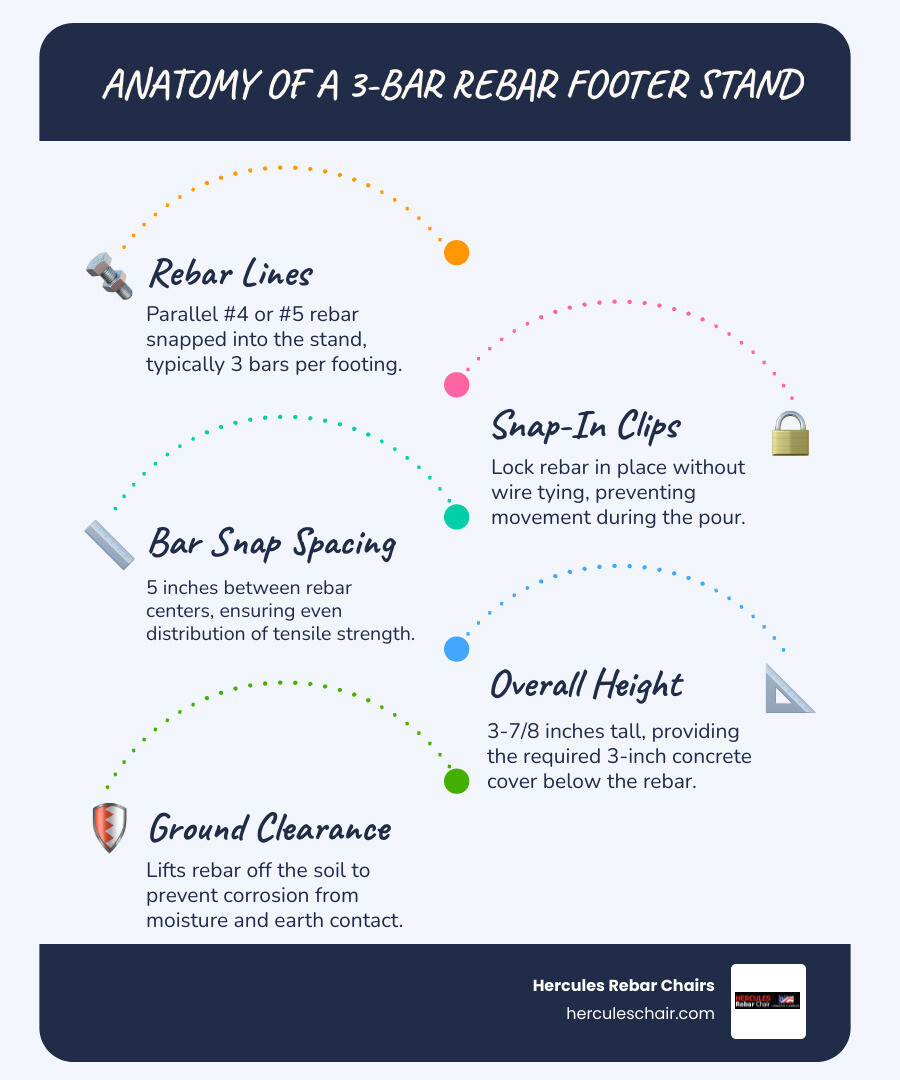
- Top pick: The Hercules #924 3-Bar Footer Stand — holds three parallel rebar lines, 5 inches apart, at 3-7/8 inches overall height.
- How to use it: Place one stand every 4 feet, snap rebar in, pour concrete. The stand stays buried permanently.
- Where to buy: Available in a 30-pack at Home Depot.
Skipping rebar support isn’t just a time risk — it’s a code risk. Rebar that sags to the bottom of a trench loses most of its structural value. Concrete poured directly against the earth requires a minimum of 3 inches of concrete cover to protect steel from corrosion. Footer stands make that clearance automatic, consistent, and fast.
Traditional wire-tying methods slow crews down and still leave room for human error. A snap-in footer stand removes both problems at once.
I’m Jordan Harris, a licensed Professional Engineer and structural engineer with five years of experience on large-scale concrete projects — and I’ve seen how the right rebar chair footer for builders can be the difference between a footing that meets code and one that doesn’t. As part of the team at Hercules Rebar Chairs, I bring that engineering background directly into product design and builder education.
The Role of a Rebar Chair Footer for Builders
When we talk about pouring a foundation that lasts for generations, we are really talking about the relationship between steel and concrete. Concrete is incredibly strong under compression (when you push on it), but it is notoriously weak under tension (when you pull or bend it). That is where rebar comes in. Rebar provides the tensile strength that keeps your concrete from cracking apart under the shifting loads of a building.
However, rebar cannot do its job if it is sitting on the bottom of the trench. If your steel is resting on the dirt, it is essentially useless.
To understand why, we have to look at the concept of concrete cover. Concrete cover is the distance between the outer surface of the concrete and the embedded steel reinforcement. When concrete is poured directly against the earth, the soil contains moisture, salts, and acids that will quickly attack bare steel. If moisture reaches the rebar, the steel will rust. As steel rusts, it expands up to ten times its original volume, causing the surrounding concrete to spall, crack, and ultimately fail.
Using a high-quality rebar chair footer for builders ensures that the steel is perfectly positioned so that the concrete can flow completely underneath it. This encapsulates the rebar in a protective alkaline environment, preventing soil moisture from causing corrosion. For a deeper dive into how these supports function across different types of builds, check out A Practical Guide to Rebar Footing Stands.
To guarantee this protection, building codes are very strict. According to the ACI 318 Building Code Requirements, any structural concrete poured directly against and permanently exposed to the earth must have a minimum of 3 inches of concrete cover. Achieving this manually is a headache; using a dedicated footer stand makes it foolproof.
Why Proper Elevation Matters in Foundation Footings
Let’s look closer at that 3-inch clearance rule. Why is 3 inches the magic number for earth-poured concrete?
When concrete is poured into an open trench, the bottom of the excavation is rarely perfectly smooth. There are clumps of dirt, loose rocks, and uneven surfaces. If you attempt to prop your rebar up on loose rocks or broken bricks (a common but highly discouraged practice), the rebar is highly likely to slip off during the pour. Even a slight sag in the rebar grid can reduce your concrete cover from 3 inches to 1 inch or less.
When rebar sits too close to the bottom of the footing:
- The steel is exposed to moisture: Soil moisture wicks directly through thin concrete, starting the corrosion process.
- Structural capacity is severely reduced: Structural engineers calculate the load-bearing capacity of a footing based on the rebar being at a specific height (the effective depth). If the rebar is too low, the footing loses its bending resistance, leading to catastrophic structural failure under the weight of the building.
- Inspectors will red-flag the project: Building inspectors in July 2026 do not tolerate sagging rebar. If they see rebar touching the dirt or supported by non-compliant materials, they will halt your pour immediately.
By using engineered plastic footer chairs, you eliminate the guesswork and ensure your foundation is built to last. For more tips on avoiding these costly mistakes, take a look at Don’t Let Your Foundation Fail with These Rebar Design Tips.
Choosing the Right Rebar Chair Footer for Builders
Not all footings are created equal, which is why we offer different structural support options depending on your specific project specifications. Depending on the load requirements of the structure, your plans might call for a two-bar system or a three-bar system.
- Two-Bar Footings: Typically used in lighter residential structures or shallower trenches. If your plans specify two parallel runs of rebar, our 2-Bar Footer Stand is the ideal choice.
- Three-Bar Footings: Often required for heavier residential foundations, commercial builds, or areas with poor soil load-bearing capacity. For these projects, the 3-Bar Footer Stand is the industry standard.
To understand the full range of options available for your job site, read through The Ultimate Guide to Footer Stand Options to make sure you are selecting the exact support system your structural plan requires.
Meet the Hercules #924 3-Bar Footer Stand

For builders who demand the absolute best in speed, strength, and code compliance, we designed the Hercules #924 3-Bar Footer Stand. This is the heavy-duty, highly visible red chair that has become a staple on job sites across the United States.
The Hercules #924 is specifically engineered to support both #4 and #5 rebar (the two most common sizes used in residential and light commercial footings). It features a unique, heavy-duty design that delivers a perfect 3-inch ground clearance to keep you fully compliant with national building codes.
Here are the exact physical specifications of the Hercules #924:
- Overall Height: 3-7/8 inches (ensuring the rebar sits at the perfect height within the footing trench).
- Bar Snap Spacing: 5 inches between each of the three parallel bar snaps. This automatically positions your three runs of rebar exactly 5 inches apart, eliminating the need to manually measure and space your steel runs.
- Material: High-strength, non-corrosive polypropylene that will never rust, degrade, or react with the concrete.
Key Benefits of the Hercules 3-Bar Design
Why do professional builders prefer the Hercules #924 over any other method? It comes down to three major performance advantages:
1. Maximum Concrete Flow
Traditional slab bolsters or concrete bricks can block the flow of concrete, creating voids or “honeycombs” underneath the rebar. The open, hollow-frame design of the Hercules #924 allows concrete to flow completely through and around the stand. This ensures total consolidation of the concrete, leaving zero weak spots in your foundation.
2. High Strength for Easy Movement
Footing trenches are busy places. Workers are stepping into the trench, dragging heavy rebar, and moving equipment. Cheap, flimsy chairs will twist, tip over, or snap under pressure. The Hercules #924 is built with exceptional structural strength. It resists lateral movement and won’t crush under the weight of a worker stepping near it, allowing your crew to move quickly and confidently.
3. Integrated Snap-In Clips (No Wire Tying!)
This is the ultimate game-changer. Traditionally, workers had to bend down in the dirt to tie every single intersection of rebar with steel wire. It is back-breaking, slow work. With the Hercules #924, you simply lay your rebar over the stand and push down. The rebar snaps securely into the integrated clips. It is locked in place in seconds without a single piece of tie wire.
For a comprehensive review of why this design outperforms the competition, check out our guide on the Top 3-Bar Footer Stands for a Rock-Solid Concrete Pour.
Installation and Spacing Guidelines
Installing the Hercules #924 is incredibly simple, but maintaining the correct spacing is critical to ensuring your rebar does not sag when the heavy concrete starts flowing from the chute. To get the best results on your job site, follow our official Footer Stand Placement Guide and learn How to Install Rebar in Footings the Right Way.
Spacing and Estimating Your Rebar Chair Footer for Builders
When laying out your footing stands, the golden rule is one stand every 4 feet.
Spacing the stands 4 feet apart provides the perfect balance of structural support and material efficiency. It prevents the #4 or #5 rebar from sagging under its own weight or shifting when the concrete is poured directly on top of it.
To calculate how many chairs you need for your project, use this simple formula:
$$\text{Total Chairs Required} = \frac{\text{Linear Footage of Footing}}{4}$$
Because our chairs are sold in convenient 30-pack quantities, estimating your order is incredibly easy. One 30-pack of Hercules #924 3-Bar Footer Stands will cover exactly 120 linear feet of footing trench.
Here is a quick look at how the Hercules snap-in system compares to traditional wire tying:
| Feature | Traditional Wire Tying | Hercules #924 Snap-In Stands |
|---|---|---|
| Installation Speed | Slow (requires manual twisting of wire at every point) | Ultra-fast (rebar snaps in place in under 2 seconds) |
| Spacing Accuracy | Manual measurement required | Automatic 5-inch parallel spacing |
| Ground Clearance | Hard to maintain consistently | Guaranteed 3-inch code-compliant clearance |
| Labor Fatigue | High (constant bending and kneeling in the trench) | Minimal (fast, easy snap-in placement) |
| Material Cost | Requires wire, ties, and separate blocks | All-in-one support stand |
To dive deeper into the mathematics of rebar support layout, read The Ultimate Guide to Spacing and Supporting Footing Rebar.
Frequently Asked Questions about Rebar Footer Chairs
Do rebar chairs get buried in the concrete or removed during the pour?
We get this question all the time from DIYers and newer apprentices: Do we take the chairs out as we pour the concrete?
Absolutely not! The Hercules #924 is designed for permanent burial. It stays in the concrete forever.
If you were to remove the chairs during the pour, the rebar would instantly sink to the bottom of the wet concrete, destroying your concrete cover and leaving your foundation vulnerable to failure. Because our chairs are made from high-strength, non-corrosive polypropylene, they integrate perfectly with the concrete mix. The concrete flows around and through the stand, consolidating into a single, solid, reinforced structure. To learn more about how permanent placement ensures structural integrity, read Foundation Strong: Mastering Rebar Placement for Lasting Concrete.
How do these stands prevent rebar collapse during a heavy concrete pour?
Concrete is heavy — weighing roughly 150 pounds per cubic foot. When it comes rushing out of a pump truck or a mixer chute, it exerts massive lateral and downward forces.
Our stands prevent rebar collapse through three design features:
- Wide, Stable Base: The base of the Hercules #924 is engineered to distribute the weight across the soil, preventing the stand from sinking into the dirt under load.
- High-Strength Polypropylene: The structural ribs of the chair are designed to handle heavy downward loads without buckling.
- Heavy-Duty Snap-In Locking Clips: Once the rebar snaps into the integrated clips, it cannot pop out or slide sideways. The steel is locked in three dimensions, ensuring it stays exactly where the structural engineer intended.
Where can builders purchase the Hercules 3-Bar Rebar Footer Chair?
We make getting our products as easy as using them. The Hercules #924 3-Bar Rebar Footer Chair is available in 30-packs at Home Depot locations nationwide, as well as through other major nationwide construction retailers and online distributors.
Whether you are a residential home builder needing a few packs for a custom home foundation or a commercial contractor ordering pallets for a large-scale development, you can find our signature red chairs ready to ship or pick up today.
Conclusion
At Hercules Rebar Chairs (a brand of the T.J. Harris Co.), we are proud to be America’s #1 choice for rebar supports, with over 14 million units sold. Our mission is simple: to save builders time and money on the job site while ensuring absolute code compliance and structural integrity.
Our signature red color is a badge of quality on job sites across all 50 states, from California to New York, and down to Florida. When inspectors see that bright red Hercules chair in your trench, they know the job is being done right.
Stop wasting time with manual wire tying, unstable concrete blocks, or cheap, flimsy chairs that collapse under pressure. Upgrade your foundation game today.
Ready to get started on your next pour? Head over to Home Depot to grab your 30-pack of Hercules #924 stands, or explore our 2-Bar Footer Stand options for smaller footprints.
For the ultimate in foundation strength and speed, make sure you always shop the best: https://herculeschair.com/2-bar-footer-stand/