

Why the Right Rebar Footer Stand Makes or Breaks Your Concrete Pour
A rebar footer stand is a plastic chair that holds steel reinforcement bars at the correct height inside a concrete footer trench — keeping rebar off the ground and in the right position during the pour.
Here’s a quick overview of what you need to know:
| Feature | 2-Bar Model (#928) | 3-Bar Model (#924) |
|---|---|---|
| Bars supported | 2 | 3 |
| Ground clearance | 3 inches | 3 inches |
| Bar spacing | 5 inches apart | 5 inches apart |
| Rebar compatibility | #4 and #5 | #4 and #5 |
| Pack size | 40 per box | 30 per box |
| Recommended spacing | Every 4 feet | Every 4 feet |
| Wire tying required | No | No |
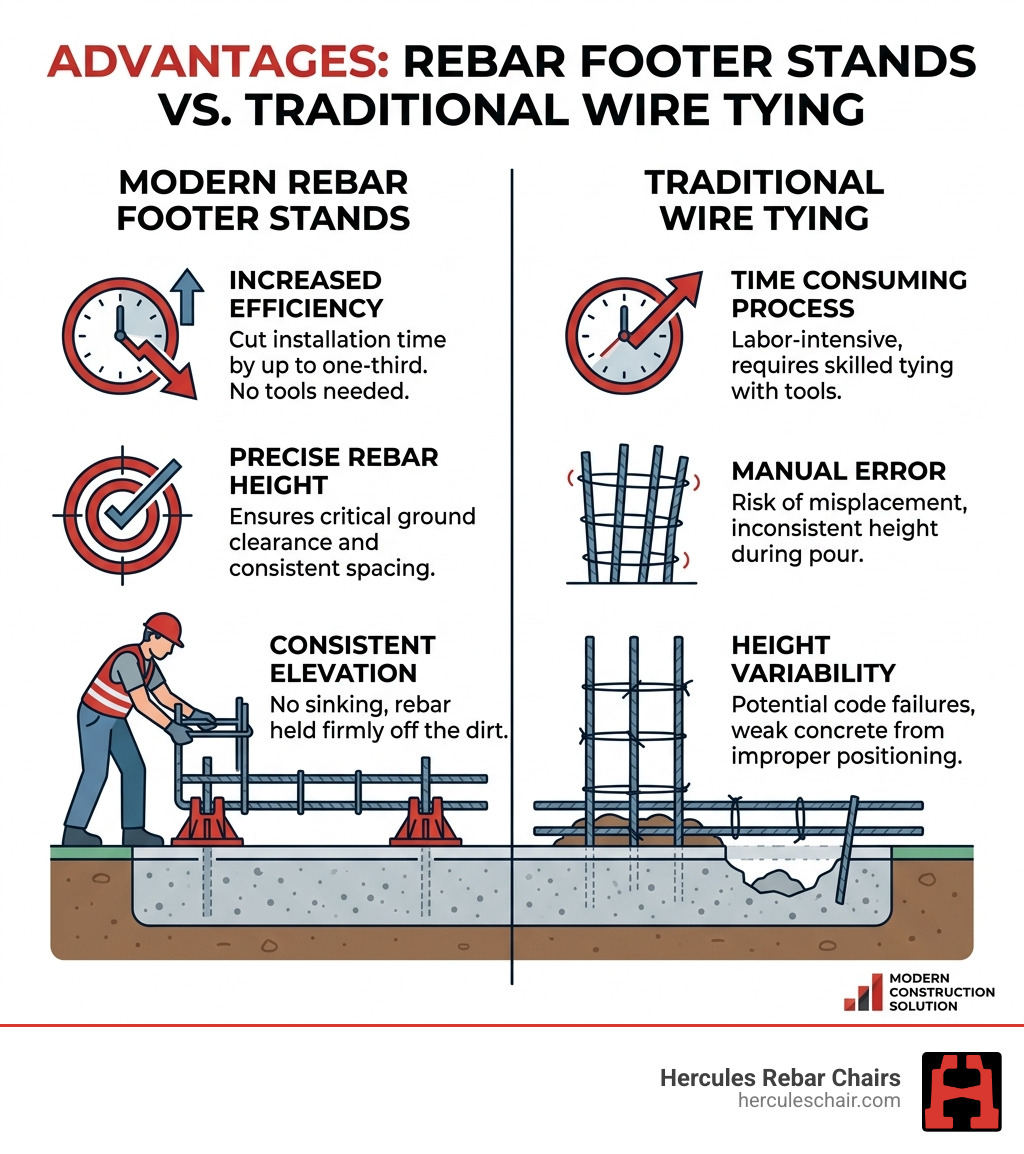
Rebar has to sit at the right height inside a footing — not resting on dirt, not floating. If it shifts or sinks during a pour, your reinforcement ends up in the wrong place. That means weaker concrete and potential code failures.
Traditional wire tying is slow, inconsistent, and frustrating. Modern footer stands snap rebar into place in seconds — no tools, no wire, no guesswork. Studies show they can cut rebar placement time by up to one-third.
In this roundup, we compare the best 3-bar footer stands available so you can choose the right one for your project.
I’m Jordan Harris, a licensed Professional Engineer with a master’s degree in structural engineering and five years of hands-on experience designing large-scale concrete structures — including projects where proper rebar footer stand selection directly impacts structural performance. Today I lead product development at Hercules Rebar Chairs, where we’ve engineered footer stands trusted by contractors across the country.
Rebar footer stand glossary:
What is a Rebar Footer Stand?
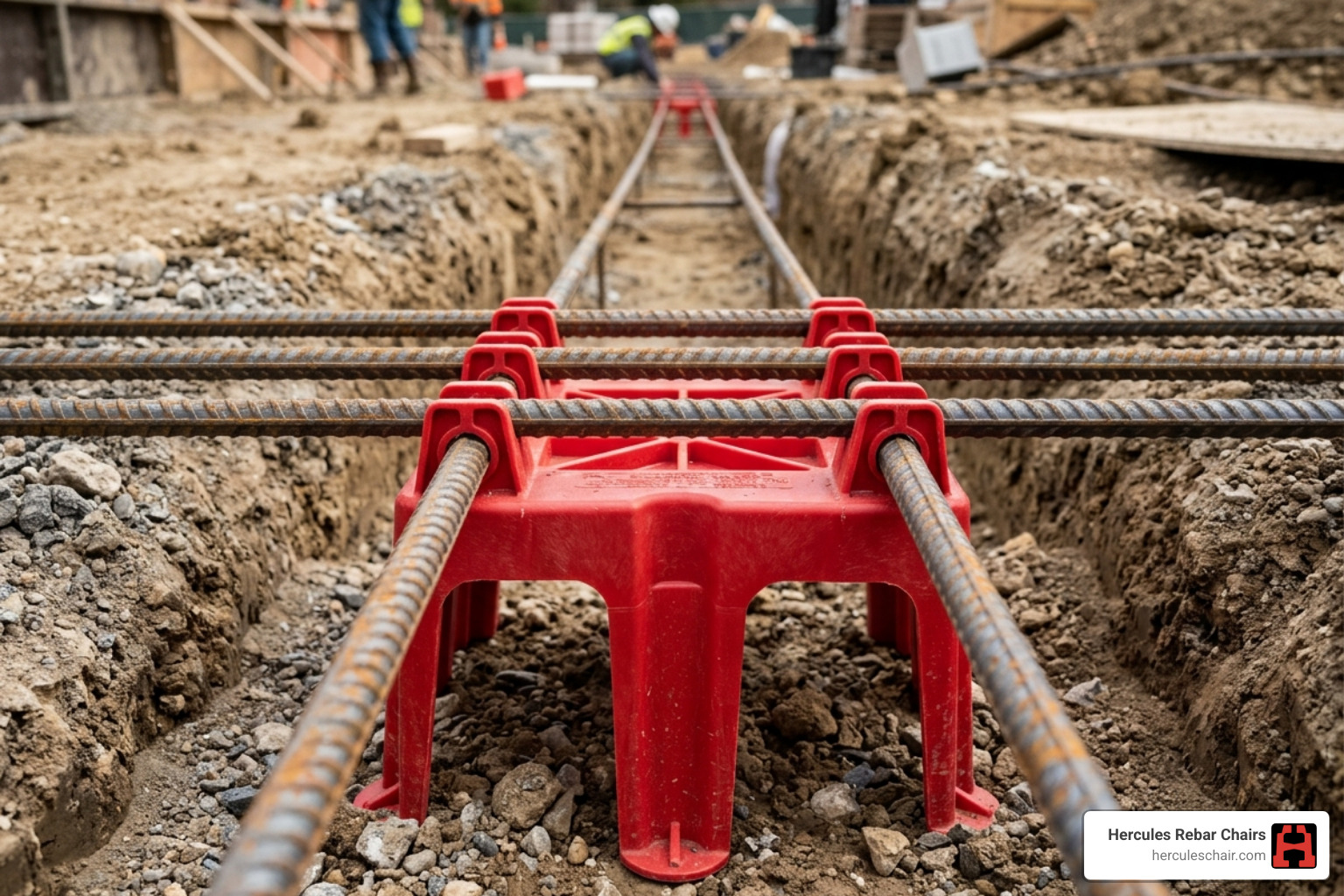
At its core, a rebar footer stand is a specialized support device designed specifically for foundation footings. Unlike standard rebar chairs used in flatwork or slabs, these stands are engineered to handle the unique geometry of a footer trench. They provide a stable base that sits on the soil (or vapor barrier) and features integrated clips to hold multiple parallel bars of steel reinforcement.
Our Hercules footer stands are instantly recognizable by their bold red color—a hallmark of quality in the American construction industry. These stands aren’t just about holding weight; they are designed for “maximum concrete flow.” This means the geometry of the chair allows wet concrete to pass through and around the support, ensuring there are no air pockets or “honeycombing” that could weaken the finished structure.
For a deeper dive into the mechanics of these supports, check out A Practical Guide to Rebar Footing Stands.
Primary Purpose in Construction
The primary mission of a rebar footer stand is to ensure structural integrity by maintaining the “concrete cover.” Building codes typically require 3 inches of concrete between the steel rebar and the earth. If the rebar is too low, it can corrode from ground moisture; if it’s too high, the footing loses its tensile strength.
By using a dedicated stand, we ensure the rebar stays exactly 3 inches off the ground before, during, and after the concrete pour. This consistency is nearly impossible to achieve with rocks, bricks, or scrap wood, which can shift or sink into soft soil under the weight of wet concrete. If your project only requires a pair of parallel bars, you might opt for a 2 Bar Footer Stand, which offers the same 3-inch clearance but in a more compact footprint.
Material Advantages of Polypropylene
Why do we use polypropylene for our Hercules stands? It’s not just because it’s lightweight. This high-strength plastic offers several critical advantages over metal or concrete alternatives:
- Corrosion Resistance: Unlike metal bolsters, polypropylene will never rust. This is vital because rust on a support can spread to the rebar itself, eventually causing concrete spalling.
- Chemical Stability: It is naturally resistant to the high pH levels found in wet concrete.
- Strength and Flexibility: Polypropylene is tough enough to support the weight of #4 and #5 rebar (and the workers walking on it) without snapping, yet it has the “give” needed for our patented snap-lock system.
- Non-Conductive: It won’t interfere with electrical grounding systems often required in modern foundations.
You can find these durable Hercules Rebar Footer 2-Bar Chair (40-Pack) 928 – The Home Depot units at major retailers across the USA, from Florida to Washington.
Key Specifications of 3-Bar and 2-Bar Models
Choosing between a 2-bar and a 3-bar model depends entirely on your engineering specifications. However, the physical dimensions of these stands are standardized to meet the most common residential and commercial footing requirements.
| Specification | #928 (2-Bar) | #924 (3-Bar) |
|---|---|---|
| Length | 10 inches | 15 inches |
| Width | 5.75 inches | 5.75 inches |
| Total Height | 3.75 inches | 3.75 inches |
| Ground Clearance | 3 inches | 3 inches |
| Bar Separation | 5 inches | 5 inches |
| Material | Polypropylene | Polypropylene |
Both models are designed to accommodate #4 (1/2 inch) and #5 (5/8 inch) rebar. The 5-inch separation between bars ensures that the reinforcement is distributed evenly across the width of the footing, providing optimal resistance to soil movement and structural loads. For more details on choosing the right configuration, see 3 Bar Footer Stand.
Load-Bearing Capacity and Strength
A common concern among contractors is whether a plastic stand will collapse when the concrete pump starts moving thousands of pounds of wet mix. Our Hercules stands are engineered to be “pour-proof.”
Each rebar clip on the #928 model is rated for 665 lbs. When you consider that these stands are placed every 4 feet, the cumulative load-bearing capacity is immense. This strength prevents the “accordion effect” where inferior chairs fold over or collapse under the pressure of the pour. We’ve designed these with a heavy-duty base that distributes weight across the soil to prevent sinking, ensuring your rebar stays level from start to finish. Learn more about these performance metrics in The Ultimate Guide to Footer Stand Options.
Compatibility with Standard Rebar Sizes
The versatility of the rebar footer stand lies in its clip design. We’ve patented a snap-fit system that works perfectly with:
- #4 Rebar (1/2-inch rods): The standard for most residential footings.
- #5 Rebar (5/8-inch rods): Frequently used in heavier commercial foundations or areas with expansive soils.
The clips are designed to “bite” the rebar. Once you press the rod into the chair, you’ll hear a distinct snap. This means the bar is locked in. It won’t pop out if someone trips over the rebar or if the concrete hose knocks against it.
Installation Guide for Maximum Stability
Installing Hercules footer stands is so simple it almost feels like cheating. Because there is no wire tying involved, the process is incredibly fast.
Recommended Spacing and Placement
To get the best results and maintain code compliance, follow these placement steps:
- Calculate Your Needs: Measure the total linear footage of your footing. Since we recommend placing a rebar footer stand every 4 feet, simply divide your total footage by four.
- Clear the Trench: Ensure the bottom of the trench is relatively level and free of large loose rocks or excessive mud.
- Layout: Drop your stands into the trench at 4-foot intervals.
- Corner Support: Always place a stand within 12 inches of any corner or intersection to ensure the overlapping rebar stays properly elevated.
- Snap and Go: Lay your rebar across the stands and step on the bars (or push with your hands) to snap them into the clips.
For a visual walkthrough, refer to our Footer Stand Placement Guide.
Eliminating Wire Tying for Efficiency
In the old days, you had to bend over with a bag of wire ties and a pair of pliers, tying every intersection by hand. It was back-breaking work that took hours.
With the Hercules snap-lock mechanism, we’ve effectively eliminated wire tying. By removing this step, contractors report reducing rebar placement time by 1/3. On a large residential project, that can save several man-hours, allowing you to get the inspection done and the concrete poured much sooner. It’s a tool-free assembly process that even a first-day apprentice can master in minutes.
Frequently Asked Questions about Rebar Footer Stands
How many rebar footer stands do I need per project?
As mentioned, the golden rule is one stand every 4 feet. If you have a 120-foot footing, you’ll need 30 stands. Conveniently, our #924 3-bar model comes in a 30-pack box, which is perfect for exactly 120 linear feet. If you’re using the #928 2-bar model, those come in a 40-pack box, covering 160 linear feet. Always buy an extra box for corners and overlaps!
Are rebar footer stands left in the concrete?
Yes! These are permanent structural components. They are designed to be completely encapsulated by the concrete. Because they are made of polypropylene, they bond well with the concrete and do not create a “pathway” for moisture to reach the rebar. Leaving them in ensures the rebar remains in the exact engineered position for the life of the structure.
Do these stands prevent rebar from shifting during the pour?
Absolutely. The combination of the heavy-duty base and the secure snap-in clips ensures the rebar stays put. Unlike “dobies” (concrete blocks) which rebar can slide off of, or wire ties that can snap, our stands lock the steel in three dimensions. Furthermore, the red Hercules stands are designed to allow concrete to flow under the bars, which actually helps “anchor” the chair in place as the weight of the wet concrete fills the trench.
Conclusion
When you’re standing over a footer trench, the last thing you want to worry about is whether your reinforcement is going to sink into the mud. Using a high-quality rebar footer stand takes the guesswork out of foundation work.
At Hercules Rebar Chairs (T.J. Harris Co.), we are proud to be America’s #1 choice for concrete supports. With over 14 million units sold, we’ve helped thousands of builders save time and money while ensuring their projects are 100% code-compliant. Whether you’re in Texas, New York, or anywhere in between, look for our signature red color to ensure you’re getting the strongest, most reliable chair on the market.
Ready to speed up your next pour and ensure a rock-solid foundation?