

Choosing Bridge Rebar Chair Supports for a Deck Pour
Bridge rebar chair supports must hold the reinforcement at the specified concrete cover through placement and the pour. When sourcing chairs, check the project specifications first. Then match the support height, spacing, and load capacity to the rebar mat and expected construction loads. A chair that shifts or breaks can leave bars out of position before the concrete hardens.
Plastic, metal, and plastic-tipped steel supports are all used in construction, but the right choice depends on the deck design and the Engineer of Record’s requirements. For a bridge deck, stability under foot traffic and concrete placement matters as much as the chair’s stated height.
I’m Jordan Harris, a Tennessee-licensed PE with five years of structural engineering experience on large concrete and steel projects. I use that background in my work developing rebar supports at Hercules Rebar Chairs and in assessing what bridge rebar chair supports need to do on site.
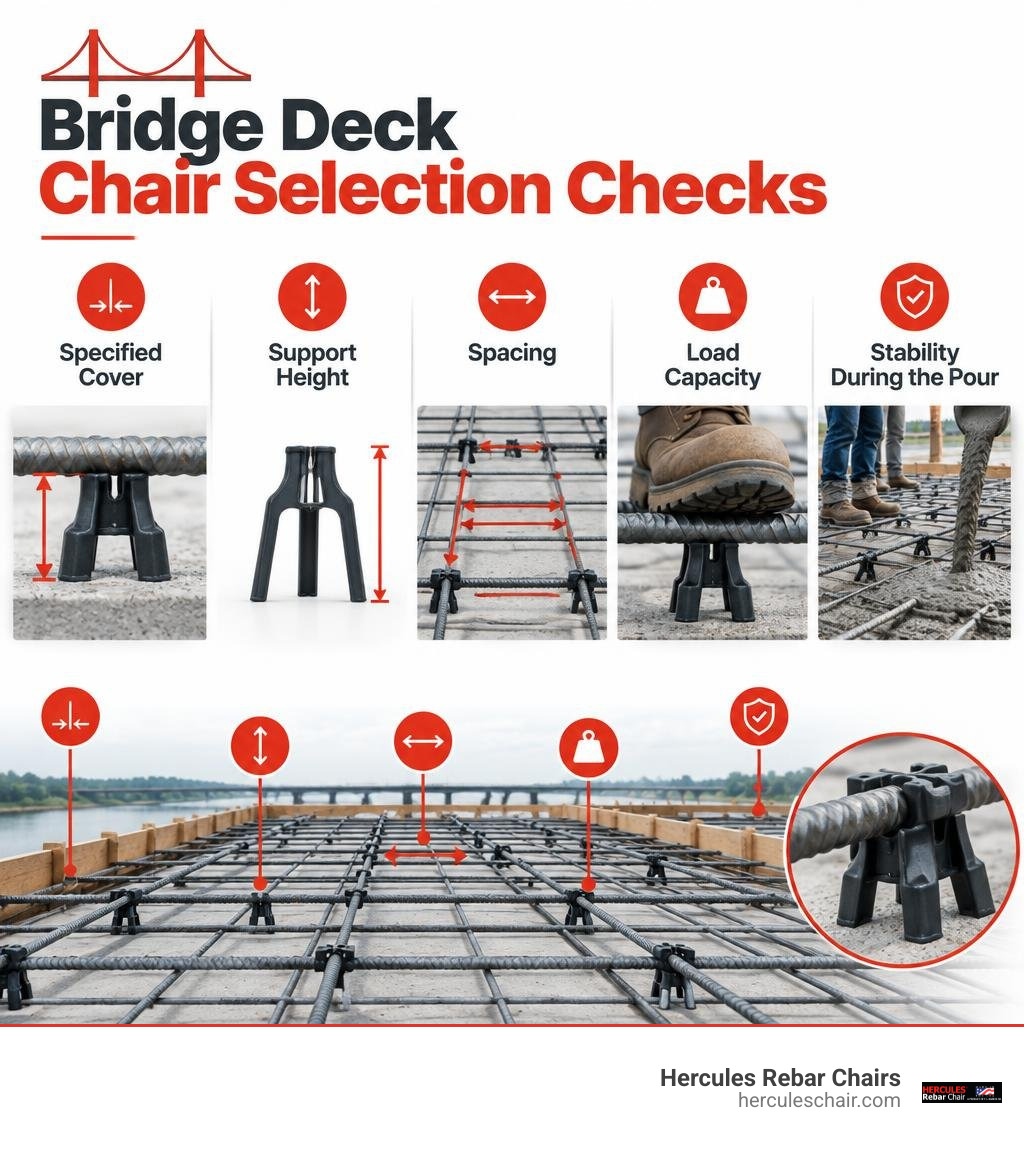
Simple guide to bridge rebar chair supports terms:
Comparative Analysis of Bridge Rebar Chair Supports
Selecting the right reinforcement accessories is fundamental to how rebar keeps our bridges from falling down. Bridge decks are subject to severe environmental exposure, dynamic vehicle loading, and rigorous structural tolerances. If the chairs fail to maintain proper elevation, the rebar can end up too close to the surface, accelerating corrosion, or too deep, compromising the tensile strength of the slab.
| Support Type | Typical Material | Load Deflection Resistance | Corrosion Risk at Deck Surface | Common Bridge Applications |
|---|---|---|---|---|
| Class 1 Plastic-Tipped Steel | Welded steel wire with PVC or polypropylene dipped feet | High to Very High | Very Low (provided plastic tips remain intact) | Upper and lower mats on DOT bridge decks requiring steel rigidity. |
| All-Metal / Plain Wire | Plain or galvanized carbon steel wire | High | High (tips can rust if exposed to water or deicing salts) | Stay-in-place metal form bridge decks where bottom exposure is sealed. |
| Monolithic High-Strength Plastic | Engineered virgin polypropylene or polymer blends | High (when properly rated) | Zero corrosion risk | Bottom and top mats on corrosive environments, marine decks, and regional bridges. |
| Two-Piece Zip-Tied Plastic | Stacked lightweight plastic chairs | Low (prone to lateral twisting) | Zero corrosion risk | General light commercial flatwork; rarely approved for bridge infrastructure. |
Plastic vs. Metal Bridge Rebar Chair Supports
The debate between all-metal, plastic-tipped metal, and all-plastic supports centers around load capacity, installation speed, and long-term durability. Metal chairs, particularly heavy-gauge wire assemblies, offer high point-load resistance and minimal deflection when ironworkers traverse the rebar mat. However, untreated steel legs resting on bridge formwork can become pathways for moisture and deicing chemicals, causing surface spalling and internal degradation over decades of service.
To eliminate rust bleed while keeping structural rigidity, many state DOTs require Class 1 plastic-tipped wire chairs. These combine the structural backbone of high-tensile wire with protective polymer boots.
On the other hand, engineered plastic supports have transformed modern placement. Early-generation plastic models suffered from brittle legs that torqued or sheared under heavy foot traffic. Modern industrial chairs, however, are molded as robust, monolithic structures. Contractors rely on the strongest rebar chairs for demanding concrete projects to provide non-corrosive performance, wide form-stable bases, and high compressive strength without adding rust pathways to the bridge deck.
Heavy-Duty and Continuous Support Alternatives
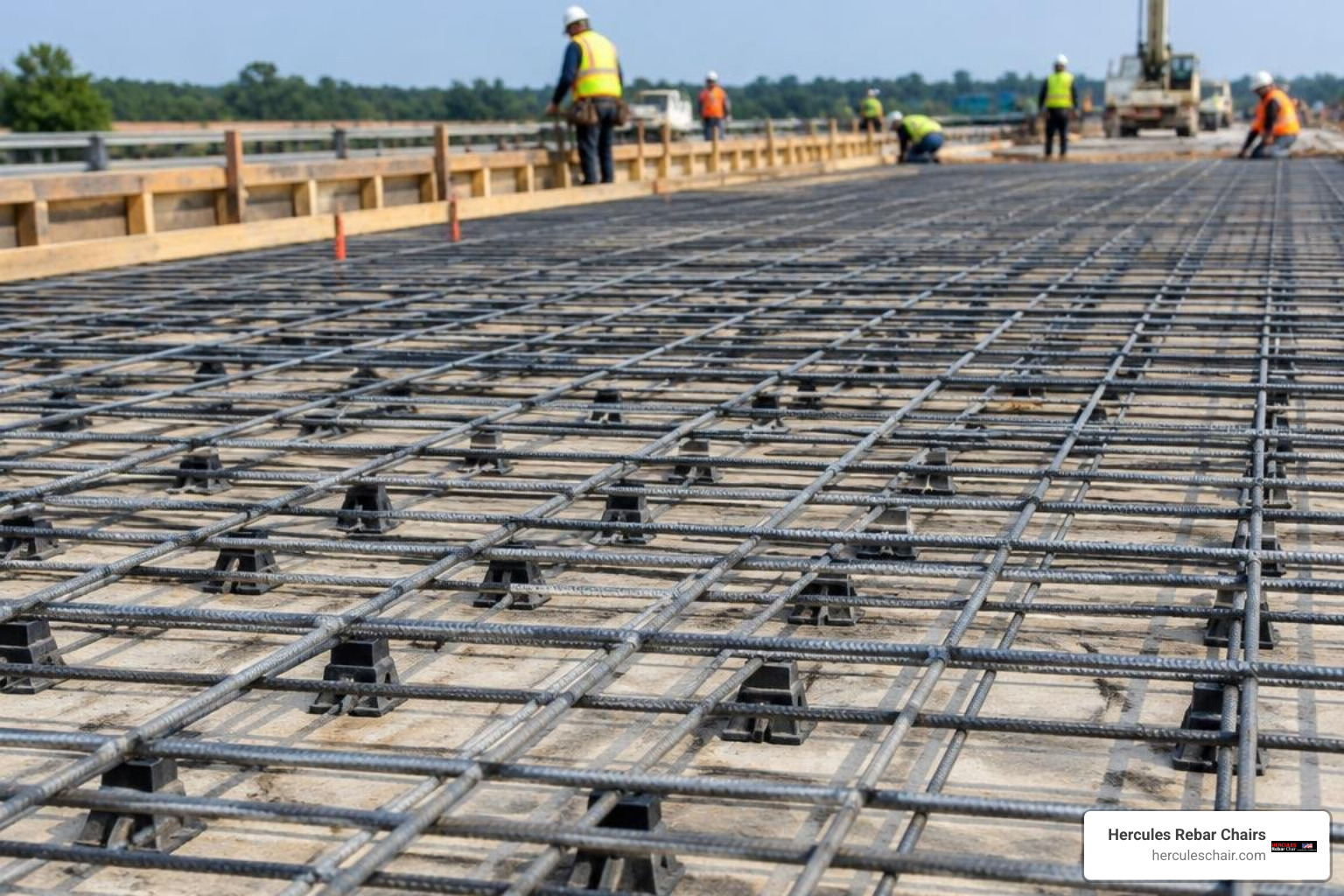
Point-load chairs are not always the best choice for dense mats or soft stay-in-place form flutes. In heavy infrastructure applications, continuous supports spread the load across wide footprints, preventing point-load punching through plywood forms or metal decking.
Contractors frequently employ continuous rebar supports such as slab bolsters and beam bolsters along the bridge span. These continuous runs maintain uniform clearance across long reinforcement runs. For deep bridge sections, abutments, and heavily loaded approach slabs, using double-legged rebar supports for maximum stability in thick slabs ensures the rebar cage will not tilt or sink during heavy concrete pumping operations.
Mitigating Failure Modes in High-Elevation Bridge Decks
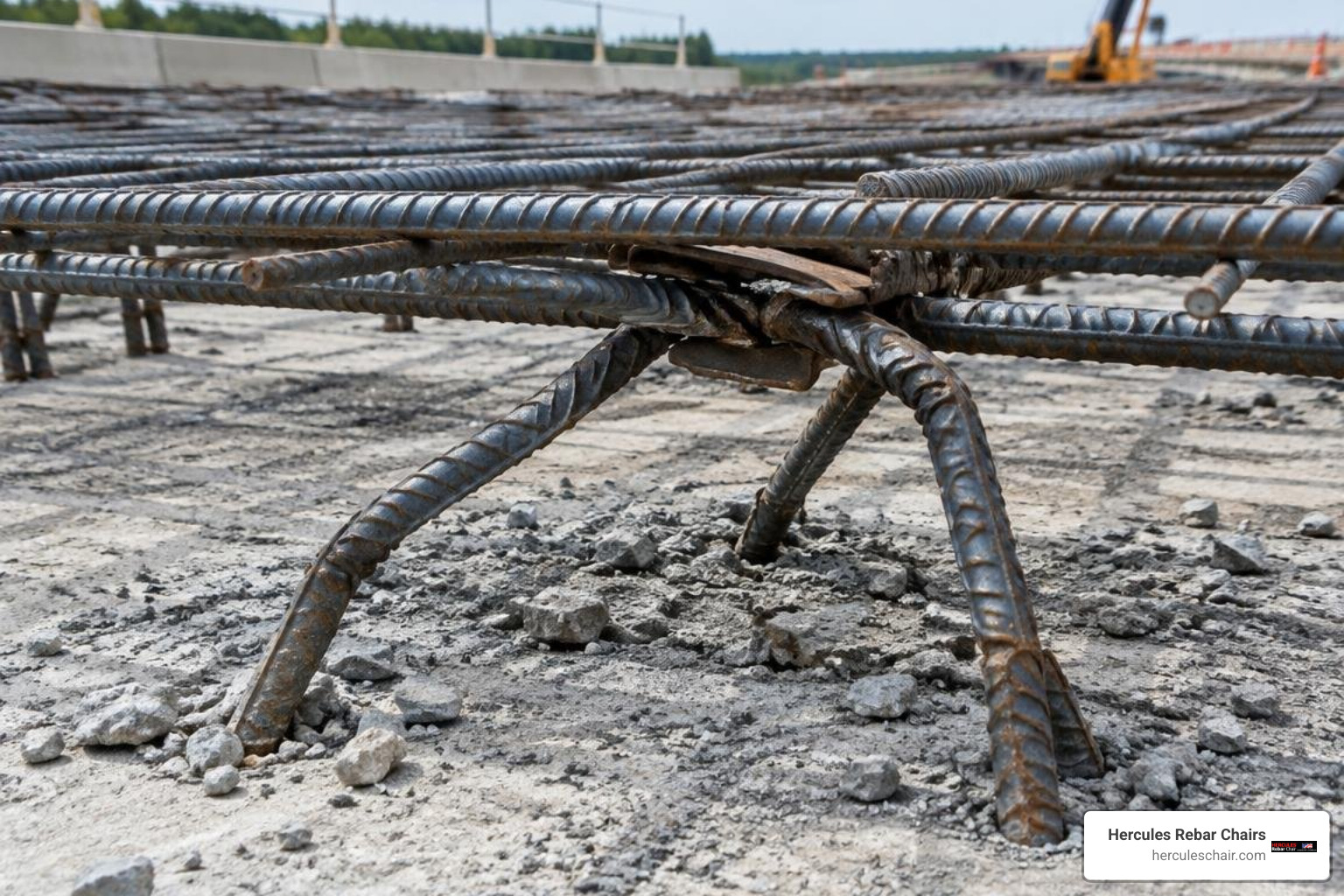
Bridge deck construction exposes rebar accessories to severe conditions. Crew members carry heavy equipment across the steel, concrete pumping hoses drag across the grid, and motorized buggies apply direct dynamic forces. When supports fail under these pressures, the structural mat deflects, leading to inconsistent concrete cover.
Using heavy-duty rebar bolsters and properly tested supports mitigates the three most common bridge deck failure modes:
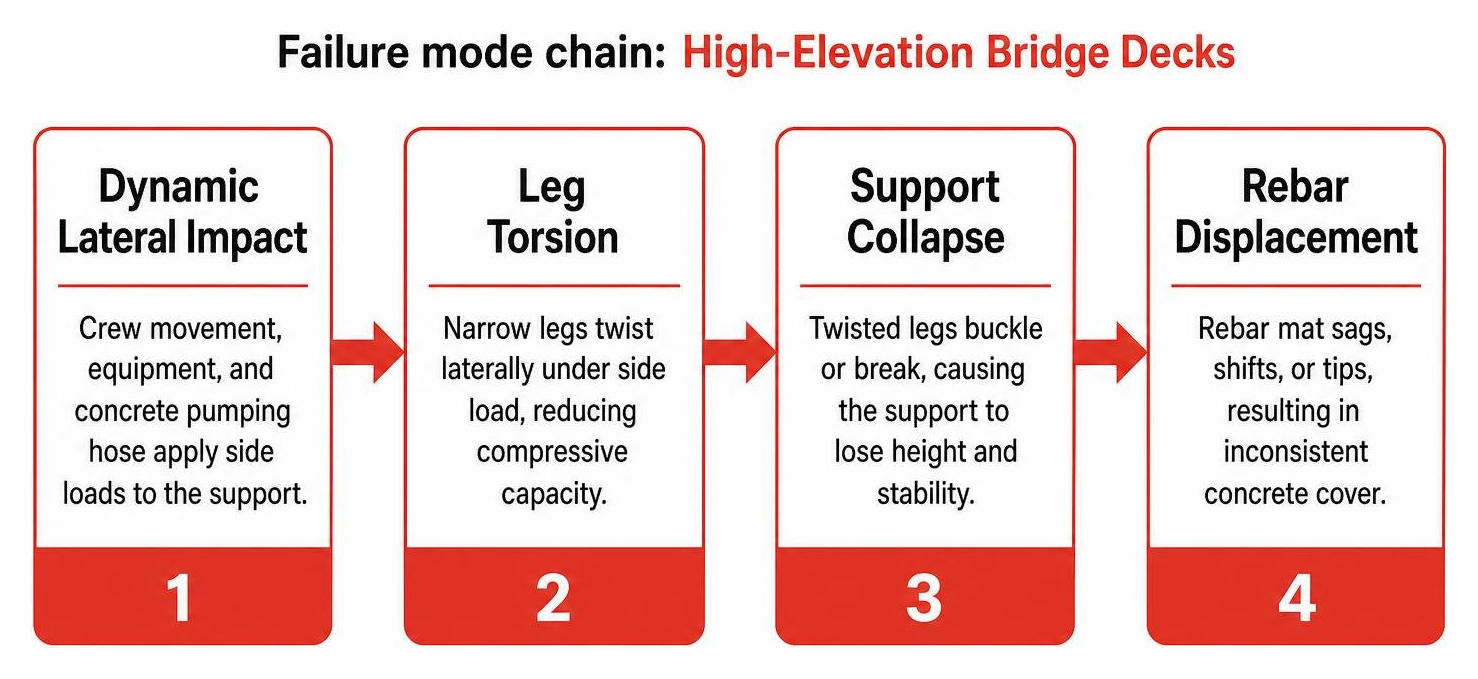
- Leg Torsion and Twist: Point supports with narrow leg profiles can twist laterally when workers walk across intersecting rebar. Once a chair rotates away from its vertical load axis, its compressive capacity drops significantly.
- Punch-Through and Form Penetration: Narrow-footed metal or plastic chairs concentrate hundreds of pounds of point load onto small contact areas, punching through deck formwork or insulating membranes.
- Stack Separation: Stacking two shorter chairs together to achieve heights over 6.5 inches creates an unstable weak point that often buckles under side loads.
Overcoming Lateral Shear, Torque, and Stack Instability
A primary complaint from site inspectors involves field-stacked chairs. In the field, workers sometimes attempt to reach a 7-inch or 8-inch top mat clearance by stacking two shorter plastic chairs and securing them with zip ties. Under dynamic crew loads, these makeshift assemblies easily twist and snap apart, dropping the top mat several inches prior to the pour.
To prevent this issue, bridge deck specifications require single-piece, monolithic supports engineered for the full target clearance height. Wide-base, tripod-style, or multi-directional flanged chairs distribute lateral forces across a larger surface area. This broad geometry resists dynamic shear forces generated by concrete pump lines and workers walking across the steel mat.
Supporting Deep Slabs and Upper Rebar Mats Above 12 Inches
For thick bridge elements—such as pier caps, post-tensioned box girders, and massive foundation mats—reinforcement clearances often exceed 12 inches. Standard individual point chairs are not designed for structural elevations at these heights.
When building heavy structural decks, consult our guide to rebar chairs, types, uses, and sizing to determine when standard chairs should transition to heavy fabricated supports:
- Structural Rebar Standees: Heavy-gauge steel reinforcement bars field-bent or shop-fabricated into wide “U” or “Z” shapes with lateral stabilizing legs tied directly into the bottom mat.
- Continuous High Chairs with Plates: Heavy welded wire assemblies featuring built-in sheet metal base plates that sit directly on bridge decking or mud mats without puncturing.
- Multi-Tier Welded Wire Bolsters: Heavy-duty structural frameworks welded together to provide multi-level support for complex top-mat networks.
Specifications, Regional Practices, and Engineering Governance
Bridge construction operates under strict oversight from state Departments of Transportation, federal agencies, and structural engineering firms. Ensuring rebar supports meet local specifications avoids costly delays or failed pre-pour inspections. For instance, detailed state guidelines like the Caltrans Bridge Deck Construction Manual Chapter 3 lay out exact standards for clear cover, chair spacing, and tying practices across highway decks.
CRSI Guidelines vs. Engineer of Record (EOR) Discretion
The Concrete Reinforcing Steel Institute (CRSI) outlines standard classifications for bar supports, defining material grades such as:
- Class 1: Maximum protection (plastic-tipped wire supports or all-plastic units).
- Class 2: Moderate protection (stainless steel-tipped wire supports).
- Class 3: No protection (bright basic carbon steel wire).
While the CRSI provides classifications and recommended spacing intervals, it does not mandate specific brand approvals across all construction sectors. This leaves material selection to the placing contractor, fabricator, and ultimately the Engineer of Record (EOR).
The EOR holds complete legal authority over project design and can mandate or prohibit specific support types. On many complex transit bridges and high-rise projects, the EOR may explicitly prohibit all-plastic chairs due to concerns about thermal expansion, fire ratings, or historic lateral stability problems. Conversely, on coastal highway bridges, an EOR may require all-plastic or non-metallic composite chairs to prevent corrosion.
Best Installation Practices for Bridge Rebar Chair Supports
Following proper jobsite installation protocols ensures reinforcement mats remain secure during the pour:
- Verify Clearance Specs: Check the project drawings for exact top and bottom cover tolerances before ordering support heights.
- Follow Spacing Grids: Never exceed recommended spacing intervals. Bridge rebar mats commonly require supports spaced on 3- to 4-foot grids, with closer spacing along high-traffic pump lanes.
- Stagger Placement: Offset chairs along adjacent bar runs rather than placing them in straight lines. Staggering prevents continuous flex planes across the mat.
- Tie Securely: Fasten rebar to chairs using approved tie wire or integrated snap-lock clips to stop displacement caused by concrete discharge flow.
- Conduct Pre-Pour Inspections: Walk the deck right before concrete placement to identify and replace any chairs that have twisted, shifted, or collapsed under dynamic traffic.
Frequently Asked Questions About Bridge Rebar Supports
Why do some Engineers of Record prohibit plastic chairs on bridge decks?
Some Engineers of Record (EORs) prohibit plastic chairs on bridge decks due to past experiences with low-grade chairs deflecting under dynamic construction loads. When workers traverse heavy top mats, lightweight plastic chairs can twist or shear. Additionally, concerns about differing coefficients of thermal expansion between concrete and certain plastics, as well as field stacking risks, lead some engineers to mandate Class 1 plastic-tipped steel supports instead.
How do US and international practices differ regarding bridge rebar chairs?
Market practices vary considerably between regions. In the United States, commercial and heavy bridge work often utilizes a mix of plastic-tipped steel wire chairs and high-strength plastic chairs, guided by state DOT qualified product lists (QPL). In other international markets, such as Australia, monolithic plastic bar chairs are widely used across suspended slabs and elevated elements. Plastic chairs represent a large portion of support sales in those markets due to their corrosion resistance.
What supports are recommended for bridge rebar mats exceeding 12 inches in height?
For mats higher than 12 inches, point-load chairs are prone to lateral overturning. The standard practice is to use shop-fabricated structural rebar standees (Z-bars or U-bars with outriggers) tied into the bottom reinforcement grid, or heavy-duty continuous multi-tier steel frames with wide base plates.
Conclusion
Preserving structural concrete cover is critical to the longevity, load-bearing capacity, and safety of bridge infrastructure. Whether working on highway overpasses, marine piers, or municipal bridge decks, pairing the correct support material with disciplined field placement prevents mat sagging, rust staining, and concrete spalling.
At Hercules Rebar Chairs (a brand of T.J. Harris Co.), we manufacture strong concrete supports engineered to simplify installation, maintain strict tolerances, and protect bridge decks across the United States. Identifiable on jobsites nationwide by our signature red color, our supports have achieved over 14 million units sold by helping contractors stay on schedule and in compliance.
When planning your next infrastructure pour, explore heavy-duty rebar support solutions designed to keep your bridge decks secure from setup to final cure.