

Why Heavy Duty Swivel Bar Stools Make or Break a Commercial Bar
Heavy duty swivel bar stools are the difference between a bar that runs smoothly for years and one that’s constantly replacing broken seating.
Here’s a quick summary of what to look for:
| Feature | Minimum for Commercial Use |
|---|---|
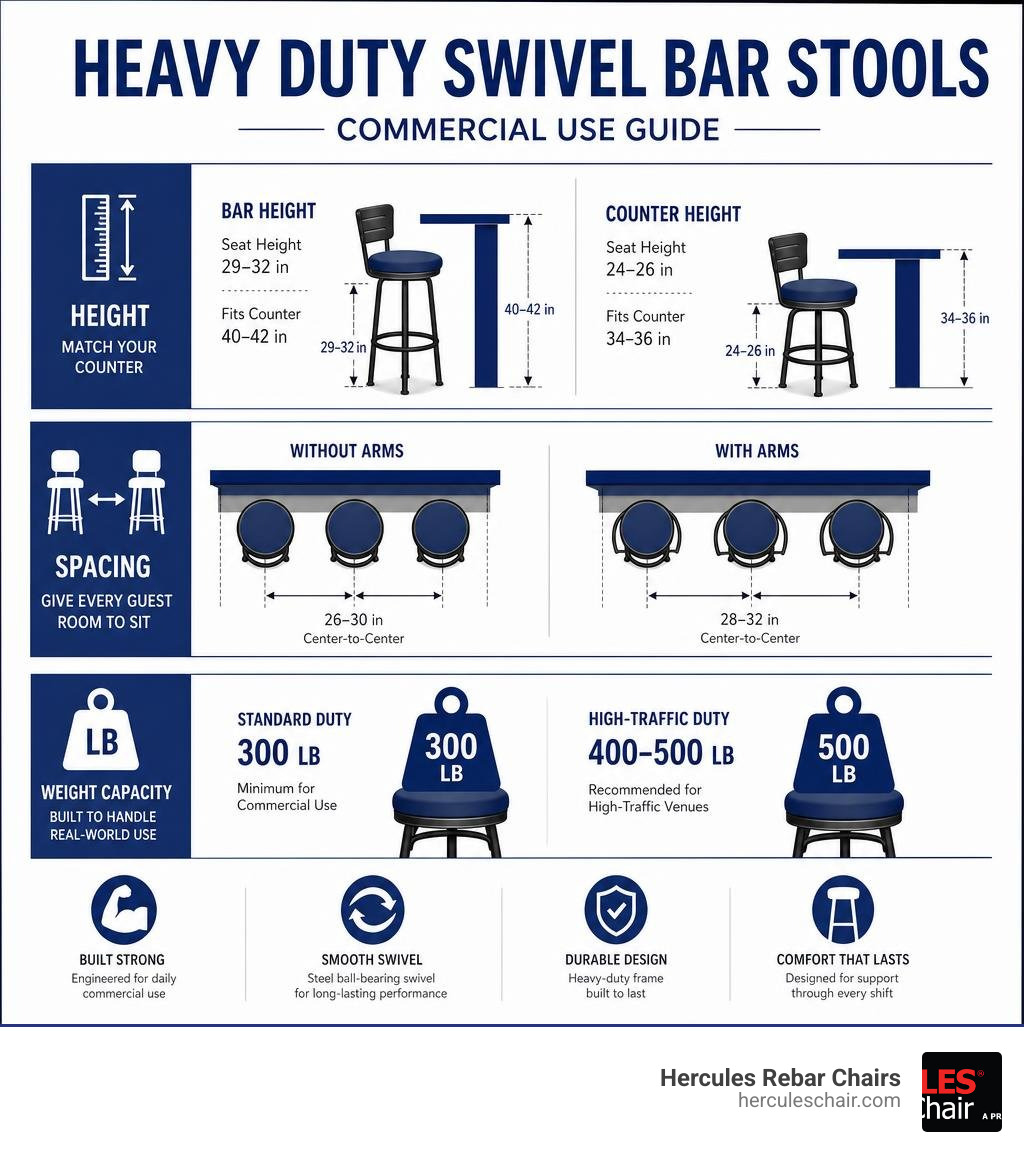
| Weight capacity | 300 lb (standard), 400-500 lb (high-traffic) |
| Frame material | 16-gauge steel with MIG-welded joints |
| Swivel mechanism | Steel ball-bearing plate (not plastic bushings) |
| Bar height seat | 29-32 inches (fits 40-42 inch counters) |
| Counter height seat | 24-26 inches (fits 34-36 inch counters) |
| Center-to-center spacing | 26-30 inches (28-32 inches with arms) |
A busy bar puts enormous stress on seating. Guests spin, lean, shift their weight, and drag stools across the floor hundreds of times a week. Most residential stools aren’t built for that. Commercial-grade stools are.
The swivel mechanism is the first thing to fail on an undersized stool. Plastic bushings wear out fast under daily use. Steel ball-bearing swivel plates last far longer — and that’s just the starting point for what separates a truly heavy-duty stool from one that only looks the part.
I’m Jordan Harris, a licensed structural engineer and product developer at T.J. Harris Company, where I’ve spent years thinking about how materials perform under repeated load — the same principles that make heavy duty swivel bar stools hold up in the real world. Let’s break down exactly what to look for.
Heavy duty swivel bar stools basics:
Engineering the Ultimate Heavy Duty Swivel Bar Stools
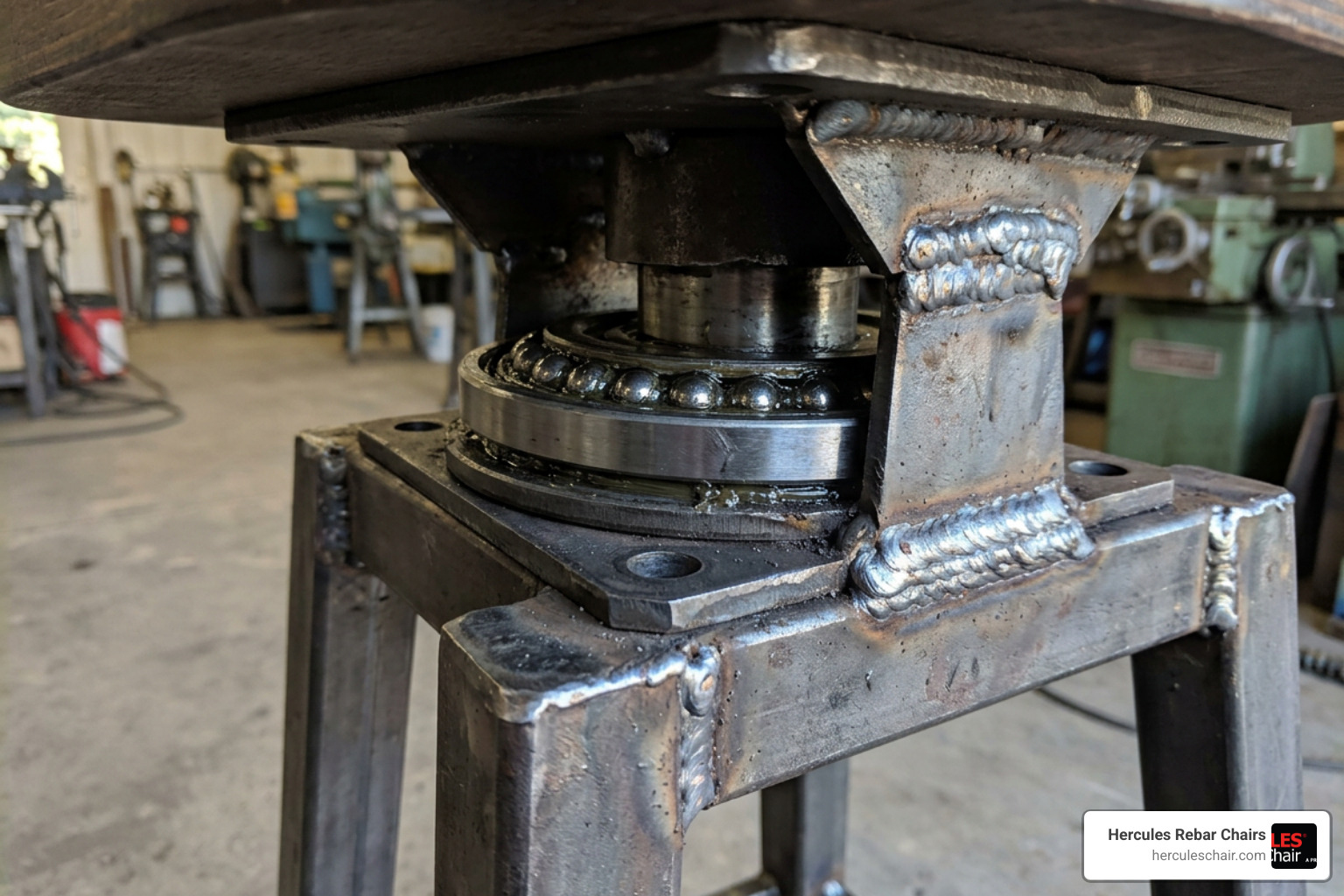
When we evaluate the structural integrity of furniture, we look at the exact same principles we use in concrete construction. If the foundation or the reinforcement is weak, the entire structure eventually fails under load. For a swivel bar stool, the “reinforcement” is the combination of steel gauge, weld quality, and bearing design.
To build a stool that can withstand high-traffic commercial venues, manufacturers must move away from thin-walled metals and simple bolt-together construction. Truly heavy-duty frames are engineered using 16-gauge or 18-gauge steel tubing. In the engineering world, a lower gauge number means thicker steel. A 16-gauge steel frame (approximately 1.25 inches in diameter) offers the structural rigidity needed to prevent the legs from splaying or bowing when supporting substantial weight.
Furthermore, the joints must be MIG (Metal Inert Gas) welded. Unlike simple spot welds or mechanical bolts that loosen over time due to the vibrations of constant turning, solid MIG-welded joints fuse the metal pieces into a single, continuous structure.
The swivel mechanism itself is the mechanical heart of the stool. Low-end stools use plastic bushings or a minimal ring of loose bearings that grind down, create metal shavings, and eventually lock up. A commercial-grade swivel features a heavy-duty plate encasing dozens of steel ball bearings (often up to 52 stainless steel ball bearings) to distribute the load evenly across a 360-degree rotation. This level of engineering ensures the stool meets or exceeds ANSI/BIFMA (American National Standards Institute/Business and Institutional Furniture Manufacturers Association) safety standards.
Weight Capacity Standards for Heavy Duty Swivel Bar Stools
For commercial environments, standard residential weight capacities of 200 to 250 lbs simply will not cut it. The minimum recommended weight capacity for any commercial swivel bar stool is 300 lbs, but high-traffic bars and restaurants should look for options rated for 400 to 500 lbs.
If you want to accommodate all customers safely and ensure ultimate durability, look toward the Big & Tall commercial categories. Some of the strongest stools in the industry are rated for 750 to 800 lbs. Let’s look at some leading examples of heavy-duty engineering in this category:
- 500 lb Capacity Heavy Duty Commercial Bar Stools: These stools are specifically built for high-traffic food service environments. Featuring reinforced steel frames and heavy-duty swivel joints, they provide the peace of mind that commercial operators need when hosting diverse crowds.
- HUSKY Seating® Heavy Duty 500 LB Restaurant Bar Stool with Swivel Seat & Ladder Back-Burgundy: This popular model features a 16-gauge welded steel frame and upgraded steel bearings. It includes a welded footrest that prevents the legs from bowing over time, making it a reliable staple for sports bars, taverns, and social clubs.
- X410 Jackie 2 – Holland Bar Stool Co.: Engineered specifically for Big & Tall performance, this ladder-back stool is independently load-tested to a massive 750 lbs without failure. It utilizes a 16-gauge, 1.25-inch tube steel frame with solid MIG-welded joints and features a swivel mechanism packed with 52 stainless steel ball bearings for ultra-smooth rotation.
- X810 Contessa 2 – Holland Bar Stool Co.: Combining a classic spindle-back aesthetic with heavy-duty performance, this model is also rated for 750 lbs. It features sustainably sourced solid hardwood accents and meets rigorous ANSI/BIFMA commercial testing standards while offering GREENGUARD certification for low chemical emissions.
Choosing Between Metal, Wood, and Upholstered Heavy Duty Swivel Bar Stools
Selecting the right material for your heavy-duty bar stools involves balancing durability, comfort, maintenance, and visual style.
- Metal Frames: Metal is the gold standard for high-traffic durability. Steel frames finished with powder coating resist scratch marks, rust, and abrasions. They are incredibly easy to wipe down and rarely suffer structural failures when properly welded.
- Wood Accents and Frames: Solid hardwood (such as domestic maple, oak, or beechwood) brings warmth and a classic aesthetic to restaurants and upscale home bars. However, wood is naturally more fibrous and susceptible to moisture changes. Commercial wood stools must use heavy-duty fasteners, mortise-and-tenon joinery, and commercial-grade finishes to prevent loosening.
- Upholstered Seats: If your goal is to keep customers sitting longer (which directly correlates to higher bar tabs), upholstered seats are essential. They typically feature high-density, fire-retardant foam (meeting CAL 117 standards) wrapped in commercial vinyl or fabric. Commercial vinyl is the preferred choice because it resists spills, can be cleaned with mild soap and water, and is free of harmful PFAS chemicals.
Here are some excellent hybrid options that combine these materials:
- 870 Hadleigh – Holland Bar Stool Co.: This model blends a refined upholstered back and seat with a robust 16-gauge steel frame. Supporting up to 550 lbs, it features a 2.5-inch high-density foam cushion and can be customized with various commercial fabrics or vinyls that meet GREENGUARD and California Section 01350 low-emission standards.
- 880 Eleanor – Holland Bar Stool Co.: Celebrating the fusion of wood and metal, the Eleanor features an elegant wood back paired with an industrial 16-gauge steel frame. It supports up to 550 lbs and is ideal for venues looking to combine industrial strength with organic wood textures.
- 832 Thor – Holland Bar Stool Co.: For a bold, modern-industrial look, the Thor features a signature wood plank backrest made from solid beech wood with horizontal slat construction. This is paired with an incredibly tough steel frame rated for 550 lbs, making it perfect for modern breweries and busy urban eateries.
Spatial Planning: Spacing, Heights, and Floor-Bolting
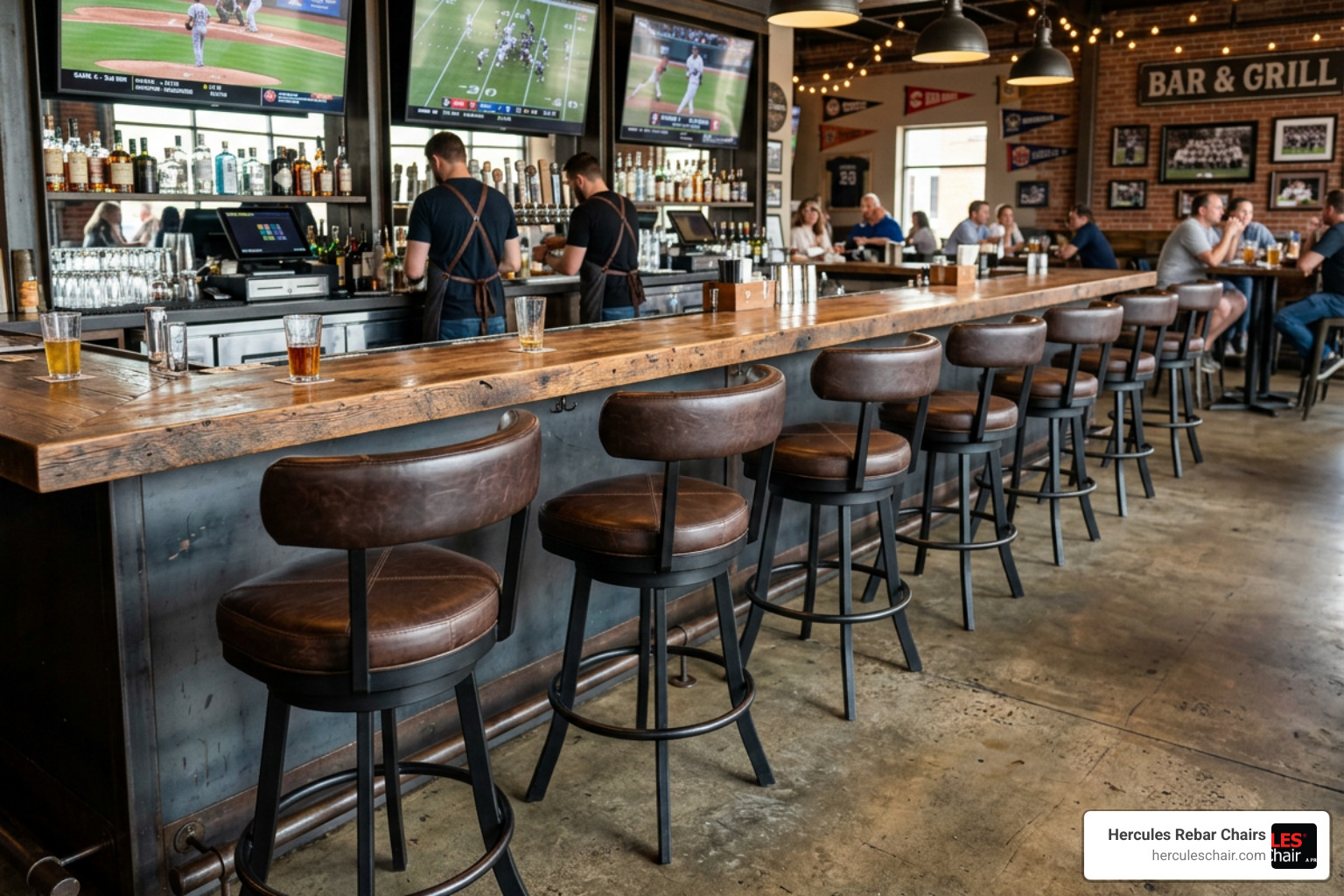
Even the most durable stool can become a liability if it is poorly spaced or the wrong height for the counter. Proper spatial planning ensures that guests can rotate safely without hitting neighboring stools, knocking elbows, or blocking walkways.
Bar Height vs. Counter Height Clearance
The most common mistake when purchasing bar stools is selecting the wrong seat height. To determine the correct height, measure from the floor to the underside of your bar counter, then subtract 9 to 12 inches to allow for comfortable leg clearance.
Here is a quick reference table to help you make the right choice:
| Counter Type | Counter Surface Height | Recommended Seat Height | Common Use Cases |
|---|---|---|---|
| Counter Height | 34″ – 36″ | 24″ – 26″ | Kitchen islands, low dining counters, ADA-accessible bar sections |
| Bar Height | 40″ – 42″ | 29″ – 32″ | Standard commercial bars, taverns, high-top pub tables |
| Spectator Height | 46″ – 48″ | 34″ – 36″ | Extra-tall commercial counters, stadium VIP suites |
If you are sourcing stools across different states and regions, you can find local selections tailored to these standard dimensions:
- Explore local inventories in Alabama via the Barstool – Alabama Furniture Market.
- For northern commercial projects, check out Bar Stools – Dining Room – Bailey’s Furniture Alaska.
- Southwestern venues can browse Dining Room > Bar Stools – Arizona Furniture.
- For broad regional selections, look at Bar and Counter Stools – American Furniture Warehouse or Counter and Bar Stools – Pilgrim Furniture.
Spacing and Floor-Bolting for Safety
Because heavy duty swivel bar stools rotate 360 degrees, they require more spatial clearance than fixed, stationary stools. If stools are placed too close together, guests will bump into each other when spinning to talk or stand up.
- Standard Swivel Stools (Backless or Low Back): Allow 26 to 30 inches of center-to-center spacing.
- Swivel Stools with Arms: Allow 28 to 32 inches of center-to-center spacing to accommodate the wider footprint and prevent arms from clashing.
For tight bar spaces, high-traffic pathways, or ADA-accessible counters, floor-bolting is an excellent safety solution. Bolt-down swivel stools feature a heavy-duty cast iron or steel base that is anchored directly into the concrete subfloor.
This prevents guests from tipping the stools over or dragging them into walkways, keeping emergency egress paths clear. Crucially, even when the base is bolted securely to the floor, the heavy-duty swivel mechanism on top still allows the seat to rotate smoothly, ensuring guest comfort.
To find options designed specifically for these layouts, explore:
- Commercial Swivel Bar Stools: High-quality options engineered to withstand the daily rigors of commercial floor configurations.
- Heavy Duty Commercial Swivel Bar Stools with Backs and Arms: Perfect for venues that want to maximize comfort with arms and backs while maintaining strict spatial and safety standards.
Maintenance, Warranties, and Commercial Longevity
To get the longest life out of your commercial seating investment, a proactive maintenance routine is essential. Even the toughest steel frames and highest-capacity swivels require occasional care to keep them operating like new.
- Upholstery Cleaning: For commercial vinyl, wipe down seats daily with mild warm water and a gentle soap. Avoid harsh bleach-based cleaners or abrasive scrubbers, which can strip the protective topcoat of the vinyl, leading to premature cracking.
- Swivel Mechanism Inspection: Every six months, inspect the swivel plates. Ensure that no debris, hair, or food particles have worked their way into the ball-bearing casing. If the swivel begins to squeak or feel stiff, apply a small amount of commercial-grade silicone lubricant to the bearing track.
- Frame and Weld Checks: Periodically check the MIG welds and frame joints for any signs of hairline fractures or stress. Check that the floor glides (usually plastic or nylon) are still intact on the bottom of the legs. Missing glides can scratch your floors and cause the stool to sit unevenly, putting off-center stress on the frame.
- Warranty Protection: When purchasing heavy-duty seating, look for manufacturers that offer a robust warranty. A 5-year limited warranty on non-moving metal parts and a multi-year warranty on the swivel mechanism are standard indicators of a manufacturer who stands behind their structural engineering.
Frequently Asked Questions about Commercial Seating
Are swivel bar stools suitable for high-traffic restaurants?
Yes, they are highly suitable, especially at bar counters where guests naturally want to turn to talk, watch sports screens, or interact with the bartender. For dining counters where food is the primary focus, we highly recommend using memory-return swivels. These mechanisms automatically return the seat to a forward-facing position when the guest stands up, keeping your bar area looking neat and organized without constant manual resetting by your staff.
What are the best heavy-duty options for outdoor bar areas?
Outdoor environments expose furniture to rain, humidity, salt air, and UV rays. Standard steel frames will rust quickly if the protective coating is chipped. For outdoor areas, choose stools constructed from marine-grade stainless steel or powder-coated aluminum. Ensure the swivel mechanism is fully encased or utilizes synthetic self-lubricating bearings that won’t rust or seize up when exposed to moisture.
How do I know if a swivel mechanism is commercial-grade?
A commercial-grade swivel is characterized by its heavy-gauge steel plates and high-density ball-bearing system. Look for swivels that use dozens of steel ball bearings encased in a solid steel housing. Avoid mechanisms that utilize plastic bushings, thin metal plates that flex under hand pressure, or those that wobble from side to side. Commercial-grade swivels are independently tested to withstand tens of thousands of continuous rotations under load.
Conclusion
At Hercules Rebar Chairs, we understand that structural integrity is the absolute foundation of safety and longevity. Whether you are reinforcing a multi-million dollar concrete foundation with our industry-leading red rebar supports or furnishing a busy commercial venue with heavy duty swivel bar stools, the engineering principles remain the same: high-quality materials, robust joints, and smart design prevent failures.
Investing in commercial-grade, high-capacity swivel stools saves you time and money on replacements while ensuring your space remains safe and code-compliant.
Explore our heavy-duty products to learn more about how we bring unmatched strength and durability to heavy-duty industries across America.