

Rebar Chair Material Selection Criteria
A proper rebar chair inspection starts by verifying three things before concrete placement: confirm the chair material and load rating match the structural drawings, check that clear cover and spacing meet ACI and CRSI tolerances, and walk the deck after traffic to catch displaced or sinking supports. Choosing the right support material is the foundation of structural durability. If a chair crushes under heavy loads or corrodes over time, the entire structural slab suffers. Inspectors must confirm that the chairs installed on-site match the engineering specifications exactly. When reviewing options, consulting a practical guide to rebar chair types helps ensure that the chosen material aligns with both structural and environmental demands.
| Chair Material Type | Rated Load Capacity | Corrosion Resistance | Ideal Application | Key Inspection Criteria |
|---|---|---|---|---|
| All-Plastic Chairs | 120 kg to >300 kg | Immune to corrosion | Slabs-on-grade, elevated decks, corrosive environments | Wide base stability; thermal rigidity up to 30 °C; no cracking |
| Plastic-Tipped Wire | 60 kg to 200 kg | Moderate (tips only) | Interior suspended slabs, dry architectural surfaces | Tip integrity intact; no exposed carbon steel; tight wire fit |
| Concrete Blocks / Spacers | >300 kg (60 MPa minimum) | Excellent (matches mix) | Heavy foundation mats, civil infrastructure, marine works | Compressive strength ≥60 MPa; matching mix chloride permeability |
| Fabricated Hurdles | Heavy structural loads | Dependent on bar coating | Mat foundations >300 mm deep | Proper tie-offs; bend diameter compliance; no footing puncture |
Material quality directly dictates long-term performance. According to published SRIA technical guidance on bar chairs, concrete bar chairs must achieve a minimum compressive strength of 60 MPa to prevent crushing under extreme structural loads. Inspectors must also check for non-staining properties on architectural surfaces, ensuring that plastic or concrete supports leave no unsightly rust stains or blemishes on exposed concrete faces.
Evaluating Supports for Corrosive and Marine Environments
In coastal areas, water treatment plants, or structures exposed to deicing salts, standard wire chairs present a massive corrosion risk. If moisture reaches a plain steel wire foot, rust travels inward like a fuse along the chair legs straight to the structural reinforcement.
Inspectors must enforce strict material rules based on environmental exposure classifications. Reviewing how to choose the right concrete rebar chair ensures that contractors select chairs with the correct chemical resistance. In severe marine environments, all-plastic units or 60 MPa concrete spacers are preferred. Concrete chairs chemically bond with the surrounding pour, completely eliminating corrosion pathways.
Heavy Foundation Mats and Deep Hurdles Support Requirements
When foundation slabs exceed 300 mm (12 inches) in thickness, standard bar chairs can no longer provide stable support for the heavy top reinforcement mats. In these scenarios, structural crews use “hurdles”—custom three-dimensionally bent reinforcing steel frames fabricated to hold upper grids.
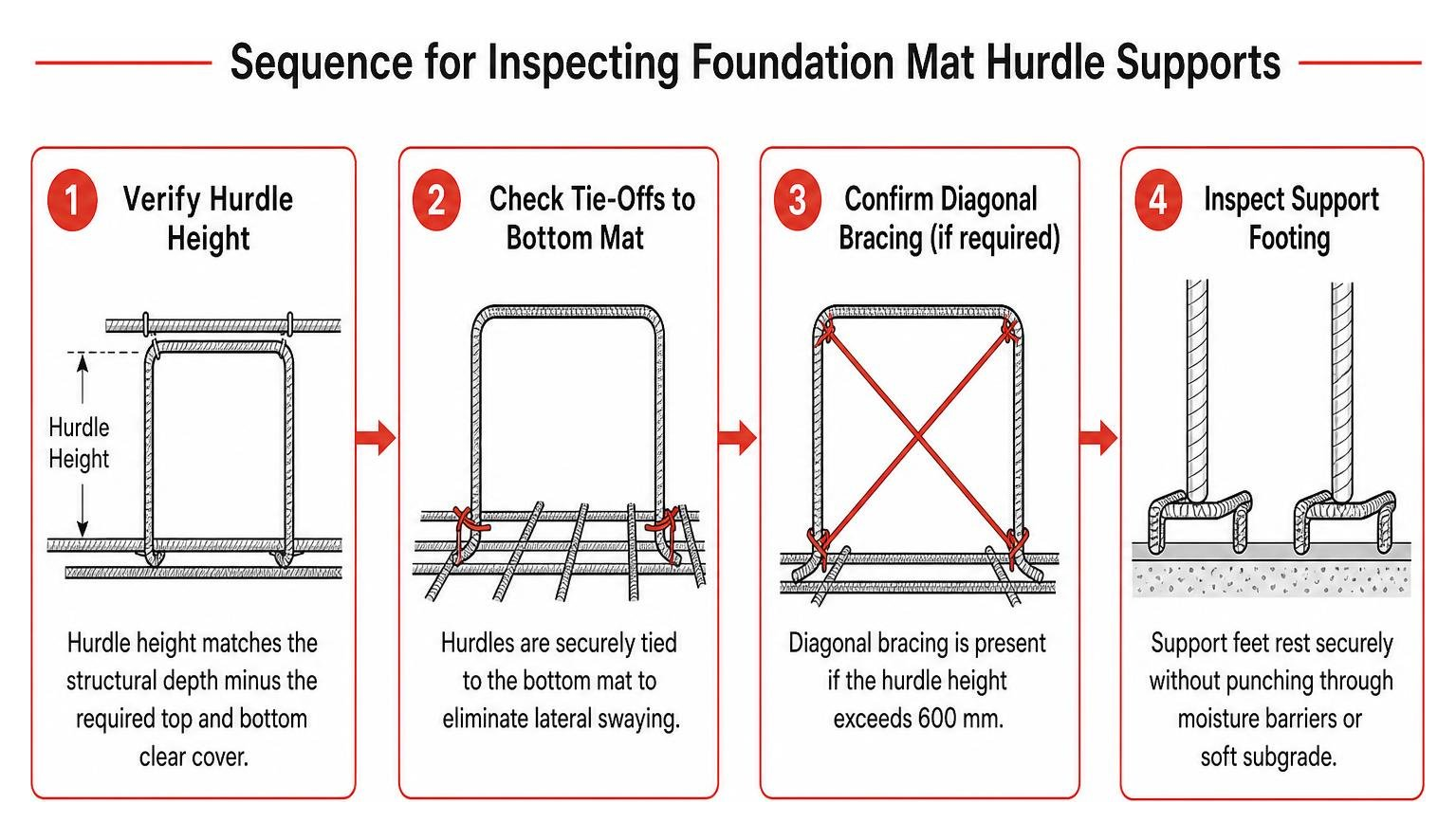
When reviewing hurdle installations, ensure that:
- The hurdle height matches the structural depth minus the required top and bottom clear cover.
- Hurdles are securely tied to the bottom mat to eliminate lateral swaying.
- Diagonal bracing is present if the hurdle height exceeds 600 mm.
- Support feet rest securely without punching through moisture barriers or soft subgrade.
Learning the principles of sitting pretty with rebar supports helps crews understand how these three-dimensional supports distribute immense loads safely across complex foundation mats.
Determining Load Capacity and Spacing Standards
A rebar chair is only as good as its load rating and layout. International and domestic standards, such as AS/NZS 2425, classify bar chairs into four distinct strength grades based on the load in kilograms they can safely support: 60 kg, 120 kg, 200 kg, and greater than 300 kg.
- 60 kg Grade: Suitable only as lightweight lateral spacers; never use these for load-bearing slab steel.
- 120 kg Grade: The absolute minimum strength grade for slab reinforcement. It safely supports the dead weight of the rebar grid along with standard worker foot traffic.
- 200 kg to >300 kg Grade: Heavy-duty chairs engineered for multi-layered mats, bridge decks, and heavy civil construction.
For spacing, the Concrete Reinforcing Steel Institute (CRSI) dictates a general maximum spacing of 4 feet (approximately 1,220 mm) on center in each direction, unless the project drawings specify tighter intervals. Highway and infrastructure standards, including the DelDOT 2026 Standard Specifications, mandate rigid adherence to certified chair load capacities to eliminate deflection during heavy bridge and paving pours. Contractors can discover why your slab needs rebar chair supports to prevent catastrophic deflection during the concrete drop.
Spacing Limits for Mesh and Slab Reinforcement
Lighter steel fabric and small-diameter bars deflect much faster than heavy structural bars. For steel fabric (mesh) in residential slabs, the ABCB Housing Provisions Standard limits chair spacing to a maximum of 800 mm on center. When working with lighter residential concrete pavements, standards like AS 3727.1 tighten this limit even further to 600 mm maximum spacing.
Following a concrete rebar spacers complete guide helps field crews calculate exact grid layouts based on bar size. Placing chairs too far apart allows the mesh to sag between contact points, dropping the steel into the bottom tension zone where it becomes useless.
Comprehensive Rebar Chair Inspection Checklist Before Pouring Concrete

A thorough field review prevents structural callbacks and code violations. Field inspectors rely on resources like the Anvilfield rebar placement and cover guide and our guide on rebar chair code compliance to align field conditions with engineering drawings.
Inspectors must verify:
- ACI 318 Clear Cover Requirements: 3 inches for concrete cast against earth; 2 inches for #6 and larger bars exposed to weather; 1.5 inches for #5 and smaller bars exposed to weather; 0.75 inches for interior slabs.
- ACI 117 Placement Tolerances: For slab depths of 4 inches or less, tolerance is ±1/4 inch; for depths between 4 and 12 inches, tolerance is ±3/8 inch; for depths over 12 inches, tolerance is ±1/2 inch.
- Cover Reduction Limits: The reduction under ACI 117 can never exceed 1/3 of the specified design cover.
- Aggregate Clearance: Clear spacing between parallel bars and around chairs must be the greatest of 1 inch, one bar diameter, or 4/3 the maximum aggregate size to prevent honeycombing.
Essential Tools and Standards for Pre-Pour Rebar Chair Inspection
Never inspect a rebar grid from memory. Field QA/QC teams should always carry calibrated cover meters, digital depth gauges, measuring tapes, and the latest Approved for Construction (IFC) structural drawings and Bar Bending Schedules (BBS).
Adhering to InterNACHI rebar inspection protocols helps inspectors identify structural defects early. Using compliant rebar elevation chairs guarantees that physical chairs meet certified vertical dimensions.
Verifying Support Stability in Your Post-Traffic Rebar Chair Inspection
A grid that looks perfect at 7:00 AM can be completely compromised by 9:00 AM after crews drag concrete pump hoses across it. Inspectors must walk the deck immediately prior to the pour.
Check the following critical conditions:
- Foot Traffic Compaction: Look for compressed chairs or rebar pushed out of its cradle clips.
- Thermal Softening: In hot weather (above 30 °C), lower-grade plastic chairs can soften and deform under load.
- Subgrade Punch-Through: Verify that chair feet have not punched into soft dirt or punctured the vapor barrier.
- Tie Wire Rigidity: Confirm all snap and saddle ties hold the rebar firmly against the chair cradles.
Reviewing the ultimate guide to rebar chairs and spacers provides deep insight into keeping structural steel completely stable under tough site conditions.
Special Inspections, Hold Points, and Quality Documentation

Under International Building Code (IBC) Section 1705.3, reinforcing steel placement requires periodic special inspections for structural concrete installations. The pre-pour rebar chair inspection serves as a critical hold point: concrete trucks must not discharge until the special inspector or structural engineer signs the inspection release form.
Proper documentation must include:
- Date-Stamped Photographs: Clear pictures showing overall chair layout, spacing grids, and edge cover measurements.
- Chair Spacing Audit Logs: Recorded measurements confirming spacing meets the 4 ft (or tighter) design requirements.
- Manufacturer Mill & Load Certifications: Verification that chairs meet specified load ratings (e.g., 120 kg or 200 kg).
- Non-Conformance Logs: Documentation of resolved issues, such as replacing broken chairs or adding extra supports in high-traffic pump lanes.
Frequently Asked Questions About Rebar Chair Inspections
What is the most common reason rebar chair installations fail inspection?
The most frequent failures are incorrect chair height, chairs displaced by worker foot traffic, and supports sinking into uncompacted subgrade. When chairs sink or shift, the reinforcement loses its required bottom concrete cover.
What rebar chair considerations matter for exterior coastal slabs?
For coastal environments (exposure classification B2 or marine zones), wire chairs should be avoided because salt air causes rust bleed-through. Instead, specify 100% heavy-duty plastic chairs or 60 MPa concrete support blocks that chemically bond with the mix and block moisture ingress.
How often should chairs be spaced under reinforcement steel?
As a standard rule under CRSI guidelines, chairs should be spaced no further than 4 feet (approx. 1,220 mm) apart. For lighter residential wire mesh or thin concrete pavements, spacing should be tightened to 600 mm to 800 mm to prevent sagging under wet concrete loads.
Conclusion
A successful concrete pour relies on what happens before the concrete ever leaves the chute. Proactive pre-pour inspection ensures that reinforcement remains locked at the exact design height, preserving long-term structural integrity and protecting projects from costly post-pour remediation.
At Hercules Rebar Chairs, we manufacture high-capacity, code-compliant supports designed to handle tough jobsite conditions. With over 14 million units sold across the United States, our signature safety-red chairs give engineers and inspectors instant visual confidence that reinforcement is properly supported. For additional insights on maintaining perfect slab geometry, check out our guide on mastering concrete slab thickness and cover.