

Why Basement Wall Rebar Chairs Matter More Than You Think
Basement wall rebar chairs are small plastic supports that hold steel reinforcement at the correct distance from the inside face of your concrete forms — and choosing the right ones can mean the difference between a wall that lasts decades and one that cracks, corrodes, or fails under lateral soil pressure.
Here is a quick overview of what you need to know:
- What they do: Elevate and hold rebar at the precise cover depth required by your structural engineer or local building code
- Where they are used: ICF basement walls, poured concrete foundation walls, footings, and vertical form applications
- Minimum cover required: Typically 1-3/16″ (30mm) inside cover for ICF walls under the BC Building Code; your jurisdiction may differ
- Recommended spacing: One chair at every rebar crossing for maximum stability
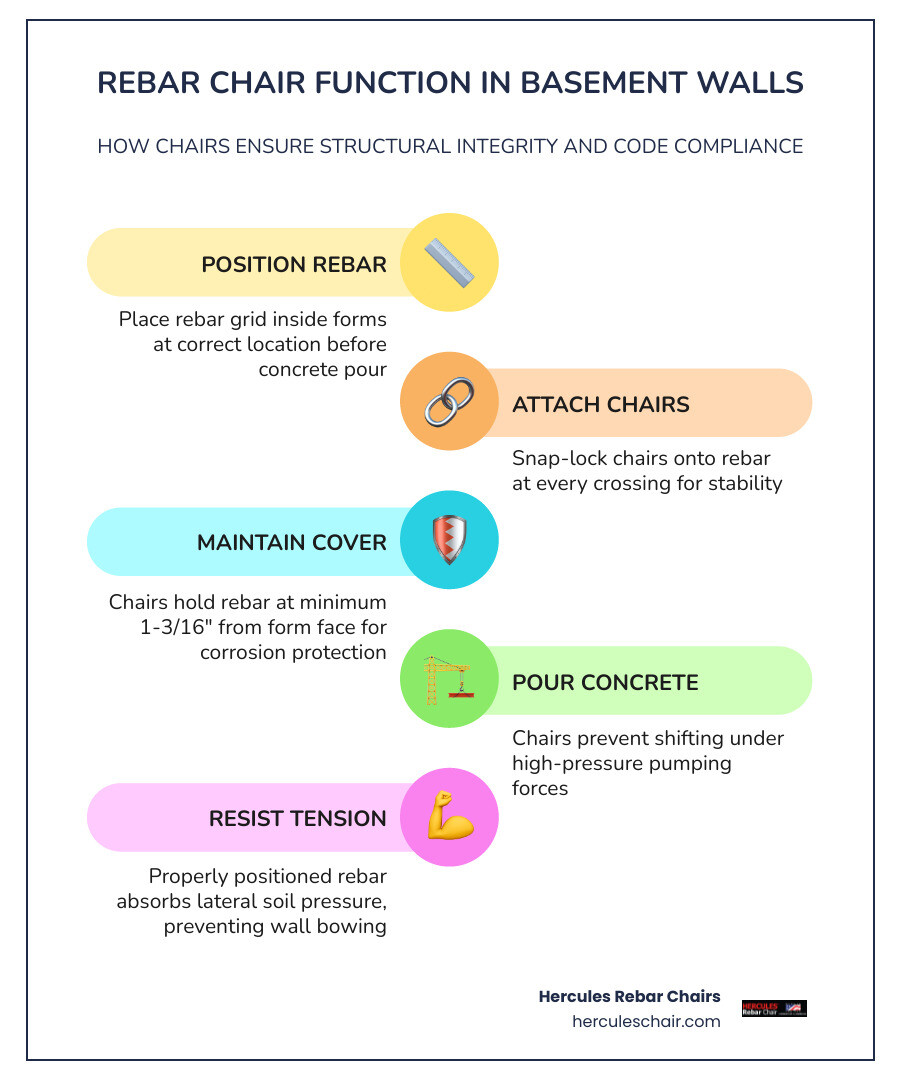
- Key benefit: Prevent rebar from shifting during high-pressure concrete pumping, which can dislodge poorly supported steel and compromise the entire pour
- Compatible rebar size: 1.5-inch chairs (such as the #911) are designed for #4 rebar in 4- to 5-inch applications
The stakes are real. Concrete has excellent compressive strength but poor tensile strength. When soil backfill pushes against a basement wall, the inside face goes into tension — and if your rebar has shifted even slightly out of position during the pour, it may not be where it needs to be to absorb those forces.
I’m Jordan Harris, a licensed Professional Engineer with a master’s degree in structural engineering and five years of experience designing large-scale concrete structures. My work with basement wall rebar chairs through the family business — T.J. Harris Company, makers of the Hercules Chair — gives me a unique perspective on both the engineering principles and the real-world job site challenges covered in this guide.
Quick basement wall rebar chairs definitions:
Why You Need Heavy-Duty Basement Wall Rebar Chairs
When you stand inside a newly excavated basement, it is easy to forget that the surrounding soil is constantly trying to push those brand-new walls inward. This constant lateral soil pressure creates immense bending forces. Because concrete is incredibly strong under compression but notoriously weak under tension, the inside face of that basement wall — the side facing your future game room or den — is placed under extreme tension.
To resist these forces, structural steel must be placed precisely where the tension is highest. If the rebar shifts during the concrete pour, it ends up in the “neutral plane” or, worse, on the compression side of the wall. In either case, the steel becomes virtually useless, leading to wall bowing, cracking, and eventual structural failure. This is exactly Why Your Slab Needs Rebar Chair Supports and why vertical walls require even more vigilance.
Using a comprehensive Rebar Placement Guide helps ensure your reinforcement grid stays locked in place. During a high-pressure pump pour, thousands of pounds of wet concrete slam into your forms. Without heavy-duty basement wall rebar chairs to secure the grid, the sheer force of the concrete will easily push the rebar out of its designed position.
Preventing Corrosion, Spalling, and Structural Failure
If rebar is positioned too close to the surface of the concrete, moisture will inevitably find its way in. This triggers a destructive process known as rust migration. As steel rusts, it expands up to several times its original volume. This internal expansion pressure causes the surrounding concrete to crack and break away — a structural nightmare known as concrete spalling.
Once spalling begins, the structural integrity of your foundation is compromised. By utilizing non-corrosive plastic basement wall rebar chairs, you create a permanent moisture barrier that prevents the steel from ever contacting the outer elements. For a deeper dive into how proper elevation prevents these issues, check out Don’t Let Your Rebar Sink: A Guide to Concrete Chairs.
Understanding Concrete Cover and Code Compliance
Building codes are not just friendly suggestions; they are legally mandated safety limits designed to prevent disasters. The minimum concrete cover — the thickness of the concrete protecting the steel — is strictly regulated. For example, the BC Building Code specifies that vertical rods in Insulating Concrete Form (ICF) walls must be placed in accordance with tables BCBC 9.15.4.5 A to C, maintaining a minimum inside cover of 1-3/16″ (30mm) from the inside face of the ICF panel. Furthermore, the bars must be located within the inside half of the wall section where the tension forces are concentrated.
Using certified, high-strength plastic chairs ensures you meet these exact clearance standards. To learn more about meeting structural specifications, see our guide on Rebar Chair Code: Ensuring Stability and Compliance.
Rebar Placement in ICF and Standard Foundation Walls
Insulating Concrete Forms (ICF) have revolutionized basement construction, but they require precise rebar engineering. ICF walls rely on a internal grid of horizontal and vertical reinforcement. Standard ICF specifications require horizontal rebar rods to be installed every 2 feet vertically, with that critical minimum inside cover of 1-3/16″ (30mm) from the inside face of the ICF panel.
To keep this vertical and horizontal steel aligned perfectly within the hollow core of the foam blocks, builders rely on specialized spacers. You can explore the differences between various support systems in The Ultimate Guide to Rebar Chairs and Spacers.
Vertical vs. Horizontal Applications in Basement Walls
It is a common misconception that rebar chairs are only meant for horizontal concrete slabs like driveways and patios. In reality, they are equally vital in vertical wall applications.
In a basement wall, horizontal bars are primarily installed for crack control, while vertical bars handle the heavy structural tension loads. If these bars are not held apart and secured, they can clump together, restricting the concrete flow. When concrete cannot flow freely around the steel, it creates internal voids and air pockets, severely weakening the wall. Using specialized chairs designed for both vertical and horizontal reinforcement ensures the grid remains rigid and open. Learn more about choosing the right design in The Ultimate Guide to Rebar Chairs Types, Uses, and Sizing for Concrete Slabs.
Footing Dowels vs. Vertical Wall Reinforcement
The connection between your horizontal footing and your vertical basement wall is a critical structural joint. Footing dowels (the steel bars projecting upward from the cured footing) must overlap with the vertical wall reinforcement to transfer lateral loads safely.
For a typical 10-inch thick ICF wall, standard North American engineering tables (such as Nudura’s) specify footing dowels as:
- 1-15M (#5) x 20 inches long spaced @ 48 inches on center, OR
- 1-10M (#4) x 20 inches long spaced @ 24 inches on center.
An important rule of thumb for builders in 2026 is that footing dowels and vertical wall rebar do not need to be tied perfectly flush against each other. Building codes allow a maximum separation of up to 1/5 of the rebar lap length (which equals about 4 inches of separation for a standard 20-inch rebar overlap). To ensure your footings are prepped correctly before the wall pour, read our guides on How to Install Rebar in Footings the Right Way and The Ultimate Guide to Spacing and Supporting Footing Rebar.
Choosing and Spacing the Right Supports
Selecting the right support method directly impacts your project’s labor costs and structural safety. Below is a comparison of common methods used to secure rebar in basement walls:
| Feature | Hercules Snap-Lock Chairs | Manual Wire Tying | Standard Non-Locking Chairs |
|---|---|---|---|
| Material | High-Strength Plastic | Steel Wire | Low-Grade Plastic / Metal |
| Installation Speed | Extremely Fast (Snap-in) | Arduous & Slow | Moderate |
| Corrosion Risk | Zero | High (at wire ends) | Low to High |
| Grid Stability | Excellent (Dual-clip) | Fair (slip-prone) | Poor (dislodges easily) |
| Labor Savings | High | Low | Moderate |
Our Hercules snap-lock chairs completely eliminate the need for manual wire tying, which is often a difficult, back-breaking chore. The built-in snap-lock mechanism holds intersecting bars tightly, saving valuable time on the job site. For more details on choosing the best style for your project, refer to A Practical Guide to Concrete Chairs for Rebar.
Selecting the Right Size of Basement Wall Rebar Chairs
For typical residential basement walls utilizing #4 rebar, we highly recommend our Hercules 1.5-inch rebar chair (Model #911). This chair is specifically engineered to support #4 rebar, providing exactly 1.5 inches of clearance from the formwork to the bottom bar. While incredibly popular for 4-inch to 5-inch concrete slabs, this exact same clearance is ideal for maintaining code-compliant concrete cover in vertical foundation walls. To find the right elevation for your engineering specs, view our catalog of Compliant Rebar Elevation Chairs for Professional Results.
How to Install Basement Wall Rebar Chairs in Vertical Forms
Installing basement wall rebar chairs in vertical forms is simple, but consistency is key:
- Assemble the Grid: Lay out your vertical and horizontal rebar according to your structural drawings.
- Snap the Chairs: We recommend placing a chair at every rebar crossing to ensure the reinforcement stays perfectly in place before, during, and after the concrete pour.
- Lock It In: First, snap the bottom piece of reinforcement into the lower clip, then snap the intersecting top bar into the upper clip. The dual-clip design secures the entire junction without any wire ties.
- Secure the Forms: Once the grid is fully supported, close your forms. The chairs will keep the steel at a rigid, uniform distance from the face of the forms, resisting the heavy dynamic forces of concrete pumping.
Frequently Asked Questions about Basement Wall Reinforcement
Can you use horizontal slab rebar chairs in vertical basement walls?
Yes! High-quality plastic chairs featuring a dual-clip snap-lock mechanism (like our Hercules #911) are excellent for vertical wall forms. The snap-lock design tightly grips the intersecting bars, preventing the chairs from slipping or falling off when concrete is poured vertically from above. This ensures uninterrupted concrete flow and perfect spacing.
What happens if rebar is driven directly into the soil before pouring?
Driving steel rebar directly into the dirt to stabilize it is a critical mistake. Soil moisture will travel directly up the steel, causing rapid rust migration. This leads to internal concrete spalling and eventual structural failure. Rebar must always be fully encapsulated in concrete, which is why using non-corrosive plastic chairs to lift the steel off the ground is a code requirement.
How many rebar chairs do I need per square foot for a basement wall?
For vertical walls, we recommend placing a chair at every single rebar crossing. This ensures the grid behaves as a single, rigid unit that won’t deform under the pressure of wet concrete. You can use our online estimator to calculate the exact number of chairs and boxes needed based on your wall dimensions and rebar grid spacing.
Conclusion
Building a basement foundation that stands the test of time requires careful planning, strict code compliance, and the right tools. By utilizing heavy-duty basement wall rebar chairs, you protect your structure against lateral soil pressure, prevent devastating concrete spalling, and save hours of tedious labor on-site.
As America’s #1 concrete support manufacturer with over 14 million units sold, Hercules Rebar Chairs (by T.J. Harris Co.) are designed to get the job done right. Proudly manufactured in our signature red color, our heavy-duty, code-compliant chairs are trusted by professionals across the USA.
Ready to secure your next build? Explore our complete product line at Hercules Rebar Chairs and find the perfect supports for your foundation walls, footings, and slabs.