

What Are Concrete Construction Materials?
| Material Category | Examples |
|---|---|
| Binding agent | Portland cement, GGBS, specialty cements |
| Aggregates | Sand, gravel, crushed stone |
| Water | Clean mixing water |
| Reinforcement | Rebar, wire mesh, fiber |
| Admixtures | Plasticizers, accelerators, waterproofing agents |
| Support accessories | Rebar chairs, dowels, expansion joints |
Concrete is the most-produced material on Earth — and demand keeps climbing as more of the world’s population moves into cities. Yet for all its ubiquity, a lot of contractors still find themselves confused about which materials they actually need for a given pour, and which accessories keep a project code-compliant and on schedule.
Getting it wrong isn’t just frustrating. It’s expensive.
This guide cuts through the noise. Whether you’re working on a slab, a foundation, or a large structural pour, you’ll find a clear breakdown of every core material category — what it is, why it matters, and how to choose it.
I’m Jordan Harris, a licensed Professional Engineer and structural engineer with hands-on experience specifying concrete construction materials for large-scale power generation projects. I now lead product development at T.J. Harris Company, where we build rebar support systems used in concrete pours across the country. That combination of field engineering and manufacturing gives me a practical perspective on what actually works — and what doesn’t.
Easy concrete construction materials word list:
Understanding Concrete: Components and Manufacturing
To understand which concrete construction materials you need, we first have to look at what concrete actually is.
At its most fundamental level, concrete is a manufactured stone. It is not a single raw material, but a composite. When we mix the binding agent (cement) with water, they trigger a chemical reaction called hydration. This hydration process forms a sticky cement paste that wraps around the loose stones and sand (aggregates), gluing them together into a solid, rock-like mass.
One of the most common mistakes in construction is assuming concrete simply “dries out” to harden. If concrete dried out too quickly, the hydration process would stop, leaving you with a weak, crumbly mess. The water-cement ratio is the absolute golden rule of concrete chemistry: it is the weight of the mixing water divided by the weight of the cement. If you add too much water, the cement paste becomes diluted, creating microscopic voids when the excess water eventually evaporates. This drastically lowers the compressive strength of the finished structure.
In modern commercial and residential building, ready-mixed concrete is the undisputed king. In fact, ready-mixed concrete accounts for nearly three-fourths of all concrete produced. It is mixed off-site at a batch plant and delivered to the job site in those familiar rotating drum trucks, ensuring a highly consistent mix that meets strict engineering design specifications.
For specialized projects, sourcing high-quality raw binders is crucial. You can learn more about how quality binders are sourced and formulated from this Portland Cement Supplier | High-Quality Cement | Heidelberg Materials resource.
The Core Ingredients of Concrete
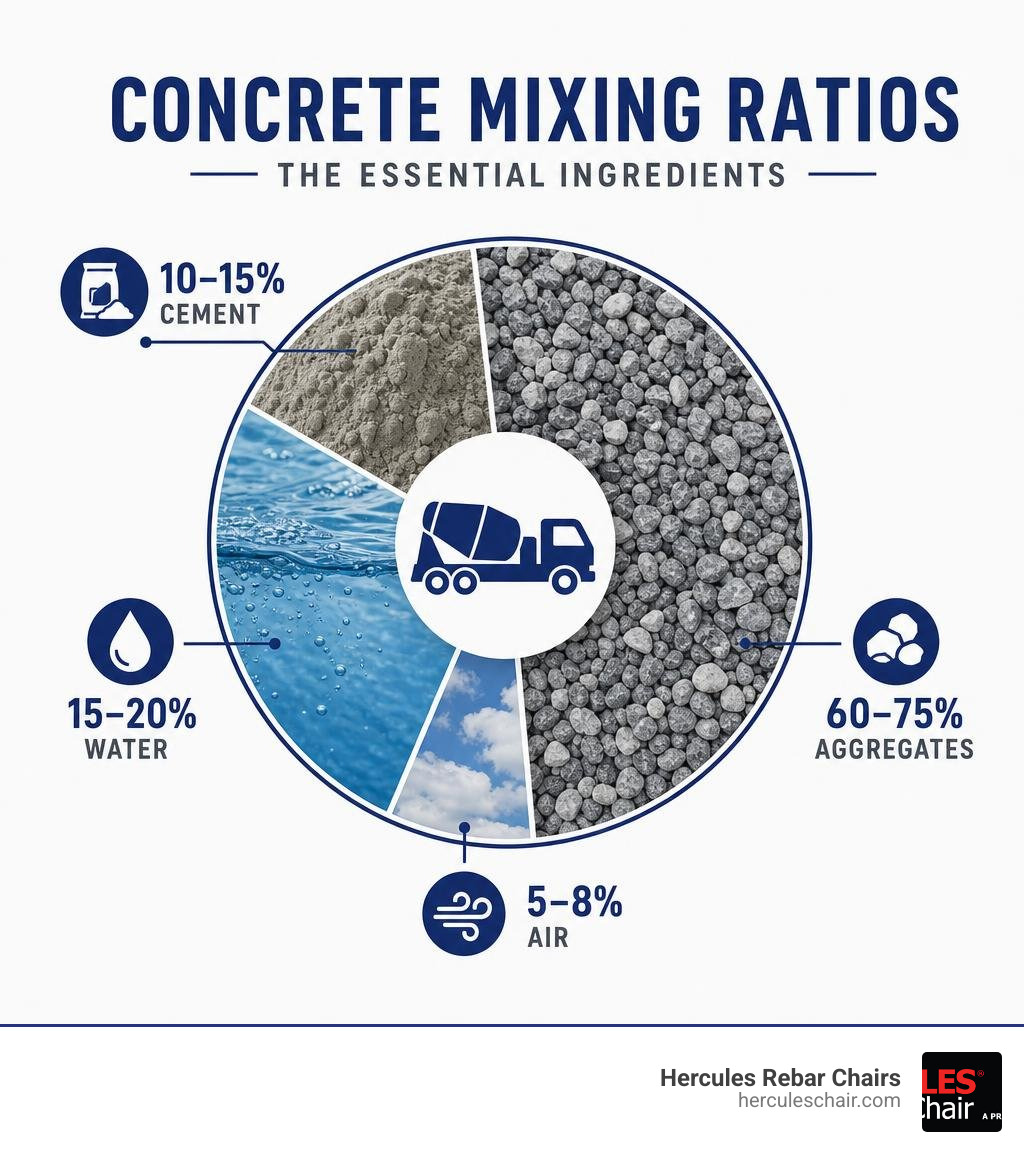
Every standard concrete mix relies on four core ingredients, balanced in precise proportions to achieve the desired strength, workability, and durability:
- Portland Cement: This is the active binder. While it is the most chemically complex component, cement typically accounts for only 10% to 12% of the total concrete mixture.
- Aggregates: Aggregates comprise 60 to 75 percent of the total volume of concrete. They act as the structural filler. Aggregates are divided into fine aggregates (usually natural sand) and coarse aggregates (gravel or crushed stone). They must be clean, hard, and free of organic matter or chemicals that could disrupt the hydration process.
- Water: Water triggers the chemical reaction with the cement and makes the wet mix workable. As a rule of thumb, if water is clean enough to drink without a noticeable taste or odor, it is clean enough to mix into concrete.
- Entrained Air: This is the invisible hero of outdoor concrete. By introducing microscopic air bubbles (usually 5% to 8% of the total volume) into the wet mix, we give moisture space to expand when it freezes. Without entrained air, outdoor concrete in cold climates will quickly scale, crack, and spall.
To dive deeper into how different cements are engineered for specific environmental demands, check out Cement | Heidelberg Materials UK.
Manufacturing and Delivery Standards
The manufacturing of cement is a massive, high-temperature industrial process. Raw materials—primarily limestone, clay, and shale—are quarried, crushed, and fed into a massive rotary kiln. These kilns, which can be longer than a 40-story building, heat the ingredients to a scorching 2,700°F (1,450°C).
This extreme heat causes a chemical transformation, fusing the raw materials into small, marble-sized nodules called clinker. The clinker is then cooled and finely ground with a small amount of gypsum (which regulates the setting time) to produce the familiar grey powder we call Portland cement.
Once the cement is mixed with water and aggregates, delivery standards become paramount. Ready-mixed concrete must be handled carefully to prevent segregation (where heavy stones sink to the bottom) and premature setting. The industry standard governing this process is the C94/C94M Standard Specification for Ready-Mixed Concrete. This specification outlines rigid quality requirements, batching tolerances, and delivery timeframes—typically requiring that concrete be discharged from the truck within 90 minutes of water meeting the cement.
Essential Concrete Construction Materials for Modern Projects
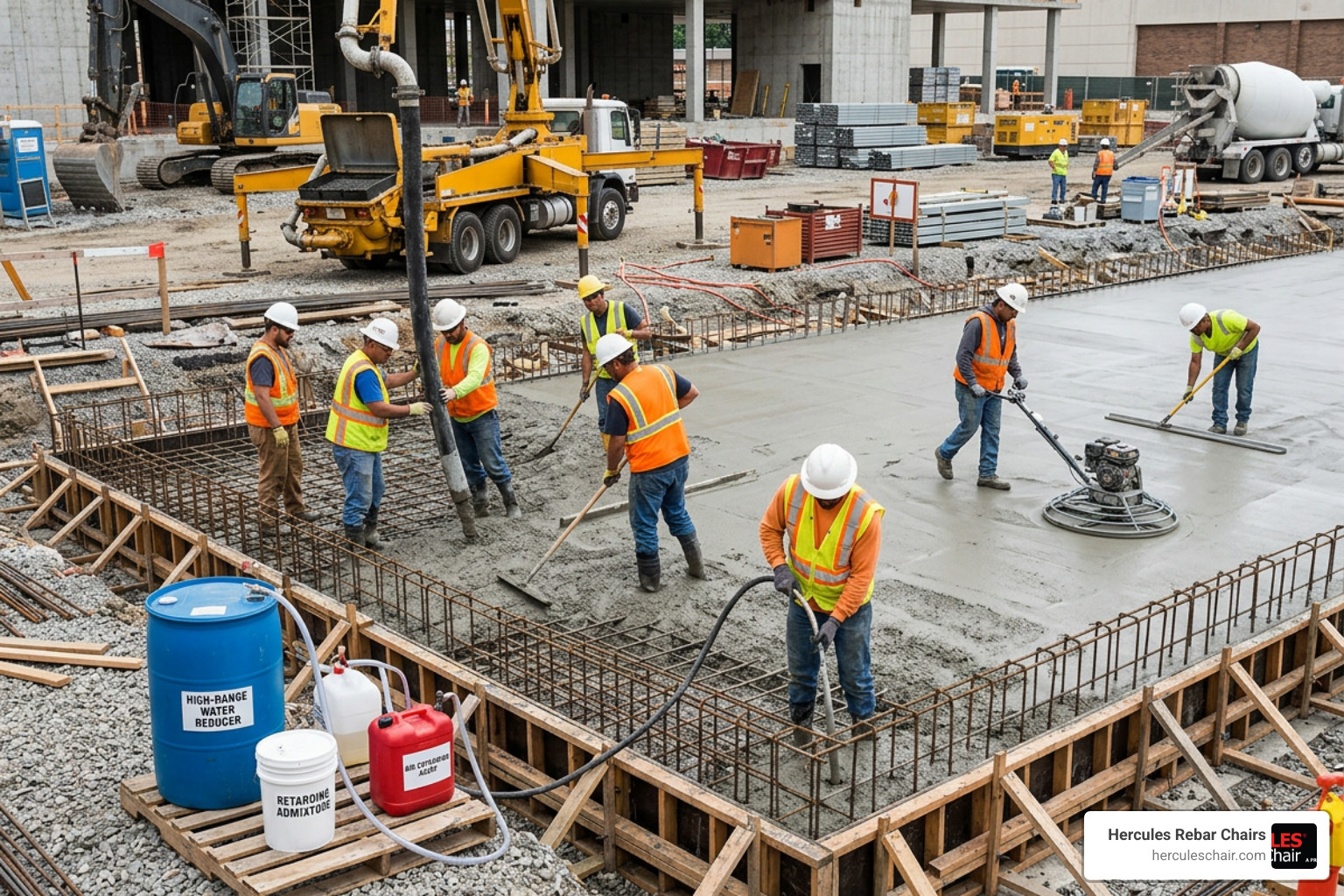
Depending on the scale, design, and location of your project, standard concrete might not cut it. Modern engineering has developed a diverse menu of specialized concrete types and chemical admixtures to solve unique structural challenges.
Main Types of Concrete and Their Applications
- Reinforced Concrete: Concrete is incredibly strong when compressed (pushed), but weak when tensioned (pulled). By embedding steel rebar or wire mesh into the wet mix, we create reinforced concrete. This composite material leverages the compressive strength of concrete and the tensile strength of steel, making it ideal for high-rise buildings, bridges, and suspended slabs.
- Precast Concrete: Instead of pouring concrete on a messy, weather-dependent job site, precast concrete elements (like wall panels, stairs, and structural beams) are cast and cured in a highly controlled factory environment. This ensures maximum quality control, reduces on-site labor, and speeds up construction timelines.
- Lightweight Concrete: By replacing traditional heavy stone aggregates with porous materials like expanded clay, shale, or pumice, we can create lightweight concrete. This material reduces the dead load of a structure, allowing for lighter, more cost-effective structural steel framing.
- High-Strength Concrete: Typically defined as concrete with a compressive strength exceeding 40 MPa (approx. 5,800 psi), high-strength concrete is achieved by lowering the water-cement ratio and incorporating silica fume or superplasticizers. It is commonly used in the lower columns of skyscrapers to keep column sizes manageable.
- Shotcrete: This is concrete projected through a hose at high velocity onto a surface. It is widely used for tunnel linings, slope stabilization, and complex curved structures like swimming pools. Specialized, pre-blended mixes like Sikacrete®-540 are engineered specifically for these demanding applications.
Admixtures and Performance Additives
Admixtures are chemical ingredients added to the concrete mix immediately before or during mixing. They allow contractors to customize how the concrete behaves while wet and how it performs once hardened:
- Plasticizers and Superplasticizers: These water-reducers make concrete highly flowable (easy to pour around dense rebar) without adding extra water, preserving the structural strength.
- Crystalline Waterproofing: These chemicals react with moisture and un-hydrated cement particles to grow millions of microscopic, needle-like crystals. These crystals permanently plug the concrete’s pores, blocking water penetration from any direction.
- Fiber Reinforcement: Adding synthetic (poly) or steel fibers directly to the mix helps control micro-cracking caused by plastic shrinkage as the concrete cures.
- Accelerators and Retarders: Accelerators speed up the setting time (perfect for cold-weather pours to prevent freezing), while retarders slow down the setting time (essential for hot-weather pours or long transit times).
Key Properties and Selection Factors
Choosing the right concrete construction materials requires balancing structural requirements with installation realities. Let’s compare how different concrete types stack up across key performance metrics:
| Concrete Type | Compressive Strength | Workability | Durability | Tensile Strength | Common Use Case |
|---|---|---|---|---|---|
| Standard Mix | Moderate (2,500–4,000 psi) | High | Moderate | Very Low | Residential driveways, sidewalks |
| Reinforced | Moderate to High | Moderate | High | Excellent (due to steel) | Foundations, structural columns, beams |
| High-Strength | Extremely High (6,000–12,000+ psi) | Low (requires superplasticizers) | Outstanding | Low (unless reinforced) | High-rise columns, heavy infrastructure |
| Lightweight | Low to Moderate | High | Moderate | Low | Floor fills, partition walls |
Selecting the Right Concrete Construction Materials
When sitting down to specify materials for your next project, you must look beyond the wet mix in the truck. A successful pour depends on a complete system of accessories and site preparation materials.
First, analyze your environmental exposure. Will the concrete be exposed to harsh freeze-thaw cycles? Will it contact sulfate-rich soils or marine salt spray? These factors dictate your cement type (e.g., ASTM Type II or Type V) and whether you need specialty admixtures.
Second, understand your load requirements. Heavy-duty commercial slabs require thicker profiles and robust reinforcement.
Finally, never overlook the curing phase. If concrete is allowed to dry out too quickly, it will lose up to 50% of its potential design strength. Sourcing the right curing blankets, vapor barriers, and joint expansion foams is just as critical as ordering the concrete itself. For a deep dive into the accessories that make or break a professional pour, read Beyond the Mix: What Every Concrete Builder Needs to Know About Accessories.
Reinforcement and Support Accessories
If you are pouring reinforced concrete, the steel rebar or wire mesh must sit in a very specific location within the slab—typically in the middle or upper third. If the steel sinks to the bottom of the wet concrete under the weight of the workers or the flow of the mix, it becomes practically useless, leaving your slab highly vulnerable to structural cracking and failure under load.
This is where rebar chairs and concrete supports become non-negotiable.
Using makeshift supports like broken bricks or rocks is a recipe for code violations and structural weak points. Instead, professional builders rely on purpose-built reinforcement products to guarantee exact steel placement.
To learn more about selecting the right reinforcement grids, check out From Rebar to Mesh: Essential Concrete Reinforcement Products Explained. To find high-quality suppliers of these structural accessories, consult Your Go-To Source for Concrete Reinforcing Accessories and Suppliers.
Sustainability, Quality Control, and Innovation

The concrete industry is undergoing its most massive transformation since the invention of Portland cement. With global urbanization demands rising, the push for sustainable concrete construction materials and rigorous quality control has never been stronger.
Innovations in Sustainable Concrete Construction Materials
Traditional cement production is highly carbon-intensive, accounting for roughly 8% of global CO2 emissions. To combat this, researchers and manufacturers are pioneering low-carbon alternatives.
The most successful solution currently in use is replacing a portion of Portland cement with industrial byproducts like GGBS (Ground Granulated Blast-furnace Slag) or fly ash. GGBS not only improves the long-term durability and chemical resistance of concrete, but it also has a massive environmental benefit: using one tonne of evoBuild low carbon GGBS in concrete reduces the embodied CO2 by around 650kg compared to using one tonne of traditional Portland Cement.
Furthermore, innovations like Heidelberg’s evoZero—the world’s first carbon-captured near-zero cement—and advanced circular economy practices (which recycle crushed demolition concrete back into new mixes) are paving the way toward carbon-neutral construction by 2050.
Quality Control and Code Compliance
No matter how advanced or sustainable your concrete mix is, it must meet strict quality control standards on-site to ensure structural safety.
Quality control starts with fresh concrete testing:
- The Slump Test: Measures the consistency and workability of the concrete before it is poured. A slump that is too high indicates too much water (weak concrete); a slump too low means it will be incredibly difficult to place and consolidate.
- Compression Test Cylinders: Standard plastic cylinders are filled with fresh concrete on-site, cured under controlled conditions, and crushed in a hydraulic press at 7 and 28 days to verify the mix meets the engineered design strength.
Beyond the mix, your formwork and support accessories must comply with local building codes and safety regulations. Shoddy formwork can blow out under the immense pressure of wet concrete, leading to catastrophic structural failures and dangerous working conditions.
To ensure your job site remains safe and fully compliant, explore The Ultimate Guide to Essential Concrete Formwork Accessories and review The Ultimate List of Professional Concrete Accessories.
Frequently Asked Questions about Concrete Materials
What is the difference between cement and concrete?
Think of cement as flour and concrete as the baked cake. Cement is an ultra-fine binding powder made from limestone and clay. Concrete is the finished, rock-like construction material created when you mix cement paste with water, sand, and stone aggregates. You cannot buy a “cement driveway”—you buy a concrete driveway that is bound together by cement.
How does the water-to-cement ratio affect concrete strength?
The water-to-cement ratio is the weight of the mixing water divided by the weight of the cement. It directly determines the density of the cured cement paste. A lower ratio creates a denser, stronger paste with fewer microscopic pores, resulting in higher compressive strength and superior durability. Adding too much water makes the concrete easier to pour in the short term, but permanently weakens the structure.
Why is reinforcement necessary in concrete construction?
While concrete is exceptionally strong when compressed, it has very low tensile strength (only about 10% of its compressive strength). When heavy loads or temperature changes bend or stretch a concrete slab, it will easily crack and fail. Embedding steel rebar or wire mesh provides the necessary tensile strength to distribute these pulling forces safely, preventing structural collapse.
Conclusion
Getting a concrete pour right requires looking at the project as a complete system. From specifying the ideal water-cement ratio and choosing the perfect chemical admixtures to sourcing high-quality aggregates, every single material choice directly impacts the lifespan of your structure.
But even the most advanced, expensive concrete mix will fail if your reinforcement steel sinks to the bottom of the slab.
At Hercules Rebar Chairs, we manufacture the strong rebar chairs and concrete supports that professional builders trust to keep their steel exactly where it belongs. Known as “America’s #1” with over 14 million units sold, our support systems are engineered to save you time and money on-site while ensuring absolute code compliance. Plus, our signature red color makes inspection a breeze—allowing code inspectors to verify your steel placement from a distance instantly.
Ready to take the guesswork out of your next pour? Calculate your rebar support needs with the Hercules Rebar Chair Estimator and ensure your project stands strong for decades to come.