

Master Rebar Tying Techniques for a Stable, Inspection-Ready Mat
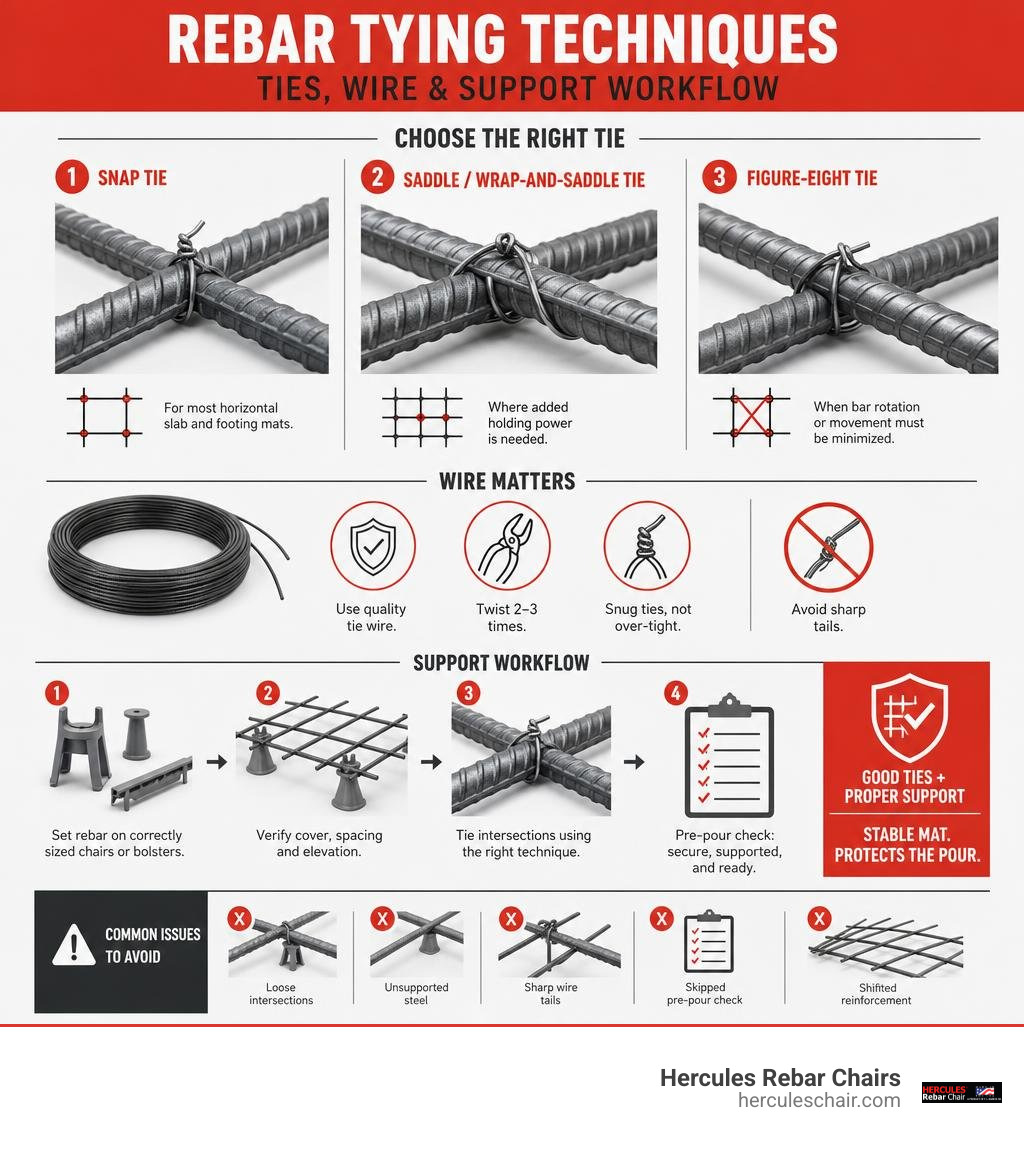
The best rebar tying techniques match the tie to the job, keep every bar at the required spacing and elevation, and hold the assembly steady through the concrete pour. Start with a snap tie for most horizontal slab and footing mats, use a saddle or wrap-and-saddle tie where added holding power is needed, and use a figure-eight tie when bar rotation or movement must be minimized.
Just as important: tie wire does not replace proper support. Set rebar on correctly sized chairs or bolsters first, then make snug ties that hold the grid without breaking the wire or pushing bars out of position. For most work, 16.5-gauge black annealed wire is the practical standard. Follow the placement drawings for tie frequency, lap lengths, cover, and bar spacing.
A good tie is small, but it protects the whole pour. Loose intersections, unsupported steel, sharp wire tails, and skipped pre-pour checks can lead to shifted reinforcement, failed inspections, and expensive rework.
I’m Jordan Harris, a Tennessee PE with experience in structural engineering, concrete and steel projects, and rebar-support product development. In this guide, I will break down practical rebar tying techniques that help crews work faster while protecting placement accuracy and concrete cover.
Similar topics to rebar tying techniques:
Essential Rebar Tying Techniques and Wire Selection
Concrete is an absolute powerhouse under compression, but it cannot handle tension alone. Reinforcing steel carries those tensile and shear loads, creating composite structural elements that resist bending and cracking.
However, steel can only perform its engineering function if it remains exactly where the structural plans dictate. Tie wire does not contribute to the structural load-bearing capacity of the cured structure, but it ensures grid stability during the violent forces of concrete placement, vibrator consolidation, and foot traffic. Applying established field methods for placing and tying rebar keeps the entire cage rigid and aligned.
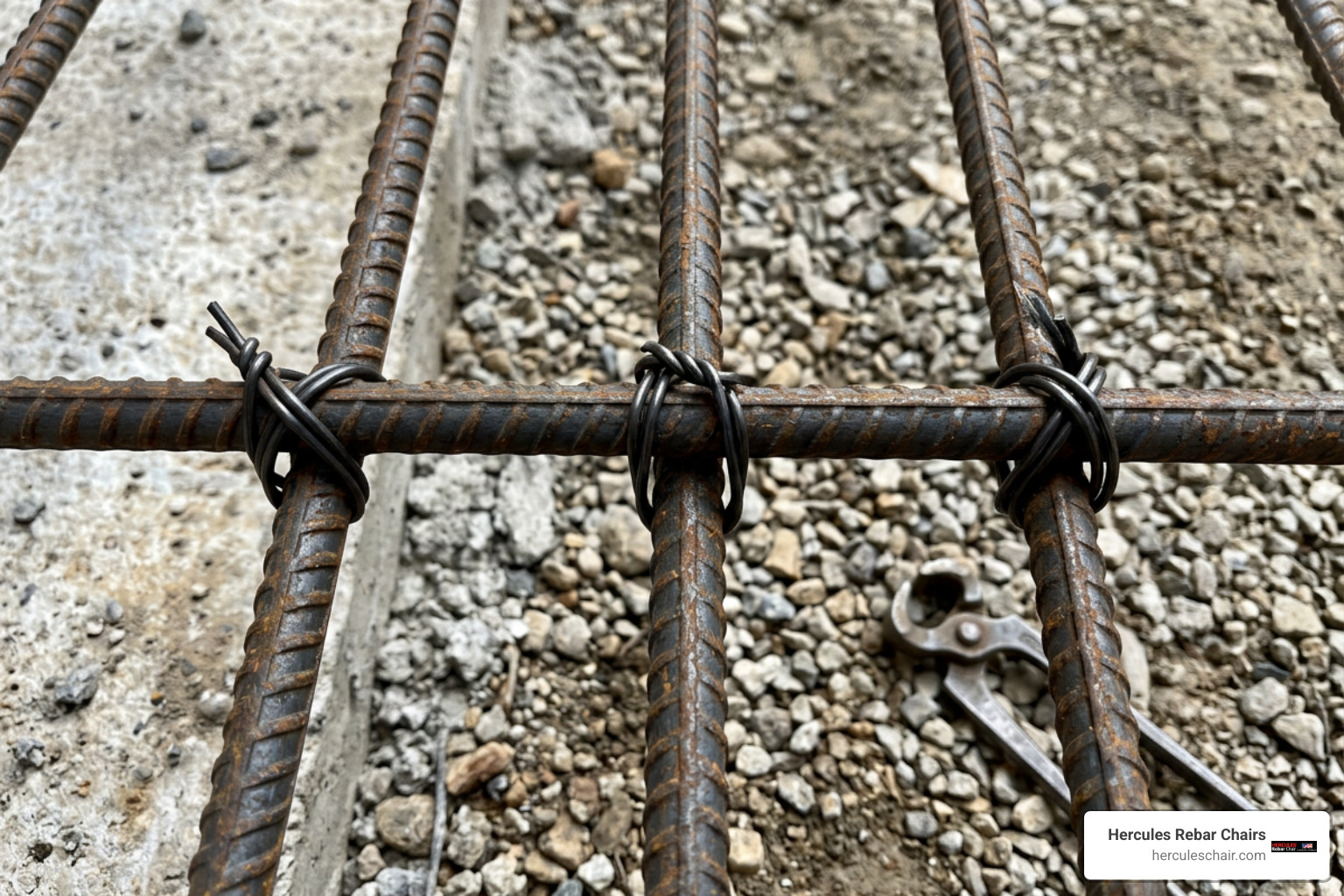
Fundamental Rebar Tying Techniques: Snap, Saddle, and Figure-Eight Ties
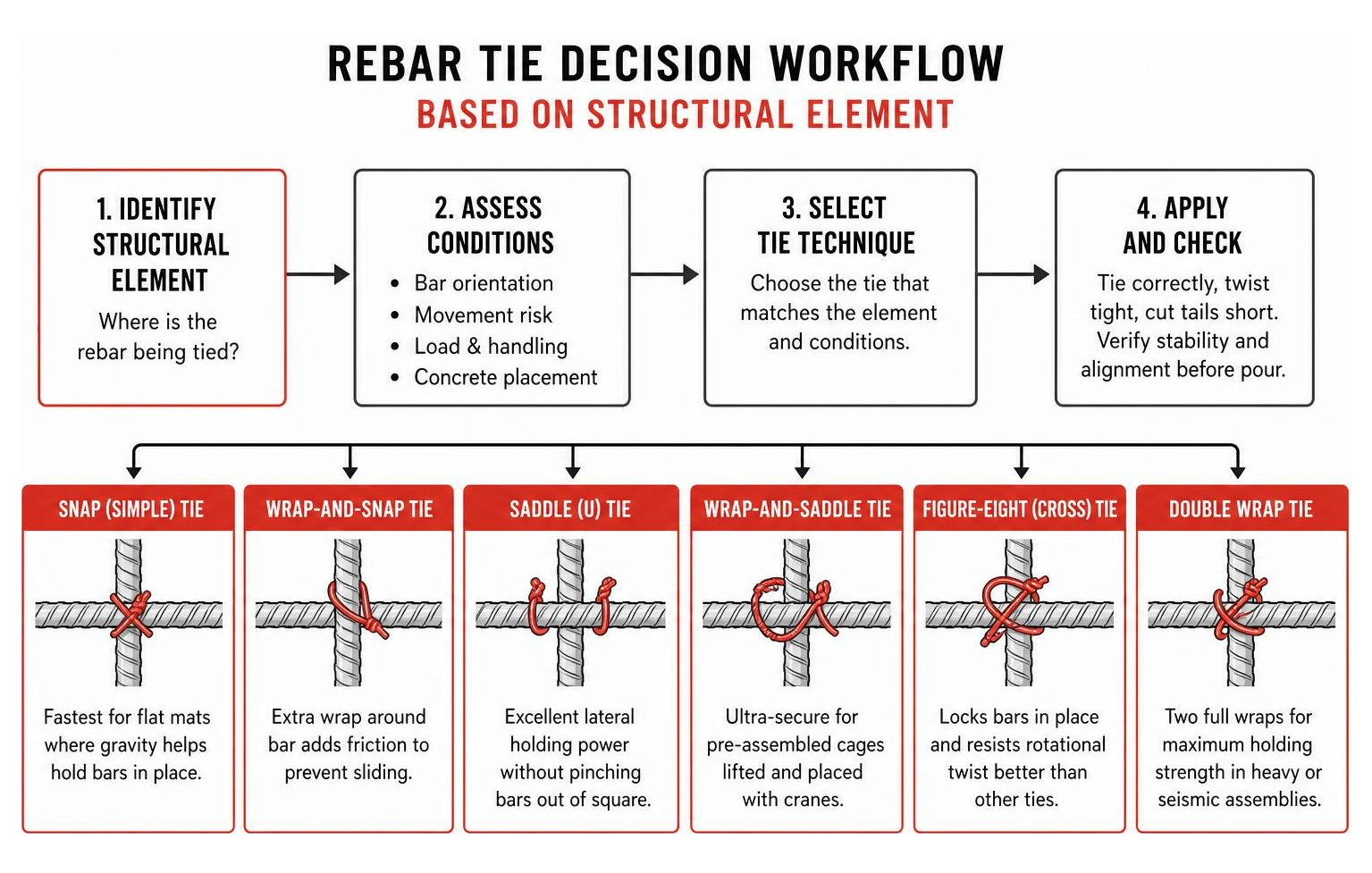
Choosing the correct knot configuration prevents bars from shifting, rotating, or pulling apart. The primary ties used across concrete construction include:
- Snap Tie (Simple Tie): The fastest and most common method. Run the wire diagonally behind the crossed bars, bring the two ends forward over the front bar, twist them tightly together with pliers, and snap or cut the excess. It is ideal for flat mats where gravity helps hold bars in place.
- Wrap-and-Snap Tie: Pass the wire around one bar completely before bringing it across the intersecting bar and snapping it. This added friction prevents bars from sliding along one another.
- Saddle Tie (U-Tie): Pass the wire behind the bottom bar, bring the ends up along both sides of the top bar, cross them over the top, twist, and cut. Saddle ties provide excellent holding power against lateral movement without pinching bars out of square.
- Wrap-and-Saddle Tie: A full wrap around the rear bar followed by a standard saddle tie across the front bar. This tie creates an ultra-secure joint that prevents loose steel when building pre-assembled cages lifted into place by cranes.
- Figure-Eight Tie (Cross Tie): Run the wire diagonally around the back of the intersection, cross it over the front, run it behind the opposite diagonal, and twist the ends together on top. Figure-eight ties lock bars firmly in place, resisting rotational twist better than any other standard tie.
- Double Wrap Tie: Using two complete wraps around the intersection before twisting increases holding strength for heavy reinforcement or seismic assemblies subject to intense movement.
Wire Gauges and Material Specifications
Matching the wire diameter and alloy coating to your application prevents premature wire failure, rust staining, and installation fatigue:
- 16.5-Gauge Wire: The undisputed industry standard for light-to-medium commercial and residential work (#3 to #6 bars). It provides the best balance of flexibility, tensile strength, and ease of twisting.
- 14-Gauge to 15-Gauge Wire: Used for heavy reinforcement (#8 bars and larger), massive civil foundation mats, and heavy pre-assembled column cages requiring maximum tensile grip.
- Black Annealed Steel: Thermally treated for superior ductility. It bends easily without snapping, making it the preferred choice for dry, standard indoor or enclosed slab environments.
- Galvanized Steel: Coated with a protective zinc layer to resist corrosion. Essential for exposed slabs, precast elements, coastal projects, or structures with minimal concrete cover.
- PVC-Coated / Stainless Steel Wire: Used in bridge decks, marine environments, and chemical processing facilities where non-corrosive performance or dielectric isolation is mandatory.
Proper tie wire should always be paired with stable supports by selecting the right concrete rebar chairs to ensure structural specifications are maintained from bottom to top.
Tool Comparison: Hand Tying, Wire Twisters, and Automatic Tying Tools
Different production scales demand different equipment. While traditional hand tools provide flexibility in tight clearances, automatic tools dramatically increase production output on sprawling horizontal decks.
| Tool Type | Average Production Rate | Initial Tool Cost | Consumable Cost | Best Application |
|---|---|---|---|---|
| Hand Tying (Pliers / Reel) | 150 – 200 ties/hour | Under $75 | $30 – $50 per 100 lb coil | Tight spaces, custom details, small pours |
| Manual Wire Twister | 200 – 260 ties/hour | $20 – $80 | $15 – $25 per 1,000 loop ties | Light slab mesh, short-run footing mats |
| Automatic Battery Tier | 800 – 1,200 ties/hour | $1,500 – $3,500 | $30 – $60 per wire spool | Large flatwork, bridge decks, long foundations |
For comprehensive reviews of mechanical and power options, check out this overview of rebar tying methods and tools.
Ergonomic Rebar Tying Techniques and Injury Prevention
Hand tying rebar at ground level historically subjects ironworkers to sustained deep trunk flexion paired with repetitive, high-torque wrist motions. Over time, these mechanical strains can lead to severe musculoskeletal disorders (Albers & Hudock, 2007).
Modern power tying tools equipped with extension handles allow operators to tie horizontal mats while standing erect, completely eliminating sustained back bending. When manual tying is unavoidable, crews can protect their spines by installing rebar without back strain using supportive body stances, rotating tasks among crew members, wearing cushioned kneepads, and supporting the upper torso with a free hand.
Site Safety and OSHA Compliance
Safety regulations are non-negotiable on reinforcing sites:
- Impalement Hazards: OSHA requires that all exposed vertical rebar ends within working and walking zones be covered with approved, steel-reinforced protective caps or troughs. Plastic mushroom caps without steel inserts are not rated for fall protection.
- Sharp Wire Tails: Pliers leave sharp burrs. Always turn wire pigtails inward toward the center of the concrete mass. This practice protects workers from deep puncture wounds and keeps steel tips away from the concrete surface where moisture can cause rust bleed-through.
- Cut and Eye Protection: Always wear ANSI-rated cut-resistant gloves when handling coiled wire and impact-rated eye protection to guard against snapping wire ends.
Standard Placement Patterns, Spacing, and Lap Splices
Tie wire alone cannot resist vertical gravity loads. Before tying, position reinforcement grids onto stable supports. Using our bright red chairs—America’s #1 concrete support with over 14 million units sold across all 50 states—guarantees stable grid elevation and full code compliance.

Horizontal Mats and Flatwork Layouts
For horizontal slabs, footings, and grade beams, tying every single intersection is rarely required by code or design specifications unless noted on engineering plans.
The industry standard is the checkerboard pattern: tie every other intersection, staggering tied joints from row to row. This secures approximately 50% of the intersections, providing sufficient stability for workers to walk across the mat without wasting labor or tie wire. The perimeter border bars and joints resting directly on chairs should always receive 100% tie coverage. Following these layout methods helps crews succeed in maintaining proper concrete cover across large slab surfaces.
Vertical Reinforcement and Column Cages
Unlike flat slabs, vertical elements must support their own weight without racking or spreading under the hydrostatic pressure of fresh concrete:
- Wall Curtains: Tie the top and bottom two rows 100% to lock vertical and horizontal bars rigidly. Intermediate intersections can follow an alternating pattern unless specified otherwise.
- Column Ties and Stirrups: Secure 100% of the intersections where ties wrap vertical main bars. Column cages undergo severe vibration during consolidation, and a single slipped stirrup can lead to localized shear failure.
- Lap Splices: When extending rebar runs, standard contact lap splices require secure fastening to maintain alignment. Secure lap splices at a minimum of three points: both outer ends of the lap and the exact center. Stagger adjacent laps according to structural drawings to avoid creating concentrated planes of weakness.
Project Estimating, On-Site Coordination, and Crew Training
Accurate project estimating keeps rebar installation profitable and prevents supply shortages mid-pour:
- Tie Wire Estimating: Budget roughly 5 to 7 pounds of 16.5-gauge black annealed wire per ton of rebar installed for manual tying. For a 50-ton project, order 250 to 350 pounds of tie wire.
- Production Benchmarks: Anticipate a new crew member completing 60 to 80 ties per hour during week one, advancing to 150 to 200 ties per hour by month two as hand rhythm and plier dexterity develop.
- Trade Coordination: Sequence rebar tying around mechanical, electrical, and plumbing (MEP) layouts. Coordinate with plumbers and electricians so conduit, floor drains, and blockouts are positioned before tying top mats shut, avoiding costly teardowns and wire cutting.
Equipping crews with dedicated reinforcement tools and accessories simplifies these daily field tasks.
Frequently Asked Questions About Rebar Tying
What is the most common tie used in slab construction?
The snap tie (simple tie) is the most common tie for slab flatwork. It is fast to execute, uses minimal wire, and provides adequate holding force when applied in a standard checkerboard pattern across horizontal mats.
How many ties are required at a rebar lap splice?
Standard contact lap splices should be tied at a minimum of three distinct points: one at each end of the overlapping section (approximately 2 inches from the bar ends) and one in the center. This three-point tie keeps both bars parallel and prevents separation during concrete placement.
Can power tiers completely replace hand tying on job sites?
While automatic tiers handle high-volume horizontal mats efficiently, they cannot completely replace hand tools. Manual tie wire pliers remain essential for tight wall forms, congested beam-column joints, deep foundation footing dowels, and complex hook details where tool heads cannot fit.
Conclusion
Mastering efficient rebar tying techniques bridges the gap between theoretical structural engineering drawings and durable concrete structures. By selecting the correct wire gauge, applying the right tie configuration for each structural element, and utilizing modern ergonomic tools, crews can maintain exceptional installation speed while safeguarding worker health and passing building inspections on the first attempt.
Combine proper tying methods with stable support systems to ensure your steel reinforcement stays locked at the correct design elevation. Explore our comprehensive rebar placement guide to elevate your site reinforcement standards.