Why Reinforcing Bar Supports Are the Foundation of Every Strong Concrete Pour
Reinforcing bar supports are devices used to hold rebar at the correct height inside a concrete form before and during a pour. Here’s a quick breakdown of what they do and why they matter:
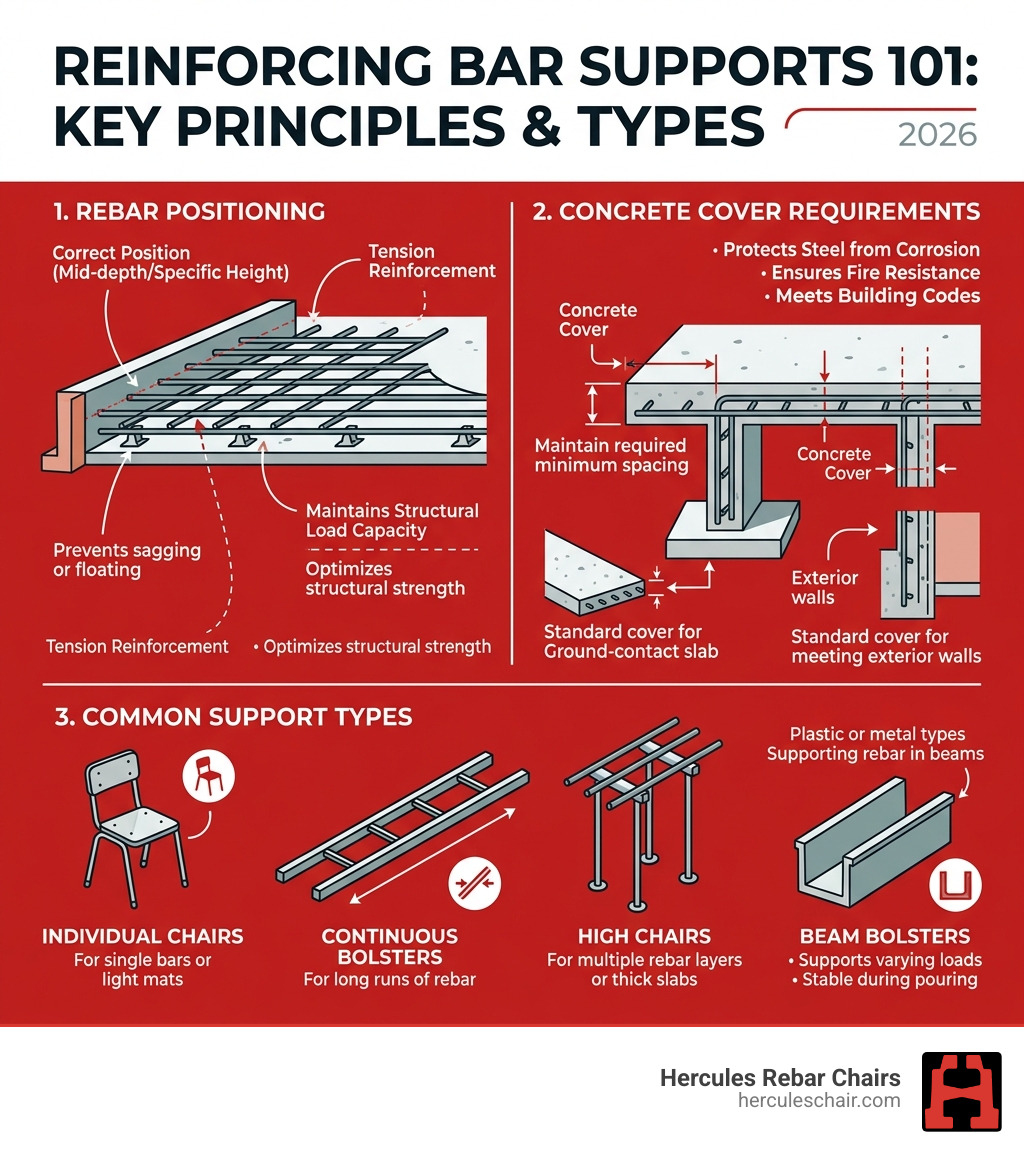
- Maintain concrete cover — they keep rebar the right distance from the surface, protecting steel from corrosion
- Ensure structural integrity — misplaced rebar, even by half an inch, can compromise an entire slab’s load capacity
- Distribute tension — properly positioned rebar absorbs and transfers tensile forces that concrete alone cannot handle
- Come in many types — individual chairs, continuous bolsters, high chairs, and beam bolsters, in plastic or metal
Concrete is incredibly strong in compression but weak in tension. Rebar fixes that — but only when it’s in the right place. If rebar sinks to the bottom of a pour or floats too high, the concrete won’t perform as designed. Reinforcing bar supports are what keep it exactly where the engineer specified.
That’s not a minor detail. On a highway slab, a bridge deck, or a commercial foundation, precise rebar placement is the difference between a structure that lasts decades and one that cracks prematurely.
I’m Jordan Harris, a licensed Professional Engineer and structural engineer with hands-on experience designing large-scale concrete projects before joining my family’s business building and manufacturing reinforcing bar supports. In this guide, I’ll walk you through everything you need to know — from support types and materials to sizing, installation, and code compliance — so you can make confident decisions on your next pour.
Understanding the Main Types of Reinforcing Bar Supports
When you step onto a job site in April 2026, you’ll see that reinforcement supports has evolved. We no longer just “prop up” steel; we use engineered systems designed for stability and speed. Choosing the right support depends on the weight of your rebar mat and the surface you’re pouring on.

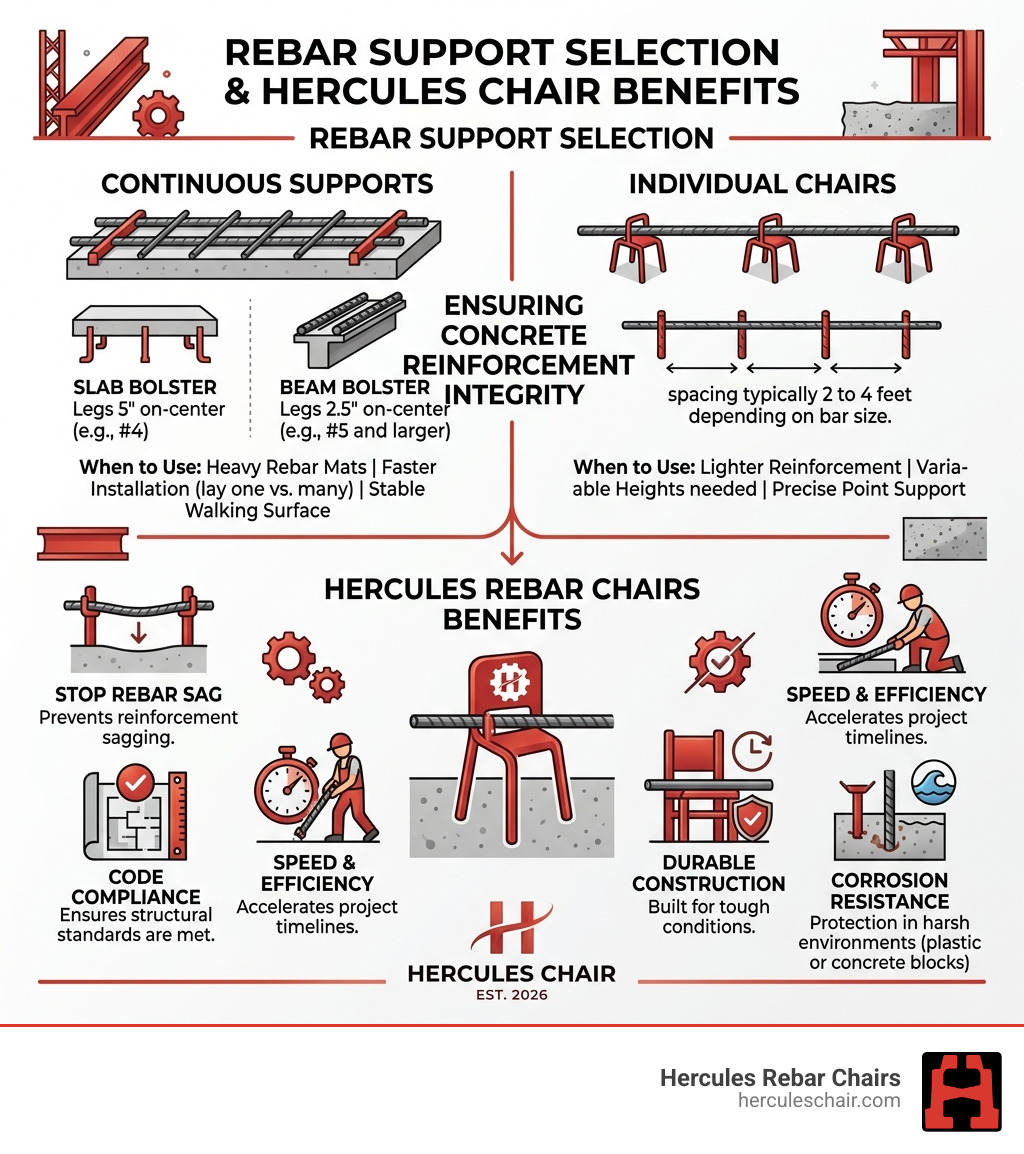
Broadly speaking, reinforcing bar supports fall into two categories: individual supports and continuous supports. Understanding which one to use is about more than just sitting pretty; it’s about ensuring the steel doesn’t shift when the pump starts humming.
| Feature | Individual Supports (Chairs) | Continuous Supports (Bolsters) |
|---|---|---|
| Labor Speed | Slower (requires more units) | Faster (long spans cover more area) |
| Stability | Good for light mats | Superior for heavy mats/high traffic |
| Primary Use | Single intersections, mesh | Long runs, heavy rebar mats |
| Cost | Lower per unit | Higher per unit, lower labor cost |
Individual High Chairs and Bar Chairs
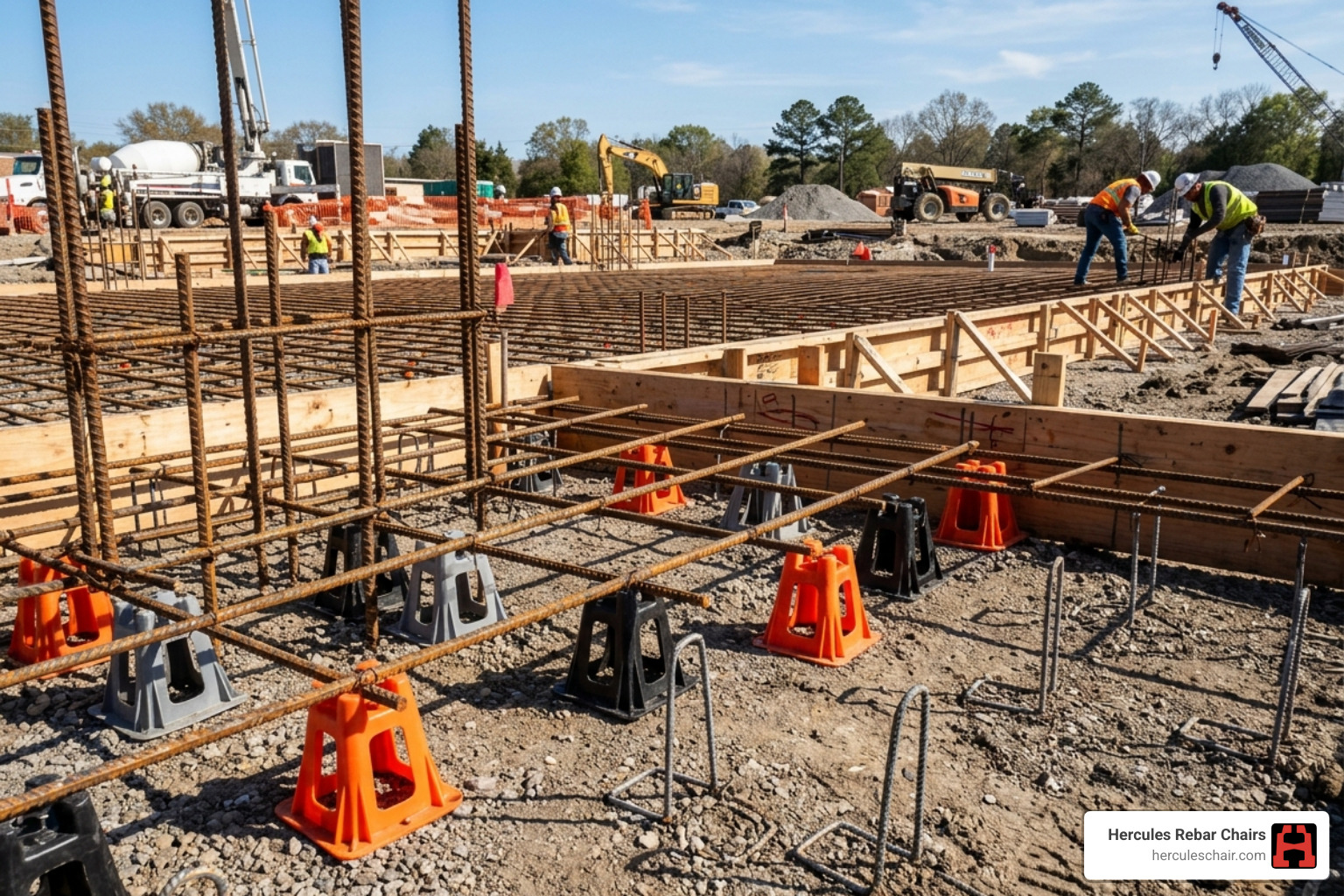
Individual chairs are the “stepping stones” of the concrete world. They are designed to support rebar at specific point loads. Standard bar chairs are typically used for bottom mats in slabs, while high chairs are used to support upper layers of steel in thicker pours.
These supports come in a massive range of sizes. For example, individual high chairs are available in heights from 2” to 15” in 1/4” increments. If you are working with wire mesh specifically, products like the 2-inch steel mesh chair are essential for keeping that thin wire from being pushed to the dirt. You can explore a comprehensive look at rebar chair types to see how these individual units handle everything from single bars to complex double mats.
Continuous Reinforcing Bar Supports: Bolsters and Runners
If individual chairs are stepping stones, continuous supports are the bridges. These are long-span systems, usually 5 to 8 feet in length for metal and about 2.5 feet for plastic. They provide uninterrupted support along the entire length of the rebar.
Slab bolsters are the most common continuous support, featuring legs spaced every 5 inches. They are perfect for supporting the bottom layer of steel. For upper mats, we use continuous high chairs, which can reach heights up to 16 inches. One major advantage of continuous high chair uppers (CHCU) is that they can eliminate the need for carrier bars, significantly reducing the amount of steel you have to buy and tie.
Material Selection: Metal vs. Plastic Supports
The “Metal vs. Plastic” debate is a classic in our industry. At Hercules Rebar Chairs, we’ve seen the industry shift toward plastic for many applications, but metal still holds the crown for heavy-duty structural work.
Metal Finishes and Rust Protection Classes
Steel supports are the strong, silent type, offering high load-bearing capacities. However, because they are made of metal, they are susceptible to corrosion if the tips are exposed at the concrete surface. This is why the Concrete Reinforcing Steel Institute (CRSI) established rust protection classes:
- Class 1 (Maximum Protection): These supports are plastic-protected (plastic-dipped or plastic-tipped feet). They are intended for moderate to severe exposure.
- Class 1A: Often includes epoxy-coated supports, used primarily with epoxy-coated rebar to prevent galvanic corrosion.
- Class 2 (Moderate Protection): Stainless steel protected, where the tips of the legs are made of stainless steel to prevent rust bleeding.
- Class 3 (No Protection): Bright basic wire, used where rust bleeding isn’t an aesthetic or structural concern.
Plastic Reinforcing Bar Supports and Non-Corrosive Benefits
Plastic supports, often made from high-density polypropylene, are the ultimate spacer secrets. They are naturally non-corrosive, meaning you never have to worry about rust “blooming” on the surface of your finished slab.
Plastic supports are also incredibly versatile. Many models, like the Aztec EZ Set, can support loads up to 500 lbs. They are also the preferred choice for elevating slabs with mesh chairs because they often feature “snap-in” designs that lock the reinforcement in place. If you’re looking for plastic rebar chairs for sale, you’ll find they are lightweight, easy to handle, and often more cost-effective for residential and light commercial projects.
Industry Standards and Sizing Requirements
You can’t just wing it when it comes to rebar height. Following the rebar chair code is mandatory for ensuring structural safety. Most projects must comply with ACI (American Concrete Institute) and CRSI standards. These codes dictate the minimum “clear cover”—the distance between the steel and the outside edge of the concrete.
Determining the Correct Height and Spacing
Choosing the right size is a science. If your chair is too short, the rebar is exposed to moisture and rusts; if it’s too tall, the rebar doesn’t have enough concrete over it to “grip,” and the slab could fail.
We’ve simplified this into a 3-step guide to bar chair sizes. Generally:
- Slab-on-Grade: Usually requires 2” to 3” of cover.
- Elevated Slabs: Often requires 3/4” to 1-1/2” of cover.
- Heavy Footings: May require 3” or more.
Whether you are choosing 4-inch or 6-inch supports, metal continuous supports are available in heights from 2” to 16” in 1/2” increments, while individual chairs often offer 1/4” increments for even more precision.
Application-Specific Selection
Different projects demand different tools.
- Slab-on-Grade: Use chairs with “sand plates” or wide bases to prevent the support from sinking into the subgrade.
- Elevated Slabs: Continuous slab bolsters are the gold standard here for speed and consistency. Check out our complete guide to rebar slab support for deeper insights.
- Tilt-Up Construction: Plastic-tipped or all-plastic supports are vital to prevent rust stains on the finished panels that will become the building’s exterior.
- Precast: Often uses specialized spacers and wheels to maintain cover in vertical forms.
Installation Best Practices for Concrete Reinforcement
Even the best reinforcing bar supports won’t help if they aren’t installed correctly. Don’t let your rebar sag by following these field-tested tips:
- Spacing is Key: For slab bolsters, the industry standard is 5-foot lengths with legs spaced 5 inches on-center. For individual chairs, spacing usually ranges from 2 to 4 feet depending on the bar size.
- Tying: Use 16.5-gauge tie wire to secure the rebar to the support. This prevents the steel from “walking” or shifting when workers walk on the mats.
- Staggering: When using continuous supports, stagger the end laps. This prevents a continuous line of weakness in the concrete.
- Stability: For any high chair over 12 inches, the legs should be cross-braced or laced with additional wire to prevent buckling under the weight of the wet concrete and the crew.
Frequently Asked Questions about Reinforcing Bar Supports
What is the difference between a slab bolster and a beam bolster?
While they look similar, they serve different masters. Slab bolsters have legs spaced at 5 inches on-center and are designed for wide, flat surfaces. Beam bolsters have much tighter leg spacing—usually 2.5 inches on-center—to handle the much heavier, concentrated loads found in beam forms and soffits.
When should I use continuous supports instead of individual chairs?
Use continuous supports when you have heavy rebar mats (#5 bar and larger) or when labor speed is a priority. Laying one 5-foot bolster is significantly faster than measuring and placing five individual chairs. They also provide a much more stable walking surface for the ironworkers. Your slab needs rebar chair supports that can handle the “traffic” of a busy pour day.
How do environmental factors like salt or moisture affect support choice?
In coastal areas or bridge decks where de-icing salts are used, corrosion is your #1 enemy. In these cases, you should move away from plain steel. Instead, look toward concrete support blocks (dobies), stainless steel tipped chairs, or heavy-duty plastic supports. These materials won’t corrode, ensuring the rebar stays protected for the life of the structure.
Conclusion
At the end of the day, your concrete is only as strong as its reinforcement—and that reinforcement is only as good as the supports holding it in place. Whether you are pouring a simple residential driveway or a 32-story hotel, using high-quality reinforcing bar supports is the most cost-effective insurance policy you can buy.
At Hercules Rebar Chairs, we’ve manufactured over 14 million units because we know that “close enough” isn’t good enough in structural engineering. Our signature red chairs are designed to save you time, keep you in code compliance, and ensure your concrete stands the test of time.
Ready to elevate your next project? Explore our products to find the perfect fit for your specific needs.