

Where to Find the Best Rebar Chair Suppliers in the U.S.
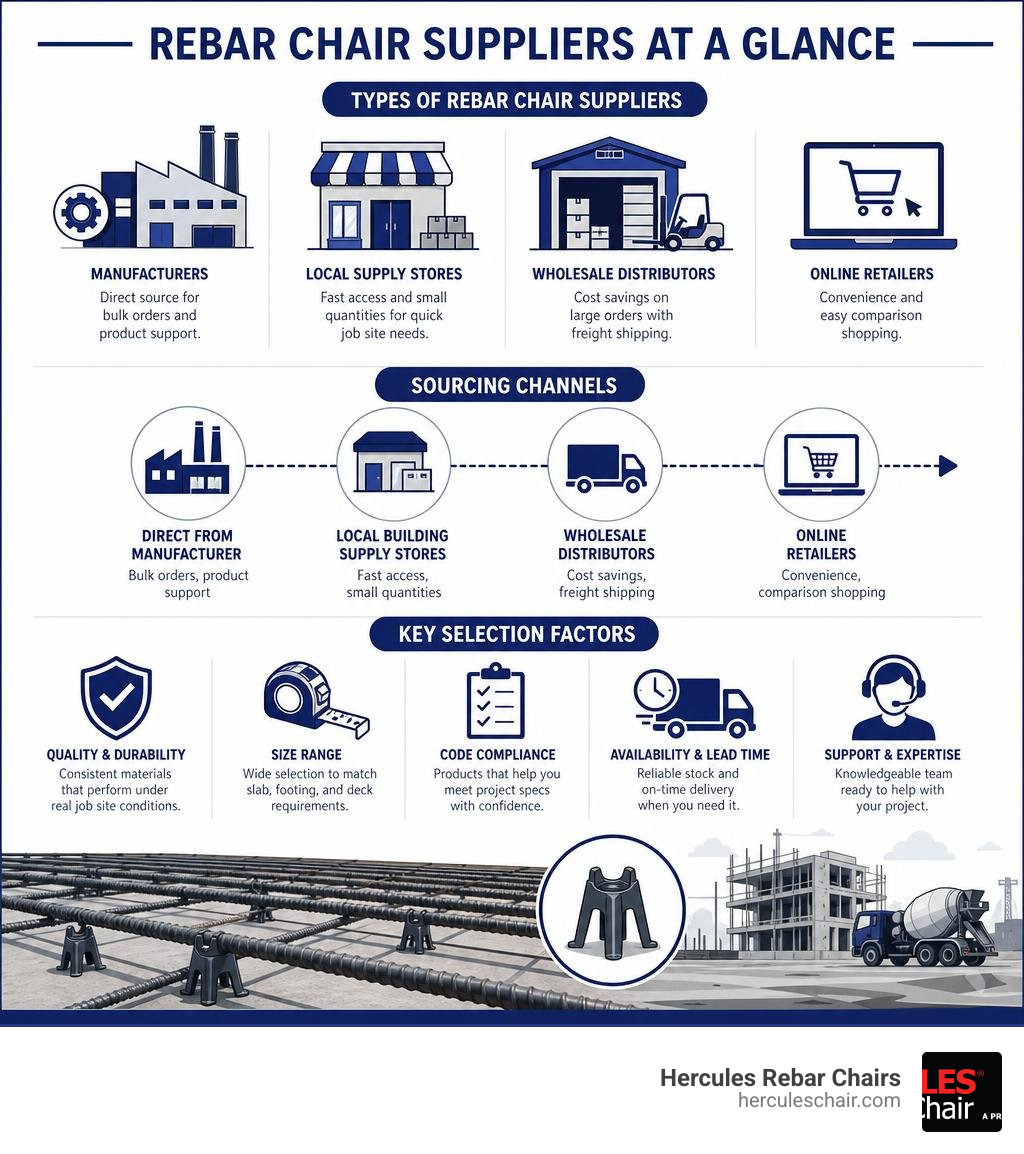
| Source Type | Best For | Examples |
|---|---|---|
| Direct from manufacturer | Bulk orders, product support | Hercules Rebar Chairs (T.J. Harris Co.) |
| Local building supply stores | Fast access, small quantities | Regional concrete supply dealers |
| Wholesale distributors | Cost savings, freight shipping | National concrete supply distributors |
| Online retailers | Convenience, comparison shopping | Home Depot, Amazon |
Every concrete pour depends on getting rebar positioned exactly right. Too low or too high in the slab, and you lose the structural integrity the design calls for. That’s where rebar chairs come in — and finding the right supplier makes a bigger difference than most contractors expect.
The wrong supplier means delayed shipments, inconsistent quality, or chairs that fail under load. The right one means code-compliant pours, faster installation, and fewer headaches on the job site.
Whether you’re pouring a garage slab, a foundation footing, or a large commercial deck, the sourcing decision matters.
I’m Jordan Harris, a licensed Professional Engineer and part of the team at T.J. Harris Company, where we’ve spent over 25 years designing and manufacturing rebar support products — giving me a front-row seat to what separates reliable rebar chair suppliers from the rest. In this guide, I’ll walk you through everything you need to know to source the right chairs for your next pour.
Key Rebar chair suppliers vocabulary:
Understanding Rebar Chairs: Types, Sizes, and Industry Standards

To make an informed decision when evaluating rebar chair suppliers, you first need a solid grasp of the product landscape. Rebar chairs—also known as bar supports—are designed to hold reinforcing steel or welded wire mesh at the correct elevation during a concrete pour. This ensures the steel is fully encased in concrete, providing the necessary tensile strength and protecting the metal from environmental corrosion.
The Material Showdown: Plastic vs. Metal
For decades, the construction industry relied heavily on metal wire chairs. While they served their purpose, traditional wire-tied methods and basic metal chairs present several distinct disadvantages. They are prone to rusting, which can bleed through to the surface of the finished concrete, creating unsightly stains and structurally compromising the slab over time.
Today, industry-standard plastic supports have largely taken over. Made from heavy-duty, non-corrosive polymers like polypropylene, plastic chairs will never rust. They also offer excellent chemical resistance and easily withstand the weight of heavy rebar cages and active construction crews.
Other material finishes include:
- Bright Basic: Standard untreated steel wire (high risk of rust).
- Plastic Protected: Steel wire chairs with plastic-dipped feet to prevent rust bleed-through.
- Epoxy Coated or Galvanized: Steel supports treated to resist corrosion, often used in bridge decks and marine environments.
- Stainless Steel: The ultimate in corrosion resistance, though highly expensive.
- Composite/All-Plastic: Lightweight, high-strength, and completely rust-proof.
Essential Industry Standards: CRSI and ACI
When sourcing rebar supports, you cannot afford to overlook code compliance. All reputable rebar chair suppliers must manufacture their products to meet the strict guidelines set by the Concrete Reinforcing Steel Institute (CRSI) and the American Concrete Institute (ACI).
Specifically, the CRSI Manual of Standard Practice categorizes bar supports into different classes based on their rust-prevention capabilities. Standard plastic supports fit into the highest categories of protection because they contain zero metal. Ensuring your supports meet ACI Code specifications guarantees that your rebar remains stable during the pour, maintaining the correct concrete cover and passing structural inspections without a hitch.
Matching Sizes, Load Capacities, and Applications
Choosing the right chair size depends entirely on your slab thickness and the required concrete cover. Below is a quick comparison table to help you match the right plastic rebar chair to your project needs:
| Support Type | Common Heights (Inches) | Best Applications | Load Capacity Rating |
|---|---|---|---|
| Mesh Chairs | 1.0″ – 2.0″ | Thin residential slabs, driveways, wire mesh | Light to Medium |
| Standard Rebar Chairs | 1.5″ – 3.0″ | Heavy slabs, commercial floors, garage pours | Heavy |
| Footer Stands / Multi-Bar | 3.0″ – 4.0″ | Deep footings, trench pours, dual-bar layouts | Extra Heavy |
| Continuous Bolsters | 1.0″ – 3.0″ | Continuous support for elevated decks, tilt-up | Heavy |
To explore high-quality options, look for designs that prioritize stable load distribution and robust polymer construction to ensure your reinforcement stays perfectly positioned.
Key Factors When Evaluating Rebar Chair Suppliers
With so many distributors and manufacturers operating in the U.S. market, narrowing down your list of potential rebar chair suppliers requires a systematic approach. Here are the critical factors you should evaluate before signing a purchase order:
1. Load Capacity and Structural Durability
A cheap rebar chair is a liability. If a worker steps on the rebar grid during a pour and the chairs collapse, your steel sinks to the bottom of the form, ruining the structural integrity of the slab. Look for suppliers who provide clear load ratings. For example, our Hercules Rebar Chairs are engineered to support massive loads without bending or crushing—strong enough that workers can confidently walk directly on the supported rebar grid.
To understand why structural strength is the ultimate metric for a successful pour, read our deep dive on Why Hercules Chairs Are the Heavyweight Champions of Rebar Support.
2. Department of Transportation (DOT) Approval
If you are bidding on municipal, state, or federal infrastructure projects, DOT approval is non-negotiable. State DOTs maintain Qualified Product Lists (QPL) or Approved Product Lists (APL) for reinforcing accessories. For instance, in the southeastern United States, having Florida DOT #415-000-O25 approval for specific chair models (such as 2.5″, 3.5″, and 5.0″ heights) is a strict requirement for highway and bridge work. Always ask your supplier for their DOT certification paperwork upfront.
3. Bulk Pricing and Wholesale Options
For large-scale commercial projects, buying by the individual box quickly drains your budget. You need a supplier that offers tiered bulk pricing, pallet-load discounts, and wholesale accounts. A cost-saving analysis should factor in the price per unit when purchasing in quantities of 10,000 pieces or more.
4. Shipping Policies and Lead Times
Concrete pours are tightly scheduled events. If your rebar chairs don’t arrive on time, your entire schedule slips, costing you thousands of dollars in idle labor and delayed concrete trucks. Evaluate your supplier’s shipping networks, freight carrier relationships, and typical lead times. Do they ship from regional warehouses closer to your job site?
Before committing to a vendor, check out our comparative guide: 5 Best Rebar Chair Distributors Compared.
Where to Buy: Sourcing Channels for Concrete Contractors

Contractors have several avenues for purchasing concrete reinforcing accessories. The right sourcing channel depends on your project’s scale, your timeline, and your geographic location.
To get a sense of the broader market, you can search directories like Rebar Suppliers & Manufacturers Serving Arizona – Thomasnet to find regional players. However, most contractors will buy through one of the following three channels:
- Direct from the Manufacturer: Ideal for large-scale operations, specialty product needs, and securing the lowest possible price per unit. Manufacturers can also provide physical product samples so you can test the durability of the chairs before placing a massive order.
- Wholesale Distributors: Great for combining your rebar chair order with other concrete accessories like tie wire, bar ties, and safety caps.
- Local Building Supply Stores: The perfect solution for immediate, same-day needs when you run short on a job site.
For a comprehensive look at how to structure your supply chain, check out Your Go-To Source for Concrete Reinforcing Accessories and Suppliers and browse our list of the Top Concrete Contractor Supply Companies You Need to Know.
Finding Local Rebar Chair Suppliers and Building Supply Stores
When you are in the middle of a pour and realize your crew miscalculated the chair count, you don’t have time to wait for a freight shipment. You need local availability. Local building supply dealers and concrete specialty stores keep inventory on hand for immediate pickup or same-day job site delivery.
To locate stocking dealers near you, use these resources:
- Explore our directory of The Best Local Building Supply Stores to see which chains carry professional-grade accessories.
- Go directly to our contractor sourcing portal: Buy Rebar Chairs / Building Supply Stores and Buy Rebar Chairs / Find a Retailer.
- If you manage a retail store yourself and want to stock the strongest chairs on the market, you can apply to Become a Hercules Dealer.
Working with Wholesale Rebar Chair Suppliers and Distributors
For commercial contractors running multiple projects simultaneously, establishing a relationship with a dedicated wholesale distributor is the smartest financial move. Wholesale distributors specialize in bulk logistics, offering consolidated freight shipping and customized credit terms (like Net 30 accounts).
By purchasing through wholesale channels, you can perform a comprehensive cost-saving analysis. Buying rebar chairs by the pallet significantly lowers your cost-per-foot of reinforced concrete.
To set up a wholesale account or find a distributor capable of handling truckload quantities, visit:
- Buy Rebar Chairs / Wholesale Distributors
- Become a Hercules Dealer / Application
- Become a Hercules Dealer / Who We Sell To
- To learn how to evaluate regional suppliers, read Finding the Best Concrete Supplies Store for Your Next Project.
Frequently Asked Questions about Rebar Supports
What are the standard plastic rebar chair sizes for slabs and footings?
The size of the rebar chair you need is dictated by the design thickness of your concrete slab or footing, as well as the required concrete cover (the distance between the steel and the outer edge of the concrete).
- For Slabs (typically 4″ to 6″ thick): Contractors commonly use 1.5-inch chairs. This places the reinforcing steel or wire mesh directly in the middle-to-upper third of the slab, which is optimal for resisting tension cracks.
- For Footings and Deep Slabs (8″ or thicker): 3-inch chairs or dual-bar footer stands are standard. These larger supports provide the substantial clearance required to protect the steel from soil moisture.
- Dual-Height Supports: Some advanced plastic chairs feature a dual-height design, allowing a single chair to be flipped to support rebar at either 1.5 inches or 2 inches, reducing the number of unique parts you need to stock on the job site.
What are the advantages of using snap-in plastic rebar chairs?
Traditional metal chairs require workers to manually tie the rebar to the support using steel tie wire. This is a slow, back-breaking process.
Snap-in plastic rebar chairs feature a flexible, integrated clip or cradle at the top. You simply push the rebar down into the cradle, and it snaps securely into place. This design offers several massive benefits:
- Labor Savings: Eliminates the time spent twisting wire ties, cutting setup times by up to 50%.
- Vapor Barrier Protection: Unlike sharp metal wire feet that can easily puncture plastic vapor barriers and rigid foam insulation, high-quality plastic chairs feature wide, flat bases that distribute weight evenly without tearing underlying membranes.
- Rust Prevention: Being made of non-corrosive polymers, they leave zero rust spots on exposed concrete surfaces.
How do I verify if a rebar chair is DOT approved?
To verify DOT approval, you should request the manufacturer’s technical data sheet and official state DOT approval letters. Most state DOTs publish their Qualified Products List (QPL) online. Search the database under “Concrete Accessories” or “Bar Supports” to verify that the manufacturer and the specific model number are listed.
Additionally, look for manufacturers who submit their products to independent, third-party structural testing to verify load capacity and material purity.
Conclusion
At the end of the day, a concrete pour is only as strong as its reinforcement—and that reinforcement is only as reliable as the chairs holding it up. Sourcing your materials from trusted rebar chair suppliers ensures your projects stay on schedule, meet structural codes, and stand the test of time.
At T.J. Harris Co., we manufacture Hercules Rebar Chairs right here in the USA. Known as America’s #1 strongest rebar support, we have over 14 million units in use across the country today. Our signature red color makes it easy for building inspectors to instantly identify that you are using top-tier, code-compliant supports on your job site. By choosing Hercules, you get unrivaled strength, major labor savings, and total peace of mind.
Ready to upgrade your concrete reinforcing game?
- Buy Rebar Chairs directly or find a local distributor today.
- Compare options by reading our guide to the Top Rated Concrete Chair Brands for Your Next Big Pour.