

What Are Mesh Support Chairs — and Why Do They Matter?
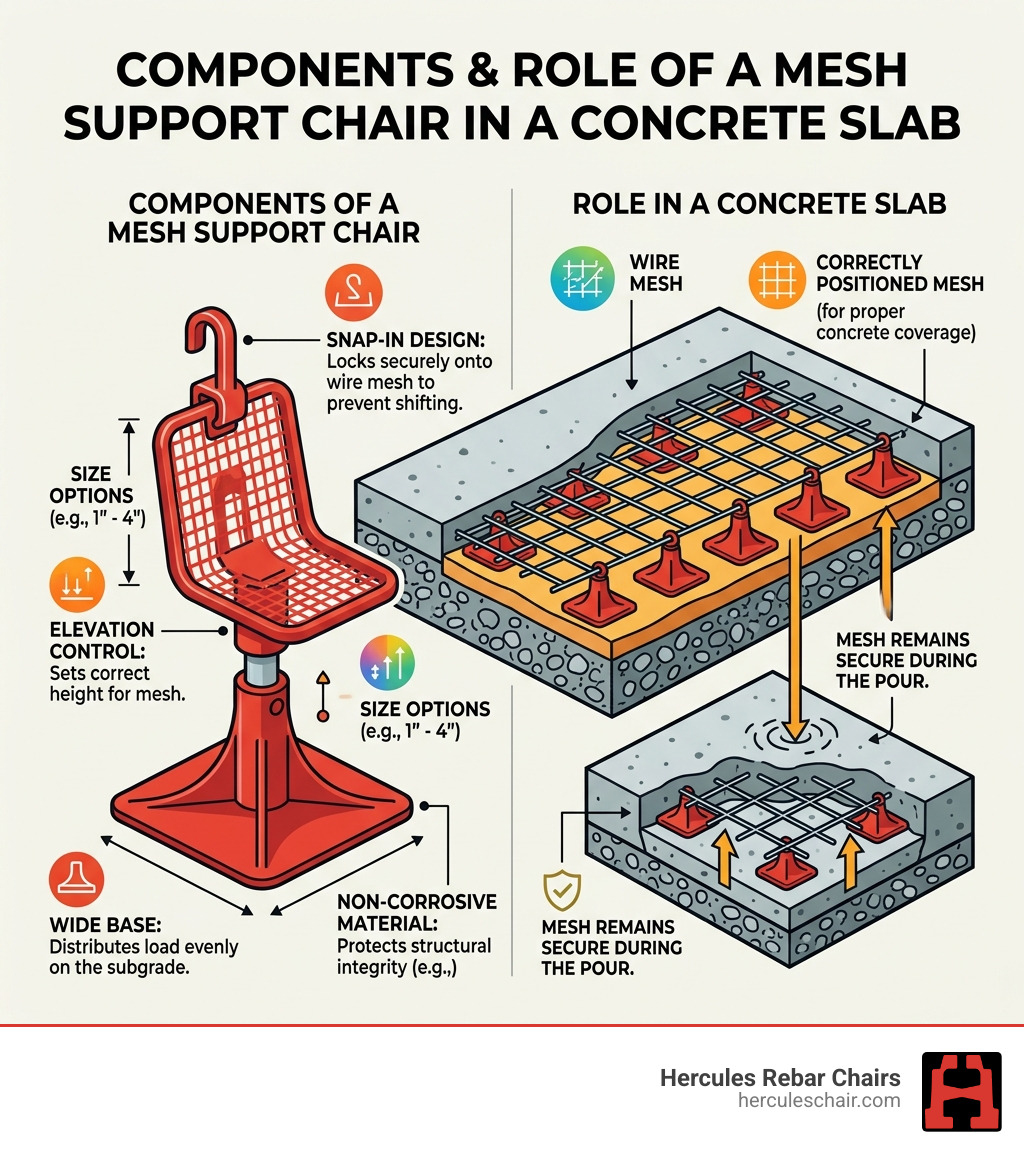
Mesh support chairs are small but critical devices used in concrete construction to hold wire mesh reinforcement at the correct height inside a slab.
Here’s a quick breakdown of what you need to know:
| Feature | What It Does |
|---|---|
| Elevation control | Keeps mesh at the right depth for proper concrete coverage |
| Snap-in design | Locks onto wire mesh to prevent shifting during the pour |
| Non-corrosive material | Protects structural integrity over the long term |
| Size options | Available in multiple heights (typically 1″ to 4″) to match slab specs |
| Wide base | Distributes load evenly on the subgrade |
Without proper mesh support, wire reinforcement can sag to the bottom of a slab — leaving it with little to no structural benefit. Getting the elevation right isn’t optional. It’s what separates a slab that lasts decades from one that cracks under pressure.
This guide covers everything concrete contractors need to know about choosing and using mesh support chairs correctly, from snap-in installation to spacing, sizing, and code compliance.
I’m Jordan Harris — a licensed Professional Engineer and part of the team at T.J. Harris Company, where we’ve engineered and manufactured concrete reinforcement support systems for over two decades. My background in structural engineering and hands-on experience with large-scale concrete projects gives me a practical, field-tested perspective on mesh support chairs and how they perform when it matters most.
Essential Mesh support chairs terms:
The Evolution of Mesh Support Chairs in 2026
As we move through April 2026, the construction landscape has shifted toward materials that offer both speed and extreme durability. Gone are the days when contractors relied solely on heavy concrete “dobies” or makeshift rocks to prop up reinforcement. Modern Mesh support chairs have evolved into high-performance engineering tools.
Today’s chairs are primarily manufactured from high-density, non-corrosive polymers. This evolution is driven by the need for better load distribution and precision elevation. In the past, reinforcement would often shift or “sink” during the walk-over by workers or the weight of the concrete pump hose. The 2026 standard emphasizes chairs that provide a stable, wide base to prevent “punch-through” on soft subgrades like sand or vapor barriers.
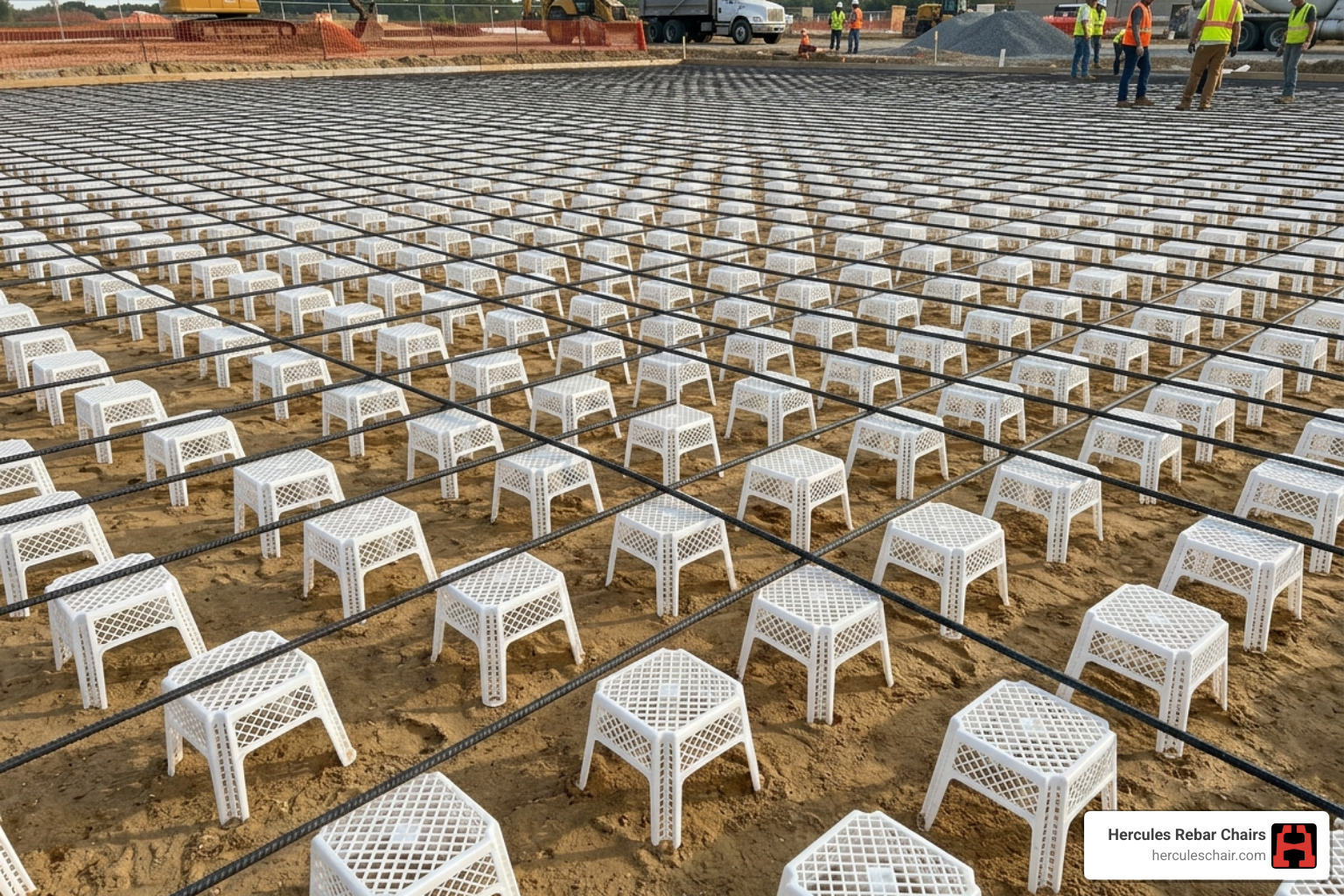
When we look at the advantages of using our specialized chairs compared to traditional methods, the difference in slab longevity is night and day.
| Advantage | Hercules Mesh Support Chairs | Traditional Methods (Bricks/Dobies) |
|---|---|---|
| Corrosion Resistance | 100% Rust-proof polymer | Can lead to “concrete cancer” if metal is exposed |
| Installation Speed | Snap-in technology (seconds) | Labor-intensive placement |
| Concrete Flow | Flow-through design eliminates voids | Large footprints can create air pockets |
| Precision | Exact height tolerance | Variable and inconsistent heights |
Why Proper Elevation Matters for Mesh Support Chairs
In our experience, the most common cause of slab failure isn’t the concrete mix—it’s the placement of the reinforcement. If your wire mesh is sitting on the ground, it’s doing absolutely nothing to help the structural integrity of the slab. It’s just buried metal.
Mesh support chairs ensure that the reinforcement stays in the “middle third” of the slab. This prevents mesh sagging and ensures that the concrete completely encapsulates the wire. This encapsulation is vital for creating a structural bond. If the mesh is too close to the surface, you get “ghosting” or surface cracks; if it’s too low, you lose the tension strength required to prevent shrinkage cracks. In harsh environments—like the coastal regions of Florida or the humid areas of Louisiana—proper coverage is the only thing protecting your mesh from moisture and subsequent corrosion.
Engineering Precision in Mesh Support Chairs
Precision is the hallmark of a professional pour. Using a chair that is even a half-inch off can compromise building code adherence. High-quality Mesh support chairs are designed with height accuracy in mind, ensuring that whether you need 1.5 inches or 3 inches of cover, you get exactly that across the entire grid.
Stability on various subgrades is another engineering hurdle we’ve cleared. A chair is only as good as its base. If you’re pouring on a vapor barrier, you need a chair that won’t puncture the plastic. If you’re on a compacted subgrade, you need a base wide enough to resist sinking. To ensure your grid is perfectly supported, you should learn how to space your wire mesh chairs like a pro to avoid any weak spots in your reinforcement.
Key Features of High-Performance Mesh Seating
When you’re out on the job site in Texas or Ohio, you don’t have time to fiddle with supports that fall over the moment a worker steps near them. High-performance Mesh support chairs must balance strength with ease of use.
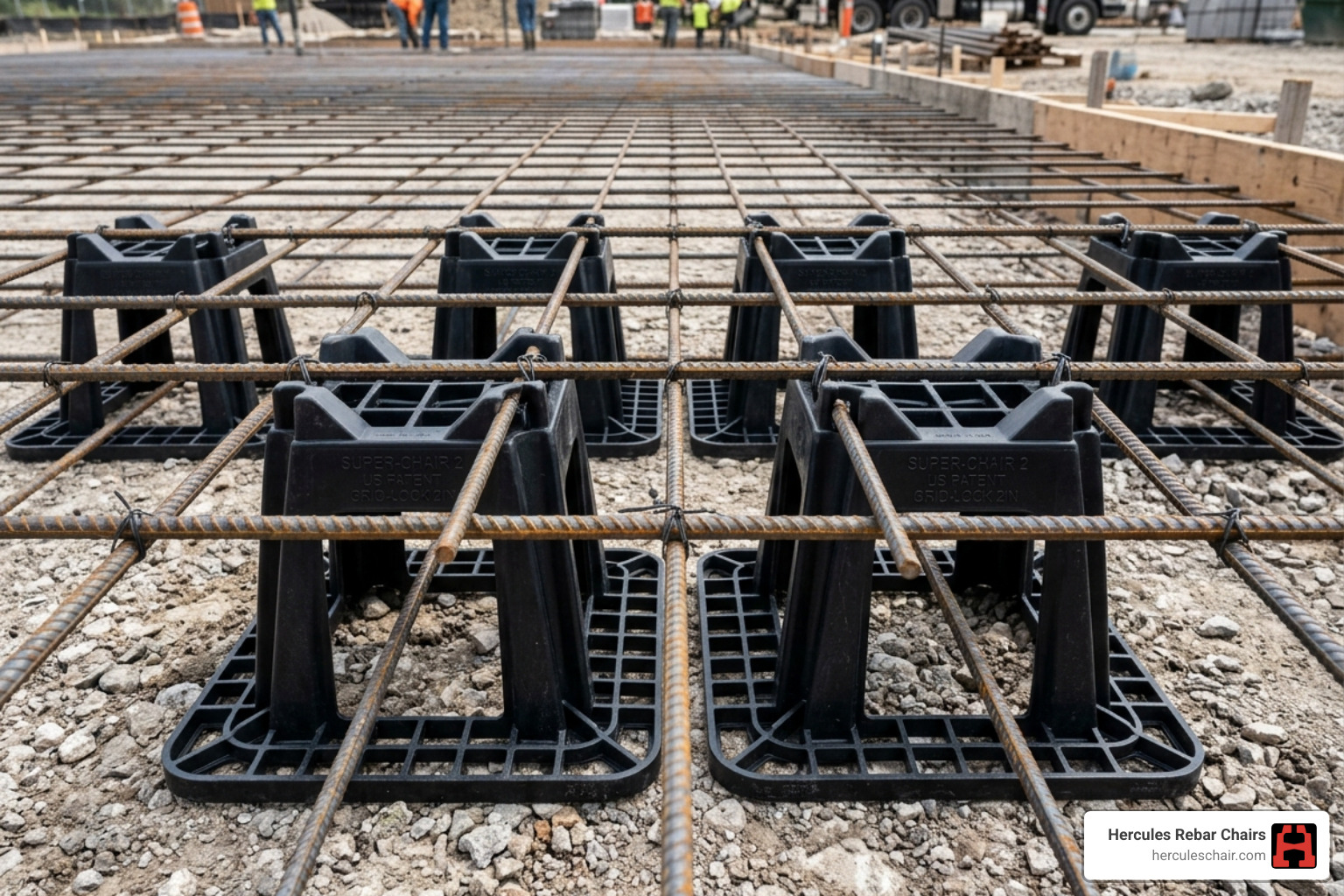
One of the standout features of modern supports is the point load capacity. Even though these chairs are lightweight, they are engineered to withstand hundreds of pounds of pressure. This is crucial because workers often have to walk on the mesh during the pour. Furthermore, a “flow-through” design is essential. You want the concrete to move freely around and under the chair to prevent “honeycombing” or voids that can weaken the finished product. To learn more about how these products transform your work, you can see how to elevate your slab with concrete mesh chairs for maximum efficiency.
Snap-In Mesh Technology
The biggest innovation in the last decade has been the “snap-in” feature. Instead of just resting the wire on top of a cradle, our Mesh support chairs feature a secure locking mechanism.
This technology offers several benefits:
- Labor Savings: You can snap the chairs onto the mesh while it’s still leaned up or on the side, then drop the whole panel into place.
- Tailored Support: Different wire gauges (from 6 to 10 gauge) require different grip strengths. Our chairs are designed to hold these specific gauges tightly.
- Movement Prevention: During the pour, the force of the concrete can move reinforcement. A snap-in chair stays attached to the wire, moving with the grid rather than being knocked out of place.
Customization and Project Planning
Every project has unique specs. A residential driveway in Arizona might only need 2-inch chairs, while a heavy-duty warehouse floor in Illinois might require 4-inch supports for a thicker slab. We offer a wide variety of height variations to meet these needs.
For large-scale jobs, shipping logistics and bulk ordering are key considerations. We understand that time is money, especially when a pump truck is scheduled. Our chairs are sold in high-volume increments—often in bags of 200 or 500—to ensure you have the quantity needed for a consistent grid. Contractor reviews consistently highlight that having a reliable, identifiable product (like our signature red chairs) makes inspection and inventory management much simpler.
Industrial Applications: Mesh Support Chairs for Concrete
In industrial settings, the stakes are higher. Whether it’s a massive tilt-up project or a bridge deck, the reinforcement must be perfect. Mesh support chairs provide the on-grade stability required for heavy-duty applications.
Using the right reinforcement products is a fundamental part of the job. For a deeper dive into the technical side, read about reinforcing your concrete everything you need to know about wire mesh.
Snap-In Functionality for Construction
In construction, “non-corrosive” is a magic word. Unlike steel supports that can eventually rust and “bleed” through to the surface of the concrete, polymer mesh chairs are inert. They will never rust, ensuring the aesthetic and structural integrity of the slab remains intact for its entire lifespan.
For specific project needs, such as a standard 4-inch slab requiring 2 inches of cover, our 2-inch mesh chair product 944 is a industry staple. It provides the perfect balance of height and stability for residential and light commercial work.
Ensuring Structural Integrity and Code Compliance
Building codes across the USA—from New York to California—are very specific about concrete cover. “Cover” refers to the distance between the reinforcement and the outer edge of the concrete. If an inspector sees mesh sitting on the dirt, they will shut the job down.
Using certified Mesh support chairs is the easiest way to guarantee code compliance, adhering to standards such as those from the American Concrete Institute. It shows the inspector that you have a system in place to maintain the required elevation. For those looking to expand their knowledge on the different types of reinforcement supports available, we recommend exploring how to from rebar to mesh essential concrete reinforcement products explained. Understanding the variety of tools at your disposal, from dobies to double mats a comprehensive look at rebar chair types, ensures you always have the right tool for the specific reinforcement being used.
Frequently Asked Questions about Mesh Support Chairs
Why are plastic mesh chairs preferred for slabs over traditional blocks?
Plastic Mesh support chairs offer several advantages over concrete blocks (dobies). First, they are much lighter, which reduces shipping costs and worker fatigue. Second, they feature a “snap-in” design that prevents the mesh from falling off during the pour—something a flat block can’t do. Finally, their flow-through design ensures that the concrete forms a monolithic bond around the support, whereas large concrete blocks can sometimes create a seam or a weak point in the slab.
How many mesh support chairs are needed per square foot?
While specific spacing depends on the wire gauge and the expected weight on the mesh during the pour, a general rule of thumb is to place a chair every 2 to 3 feet in a grid pattern. You want to ensure that there is no visible sagging between the chairs. If the mesh “bounces” significantly when stepped on, you need to increase the frequency of the supports. Proper spacing is the only way to ensure the mesh stays in the center of the slab.
What is the price range for bulk mesh chairs in 2026?
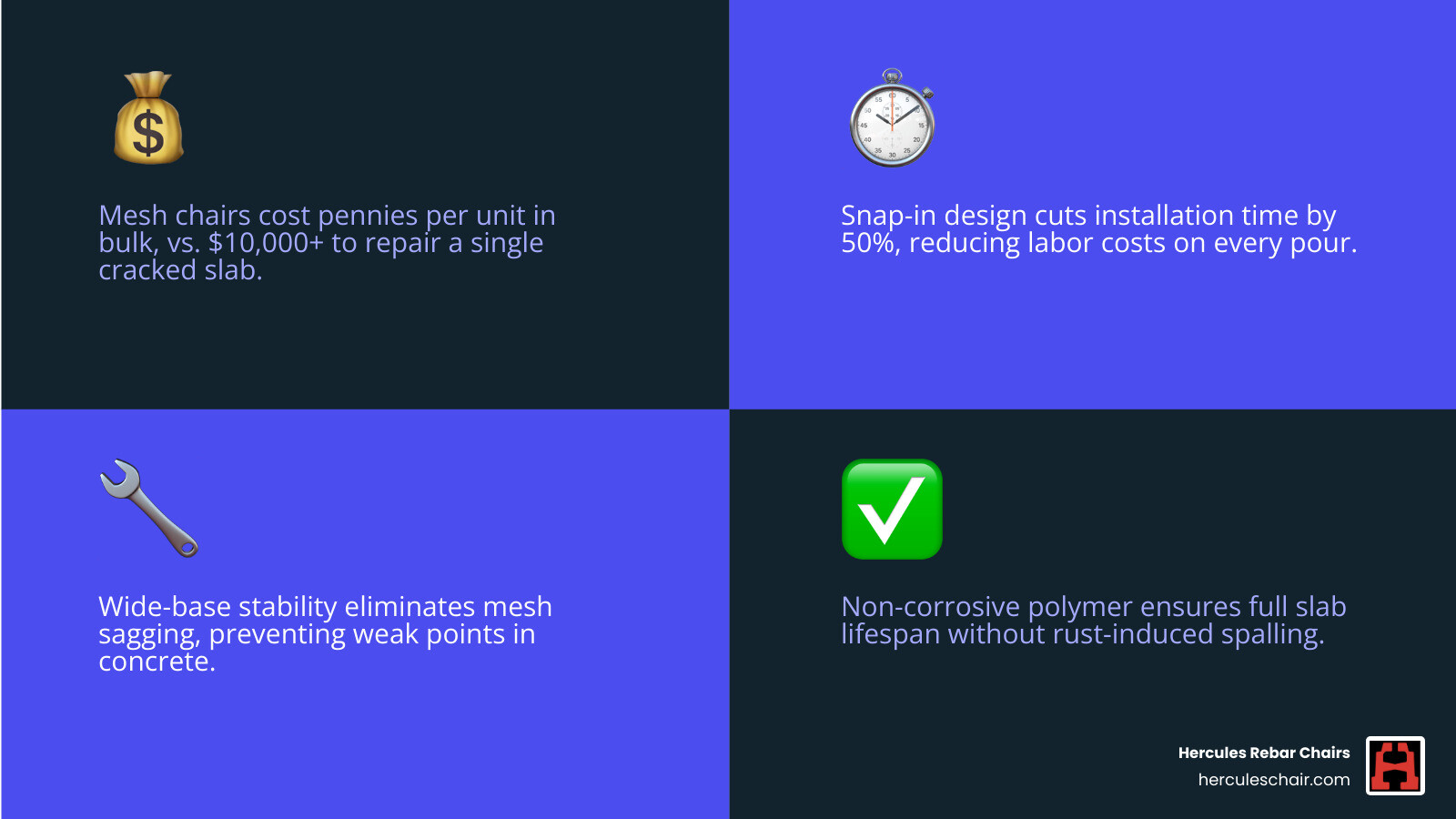
In 2026, the cost of Mesh support chairs remains highly competitive, especially when compared to the cost of a slab failure. Budget options can be found for pennies per unit when bought in bulk. Premium models with advanced locking mechanisms or extra-wide bases for sand might cost slightly more, but they save money in the long run by reducing labor time and ensuring the project passes inspection the first time. Investing in high-quality supports is an investment in the structural quality of your reputation.
Conclusion
At Hercules Rebar Chairs (T.J. Harris Co.), we take pride in supporting the backbone of American infrastructure. As “America’s #1” manufacturer, we’ve sold over 14 million units to contractors who demand the best. Our signature red Mesh support chairs are more than just plastic—they are a guarantee of time savings, cost-efficiency, and absolute code compliance.
Whether you are working in the heat of Georgia or the rugged terrain of Wyoming, our supports are engineered to perform. Don’t leave your structural integrity to chance. Use the chairs that stay put and keep your mesh where it belongs.
Ready to secure your next project? Visit us to buy rebar chairs and experience the Hercules difference.