

Why Proper Rebar Installation Makes or Breaks Your Concrete
How to install rebar correctly is one of the most important skills in concrete construction. Do it right, and your structure can last for generations. Get it wrong, and cracks, failures, and costly repairs follow.
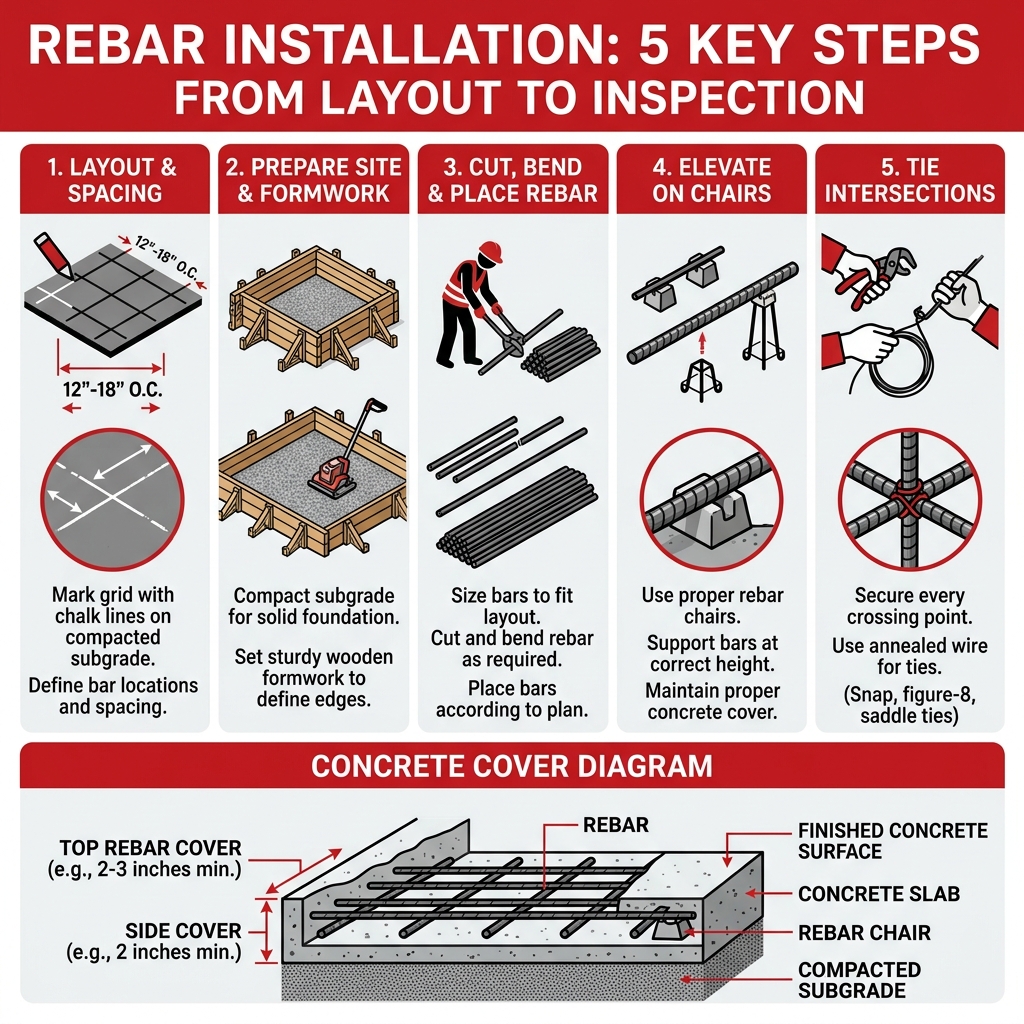
Here’s a quick overview of the core steps:
- Plan your layout – Mark a grid with chalk lines, typically 12-18 inches on center
- Prepare the site – Compact subgrade to at least 90-95% Proctor density and set your formwork
- Cut and bend rebar – Size bars to fit your layout using a rebar cutter and bender
- Place rebar on chairs – Set rebar chairs to hold bars at the correct height for proper concrete cover (usually 2-3 inches minimum)
- Tie intersections – Secure every crossing point with annealed wire using snap, figure-8, or saddle ties
- Inspect before pouring – Verify spacing, cover, and lap splices before any concrete goes in
Concrete is incredibly strong under compression – but it’s surprisingly weak when pulled or bent. Without rebar, even a well-poured slab can crack under everyday loads, let alone seismic stress or heavy equipment. Rebar provides the tensile strength that concrete simply can’t deliver on its own.
That’s why installation isn’t just a construction step – it’s the foundation of structural integrity.
I’m Jordan Harris, a licensed Professional Engineer with a master’s in structural engineering and five years of hands-on experience designing large-scale concrete structures. Understanding how to install rebar correctly has been central to my career, and now I bring that same engineering discipline to product development at Hercules Rebar Chairs, where we’ve helped contractors place rebar right on more than 14 million pours. Let’s walk through everything you need to know to do this job with confidence.
How to install rebar terminology:
The Fundamentals of Concrete Reinforcement
To master how to install rebar, we first have to understand why we use it. Concrete is like a stubborn weightlifter: it can hold up a massive amount of weight pressing down on it (compression), but if you try to pull it apart or bend it (tension), it snaps like a dry cracker.
Steel rebar acts as the “skeleton” of the structure. When loads are applied—whether it’s a heavy truck on a driveway or the shifting of expansive clay soil—the steel takes on the tension forces that would otherwise cause the concrete to fail. This partnership between steel and concrete is what allows us to build everything from simple sidewalks to massive skyscrapers.
Properly installed rebar doesn’t just add strength; it manages crack prevention. While all concrete is prone to some shrinkage, rebar ensures that cracks stay tight and don’t compromise the load-bearing capacity of the element. For a deeper dive into these principles, check out our guide on Foundation Strong: Mastering Rebar Placement for Lasting Concrete. You can also find more technical background on rebar basics and structural importance.
Understanding Rebar Grades and Sizes
Not all steel is created equal. In the U.S., rebar is sized by a number system where the number represents the diameter in eighths of an inch.
- #3 Rebar: 3/8 inch (common for light patios or driveways).
- #4 Rebar: 1/2 inch (standard for residential footings and walls).
- #5 Rebar: 5/8 inch (used in heavy-duty slabs and commercial applications).
Most residential and light commercial work uses “deformed bars,” which have ridges or ribs rolled into the surface. These ribs are essential because they provide a mechanical bond between the steel and the concrete, preventing the bar from slipping. We also see different material types, such as epoxy-coated rebar, which is used in high-moisture or coastal environments to prevent rust. All rebar we use should meet ASTM (American Society for Testing and Materials) standards to ensure the steel has the chemical and physical properties required by your local building codes.
Essential Tools and Site Preparation
Before the first piece of steel hits the ground, site prep is king. You can have the perfect rebar grid, but if it’s sitting on soft, mushy soil, your slab will eventually fail.
We recommend compacting the subgrade to at least 90% of its optimal density (Standard Proctor), though many architects and engineers prefer 95% for residential slabs. This prevents the “settling” that leads to structural cracks. Once the ground is firm, you’ll set your formwork—the wooden or metal perimeter that holds the wet concrete in place.

Rebar vs. Wire Mesh: Which Do You Need?
A common question we hear is whether to use rebar or welded wire mesh. While they both provide reinforcement, they serve slightly different purposes.
| Feature | Rebar | Wire Mesh (6x6x10) |
|---|---|---|
| Primary Function | Structural tensile and shear strength | Crack width control and joint integrity |
| Placement | Usually bottom 1/3 to center | Usually middle to top 1/3 |
| Installation | Requires chairs for precision | Often “pulled up” during pour (less accurate) |
| Best For | Footings, walls, heavy-load slabs | Light sidewalks, thin residential pads |
For more on choosing the right reinforcement for your project, see Slab Strong: Mastering Rebar Placement for Durable Concrete.
Planning the Layout
Accuracy starts with a tape measure and a chalk line. Most structural plans call for rebar to be placed in a grid, often spaced 12 to 18 inches on-center.
We like to use “layout bars”—two bars placed at opposite ends of the pour area. We mark these bars using soapstone or bright spray paint at the required intervals. This creates a visual guide so that when we lay the rest of the bars, the grid is perfectly square and consistent.
How to Install Rebar: A Step-by-Step Guide
Now we get to the manual labor. Safety is paramount here, as rebar is heavy and often has sharp edges.
Cutting and Bending
Standard rebar comes in 20-foot or 60-foot lengths. Unless your project is exactly that size, you’ll need to cut it. For small DIY jobs, a manual rebar cutter or a high-quality angle grinder with a diamond blade works well. For larger jobs, we use hydraulic cutters.
Bending is often required for corners or “hooks.” You can use a manual hickey bar for light-duty bending, but a bench-mounted manual bender or a powered bender is much more efficient for #4 or #5 bars. Always follow the CRSI handling and storage guidelines to ensure you aren’t damaging the structural integrity of the steel during the fabrication process.
Mastering the Art of Tying Rebar
Tying is what holds your grid together while people walk on it and concrete is pumped over it. You aren’t “welding” it; you’re just securing it. You’ll need annealed steel wire (usually 16 or 16.5 gauge) and a pair of lineman’s pliers or a tie spinner.
There are three main ties we use:
- Snap Tie (Single Tie): The simplest tie, made by wrapping the wire once around the intersection and twisting.
- Figure 8 Tie: More secure than a snap tie; it wraps around the bars in a way that prevents them from sliding diagonally.
- Saddle Tie (U-Tie): Perfect for tying vertical bars to horizontal ones, as it cradles the bars securely.
For a visual walkthrough of these knots, see these step-by-step tying techniques.
How to Install Rebar in Footings and Slabs
Footings are the “feet” of your building, and they require specific care. For a typical 12-inch thick footing, the rebar mat should be placed about 3 to 4 inches from the bottom. This ensures the steel is in the “tension zone” but still has enough concrete “cover” to prevent rust.
In slabs, you’ll often see “turn-down edges”—where the concrete is thicker at the perimeter. We often run an extra piece of rebar (a “perimeter bar”) through this thickened edge to prevent the slab from curling or cracking at the corners. For more specific instructions, read How to Install Rebar in Footings the Right Way and How to Master Garage Slab Rebar Placement in 30 Days.
Precision Placement and Structural Integrity
The most common mistake people make when learning how to install rebar is letting the steel rest on the ground. If rebar touches the dirt, it will moisture-wick, rust, and eventually cause the concrete to “spall” or break apart from the inside out.
Lap Splices, Dowels, and Stirrups
Since rebar comes in set lengths, you’ll often need to overlap two bars to continue a run. This is called a lap splice. A general rule of thumb is to overlap the bars by 40 times their diameter. For #5 rebar (5/8″), that means a 25-inch overlap.
- Dowels: These are short bars used to connect two different concrete pours (like a footing to a wall).
- Stirrups: These are “loops” of rebar used in beams to provide lateral strength and hold the main longitudinal bars in place. You can learn more about the importance of beam stirrups here.
For a comprehensive look at these components, check out our Rebar Placement Guide.
Maintaining Concrete Cover with Supports
To keep the rebar at the perfect height during the pour, you must use supports. In the old days, people used rocks or broken bricks, but those are unreliable and can create weak spots in the concrete.
This is where Hercules Rebar Chairs come in. Our chairs are designed to be strong enough to withstand the weight of workers walking on the grid without collapsing. We recommend spacing chairs every 3 to 4 feet to prevent the bars from sagging. Using the right support ensures you maintain the required “concrete cover”—the distance between the steel and the edge of the concrete. For slabs on grade, this is typically 3 inches if the concrete is against the earth.
Explore our specific guides on Footer Stand Placement Guide and A Practical Guide to Rebar Footing Stands to see how to maintain this precision.
Safety Standards and Code Compliance
Construction sites are dangerous, and rebar is one of the leading causes of “impalement” injuries. OSHA (Occupational Safety and Health Administration) has very strict rules about this. Any vertical rebar or projecting ends must be capped.
Best Practices for How to Install Rebar Safely
- Rebar Caps: Use high-impact plastic caps with an embedded metal plate. These are designed to prevent a worker from being impaled if they fall onto the bar. You can read the official OSHA rebar capping requirements for more details.
- PPE: Always wear hard hats, safety glasses, and heavy-duty gloves. Steel-toed boots are non-negotiable—dropping a piece of #5 rebar on your toe is a mistake you only make once.
- Fall Protection: If you are working on rebar cages for walls or columns above certain heights, fall arrest systems are required.
Frequently Asked Questions about Rebar Installation
How much should rebar overlap at a splice?
As mentioned, the standard is usually 40 bar diameters. For #4 rebar, that’s 20 inches; for #5, it’s 25 inches. Always check your specific structural plans, as high-stress areas may require longer laps.
What is the minimum concrete cover for rebar in a slab?
For a standard 4-inch to 6-inch slab on grade, you generally want the rebar in the center or slightly below center. However, per ACI (American Concrete Institute) codes, if concrete is cast against and permanently exposed to earth, you need a minimum of 3 inches of cover.
Can I use rocks or bricks instead of rebar chairs?
While people do it, we strongly advise against it. Rocks can shift during the pour, and bricks are porous, which can allow moisture to reach the rebar and cause rust. Hercules Rebar Chairs are engineered to provide a stable, non-porous support that won’t compromise the concrete’s chemistry.
Conclusion
Mastering how to install rebar is about more than just tying steel together; it’s about ensuring the safety and longevity of the structures we live and work in. By following proper layout, tying, and support techniques, you ensure that your concrete is truly “unbreakable.”
Before you pour, always run through a final inspection checklist:
- Is the subgrade compacted?
- Are all intersections tied securely?
- Is the lap splice length correct?
- Are the rebar chairs spaced every 3-4 feet?
- Are all exposed ends capped for safety?
At Hercules Rebar Chairs, we take pride in being America’s #1 choice for concrete supports. With over 14 million units sold, our red chairs are a symbol of quality and code compliance on jobsites across the USA. Whether you are working on a small driveway in Alabama or a massive foundation in California, we have the tools to help you get the job done right.
Ready to elevate your next project? Learn more about our 2-inch steel mesh chairs and see why professional contractors trust us for their reinforcement needs.