

Find Labor-Saving Rebar Supports That Fit Your Pour
The best labor saving rebar supports hold steel at the required height and stay stable during a pour. Look for rebar chairs that match your bar size, required concrete cover, and jobsite surface. A stable chair can cut down on repeated lifting and repositioning, though it does not replace every wire tie.
Hercules Rebar Chairs makes supports for concrete work, including its recognizable red chairs. The right choice depends on your layout and load, not just how fast a chair goes down.
I’m Jordan Harris, a Tennessee-licensed structural engineer who has worked on large concrete projects and now helps develop rebar supports at T.J. Harris Company. I’ll use that experience with labor saving rebar supports to show where chairs can save work without losing sight of proper steel placement.
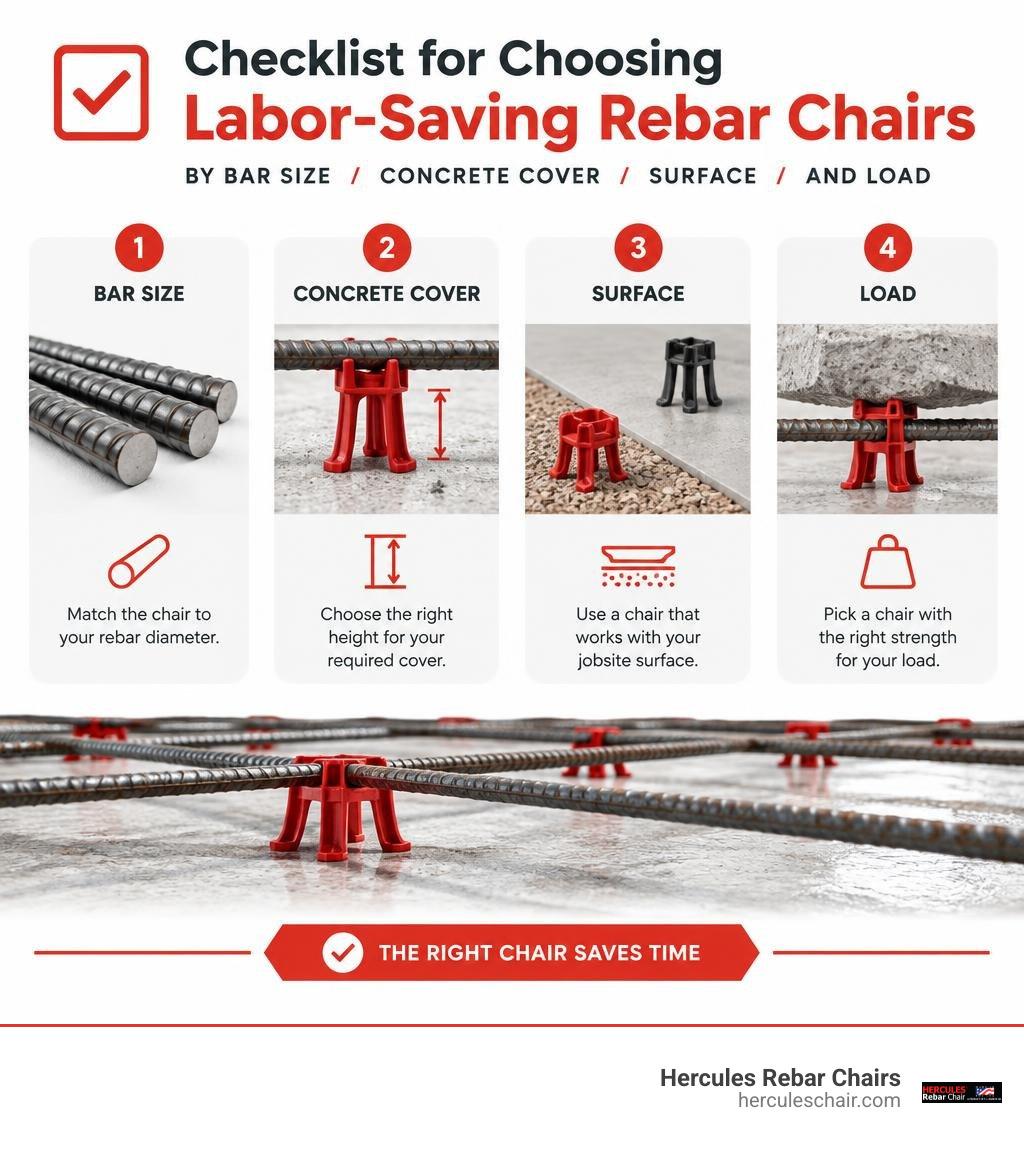
Labor saving rebar supports vocab to learn:
The Real Cost of Traditional Rebar Tying vs. Modern Rebar Chair Supports
On any active jobsite across the country, tying reinforcing steel by hand has long been viewed as a standard rite of passage. Ironworkers hunch over vast horizontal decks or balance on scaffolding, wrapping tie wire around intersections every few inches. While steel tying will always be a necessary skill in concrete construction, relying solely on manual wire ties to hold bars at the proper elevation is one of the most expensive and physically punishing habits in our industry.
The physical toll of traditional rebar installation is immense. Workers endure severe ergonomic strain from prolonged bending, repetitive wrist twisting, and lifting heavy reinforcing bars from awkward angles. Over an eight-hour shift, ironworker fatigue sets in quickly. As muscles tire, tie tightness drops, bars slip out of alignment, and the risk of acute musculoskeletal injury climbs.
Working at elevation adds another layer of complexity. Assembling heavy reinforcement on raised platforms or tall column scaffolding presents serious fall hazards and material-handling risks. Safety standards like the California Division of Occupational Safety and Health reinforcing steel and post-tensioning safety regulations require strict fall protection, stable working surfaces, and proper point-of-placement safety protocols. Every extra minute an ironworker spends wrestling with loose bars, balancing on planks, or reaching out to secure a sagging joint increases exposure to jobsite accidents.
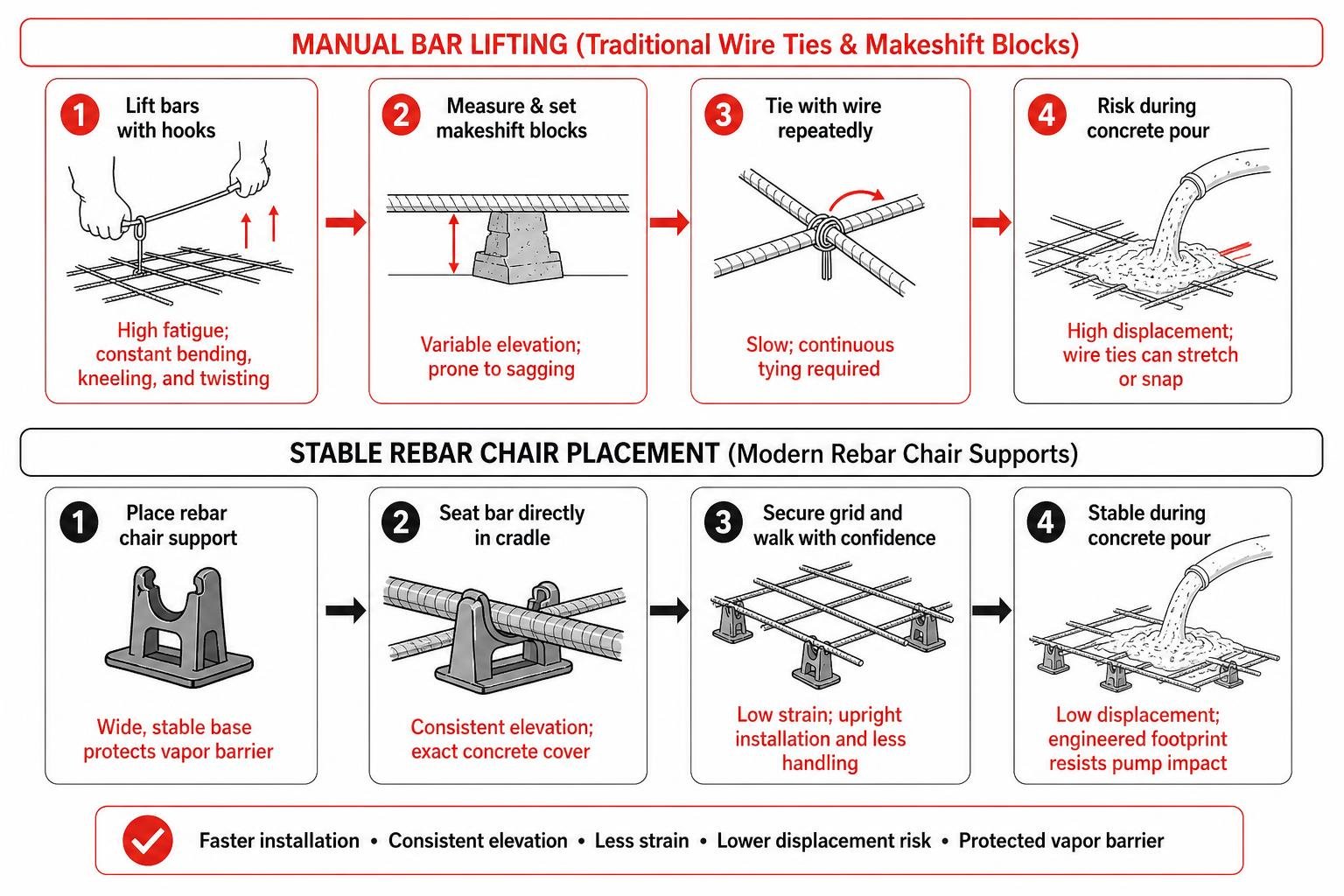
Learning how to install rebar without back strain starts with changing how we support steel before and during placement. When crews transition from manual positioning hacks—such as lifting bars with hooks while pouring or using makeshift concrete blocks—to engineered support chairs, installation workflows transform.
| Placement Factor | Traditional Wire Ties & Makeshift Blocks | Modern Rebar Chair Supports |
|---|---|---|
| Installation Speed | Slow; requires manual lifting, measuring, and continuous tying | Fast; quick placement with direct bar seating |
| Elevation Accuracy | Variable; prone to sagging between widely spaced ties | Consistent; maintains exact code-specified concrete cover |
| Worker Ergonomics | High fatigue; constant bending, kneeling, and twisting | Low strain; upright installation and reduced handling |
| Displacement Risk | High; wire ties stretch or snap under concrete pour pressure | Low; engineered footprints resist concrete pump impact |
| Vapor Barrier Safety | High puncture risk from sharp wire ends and cracked brick | Protected; smooth, wide base platforms prevent tears |
By standardizing support heights with dedicated chairs, crews eliminate tedious guesswork. Instead of constantly checking clearances with tape measures and re-tying loose sections, workers can lock in required clearances immediately and keep the project moving forward.
Top Labor Saving Rebar Supports for Modern Jobsite Efficiency
Meeting concrete cover tolerances consistently is the cornerstone of structural durability. If reinforcement sits too low, moisture penetrates the slab over time, leading to internal corrosion, spalling, and costly structural failure. If steel sits too high, top-layer cracking compromises surface integrity.
Contractors looking to compress tight construction schedules turn to specialized supports that provide immediate stability without demanding extra labor. Consulting a comprehensive rebar chair types guide helps project engineers and foremen select the right accessory for each pour type, whether pouring suspended decks, grade slabs, or deep foundation footings.

Why Rebar Chairs Are Essential Labor Saving Rebar Supports
In commercial and residential builds, every movement on the deck counts. When ironworkers position loose cut-and-bent steel, keeping the mat rigid is often an uphill battle. Foot traffic from pumping crews, heavy vibrator equipment, and the force of discharging concrete can easily knock unseated reinforcement out of tolerance.
Modern rebar chairs feature secure cradles and bar-gripping channels that hold longitudinal and transverse bars in a stable grid. Once snapped or placed into position, the steel stays put. This rigidity allows crews to walk the mat confidently without bending bars out of their specified design planes. It is easy to see why smart contractors let rebar chairs save labor: removing the need to constantly readjust and re-elevate steel during the pour cuts down punch-list corrections and speeds up concrete delivery cycles.
Heavy-Duty Base Supports for Soft Subgrades and Heavy Mats
Pours over compacted earth, sand, or insulated subgrades introduce a classic jobsite headache: chair punch-through. Standard narrow-legged supports can sink directly into soft soils or pierce through delicate moisture barriers when loaded with heavy reinforcement and worker foot traffic.
To solve this, heavy-duty base supports utilize wide, flat footprints designed to distribute vertical loads over a broader surface area. These stable platforms prevent point-load penetrations, protecting underlying vapor retarders from tearing while preventing rebar sinking in concrete pours. Using dedicated wide-base supports eliminates the old-school, labor-heavy workaround of cutting and hauling individual plywood squares or cracked concrete pavers across the jobsite.
Installing Labor Saving Rebar Supports in Column Cages
Column construction requires extreme accuracy, as vertical reinforcing bars and lateral ties must maintain precise clearances from formwork panels. Assembling columns bar-by-bar at elevated heights is notoriously slow, tie-wire intensive, and hazardous.
Many high-efficiency contractors now assemble reinforcement cages horizontally on ground-level stands or off-site yards before lifting them into place with cranes. Integrating heavy-duty supports and spacers along the column perimeter prevents internal distortion and cage racking during transport and rigging. Placing reliable supports helps in preventing rebar sagging across long spans when lifting pre-assembled cages vertically, ensuring that ties and main bars do not bow or touch exterior formwork walls during alignment.
Field Results: Slashing Assembly Hours and Total Column Costs
Adopting modern placement strategies and reliable bar chairs delivers measurable savings in overall project overhead. Shifting rebar assembly from precarious scaffolding down to ground level and pairing pre-assembled cages with high-performance rebar chairs directly optimizes crane time, crew allocation, and trade sequencing.
Field studies and jobsite data reveal dramatic efficiency gains when moving away from loose steel handling toward prefabricated, supported assemblies:
- 22.2% Savings on Total Column Cost: Eliminating elevated tying and cutting down on-site adjustments slashes total column expenditures.
- 33.3% Savings on Column Construction Time: Prefabricated cages outfitted with precise supports drop into place within a fraction of the time required for stick-built methods.
- 20.4% Savings on Total Project Duration: Faster reinforcement cycles accelerate formwork cycling, concrete placements, and subsequent trade schedules.
- 10x Faster Placement: Pre-supported cages can be delivered and set into final position in roughly one-tenth the time it takes to manage loose cut-and-bent steel at elevation.
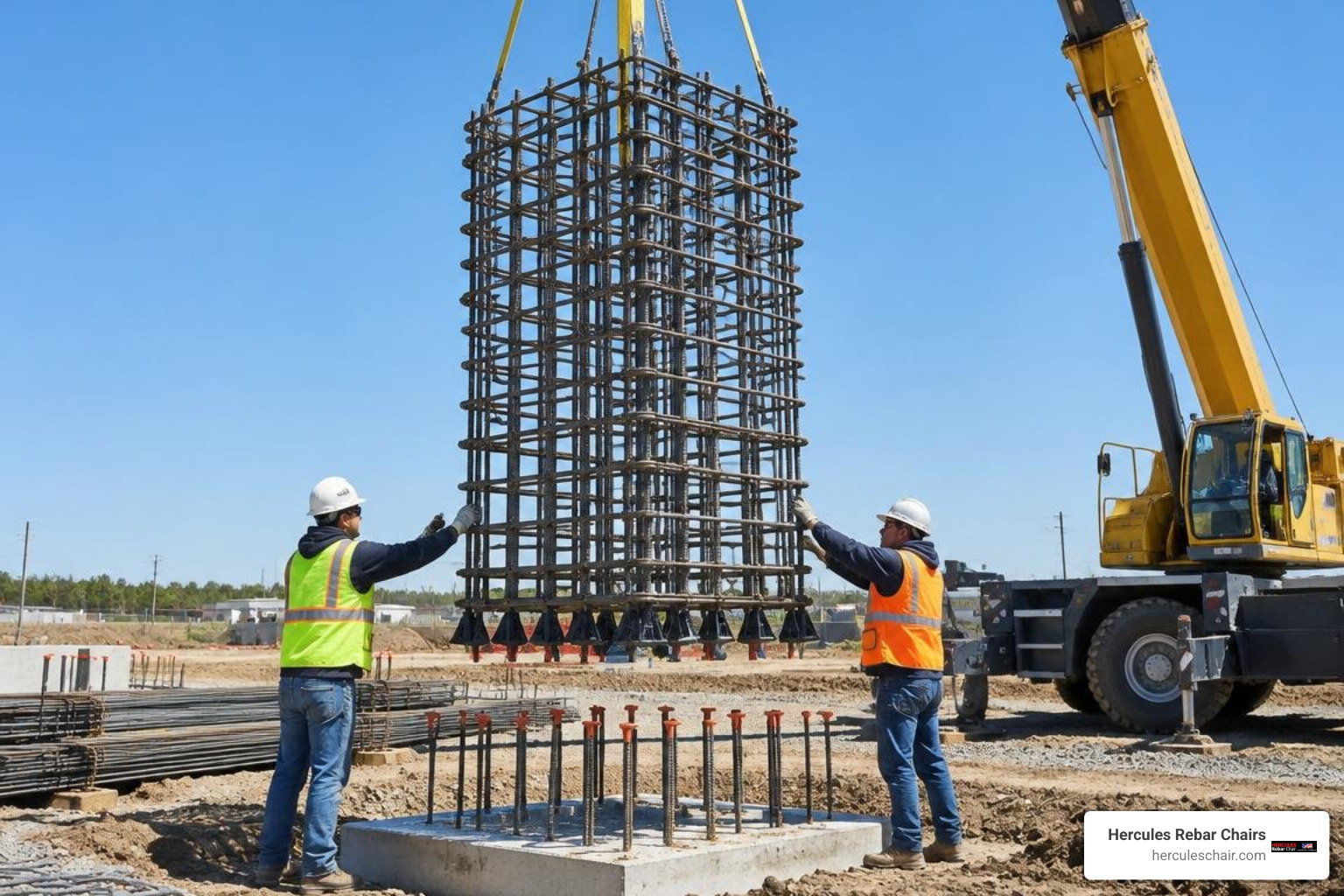
When cranes lift fully supported assemblies into place, hook time is cut dramatically. Instead of tying loose bars while hanging from a harness, ironworkers simply guide the cage, align base splices or mechanical couplers, and secure the column in minutes. Installing essential slab rebar chair supports and vertical spacers ensures structural clearances are locked in before concrete trucks arrive, avoiding costly delays or rework orders from municipal building inspectors.
Frequently Asked Questions about Rebar Chair Supports
How do labor-saving rebar supports reduce manual wire tying?
Labor-saving rebar supports reduce manual wire tying by providing rigid cradles and secure snap-in channels that mechanically hold reinforcing bars at their specified elevations. Traditional methods require workers to tie every single intersection to maintain mat elevation across temporary blocks or hooks. With engineered chairs, only structural tie points are required for overall grid continuity, allowing crews to skip dozens of unnecessary leveling ties across the slab or footing.
Can labor-saving rebar supports withstand heavy concrete placement?
Yes, high-grade polymer rebar chairs are engineered to withstand extreme static and dynamic jobsite loads. Manufactured from robust polypropylene and specialized composite polymers, these supports resist crushing under dense multi-layer steel mats, worker foot traffic, and the direct impact of high-volume concrete pump lines. Their wide base designs distribute vertical loads evenly, preventing displacement or lateral tipping during heavy mechanical vibration.
What total project time savings can contractors expect from supported rebar layouts?
Contractors can achieve up to a 20.4% reduction in overall project schedules by combining modern rebar support systems with streamlined assembly practices. Standardizing chairs across slabs and vertical elements eliminates pre-pour re-inspections, speeds up ironworker installation rates, and allows concrete finishing crews to pour without stopping to lift sunken steel out of the mud.
Conclusion
Maximizing jobsite profitability in concrete construction requires balancing speed, structural integrity, and crew safety. Sticking with outdated manual placement methods and makeshift bar supports wastes valuable payroll hours, strains skilled ironworkers, and introduces unnecessary structural risks.
At Hercules Rebar Chairs (T.J. Harris Co.), we manufacture rugged, American-made rebar chairs designed to keep your projects on schedule and fully code-compliant. With over 14 million of our signature red chairs sold across the United States, we help contractors across the country cut installation labor, protect their crews, and pour with absolute confidence.
Ready to streamline your next pour and protect your bottom line? Explore code-compliant rebar chairs and jobsite support accessories to find the exact supports built for your project specifications.