

Choosing Double Legged Rebar Supports for Thick Slabs
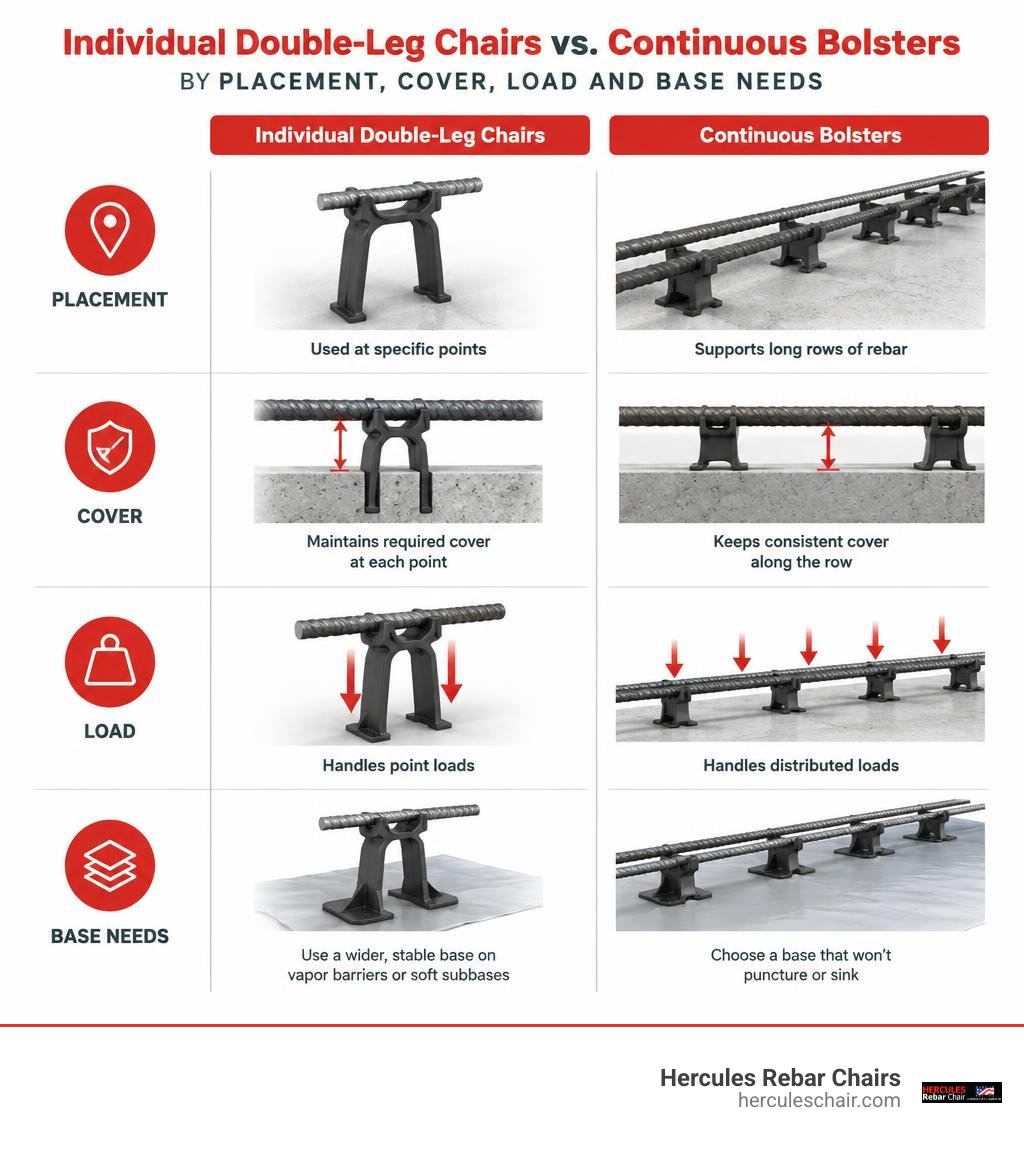
Choose double legged rebar supports by the job they need to do: use individual chairs where the layout calls for support at specific points, or continuous bolsters where long rows of rebar need support. In either case, check the required concrete cover, support height, load capacity, and spacing before the pour. If the supports sit on a vapor barrier or soft subbase, choose a base that will not puncture or sink into it. Taking time to verify these details before the trucks arrive keeps your reinforcement cage at the specified elevation and avoids costly rework after the concrete is placed.
A wider, stable base can help keep heavy reinforcement from shifting as crews walk, place concrete, and vibrate the slab. But the best choice depends on the slab design and site conditions, not just the number of legs. Deep slabs often carry multiple layers of large-diameter bars, so the support pattern must account for concentrated loads at lap splices, penetrations, and construction traffic lanes. For those conditions, double legged rebar supports give you a predictable line of bearing that resists both vertical settlement and lateral movement.
I’m Jordan Harris, a Tennessee-licensed structural engineer who has worked on large concrete projects and now helps develop rebar supports at Hercules Rebar Chairs. I’ll use that experience to compare double legged rebar supports with other options for thick slabs.
Double legged rebar supports terms you need:
Engineering Advantages of Double Legged Rebar Supports in Heavy Slabs
Thick industrial slabs, mat foundations, and structural transfer decks place extreme demands on reinforcement accessories. When pouring concrete depths exceeding 12 inches, reinforcement cages carry substantial self-weight, in addition to severe dynamic loads from concrete pump discharge lines and finishing crews. Using the correct supports ensures the steel stays exactly where the design engineer specified. You can easily prevent slab sag with heavy-duty bolsters designed to withstand these immense vertical forces.
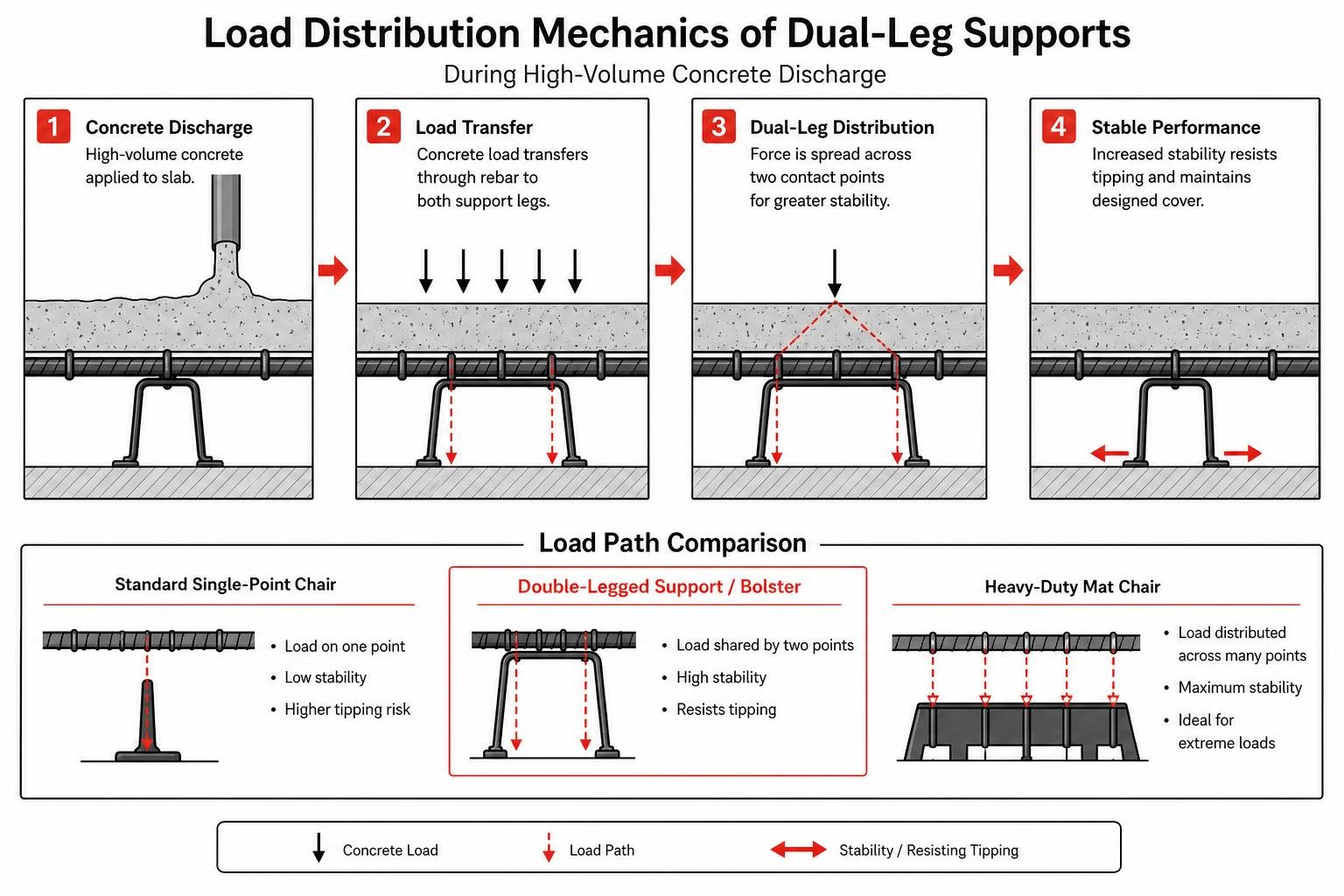
The difference between a support that keeps its elevation and one that sinks becomes clear when you look at how the load is transferred into the subbase. A dual-leg design spreads each load point across two bearing surfaces, so the pressure per square foot falls dramatically compared with a narrow single-post chair. That matters most when the subbase is granular, damp, or covered with a vapor barrier that cannot tolerate concentrated pressure. By reducing point loading, double legged rebar supports help maintain the specified bottom-cover clearance without punching holes in the moisture protection layer.
When placing massive quantities of reinforcement, modern engineering teams coordinate the placement of heavy rebar cages using detailed modeling tools. Integrating structural coordination via advanced BIM workflows helps contractors identify high-stress support zones and maintain exact bottom-cover clearances before the concrete trucks even arrive on site. That coordination becomes more important as slab depth increases, because a small deviation in cage elevation can reduce the effective depth of the section and affect the long-term performance of the slab.
| Support Feature | Standard Single-Point Chair | Double-Legged Support / Bolster | Heavy-Duty Mat Chair |
|---|---|---|---|
| Tipping Resistance | Low (Single-axis pivot) | High (Dual-point spread) | Maximum (Broad footprint) |
| Point Load Capacity | Up to 350 lbs | Up to 1,000+ lbs | 1,500+ lbs |
| Vapor Barrier Safety | Requires base plate | Built-in wide runner/feet | Flat plate base |
| Lateral Rigidity | Prone to side kick-out | Resists flow deflection | Rigid cross-braced |
Comparing Heavy-Duty Double Legged Rebar Supports to Single-Point Chairs
Single-point chairs—often shaped like simple cones or single wire posts—work fine for lightweight residential footings, but they fall short in deep commercial slabs. As workers walk across the rebar mat, a single-point chair acts like a pivot point, allowing the bar to rock or tip over. In a heavy mat, that rocking motion can shift the entire grid out of position before the pour begins.
Double legged rebar supports distribute vertical loads across two distinct contact planes. This geometry counteracts the twisting forces created when pumping heavy aggregate concrete directly onto reinforcement, and it gives the cage a wider stance that resists side movement during vibration. When selecting double rebar chairs for thick foundations, looking for products with a wide stance helps ensure the entire reinforcement grid stays rigid and upright throughout the pour.
Sizing and Spacing Standards for Double Legged Rebar Supports
The Concrete Reinforcing Steel Institute (CRSI) sets strict parameters for bar support spacing to avoid excessive sag between contact points. For thick slabs supporting heavy rebar mats (#6 through #11 bars), supports must be sized to maintain exact bottom-cover requirements without crushing under load. The spacing calculation starts with the bar diameter and mat weight, then factors in construction traffic and the method of concrete placement. Heavier mats may require a tighter grid pattern than lighter reinforcement, especially near pump discharge locations where impact loads spike during the pour. Referencing comprehensive rebar chair sizing guidelines ensures you match the chair height directly to the clear cover specified in your structural drawings.
Selecting the Right Reinforcement Chairs for Demanding Projects
Selecting chairs for heavy civil and industrial work requires balancing load rating, ease of placement, and material durability. A chair that meets the engineering load requirement but fails during placement is not a workable solution, and a chair that is easy to set but cannot hold the mat elevation is a structural risk. The right reinforcement chair is the one that satisfies all three demands for the full duration of the pour.

Critical infrastructure facilities demand extra vigilance. For instance, heavy-duty rebar supports for chemical and power plants must support multi-layered steel mats while resisting harsh chemical exposure. In those environments, the support system is part of the structure’s long-term durability, not just a temporary placeholder during construction. In addition to selecting the right chairs, sourcing certified reinforcement steel ensures that your structural members meet the exact yield strength requirements called for in the project specifications.
Continuous Bolsters vs. Individual Dual-Leg Chairs
Continuous slab bolsters provide uninterrupted linear support along the entire length of the reinforcement line, making them ideal for heavy, dense rebar layouts. Because the support is continuous, the bar does not span between isolated bearing points, which reduces deflection and keeps the reinforcement at a more uniform elevation. Individual dual-leg chairs, on the other hand, allow for targeted support placement around penetrations and structural blockouts. In many thick slab applications, the most efficient approach is a combination of both: continuous bolsters along the main bar runs and dual-leg chairs at openings or edge conditions that require a discrete support point. Utilizing continuous concrete support options helps optimize concrete aggregate flow around congested steel grids, reducing the risk of honeycombing and voids in the cured slab.
Steel Wire Rebar Supports and Corrosion Protection
When using steel wire chairs, protecting against moisture intrusion is vital. Exposed wire tips at the slab surface can lead to rust bleed, which compromises both appearance and long-term durability. Over time, moisture can travel along the wire from the surface to the interior of the slab, creating a path for corrosion to reach the reinforcement itself. Specifying high-strength steel rebar chairs with plastic-dipped or non-corrosive legs prevents moisture from wicking into the structural concrete. Where the slab is exposed to weather or aggressive chemicals, that protection becomes a necessary part of meeting the design service life.
Installation Best Practices for Deep Foundation Slabs

Proper installation on site makes the difference between an inspection pass and costly rework. Crews should place supports in a staggered pattern to prevent continuous fault lines in the concrete matrix. Staggering the supports breaks up any potential plane of weakness that could form when chairs are aligned in straight rows, and it gives the mat more uniform bearing across the entire slab area.
- Lay out the primary bottom bar layer and snap chalk lines for support locations.
- Space individual dual-leg chairs or bolsters according to CRSI standards (typically 3 to 4 feet on center depending on bar size).
- Tie every support securely to the intersecting rebar with heavy-duty tie wire to avoid displacement.
- Implement proactive measures for preventing reinforcement sag on job sites by checking clearance beneath intersecting mats before concrete delivery.
- Walk the mat after all ties are complete and verify that no chair has shifted or sunk at the subbase contact point.
The tie wire step is especially important for double legged rebar supports in deep slabs. When concrete hits the mat, the combination of pump discharge pressure and moving crew loads can lift a tied bar and break the bond between the bar and an untied chair. Securing every support to the reinforcement prevents that separation and keeps the entire cage working as one rigid assembly.
Subbase Protection and Vapor Barrier Integrity
When pouring slabs-on-grade over poly vapor barriers or uncompacted subgrade, point loads from rebar chairs can puncture the moisture membrane. A puncture may go unnoticed until the slab is in service, when moisture begins migrating upward through the slab and damaging flooring or coatings. Utilizing high-capacity chair designs for demanding pours with integrated wide sand plates distributes the weight evenly over the dirt or plastic, completely mitigating puncture risks and settlement. Where the subgrade is loose or poorly compacted, the wider footprint also prevents the chair from sinking before the concrete locks everything in place.
Frequently Asked Questions About Concrete Slab Supports
How do double-legged supports prevent cage movement during concrete placement?
Double-legged supports feature a broad stance that prevents the rocking motion common to single-post chairs. When concrete is discharged from pump hoses, the dual contact points convert lateral forces into vertical ground pressure, keeping the cage centered. The wider footprint also resists the rolling tendency that can occur when heavy bars are walked on or when fresh concrete pushes against the side of the mat.
What is the standard spacing for heavy supports in slabs over twelve inches thick?
For slabs over 12 inches thick using #6 to #9 reinforcement, CRSI generally recommends spacing supports at approximately 4 feet on center in both directions. For larger #10 and #11 bars, support spacing may need to be tightened to 3 to 3.5 feet depending on expected construction traffic. The governing factor is bar deflection between support points: if the bar sags enough to reduce the specified concrete cover, the spacing must be tightened regardless of the general rule.
Can dual-legged chairs be placed directly on granular subgrades?
Yes, provided they are equipped with wide-base sand plates or continuous base rails. Placing narrow wire feet directly onto loose aggregate or crushed stone will cause the supports to sink, compromising the required concrete cover. Where the granular subgrade has been compacted and the chair includes a broad bearing surface, the support can maintain its elevation without additional preparation.
What is the difference between a chair and a bolster?
A chair is an individual support placed at discrete points along a bar or mat, while a bolster is a continuous support that runs along the length of the reinforcement. For thick slabs with dense bar layouts, bolsters provide continuous bearing that eliminates sag between support points. Chairs offer more flexibility where the bar layout is irregular or where supports must be placed around penetrations and embedded items.
Conclusion
Getting concrete cover right is critical to the structural integrity and lifespan of your slab. As America’s #1 choice with over 14 million units sold across the USA, our distinctive red Hercules Rebar Chairs deliver the strength, stability, and code compliance your jobsite demands. To explore our complete lineup of field-proven products, view the full lineup of heavy-duty concrete supports and keep your next pour right on target.