

When One Layer Isn’t Enough: What to Know Before Buying Double Stack Rebar Chairs
Double stack rebar chairs are modular plastic or composite supports designed to hold two separate layers of rebar at precise heights in a single concrete pour — no custom fabrication required.
Quick answer: Best double stack rebar chair options by use case
| Use Case | What to Look For |
|---|---|
| Slab-on-grade / tilt-up | Stackable polypropylene, wide base, CRSI Class 1 |
| Post-tensioned slabs | High composite chairs, 12″–26″ range, ¼” increments |
| Precast / architectural | Non-bleeding HDPE, minimal footprint, no wire tying needed |
| DOT / bridge deck | Wide-set legs, certified load ratings, state-approved materials |
| General double mat | Stackable in ½” increments, accepts #3–#8 rebar |
Getting the cover depth right on a double-mat pour isn’t just a best practice — it’s a structural requirement. Shift that bottom mat even a half-inch too low, or let the top mat sag during a pour, and you’ve compromised the load path the engineer designed. Yet contractors still regularly resort to bent rebar standees, half-bricks, or shipping bolsters that cost $150 in product and $500 to ship, just to support an upper mat. There’s a better way.
I’m Jordan Harris, a licensed PE with a background in structural concrete engineering and co-developer of the Hercules Chair product line, which has included solutions for double stack rebar chairs and multi-layer support systems for over-a-decade of field use. In the sections below, I’ll break down exactly which stackable chair products perform best by application, material, and load requirement — so you can make a confident, code-compliant choice before your next pour.
Understanding Double Stack Rebar Chairs and Multi-Layer Support
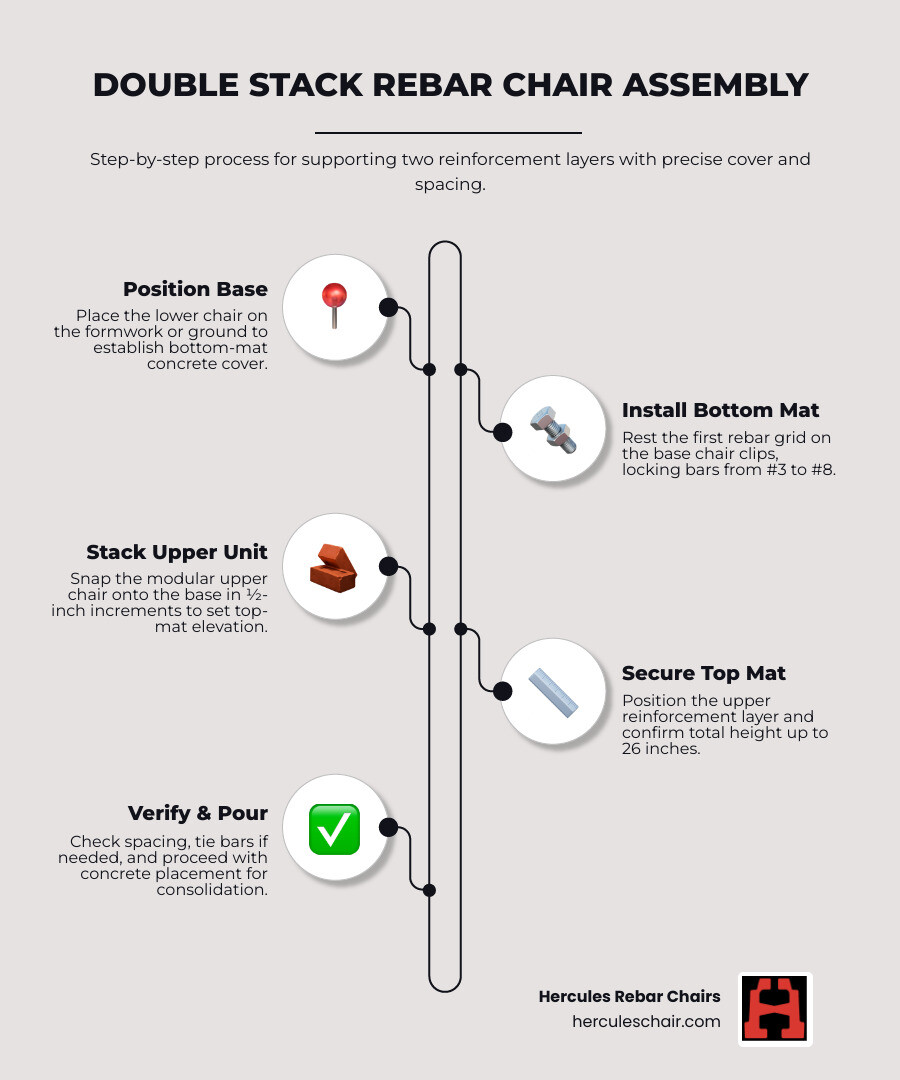
When we talk about double stack chairs, we mean supports built to carry more than one reinforcement layer by stacking, interlocking, or straddling one support on another. Instead of using a single fixed-height chair under one mat, these systems let us maintain bottom cover and then create reliable separation up to the next mat.
That matters on slab-on-grade, tilt-up, elevated slabs, bridge decks, and post-tensioned work where both vertical spacing and cover have to stay consistent across the pour.
If you want a broader primer on support categories, our guide on rebar chair types, uses, and sizing for concrete slabs is a good starting point. For industry guidance on placement tolerances, support practices, and bar support terminology, it is also helpful to review the Concrete Reinforcing Steel Institute.
How Double Stack Rebar Chairs Differ from Standard Supports
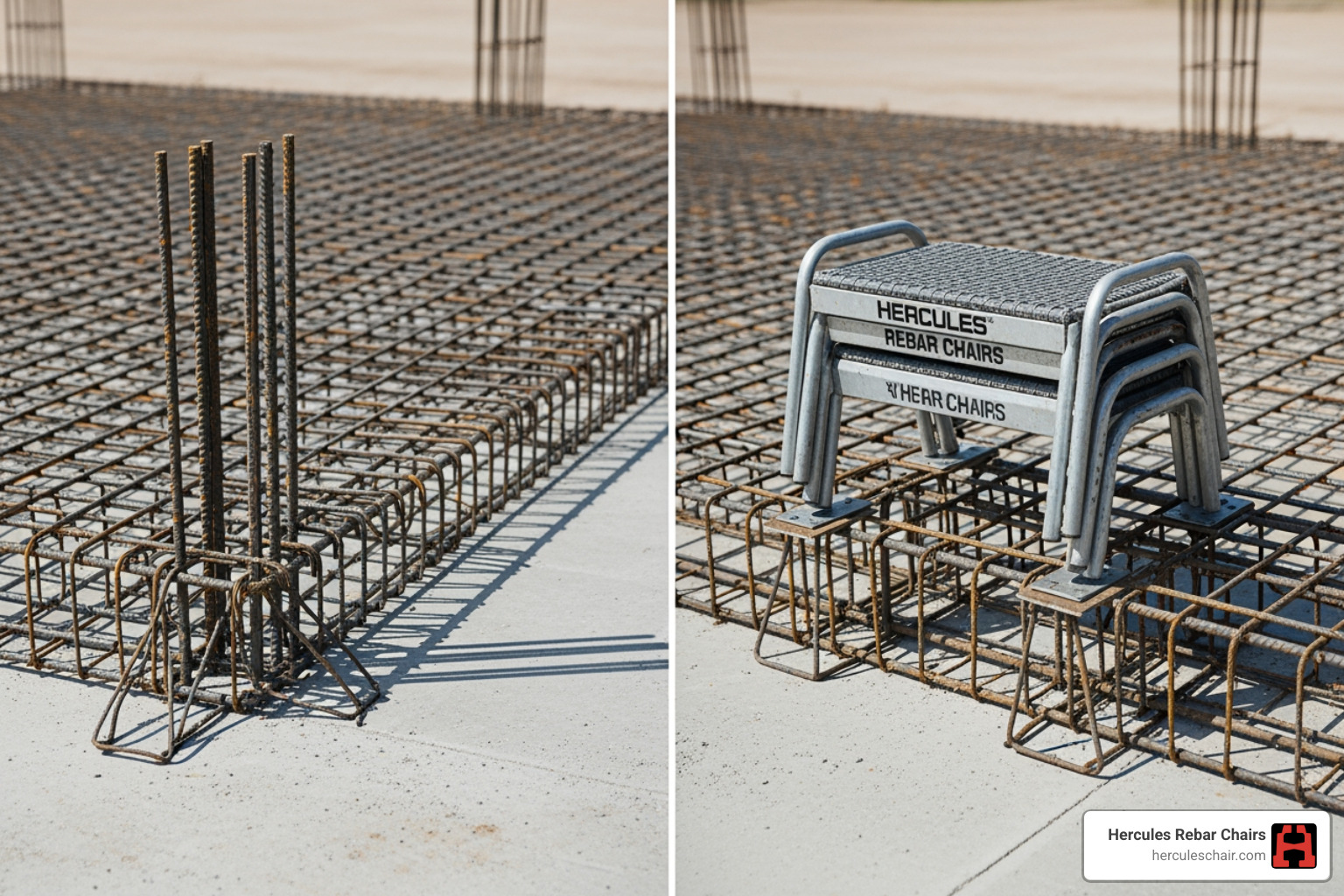
A standard single-height support does one job: hold one bar or one mat at one elevation. That is fine for a simple slab with one reinforcement layer.
A double stack system adds flexibility:
- It supports a bottom mat and helps establish spacing to an upper mat.
- It can often be built up in modular increments.
- It usually has clips, saddles, or cages that hold bars more securely.
- It reduces field improvisation with bent standees or cut-and-tie solutions.
- It makes it easier to match the engineer’s required cover and inter-mat spacing.
In practical terms, single chairs are simple. Double stack chairs are systems.
Some stackable polypropylene chairs accept #3 through #8 bar and build height in 1/2 inch increments starting from 1-1/2 inch or 2 inch cover. On the taller end, composite stack chairs used in post-tensioned and double-mat work are available from about 12-3/4 inches to 26-1/2 inches in 1/4 inch increments. That wide range is one of the biggest differences between “basic support” and “designed multi-layer support.”
Common Height Ranges and Stacking Increments
The most common ranges we see break into two categories:
Low-to-mid height stackable chairs
These are common for slabs and double mats where the top layer is not dramatically elevated.
Typical traits include:
- Starting cover heights of 1-1/2 inch or 2 inch
- 1/2 inch stacking increments
- Compatibility with #3 to #8 rebar
- Compact footprints for slab and footing work
These are useful when we need precise but modest elevation changes without overcomplicating layout.
Tall composite stack chairs
These are better suited for larger vertical separations, top mat support, and post-tensioned assemblies.
Typical traits include:
- Heights from about 12-3/4 inches to 26-1/2 inches
- 1/4 inch increments
- Two-piece and three-piece configurations
- Larger footprint for better stability at height
That 1/4 inch adjustability is especially helpful when the specified top steel elevation is tight and there is no room for “close enough.”
The key is choosing a support that hits both requirements:
- Concrete cover from the form or subgrade to the bottom steel
- Accurate spacing from the bottom mat to the upper reinforcement
If the chair is too bulky or closed-in, it can also hurt consolidation. Good stack chairs leave room for aggregate flow around the support, not just under it.
Key Applications for Stackable Reinforcement Supports
Double stack systems are not niche products anymore. By May 2026 standards and jobsite expectations, they are a practical choice anywhere multiple reinforcement layers have to remain where the engineer put them.
Best-fit applications include:
- Slab-on-grade with upper and lower mats
- Tilt-up panels
- Post-tensioned slabs
- Precast elements
- Bridge decks and DOT work
- Heavy reinforced walls and foundations
- Mat foundations with layered steel or mesh
Our article on why bar chairs are essential for strong slabs goes deeper into why support consistency matters so much in slab performance.
Benefits of Using Double Stack Rebar Chairs in Heavy-Duty Pours
The biggest advantage is control. We can keep the steel where it belongs before, during, and after concrete placement.
Other major benefits include:
- Better vertical accuracy for multi-layer reinforcement
- Faster setup than custom-bent standees
- More consistent cover across large placements
- Easier inspection before the pour
- Less risk of sagging top mats
- Lower chance of field-made supports damaging forms or creating inconsistent spacing
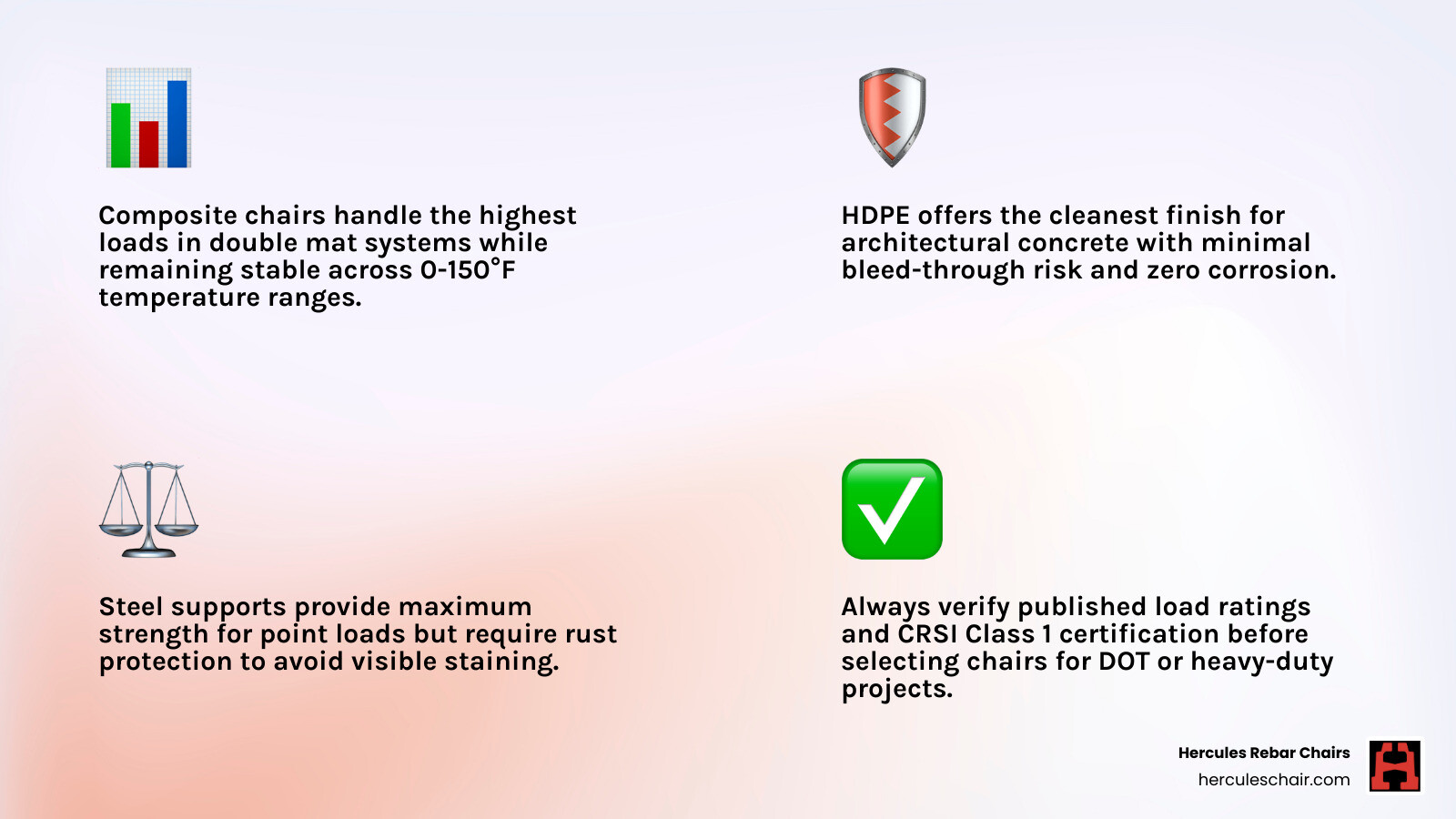
Material choice also drives performance. Composite supports are especially attractive where corrosion resistance matters. Some composite stack chairs are designed to maintain nearly the same strength from 0 degrees F to 150 degrees F, which helps on projects that swing from winter mornings to hot summer afternoons.
For a broader look at support performance in the field, see Everything You Need to Know About Rebar Supports.
Performance in Architectural and Exposed Concrete
Architectural concrete adds another layer of scrutiny: visible blemishes.
In exposed work, we usually want chairs that offer:
- Minimal footprint
- Small contact points
- Non-bleeding materials
- Corrosion resistance
- Reduced chance of visible rust shadows or chair marks
HDPE and polypropylene are commonly chosen because they are non-corrosive and lightweight. In precast applications, virgin HDPE formulations are often preferred where low bleed and clean surfaces matter. Composite chairs can also perform very well because they do not rely on exposed wire that can telegraph through finishes or create corrosion concerns later.
Some tall composite designs use rounded foot points intended to reduce formwork damage and remain much less visible in exposed concrete. That is the kind of detail that sounds small until the architect is staring at a finished panel.
Comparing Materials and Load Capacities
Material is not just a purchasing detail. It affects strength, stability, corrosion risk, temperature response, and appearance.
Here is a simple comparison of common options used for stacked supports.
| Material | Typical Use | Advantages | Watchouts |
|---|---|---|---|
| Composite | Tall stack chairs, post-tensioned, DOT, double mat | High strength, non-corrosive, stable across wide temperatures, often good for exposed work | Usually higher upfront cost than basic plastic |
| HDPE | Precast, slab-on-grade, architectural surfaces | Clean finish, low bleed potential, corrosion resistant | Verify actual load rating and bar fit |
| Polypropylene | General stackable chairs, slab and tilt-up work | Lightweight, economical, non-corrosive, easy to handle | Not every model is suited for heavy walking loads |
| Steel with plastic tips or dipped legs | High-load point supports, some commercial setups | Strong and familiar in heavy-duty work | Can be more visible in exposed concrete and needs protection against rust staining |
If you want a broader comparison of support categories, our article From Dobies to Double Mats: A Comprehensive Look at Rebar Chair Types is worth bookmarking.
What should contractors look for on specifications?
- Published load capacity, not assumptions
- CRSI classification where applicable
- DOT approval or state acceptance for transportation work
- Bar size compatibility
- Base geometry for the actual surface condition
- Suitability for exposed or architectural concrete
Some stackable chairs are specifically marketed as meeting CRSI Class 1 bar support requirements. That can be a useful screening tool, but we still recommend checking the exact product data for the actual application and load condition.
Strength vs. Stability: Chairs vs. Bolsters and Standees
Double stack chairs are not always the only support category used in reinforced concrete. The question is when they are the best fit.
Double stack chairs
Best when we need:
- Modular height adjustment
- Individual point support
- Fast installation
- Good corrosion resistance
- Clean support for multi-layer mats
Continuous bolsters
Common where the design calls for:
- Long linear support under a mat
- Consistent support along a run
- Better walkability in some layouts
Bolsters can help distribute support along a line, but they are less flexible when odd spacing or complex geometry shows up.
Individual high chairs
Common where the design calls for:
- Taller single-point support
- Focused support under heavier bars
- A straightforward fixed-height setup
The tradeoff is they may not provide the same modular adjustability as true stack systems.
Field-fabricated standees
These may appear on some jobs when:
- The design is unusual
- A crew is working through a special detail
- A project-specific solution is required
But they can vary in height, take labor to build, and are harder to standardize for inspection.
In short:
- Choose double stack chairs for flexibility and clean repeatability.
- Choose other support types only when the design or field condition clearly calls for them.
Material Performance Across Temperature Extremes
Temperature swings do more than make the pour crew grumpy.
Materials respond differently to heat and cold, so on year-round projects across the U.S., we need to think about performance before the truck arrives.
Composite supports stand out here. Published data for some composite stack chairs shows little change in strength from 0 degrees F to 150 degrees F. That is a meaningful advantage in hot paving regions, cold morning placements, and projects with long staging times.
Polypropylene and HDPE perform well in many standard applications, especially when stored and handled properly, but we always recommend verifying the manufacturer’s intended use if:
- The chair will carry taller stacks
- The top mat may see worker traffic
- The project is exposed to intense heat before placement
- DOT or agency specifications are involved
UV exposure before installation also matters. If supports will sit on site for extended periods, storage practices can affect longevity, especially with lighter-duty plastic products.
Installation Best Practices for Double Mat Systems
A good chair can still fail if it is installed badly. That is not the chair’s fault. That is just construction’s way of keeping us humble.
Our guide on reinforcement supports covers the basics, but double-mat systems need extra attention.
Key field practices include:
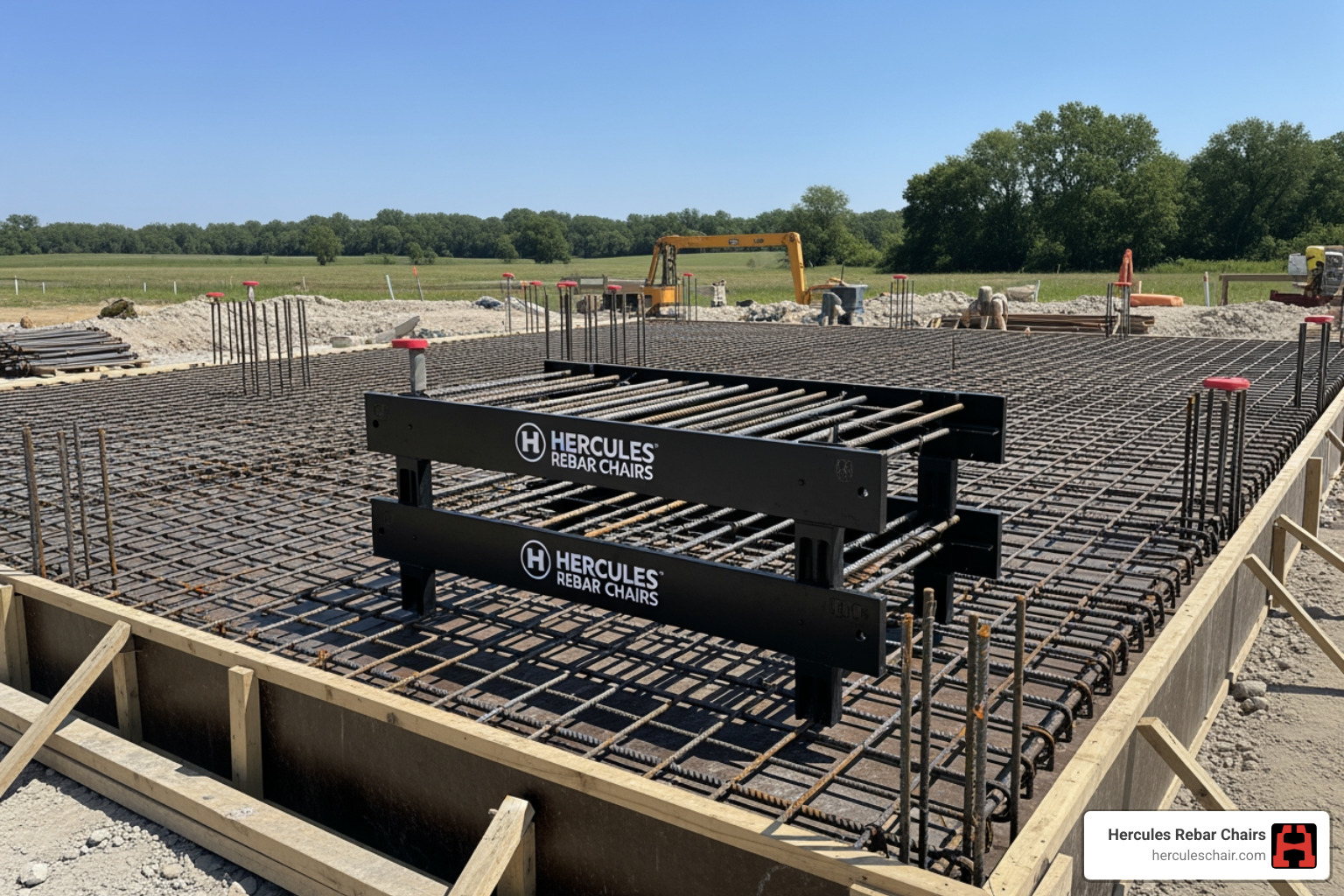
- Lay out support spacing before tying the upper mat
- Match chair capacity to expected live load during placement
- Tie bars where movement is likely
- Use wider bases or sand pads on softer subgrade or vapor barriers
- Keep supports aligned so upper mat loads transfer cleanly
- Avoid random substitutions mid-job that change cover
Features that improve installation and performance include:
- Wide bases for soft or uneven surfaces
- Snap-in clips to hold bars securely
- Arch feet or open geometry for concrete flow
- Sand pads for added bearing area
- Rounded or low-marking feet for formwork protection
Ensuring Proper Concrete Consolidation
One of the easiest mistakes in support selection is focusing only on height.
A chair also has to let concrete move around it.
Look for:
- Large cavities or open spaces in the body
- Narrow contact points instead of wide flat plates
- Arch-foot or open-leg shapes that reduce trapped aggregate
- Designs that do not create shadow zones under the upper mat
This is especially important in heavily reinforced sections. If the support is too bulky, it can contribute to poor consolidation and local honeycombing. Better stack chairs are designed to support steel while still letting paste and aggregate pass through.
Spacing and Layout for Maximum Stability
Spacing depends on:
- Bar size
- Mat density
- Chair height
- Expected worker traffic
- Surface condition
- Manufacturer recommendations
- Project specifications
That said, several practical rules of thumb appear repeatedly in the field:
- Individual chairs are often placed about 2 to 3 feet apart along the bar run in lighter configurations.
- Continuous bolsters are commonly spaced around 4 feet apart in slab grid applications.
- Taller or more heavily loaded stacked systems usually need tighter, more deliberate spacing.
For double mats, we recommend thinking in both directions:
- Along the bar line
- Across the grid so loads do not concentrate into a few chairs
If workers will be on the upper mat, do not assume any stackable chair is automatically walkable. Verify capacity, reduce spacing if needed, and consider whether the top assembly needs additional support. Some crews improve stability by adding wire mesh or increasing support density in traffic areas, but the right answer is to match the support system to the anticipated load from the start.
Frequently Asked Questions about Stackable Supports
What rebar sizes are compatible with double stack rebar chairs?
Many stackable plastic chair systems accept #3 through #8 rebar, which covers a wide range of slab, wall, footing, and mat work. Some lighter-duty products are limited to #4 and #5, while specialty double rod or high chair options may suit larger bars or heavier assemblies.
Always check:
- Maximum bar size in the clip or saddle
- Whether the rating changes when stacked
- Whether the product is intended for bar, mesh, or both
If your assembly includes mixed reinforcement sizes, make sure the support fits the actual bar in the chair location, not just the average bar on the plan.
Can you walk on rebar mats supported by stackable chairs?
Sometimes, but not always.
This depends on:
- The chair material
- The chair height
- Spacing
- Mat stiffness
- Tie quality
- Worker load
- Whether traffic is temporary or constant
Certain continuous bolster systems and heavier support layouts can carry walking loads when spaced correctly, but many lightweight plastic stack chairs are designed primarily for positioning, not for repeated foot traffic on an unsupported top mat.
Our rule is simple:
- If walking is expected, verify the load path.
- If the product data does not clearly support it, do not guess.
- Increase support density or use a different support type where needed.
Safety and steel position are too important to leave to optimism.
Are these chairs approved for Department of Transportation (DOT) projects?
Some are, but approval is product-specific and state-specific.
For DOT work, look for:
- CRSI classification where required
- Published material data
- Wide-set legs where the spec calls for them
- State acceptance or approved-products listing
- Clear documentation for inspectors
Certain stackable caged chair designs are made with wide-set legs specifically to satisfy DOT-type requirements, and composite stack chairs are commonly used in transportation-related work because they are non-corrosive and stable across varying temperatures.
For projects in the U.S. states we serve, the best practice is to confirm the exact agency requirement before ordering. “Looks heavy-duty” is not a submittal package.
Where can contractors source double stack rebar chairs, and what do packaging and pricing look like?
Contractors can source stackable supports through specialty concrete supply houses, reinforcement accessory distributors, and direct manufacturers.
Packaging varies a lot by type:
- Some stack chairs are packed 300 to 500 per carton
- Some high stack products come in smaller cartons such as 225 pieces
- Some specialty products are sold in bags of 50
- Some standard double chairs are sold in packs of 500
Pricing also varies widely by height, material, and quantity. As one market example, a polypropylene double chair pack of 500 has been listed around $136.94, while metal chairs can range roughly from $0.33 to $0.80 each depending on volume. Shipping can become a major line item on bulky supports, which is one reason contractors often prefer compact modular chairs over long bolster sections.
Conclusion
The best double stack rebar chairs are the ones that match your actual pour conditions, not just the cheapest item on a catalog page.
For most buyers, the decision comes down to five checkpoints:
- Required cover and inter-mat spacing
- Bar size compatibility
- Load and traffic expectations
- Surface and formwork conditions
- Compliance requirements such as CRSI or DOT approval
If you need compact modularity, stackable polypropylene systems are often the practical choice. If you need tall top-mat support and tight height control, composite systems shine. If you need a clean finish in architectural work, low-marking non-corrosive materials matter. And if your crew is about to start bending standees in the yard, that is usually your sign to look at a better manufactured support.
At Hercules Rebar Chairs, we build supports to save time, reduce placement headaches, and help crews stay code-compliant without reinventing the wheel on every pour. We are proud to be America’s #1, with 14 million units sold and our signature red color making our products easy to spot on the jobsite before they disappear into the concrete where they belong.
If you are comparing options for your next double-mat project, explore Our Products and see which support system fits your slab, tilt-up, precast, post-tensioned, or DOT application best.