

Continuous Mesh Rebar Chairs Keep Reinforcement at the Right Height
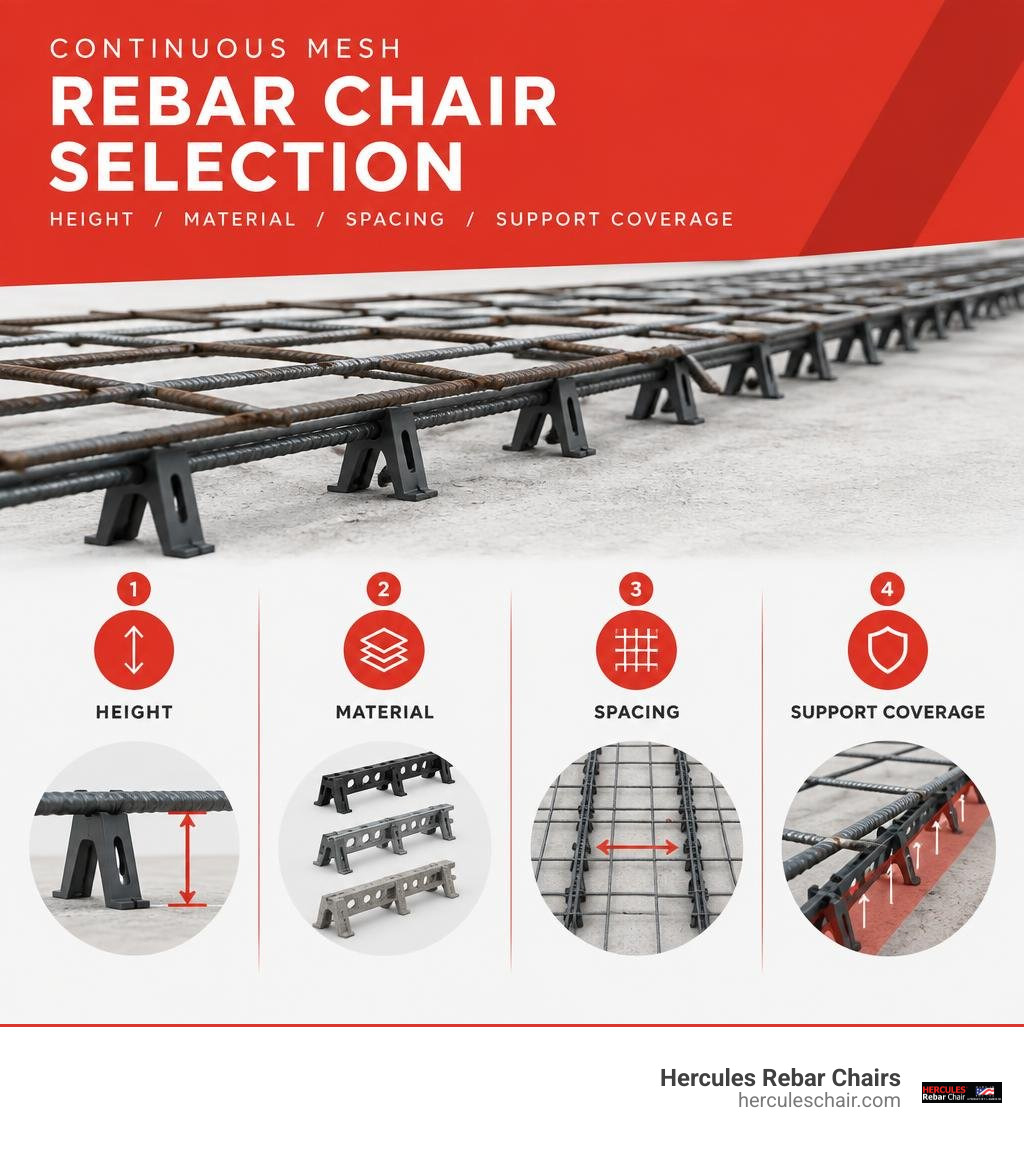
Continuous mesh rebar chairs support welded wire mesh or rebar grids along a longer line instead of at isolated points. For most slab-on-grade work, choose a chair height that delivers the specified concrete cover, lay supports on a consistent grid, and start with roughly 3-foot spacing unless the plans or engineer require closer spacing.
They help keep reinforcement from sagging, shifting under foot traffic, or being pressed into the subgrade during the pour. Compared with individual chairs, continuous supports can spread the load across more of the mesh, improve grid stability, and reduce the time spent placing many separate supports.
The right choice still depends on the job. Plastic chairs are common for typical slabs, while wire or steel supports suit heavier structural reinforcement. Concrete dobies can be appropriate where the project specification calls for them. This guide compares those options so you can buy supports that match your slab, mesh, cover requirement, and pour conditions.
I am Jordan Harris, a Tennessee Professional Engineer with experience in structural concrete and steel projects, manufacturing, and rebar-support product development. I use that background to explain how continuous mesh rebar chairs can help crews place reinforcement faster while protecting the elevation the design requires. For broader context on reinforcement positioning, see rebar.
Basic continuous mesh rebar chairs glossary:
Understanding Continuous Mesh Rebar Chairs vs Single Point Supports
Maintaining the structural integrity of concrete flatwork demands consistent reinforcement elevation. When pouring concrete over steel rebar or welded wire reinforcement (WWR), the steel must remain suspended at the precise design depth to handle tensile stresses. If the steel settles to the subgrade or floats near the top surface, the slab risks premature cracking, curling, and catastrophic structural failure.
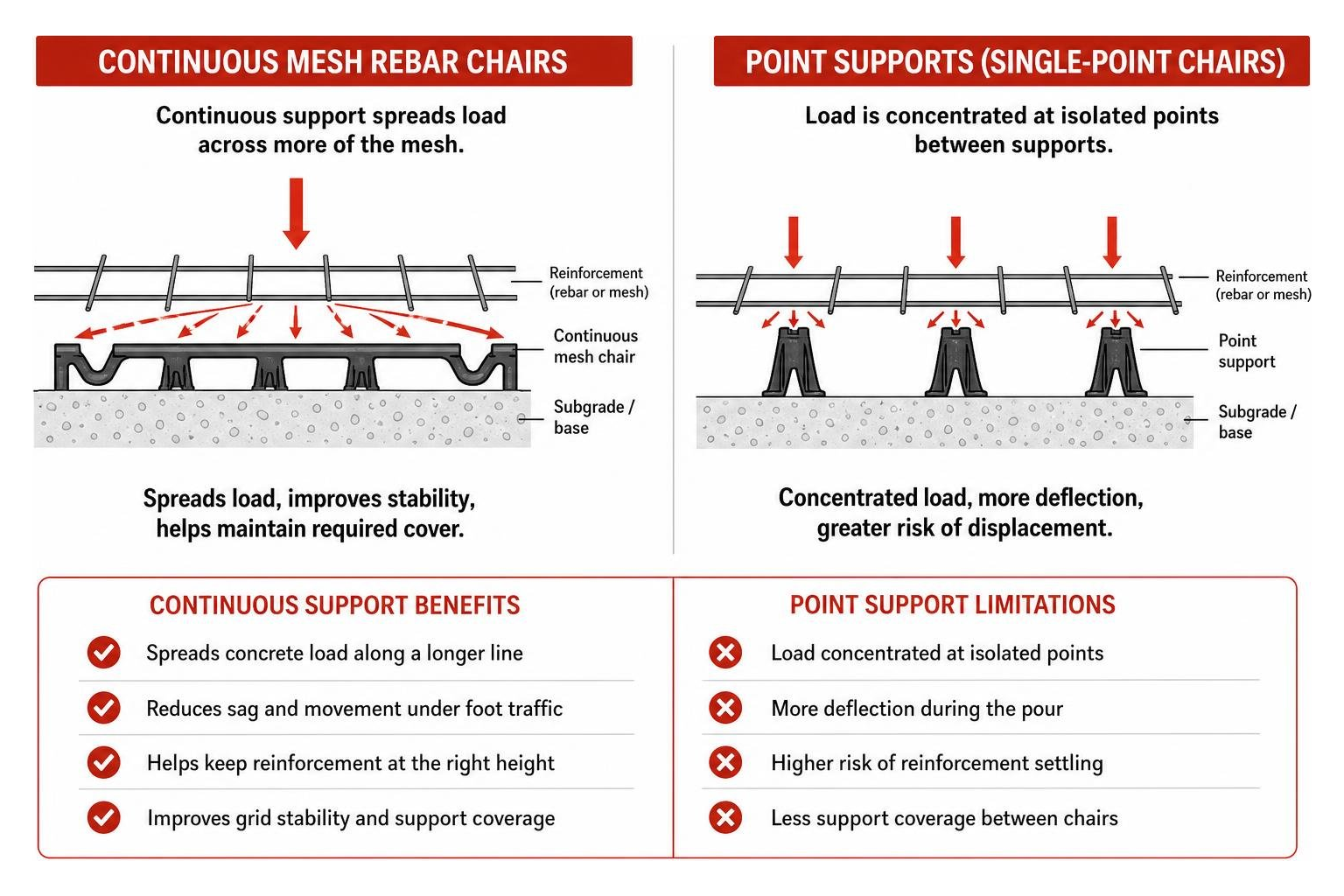
When selecting supports, contractors generally choose between continuous line supports and single-point chairs. Single-point supports hold rebar or mesh at isolated intersections. In contrast, continuous mesh rebar chairs provide extended, linear stability that bridges across multiple grid lines. By understanding continuous rebar supports, field teams can prevent the heavy deflection that occurs when concrete crews walk over reinforcement during the pour.
How Continuous Mesh Rebar Chairs Function in Concrete Slabs
Continuous mesh chairs act as continuous runners beneath the reinforcement steel. Instead of bearing the load at an isolated contact point, a continuous runner spreads weight along an extended contact plane. This broad base is essential when placing reinforcement over soft subgrades, gravel, sand, or delicate vapor barriers.
When concrete is discharged from a pump hose or buggy, the instantaneous hydraulic pressure can easily depress welded wire fabric. Continuous chairs resist this downward thrust by distributing the force evenly across the slab footprint. Exploring continuous support options helps project managers match runner profiles to specific reinforcement patterns, ensuring uninterrupted concrete encapsulation and maintaining uniform concrete cover throughout the curing cycle.
Single Point Rebar Chairs and Dobies
Single-point rebar chairs and concrete blocks (often called dobies) remain standard in many traditional specifications. A dobie is a precast concrete block, often with embedded tie wires, while a standard single-point plastic chair clips onto a single bar intersection.
While individual chairs are useful for tight spaces, edges, and simple footings, they introduce distinct challenges on large slab pours:
- Point Displacement: Walking across a mesh grid supported only by single-point chairs concentrates all worker weight onto tiny contact patches, often popping the wire loose or tilting the chair.
- Subgrade Sinking: Narrow footprints on single-point supports can punch straight through vapor barriers or sink into uncompacted gravel under heavy loads.
- Labor Consumption: Setting hundreds of individual chairs and tying them off requires significantly more field hours than placing long continuous runners.
Reviewing a practical guide to rebar chair types clarifies when point supports are acceptable and when continuous supports are necessary to prevent reinforcement displacement.
Material Options and Multi-Mat Configurations
Reinforcement supports must withstand severe structural loads and resist chemical reactions within wet concrete. Selecting the right chair material ensures long-term durability and prevents surface rust blemishes or moisture penetration.

Selecting Materials for Continuous Mesh Rebar Chairs
Concrete reinforcement supports are manufactured in three primary materials, each serving specific site demands:
- Polypropylene Plastic: Engineered plastic chairs are lightweight, fully corrosion-proof, and cost-effective. High-grade plastic chairs feature wide, stable bases that prevent puncture damage to underlying moisture barriers. When outfitting commercial slabs, contractors often seek the best plastic rebar chairs for sale to balance structural strength with rapid jobsite handling.
- Heavy-Duty Wire and Steel: Heavy structural foundations, thick bridge decks, and heavily reinforced industrial slabs require the rigid capacity of steel. Steel mesh chairs and continuous wire runners support dense rebar grids without crushing. Learning how to use galvanized rebar chairs and continuous wire spacers prevents corrosion bleed-through on exposed soffits. For heavy industrial specs, consulting a steel rebar chair guide for 2026 ensures compliance with current heavy-load standards.
- Precast Concrete Dobies: Dobies match the thermal expansion properties and compressive strength of the surrounding concrete pour. They are common in civil works, heavy foundation footings, and marine structures where non-metallic or monolithic material continuity is mandated.
Single-Mat vs Multi-Mat Reinforcement Configurations
Reinforcement design varies from a simple single layer of welded wire fabric to complex, multi-layered rebar mats. Matching chair profiles to these configurations is vital for structural success:
- Single-Mat Elevation: Common in residential flatwork, driveways, and light commercial floors. Single-mat systems use continuous runners to keep the mesh suspended within the middle-to-upper third of the slab depth to resist shrinkage cracking.
- Multi-Mat Reinforcement: Heavy structural slabs, mat foundations, and highway paving often require both a bottom mat (to resist positive bending moments) and an elevated top mat (to resist negative bending moments). Supporting elevated top mats demands high-capacity bolster chairs or continuous wire stand runners that bear the load of upper steel layers without buckling.
Understanding the role of essential concrete reinforcement products ensures each steel layer maintains its exact elevation during placement.
How to Calculate and Space Continuous Mesh Supports
Proper jobsite estimation prevents delays and ensures structural compliance. Placing too few chairs results in sagging reinforcement, while over-ordering inflates material budgets.
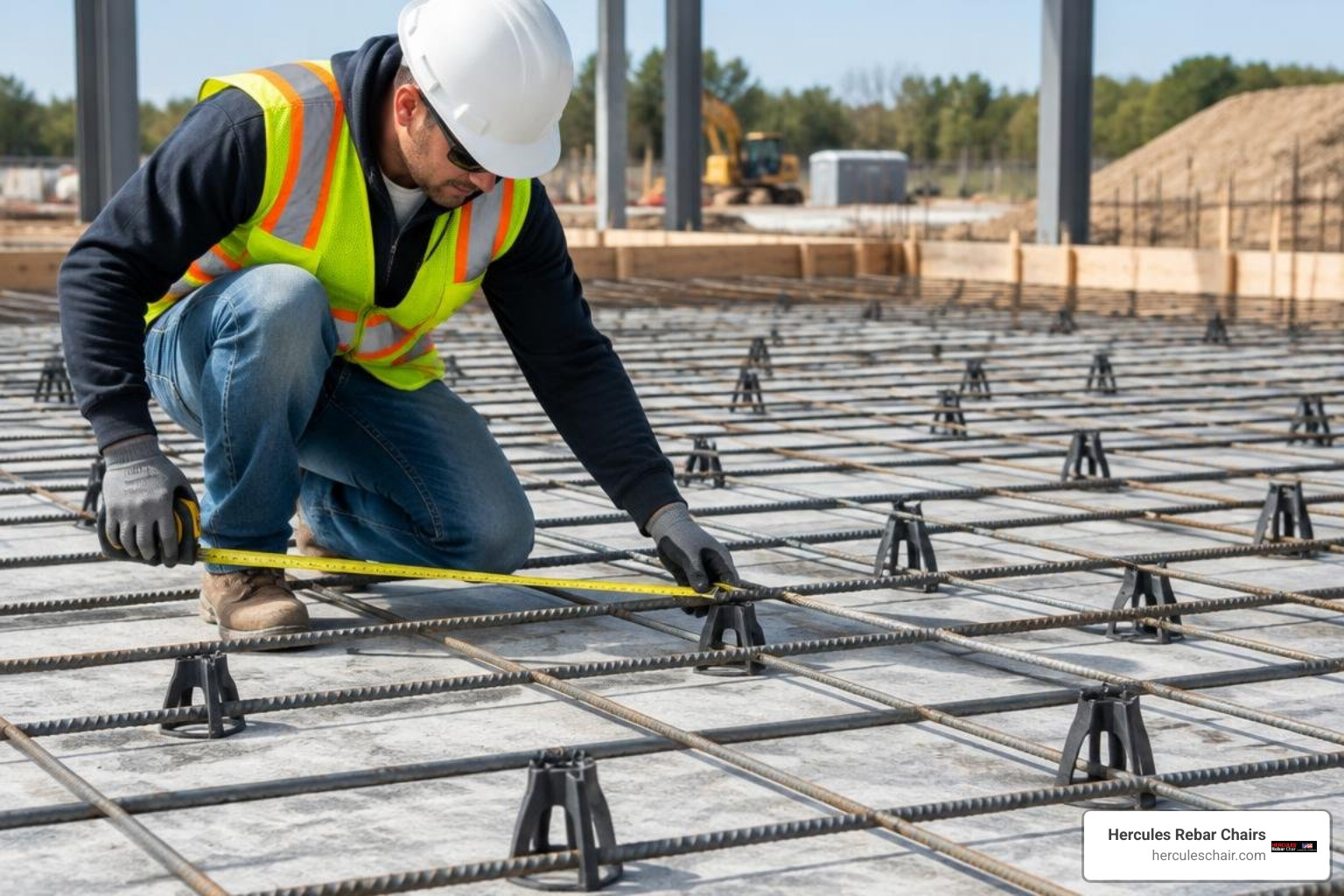
The Grid Spacing Formula and Sizing Rules
To determine the exact quantity of continuous mesh rebar chairs needed for a rectangular slab layout, use the standard engineering calculation formula:
Where:
- nC = Total number of support chairs required
- L = Length of the slab (in feet)
- W = Width of the slab (in feet)
- CS = Chair spacing interval (default standard is 3 feet)
Step-by-Step Calculation Example
Consider a commercial slab-on-grade measuring 30 feet long by 20 feet wide, using the standard 3-foot chair spacing:
- Calculate the length rows:
roundup(30 / 3) + 1 = 10 + 1 = 11 support lines along length - Calculate the width columns:
roundup(20 / 3) + 1 = roundup(6.67) + 1 = 7 + 1 = 8 support lines along width - Multiply the rows by the columns:
nC = 11 * 8 = 88 total support chairs
Mastering the rules for spacing your wire mesh chairs ensures balanced load distribution. For deeper insights into matching chair heights to concrete thickness, refer to the complete guide on types, uses, and sizing for concrete slabs.
Common Installation and Spacing Pitfalls to Avoid
Even high-quality supports will fail if placed incorrectly. Avoid these common field mistakes:
- Excessive Spacing Intervals: Extending chair spacing beyond 3 to 4 feet causes thin-gauge welded wire mesh to sag between supports, leaving reinforcement resting on the subgrade.
- Ignoring Foot-Traffic Paths: Concrete pump operators and screed crews naturally walk along specific paths. Reinforce high-traffic travel lanes with additional continuous supports to handle concentrated dynamic loads.
- Vapor Barrier Punctures: Using pointed or narrow-legged chairs directly on poly vapor retarders causes tears that allow moisture intrusion. Always select wide-base, flat-bottom continuous runners for barrier installations.
- Inadequate Edge Clearance: Placing chairs too close to formwork can expose steel or plastic runners at the exterior edge of the finished slab, leading to moisture paths and edge spalling. Maintain a minimum of 2 inches of side cover.
Continuous Mesh Chairs vs Dobies and Wire Stands
Choosing the optimal support system requires evaluating installation speed, material expenses, and performance characteristics.
| Feature / Metric | Continuous Mesh Chairs | Single Plastic Chairs | Heavy Steel Wire Stands | Concrete Dobies |
|---|---|---|---|---|
| Primary Material | Polypropylene / Heavy Wire | Engineered Polymer | Heavy-Gauge Steel | Precast Concrete |
| Load Distribution | Continuous Linear Spread | Isolated Point Load | Linear / Point Hybrid | Isolated Point Load |
| Installation Speed | Fast (Runner placement) | Moderate (Clip per joint) | Fast (Long wire lengths) | Slow (Manual placement & tying) |
| Vapor Barrier Safe | High (Wide flat base) | Moderate (Requires wide foot) | Low (Requires plastic base tips) | High (Flat block surface) |
| Sagging Resistance | Excellent | Fair to Moderate | High to Excellent | Fair |
| Corrosion Risk | Zero (Plastic) / Low (Galv) | Zero | Low to Moderate | Zero |
| Typical Best Use | Slab-on-grade & WWR Mesh | Light residential rebar | Heavy structural & bridge decks | Deep civil footings & marine slabs |
When you are ready to equip your jobsite with reliable, code-compliant supports, you can buy rebar chairs directly configured for your specific slab profiles and structural loads.
Frequently Asked Questions
What is the formula for calculating total continuous mesh rebar chairs?
The standard estimation formula is nC = (roundup(L / CS) + 1) * (roundup(W / CS) + 1). Divide the slab length (L) and width (W) by your chosen chair spacing (CS, typically 3 feet), round each result up to the nearest whole integer, add 1 to each, and multiply the two numbers together.
What is the standard spacing for continuous mesh supports?
The standard industry rule of thumb is 3-foot on-center spacing in both directions. For light-gauge wire mesh or slabs expecting heavy foot traffic during the pour, reduce spacing to 2 or 2.5 feet. For heavy, rigid rebar grids (such as #5 bar or larger), spacing can often extend to 3.5 or 4 feet if verified by engineering calculations.
When should wire or steel chairs be chosen over plastic chairs?
Wire or steel chairs should be selected for heavy industrial slabs, multi-mat structural foundations, bridge decks, and high-temperature concrete pours where reinforcement loads exceed the compressive strength of plastic polymer chairs.
Conclusion
Achieving code-compliant concrete cover and long-lasting structural strength requires reliable reinforcement elevation. Continuous mesh rebar chairs eliminate the sagging, tipping, and elevation loss common with isolated point supports, giving contractors peace of mind during demanding concrete pours.
At Hercules Rebar Chairs (T.J. Harris Co.), we engineer premium concrete supports designed to save labor time and ensure flawless jobsite code compliance. Known across the United States as “America’s #1” with over 14 million units sold nationwide, our signature red chairs offer high visibility on the subgrade, making QA/QC inspections fast and effortless. To equip your next residential, commercial, or civil project with high-performance elevation solutions, browse our full line of concrete reinforcement products today.