

Why Heavy Duty Rebar Bolsters Are Critical for Structural Concrete
Heavy duty rebar bolsters are high-strength supports placed under reinforcing steel to hold it at the correct height inside a concrete pour. Here’s a quick summary:
- What they are: Continuous rebar support chairs that elevate steel off the form or ground
- Why heavy duty: Rated for up to 3,000 lbs of load — built for thick slabs, heavy rebar mats, and demanding commercial pours
- Common heights: 3/4″ to 5″ cover heights available
- Materials: Heavy duty plastic (polypropylene) or steel wire with plastic tips
- Key applications: Elevated slabs, footings, beams, bridge decks, tilt-up walls, and precast panels
- Industry standard: Should meet CRSI Class 1 Bar Support requirements
When rebar sinks or shifts during a concrete pour, the slab loses the structural integrity it was designed to have. Inadequate concrete cover leads to corrosion, cracking, and long-term failure — problems that are expensive to fix and impossible to ignore on code-compliant projects.
That’s the exact problem heavy duty rebar bolsters solve. They keep your steel exactly where the engineer specified it — no shifting, no sinking, no guesswork.
I’m Jordan Harris, a licensed Professional Engineer (PE) with a background in large-scale concrete and structural projects, and I’ve worked extensively with heavy duty rebar bolsters as part of my role at T.J. Harris Company, where we engineer rebar support products built for real job site demands. In the roundup below, I’ll walk you through the best options available today so you can pick the right bolster for your next pour.
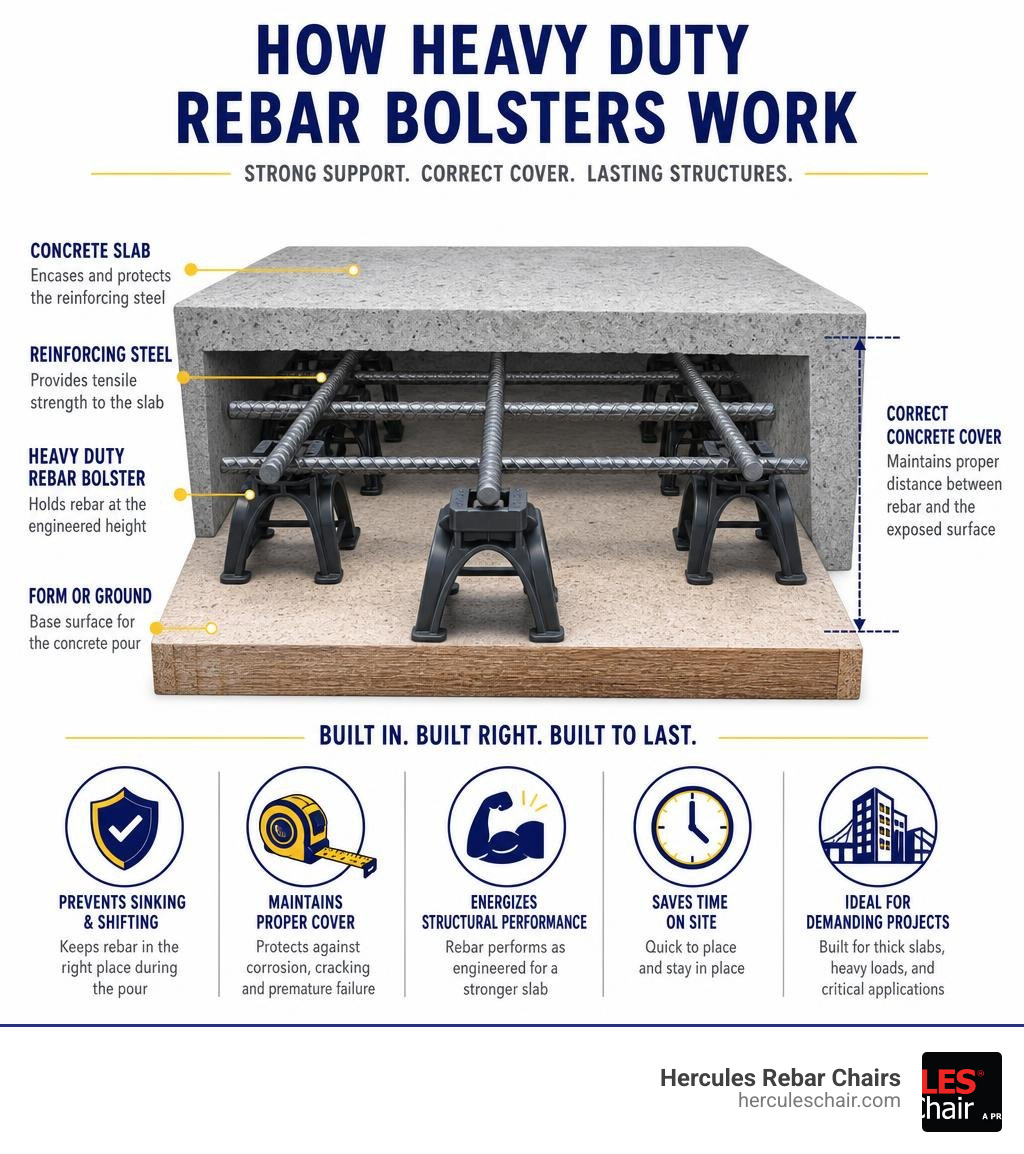
What Are Heavy Duty Rebar Bolsters and Why Do You Need Them?
In the concrete world, your rebar is only as good as its placement. If your steel grid sinks to the bottom of the slab or gets pushed to the top during a heavy pour, it stops doing its job. That is where slab bolsters come into play. But what exactly are they, and why do we need to upgrade to heavy duty options?
To put it simply, slab bolsters are continuous support systems designed to hold up long runs of reinforcing steel. Unlike individual rebar chairs, which only support the steel at single points, bolsters provide a continuous line of support. This makes them incredibly stable and reduces the chances of the rebar sagging between support points. If you are new to this concept, you might want to start with our guide on What are concrete bolster chairs and why do you need them? to understand the basics.
Key Differences Between Standard and Heavy Duty Rebar Bolsters
Standard slab bolsters work beautifully for light residential projects or thin sidewalks, but they quickly buckle under the pressure of commercial construction. Heavy duty rebar bolsters are engineered to handle massive loads.
The most significant difference lies in their structural stability and weight capacity. While standard supports might bend or collapse under the weight of workers walking on the steel grid, heavy duty plastic slab bolsters boast an incredible 3,000 lbs load capacity. They are manufactured from high-strength, heavy-duty materials like 6 gauge steel construction or 100% virgin polypropylene. This ensures that even when you are pouring heavy rebar mats or working on thick foundation slabs, your steel remains perfectly positioned. For more on this, check out why Slab bolster chairs and why your rebar deserves a seat.
How Heavy Duty Bolsters Prevent Concrete Sagging and Ensure Cover
“Concrete cover” refers to the distance between the outer surface of the concrete and the embedded reinforcing steel. If the steel is too close to the surface, moisture and oxygen will seep through the porous concrete, causing the rebar to rust, expand, and spall the concrete.
Using heavy duty rebar bolsters ensures that your steel stays locked at the exact specified height throughout the entire pour. Because they offer continuous support, they prevent the rebar from sagging between chairs. Without this continuous elevation, heavy concrete being discharged from a chute or pump can easily push the steel grid down to the dirt. To understand why this is a recipe for structural failure, read our deep dive on Why your slab needs rebar chair supports.
Comparing Slab Bolsters, Slab Bolster Uppers, and Beam Bolsters
When shopping for rebar supports, you will quickly realize that “bolster” is an umbrella term. There are slab bolsters, slab bolster uppers, and beam bolsters. Choosing the wrong one can lead to major installation headaches, so let’s break down the differences. To get a broader overview of continuous systems, you can also read The long span solution understanding continuous rebar supports.

Slab Bolster Lowers vs. Slab Bolster Uppers
The difference between a slab bolster lower (often just called a slab bolster) and a slab bolster upper comes down to where they sit in your steel grid:
- Slab Bolster Lowers: These are designed to support the bottom layer of steel rebar in a concrete slab. They sit directly on the formwork or the ground.
- Slab Bolster Uppers (SBU): These are used to support an upper layer of steel above a lower layer. They feature a flat, continuous top wire or support channel and are designed with a wide footprint—often a 5 inch width for continuous slab bolster uppers—to straddle the lower steel mats. They can also be placed directly on soft material surfaces like carton forms or fill material without sinking.
For example, high-quality continuous slab bolster uppers are specifically built to provide this stable, elevated foundation for multi-layered steel grids.
The Role of Heavy Duty Beam Bolsters in Concrete Construction
While slab bolsters are designed for wide, flat surfaces, beam bolsters are built to support heavy, dense cages of lower beam steel. They are typically placed in the bottom of beam forms to hold the heaviest structural steel elements off the formwork.
Heavy duty beam bolsters feature closely spaced legs (often on 2-1/2″ centers) and robust arch designs to maximize strength under extreme loads. When you are dealing with massive structural beams, ordinary supports simply won’t cut it. You need dedicated heavy-duty rebar supports and accessories to ensure safety and structural compliance.
Material Selection: Why Heavy-Duty Plastic Bolsters Outperform Traditional Steel
For decades, steel wire was the default choice for rebar supports. However, as material science has advanced, heavy-duty plastic bolsters have taken over modern jobsites. Let’s compare these materials to see why plastic is winning the battle. If you want to explore all the variations, check out The ultimate guide to rebar chairs types uses and sizing for concrete slabs.
Advantages of Heavy Duty Plastic Rebar Bolsters
Heavy-duty plastic bolsters, such as those made from 100% virgin polypropylene, offer several game-changing benefits:
- 100% Corrosion-Free: Plastic will never rust. This completely eliminates the risk of rust bleeding through to the surface of your finished concrete.
- Lightweight & Easy to Handle: A carton of 1-1/2″ heavy duty plastic slab bolsters provides 220 feet per carton but only weighs 49 lbs per carton. Compare that to the back-breaking weight of equivalent steel bolsters!
- Snap & Lock Connections: Many plastic bolsters feature molded end-connection holes. This allows you to snap multiple pieces together for custom, continuous runs without needing tie wire.
- High Strength: Don’t let the word “plastic” fool you. These engineered polymers easily match the 3,000 lbs load capacity of steel.
- Visibility: At Hercules, our signature red color makes inspection a breeze. Inspectors can see at a glance that the supports are in place before the pour begins.
For a great example of a top-tier plastic option, look at heavy-duty slab bolsters designed specifically for high-load applications.
The Drawbacks of Traditional Metal and Wire Bolsters
While metal bolsters are strong, they come with significant downsides:
- Rust and Bleeding: If the metal tips of a wire bolster touch the formwork, moisture will eventually reach them. This causes the metal to rust, leading to unsightly orange stains on the concrete surface and potential structural degradation.
- High Shipping and Handling Costs: Because steel is heavy, shipping costs can skyrocket.
- Labor-Intensive: Metal bolsters must be tied together manually on-site, consuming valuable labor hours.
To dive deeper into how these materials affect your long-term concrete health, read Chair-ish your concrete a deep dive into rebar support systems.
Quick Comparison: Plastic vs. Steel Bolsters
| Feature | Heavy-Duty Plastic Bolsters | Traditional Steel Wire Bolsters |
|---|---|---|
| Corrosion Resistance | Excellent (100% Rust-Proof) | Poor (Requires plastic tips or coatings) |
| Weight | Lightweight (~49 lbs per 220 ft carton) | Very Heavy |
| Installation | Fast (Snap & Lock connections) | Slow (Requires manual tying) |
| Load Capacity | Up to 3,000 lbs | Up to 3,000 lbs |
| Surface Staining | None | High Risk |
Key Specifications and Industry Standards for Heavy Duty Bolsters
Choosing the right heavy duty rebar bolsters requires looking closely at product specifications and ensuring they meet rigorous industry standards. If you are planning a commercial or DOT project, compliance is not optional. You can read more about standard sizing in The ultimate guide to rebar chairs and spacers and discover why these standards exist in Elevate your concrete why bar chairs are essential for strong slabs.
Sizing, Spacing, and Load Capacity of Heavy Duty Rebar Bolsters
When selecting your bolsters, keep these key specifications in mind:
- Height/Cover: Heavy duty bolsters are available in cover heights ranging from 3/4″ up to 5″ to accommodate different slab thicknesses.
- Length: They typically come in easy-to-handle lengths. For example, steel bolsters often come in 5 ft lengths, while plastic bolsters are frequently sold in 2.5 ft or 44-inch stackable sections.
- Weight: Lightweight designs, like a 5 ft x 2″ steel slab bolster upper weighing only 23 oz (1.44 lbs), keep your crew fast and efficient.
- Spacing: While typical spacing for slab bolster uppers is 5 inches on center to provide uniform support, always refer to your project’s engineering specifications.
Understanding CRSI and ACI Compliance
To guarantee structural safety, look for bolsters that comply with key industry standards. For general background on reinforcing steel practices and industry resources, the Concrete Reinforcing Steel Institute provides information at CRSI.
- CRSI Class 1 (Maximum Rust Protection): The Concrete Reinforcing Steel Institute (CRSI) classifies supports based on their rust-prevention capabilities. Class 1 requires supports to be completely non-corrosive (like plastic) or have plastic-protected legs to prevent rust from reaching the concrete surface.
- ACI 315 & ACI 318: The American Concrete Institute (ACI) sets the rules for detailing and placing reinforcing steel. High-quality bolsters must meet these design standards to ensure they don’t fail during concrete consolidation.
- DOT Approvals: For highway, bridge, and municipal work, ensure your supports are approved by your state’s Department of Transportation.
Installation Best Practices for Heavy Duty Bolsters on the Job Site
Even the best heavy duty rebar bolsters won’t save your slab if they are installed incorrectly. Follow these professional tips on your next pour to ensure flawless results. For a complete look at managing different types of reinforcement layouts, read From dobies to double mats a comprehensive look at rebar chair types.
- Prepare the Subgrade: If you are pouring slab-on-grade, ensure your base (dirt, sand, or gravel) is well-compacted. If using wire bolsters on soft soil, always choose models with integrated sand plates to prevent the legs from sinking into the ground.
- Space Per Engineering Specs: Lay out your bolsters parallel to each other. Space them according to your structural drawings—typically 4 to 5 feet apart, with the rebar running perpendicular across the top.
- Lock the Connections: If using heavy-duty plastic bolsters, take advantage of the snap-and-lock ends. Connecting them into continuous runs prevents them from shifting or tipping over when the concrete pump hose drags across the deck.
- Place Upper Layers Correctly: When installing a double mat of steel, place your slab bolster uppers directly over the lower mat. Ensure the runner wires run perpendicular to the lower steel layer for maximum stability.
- Secure the Rebar: Tie your reinforcing steel to the bolsters at regular intervals using tie wire. This keeps the entire grid rigid and prevents the steel from floating or drifting during vibration.
Frequently Asked Questions About Heavy Duty Rebar Bolsters
What is the typical spacing for heavy duty slab bolster uppers?
Slab bolster uppers are typically spaced at 5 inches on center along the run, though the parallel rows of bolsters themselves are usually spaced 4 to 5 feet apart. Always defer to your project’s structural engineer or architectural plans, as heavy structural loads may require tighter spacing.
Can heavy duty plastic bolsters support the same weight as steel?
Yes! Modern heavy-duty plastic bolsters made from high-strength virgin polypropylene are engineered to support up to 3,000 lbs of load capacity. This is fully equivalent to heavy-duty 6 gauge steel wire supports, but with the added benefit of being 100% rust-proof.
What is the difference between a slab bolster and a beam bolster?
A slab bolster is designed with a wider footprint and continuous support to hold up flat sheets of mesh or rebar mats in slabs. A beam bolster is narrower, features heavier-gauge wire or reinforced plastic arches, and has closely spaced legs designed to handle the concentrated, heavy loads of lower beam steel inside deep concrete beam forms.
Conclusion
At the end of the day, your concrete structures are only as strong as the steel inside them—and that steel is only as strong as the supports holding it in place. Don’t let your hard work sag, sink, or rust.
At Hercules Rebar Chairs, we are proud to be America’s #1 choice for concrete supports, with over 14 million units sold across the USA. Our heavy-duty, code-compliant red chairs and bolsters are engineered to save you time and money on the job site while ensuring absolute structural integrity. Ready to elevate your next project? Explore Our products today!