

Choose Compatible Steel Reinforcement Couplers Before the Pour
Steel reinforcement couplers are mechanical sleeves that join two rebar ends without the long overlap required by a lap splice. To choose a compatible coupler, match it to the bar size, steel grade, coating, splice location, and required code rating – then confirm the installation method fits the jobsite.
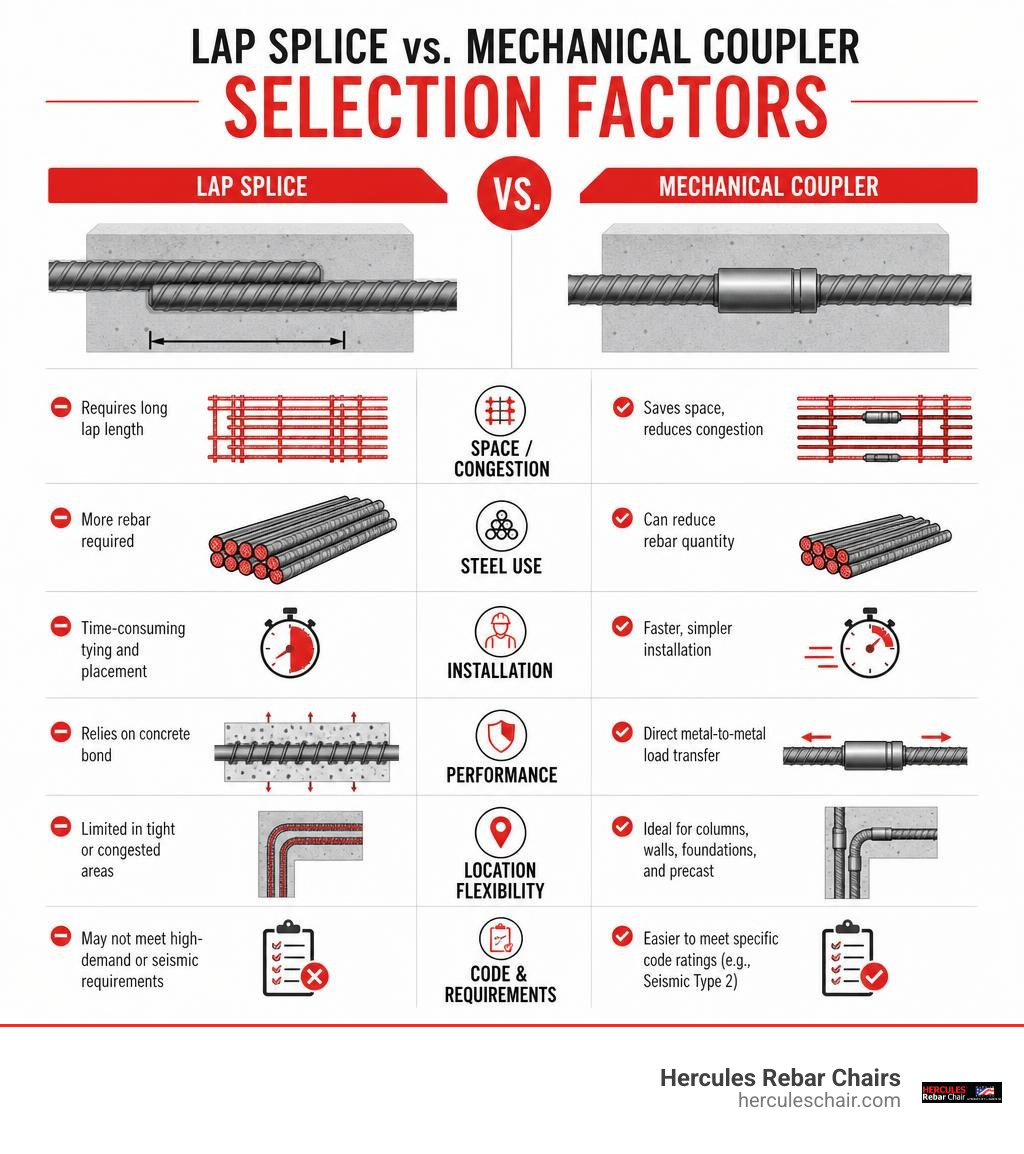
They are especially useful in crowded columns, walls, foundations, and precast connections where lap splices add too much steel and make concrete placement harder. Mechanical butt splices can also reduce steel use, with reported savings ranging from about 11% for #5 bar to 140% for #10 bar compared with lap splices.
The key is not to treat every coupler as interchangeable. A threaded coupler may need prepared bar ends and a bar that can rotate. A shear-bolt coupler can suit repair work or fixed bars. Seismic and high-demand locations may require an ACI 318 Type 2 splice rather than a Type 1 splice.
I am Jordan Harris, a Tennessee-licensed Professional Engineer with civil and structural engineering training and five years of experience on large concrete and steel projects. At Hercules Rebar Chairs, I bring that field-focused perspective to practical decisions involving steel reinforcement couplers, reinforcement support, and reliable concrete placement.
Types and Mechanics of Steel Reinforcement Couplers
Understanding how mechanical splices transfer forces is the first step toward choosing the right connection. Unlike lap splices, which rely entirely on concrete bond stress to transfer load across overlapping bars, mechanical couplers form a direct, inline butt joint. This continuous load transfer handles both tension and compression, maintaining structural ductility and preventing brittle bond failures under heavy cyclic stress. With splicing made simple with these top rated rebar couplers, crews can streamline steel placement without dealing with the cumbersome rebar congestion caused by long lap zones.
Threaded and Taper-Threaded Splice Systems
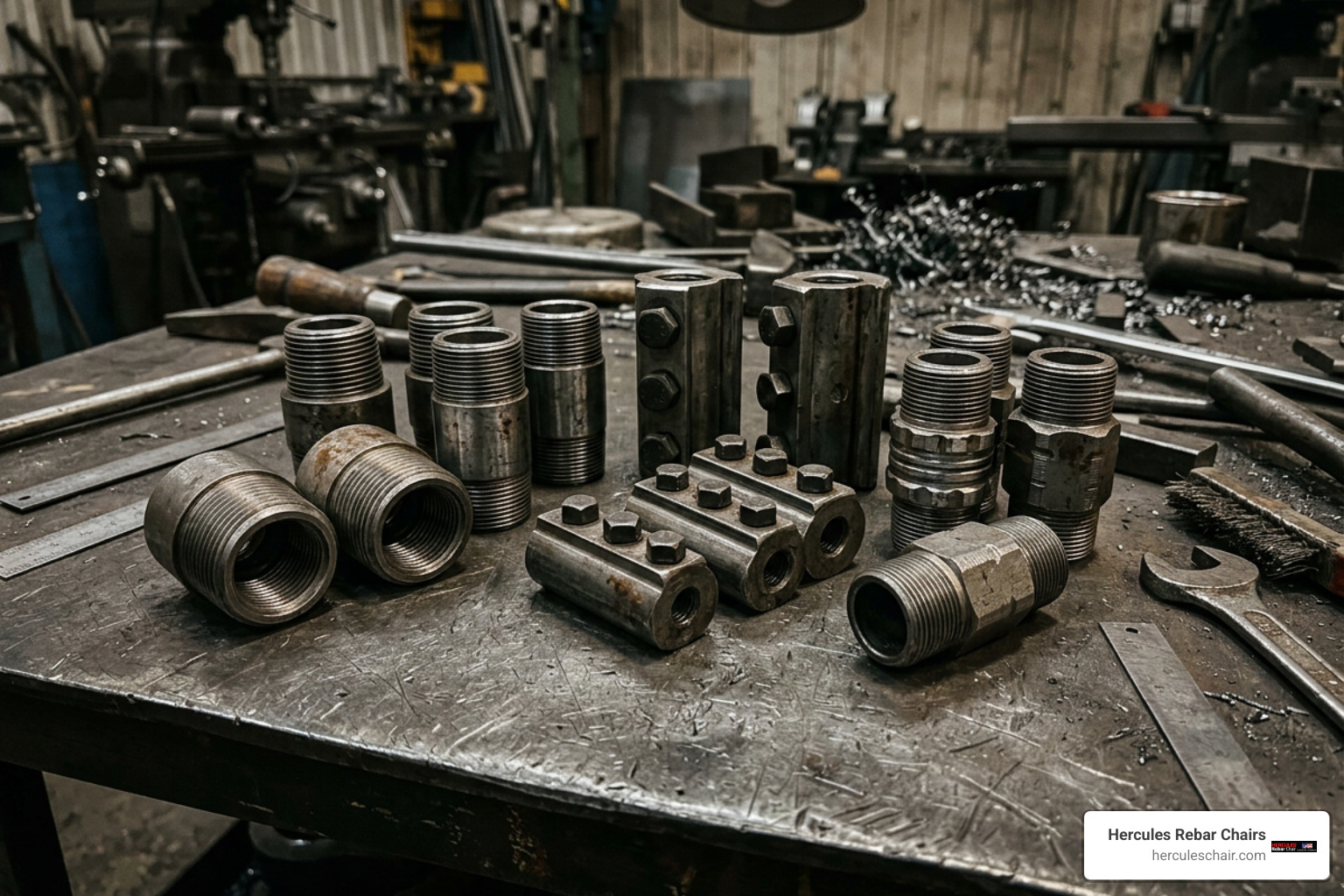
Threaded connections represent the most common mechanical splicing approach on commercial and infrastructure jobsites. These systems generally fall into two categories: taper-threaded and parallel-threaded sleeves.
Taper-threaded couplers use matching conical threads cut or rolled onto the reinforcing bar ends. The tapered profile allows the coupler to spin freely over the bar until the threads engage, requiring as little as four to five turns to seat fully. In standard assemblies, an initial hand-tight torque of roughly 5 ft-lbs achieves positive engagement before final tightening.
Parallel-threaded systems often utilize cold forging or bar upsetting before threading. This upsetting process expands the cross-sectional area of the bar end so that thread cutting does not reduce the net tensile area below nominal dimensions. Understanding why threaded rebar couplers and why they are the industry standard helps estimators and engineers specify connections that eliminate slip while preserving the bar’s full yield capacity.
Shear-Bolt and Set Screw Couplers
When bar ends cannot be threaded in a fabrication shop or rotated on site, shear-bolt couplers offer a dependable alternative. These sleeves feature internal serrated grip rails and heavy-duty lock shear bolts.
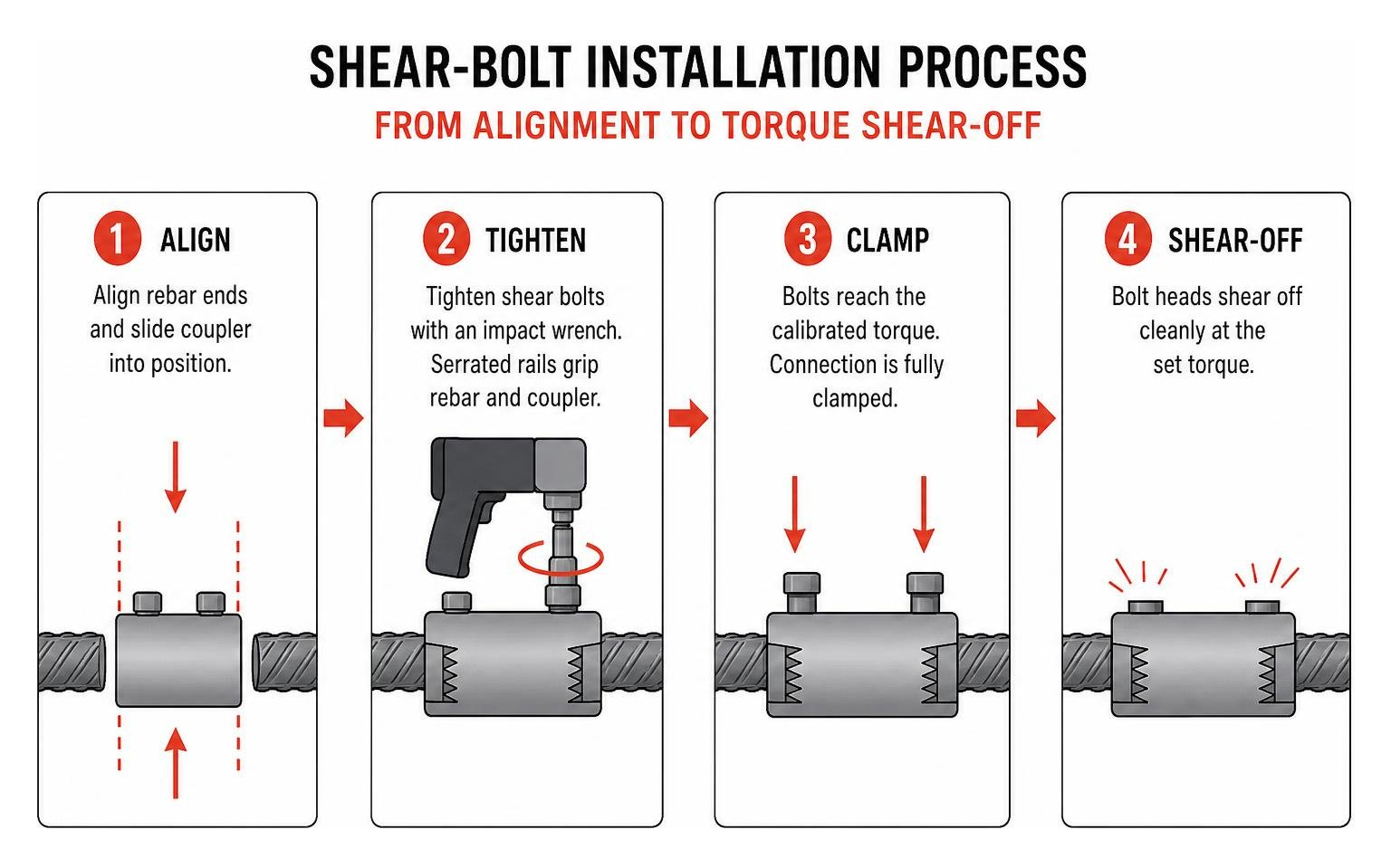
As an installer tightens the bolts using an electric or pneumatic impact wrench, the serrated rails bite into both the rebar deformations and the coupler wall. The bolts are engineered with calibrated break-off points; once the designated clamping torque is reached, the bolt heads shear off cleanly. Because they require zero bar-end threading or pre-fabrication, mechanical couplers for reinforcement bars that never let go are ideal for structural repair, field retrofits, and splicing into existing bent or cut rebar dowels.
Grouted Sleeves and Weldable Connectors
Precast elements and composite structural steel designs often demand specialized coupler geometries:
- Grouted Sleeves: Common in precast column-to-foundation and wall-to-wall joints. The sleeve features a wide internal cavity filled with high-strength, non-shrink structural grout, which easily accommodates precast placement tolerances and slight bar misalignments.
- Weldable Half-Couplers: Used to connect reinforcing bars directly to structural steel embed plates, piling caps, or composite columns. These thick-walled steel tubes feature a factory-machined 20-degree chamfer on the base to facilitate certified structural welding, while the open end houses threads or shear bolts for the rebar splice.
Reviewing the contractors guide to rebar couplers and sleeves ensures that your field teams understand the distinct labor and equipment requirements of each mechanical connection.
Key Factors for Selecting Compatible Couplers
Selecting a compatible coupler requires balancing rebar dimensions, metallurgical properties, and site handling constraints. Using the wrong coupler type can result in slippage, bar pull-out, or reduced concrete clearance.
| Coupler Type | Bar Size Range | Primary Installation Tooling | Compatible Rebar Grades | Best Application |
|---|---|---|---|---|
| Taper-Threaded | #4 to #18 (13mm–57mm) | Pipe wrench, hand torque wrench | ASTM A615, A706 (Grades 60, 75, 80) | New cast-in-place columns, beams, mats |
| Parallel-Threaded (Upset) | #4 to #18 (13mm–57mm) | Bar-end cold forging machine, threading lathe, wrench | ASTM A615, A706, A1035 (Grades 60 to 100) | High-strength seismic shear walls, high-rise cores |
| Shear-Bolt / Set Screw | #3 to #18 (10mm–57mm) | 1-inch pneumatic/electric impact wrench (1000 Nm rating) | Any grade/profile (ASTM A615, A706, smooth bar) | Structural repair, bridge retrofits, short bar extensions |
| Grouted Sleeve | #4 to #18 (13mm–57mm) | Grout pump, mixing paddle, non-shrink grout | ASTM A615, A706 (Grades 60, 75, 80) | Precast element connections, column base plates |
| Weldable Coupler | #4 to #18 (13mm–57mm) | Certified arc welder, impact/torque wrench | ASTM A108 CD 8620 body to A615/A706 bar | Rebar-to-structural-steel embedment plates |
Matching tools to connection systems is critical for productivity, and referencing a comprehensive guide to comparing rebar connection tools will keep your tooling strategy aligned with project requirements.
Sizing and Specifying Steel Reinforcement Couplers
Sizing must account for imperial and metric bar designations across ASTM A706 Grade 60 (weldable, ductile alloy) and ASTM A615 Grade 75 steels. When step-downs occur in multi-story columns—such as transitioning from a #14 bar in a lower level to a #11 bar above—transition couplers eliminate the need for complicated lap bending.
Beyond bar diameter, you must evaluate the coupler’s external diameter against minimum concrete clear cover requirements. A bulky sleeve increases the effective profile of the rebar assembly, which can compromise the protective concrete envelope if chairs and supports are not properly sized. Consulting our guide on how to master the rebar splice length formula highlights how mechanical joints simplify design calculations while requiring strict attention to spatial clearances.
Positional vs Standard Rotation Connections
Standard couplers require that at least one of the bars being spliced can be rotated freely along its longitudinal axis during assembly. However, in heavily reinforced structures like diaphragm walls, pre-tied column cages, and right-angle bent dowels, rotating a 40-foot rebar cage is physically impossible.
In these conditions, positional couplers solve the problem. These multi-piece assemblies feature internal and external threading or sliding collar mechanisms that allow the sleeve to bridge the gap without rotating either bar. Many advanced positional systems incorporate visual engagement indicators, allowing site inspectors to verify full engagement at a glance. Exploring reinforcing bar couplers making ends meet in concrete construction provides deeper insight into handling non-rotatable bars across complex formwork geometry.
Structural Performance, Testing, and Building Code Compliance
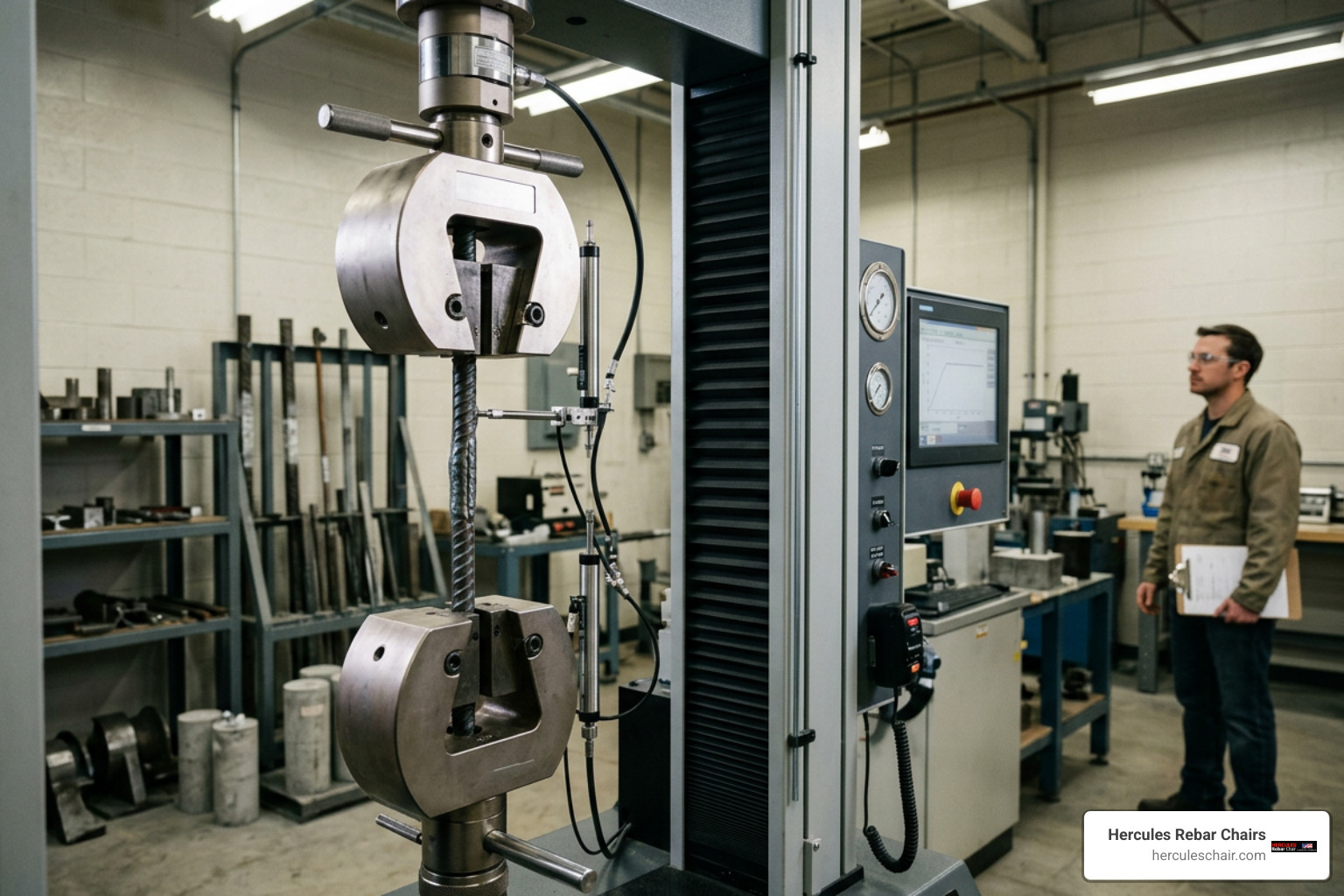
State departments of transportation and municipal building authorities maintain strict qualification criteria for mechanical splices. For example, the state standard for Steel Reinforcing Couplers | Caltrans establishes performance categories that separate splices into Service Splices and Ultimate Butt Splices.
Meeting the Authorization Criteria for Steel Reinforcing Couplers List – CA.gov involves rigorous static tension testing, cyclic tension-compression fatigue testing, and slip measurements. Under standard testing protocols, couplers must exhibit total plastic slip under 0.1 mm to ensure concrete crack control under service loads. Contractors can explore a comprehensive guide to bar splices in construction for a complete breakdown of quality assurance frameworks.
Code Requirements for Steel Reinforcement Couplers in Seismic Zones
Under ACI 318-19, mechanical couplers are categorized into two structural classes:
- Type 1 Mechanical Splices: Must develop at least 125% of the specified yield strength ($1.25 Ab fy$) of the spliced rebar in tension or compression. Type 1 splices are permitted in non-critical regions but are restricted from yielding regions or plastic hinge zones during seismic events.
- Type 2 Mechanical Splices: Must develop the full specified tensile strength ($Ab fu$) of the bar. Because they ensure that rebar ductility is maintained throughout high-inelastic cyclic deformation, Type 2 couplers are permitted anywhere in structural elements, including beam-column connections and ductile shear walls.
To prevent local stiffness concentrations, design codes often enforce a staggering rule, requiring adjacent mechanical splices in tension ties or critical seismic zones to be staggered by a minimum of 30 inches (750 mm). Understanding how mechanical couplers keep your reinforcement steel together is essential for building code-compliant seismic assemblies.
Sustainability and Material Savings in Modern Construction
Switching from lap splicing to mechanical couplers delivers measurable environmental and economic benefits:
- Steel Tonnage Reduction: Eliminating overlapping lap lengths saves up to 140% in rebar weight on large #10 to #18 bars.
- Embodied Carbon Savings: By cutting excess steel manufacturing and transportation weight, mechanical splicing can yield up to a 90% reduction in splice-related $CO_2$ emissions.
- Site Efficiency: Lighter rebar cages reduce crane hook time and simplify concrete placement around dense mats.
Discover why every engineer loves a good rebar joint coupler when balancing sustainability targets with fast-track construction schedules.
Best Practices for Jobsite Installation and Quality Control
A mechanical splice is only as reliable as its field installation. Whether working with taper-threaded sleeves or shear-bolt systems, crews should adhere to a structured quality control workflow:
- Inspect Threads and Protect Bar Ends: Ensure thread protectors remain in place until the moment of connection. Clean off any mud, grit, or concrete slurry using a stiff wire brush.
- Verify Center Stop Pins: On shear-bolt assemblies, check through the inspection port to confirm the rebar is fully seated against the internal stop pin.
- Follow Sequential Tightening: When installing shear-bolt couplers, tighten bolts progressively from the center outward toward the ends. For heavy-duty models, employ an alternating pattern—similar to tightening automotive wheel lug nuts—using a pneumatic wrench delivering at least 100 psig and 185 CFM airflow.
- Confirm Torque Rupture: Verify that all shear bolt heads have snapped off cleanly. If a head fails to break, measure the unruptured bolt height ($H$) against manufacturer tables to confirm adequate penetration.
- Maintain Concrete Cover with Stable Chairs: Because couplers have a larger outer diameter than the bar, standard concrete cover is easily compromised. Heavy, multi-bar spliced cages can deflect under dynamic foot traffic or concrete pouring loads.
At Hercules Rebar Chairs, our heavy-duty, highly visible red concrete supports are engineered to hold spliced rebar assemblies securely at their specified elevations. With over 14 million units sold across the United States, our chairs ensure that bulky mechanical sleeves do not sag against the formwork, protecting structural integrity and ensuring code compliance across every pour.
Frequently Asked Questions About Steel Couplers
What is the difference between Type 1 and Type 2 mechanical couplers under ACI 318?
Under ACI 318-19, a Type 1 mechanical coupler must develop at least 125% of the bar’s specified yield strength ($1.25 Ab fy$). A Type 2 coupler must meet the Type 1 threshold and also develop the full specified tensile strength ($Ab fu$) of the reinforcing bar. Because Type 2 couplers prevent brittle connection failures during earthquake loading, building codes permit their use within seismic plastic hinge zones, whereas Type 1 couplers are restricted from these yielding regions.
Can mechanical couplers be used on epoxy-coated rebar?
Yes, but special precautions are required. Most mechanical couplers are evaluated by default on uncoated, black reinforcing steel. When installing couplers on epoxy-coated rebar, state DOT specifications (such as Caltrans Section 52) typically require an approved secondary corrosion protection covering—such as heat-shrinkable sleeves or specialized epoxy touch-up coatings—to seal the bare mechanical interface against moisture and chloride intrusion.
How do shear-bolt couplers confirm proper installation torque?
Shear-bolt couplers feature calibrated, break-away bolt heads designed to shear off automatically when the exact design clamping torque is achieved. This provides immediate visual quality control for inspectors. If a bolt head does not snap off due to tool limitations, quality control teams can verify compliance by measuring the remaining unruptured bolt height ($H$) with calipers to ensure the bolt has driven the internal gripping rails to the correct embedment depth.
Conclusion
Choosing the right mechanical splice system is essential for maintaining load path continuity, reducing reinforcement congestion, and accelerating construction schedules. By evaluating bar sizes, threading methods, rotational limits, and seismic code classifications early in the design phase, structural engineers and concrete contractors can eliminate costly field rework.
To guarantee that your spliced steel cages maintain their specified concrete cover and resist deflection during the pour, pair your rebar assemblies with industry-proven concrete supports. Explore rebar couplers your ultimate guide to connecting steel strong to ensure your reinforcement details stay strong, stable, and code-compliant from layout to final inspection.