

Why Height and Stability Matter in Deep Slabs
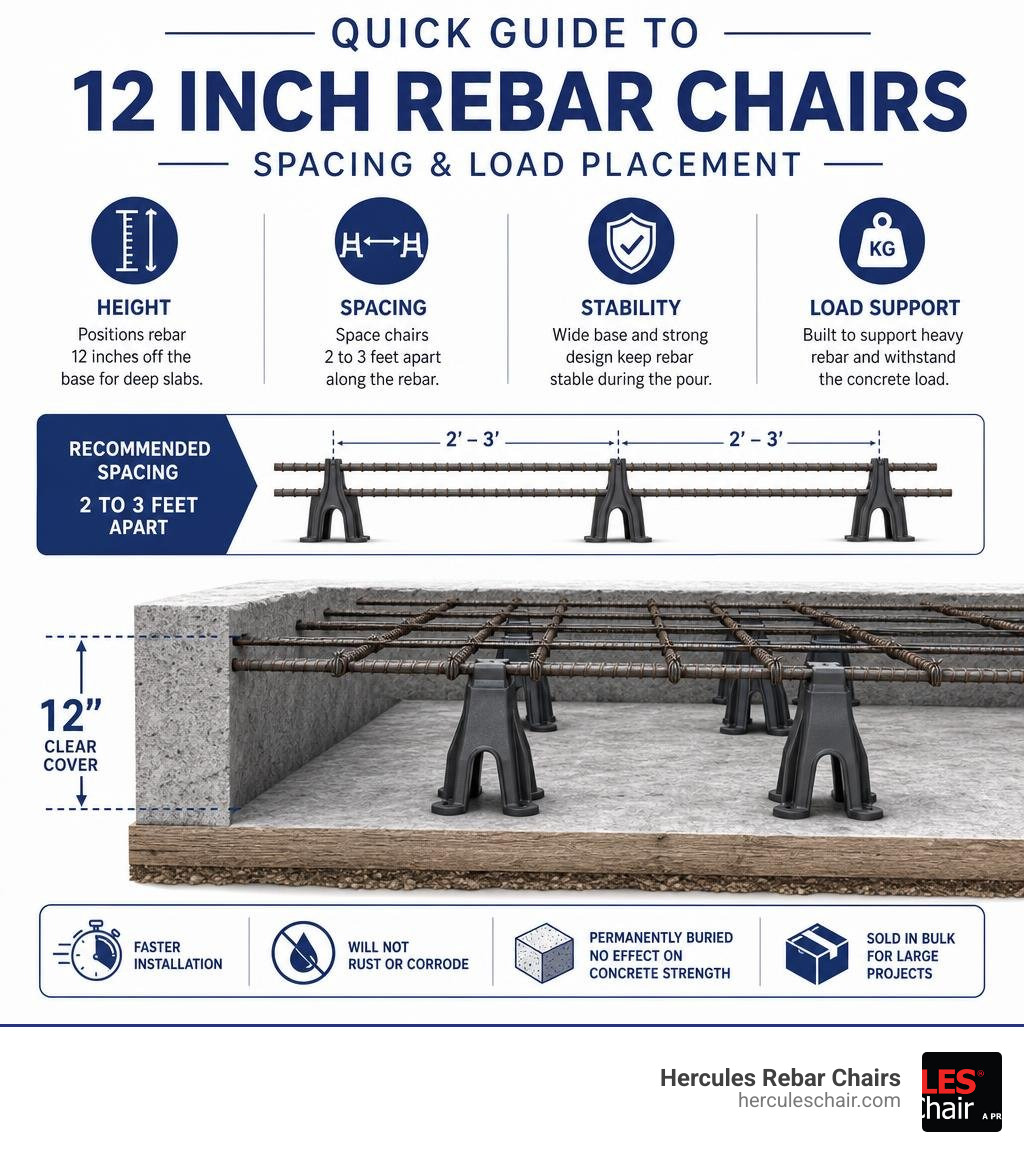
When pouring thick concrete slabs, maintaining the correct elevation of your steel reinforcement is critical for structural safety. Using 12 inch rebar chairs is the fastest and most reliable way to hold heavy rebar grids or top steel mats exactly 12 inches off the ground or formwork before the pour.
Quick Guide: 12 Inch Rebar Chairs at a Glance
- Primary Use: Elevating heavy rebar mats in deep slabs, bridge decks, and thick foundations.
- Recommended Spacing: Space chairs 2 to 3 feet apart along the rebar to prevent sagging under heavy loads.
- Key Benefit: Heavy-duty plastic chairs eliminate wire tying, will not rust or corrode, and remain permanently buried in the concrete without affecting its strength.
- Pack Sizes: Typically sold in bulk boxes of 50 to 100 units, or pallets of 600 units for large commercial projects.
As a structural engineer and the product development lead at Hercules Rebar Chairs, I have spent years designing and testing high-capacity concrete supports, including heavy-duty 12 inch rebar chairs built for demanding commercial projects. My background in civil engineering helps me understand the immense pressure these tall supports must withstand when the concrete starts to flow.
When you are pouring a massive deep slab—whether it is a heavy industrial floor, a bridge deck, or a commercial foundation—the depth of the concrete slab itself introduces severe structural requirements. Steel reinforcement cannot simply sit at the bottom of the pour. It must be positioned precisely within the slab’s cross-section to handle tensile stresses. If the steel sinks even an inch lower than specified, the load capacity of the entire slab drops dramatically.
With tall supports like 12 inch rebar chairs, maintaining stability during the pour is a major engineering challenge. Standard, flimsy chairs can easily tip over or collapse under the weight of heavy rebar mats and the dynamic forces of flowing concrete. That is why we focus on creating ultra-stable, high-capacity designs that ensure your steel stays exactly where it belongs.
Understanding the Role of 12 Inch Rebar Chairs in Deep Slabs
In deep concrete slabs, the placement of reinforcing steel is a game of millimeters. Achieving the perfect concrete cover—the distance between the outer surface of the concrete and the embedded rebar—is vital to prevent structural failure. If the rebar is too close to the surface, it is vulnerable to water penetration, rust, and eventual spalling. If it is too deep, the structural design is compromised.
For projects requiring a thick slab, a 12-inch elevation is often the magic number to support upper steel mats. To understand why these supports are so critical, you can read about Why Your Slab Needs Rebar Chair Supports to see how they prevent structural failures.
Using high-quality spacers is the only way to guarantee that your reinforcement grid remains suspended at the exact design height throughout the entire pouring and curing process. For a broader look at how these systems function across different projects, check out The Ultimate Guide to Rebar Chairs and Spacers.
Primary Purpose of 12 Inch Rebar Chairs in Heavy Construction
In heavy civil and commercial construction, projects rarely rely on a single grid of rebar. Instead, they utilize “double mats”—a lower grid of steel to handle positive bending moments and an upper grid to handle negative bending moments.
12 inch rebar chairs are primarily used to support this upper mat of steel. They are essential in:
- Bridge Decks: Where heavy dynamic loads require massive double-reinforced concrete slabs.
- Foundation Footings: Supporting thick structural grade beams and columns.
- Thick Industrial Slabs: Designed to support heavy machinery, warehouses, and constant forklift traffic.
To choose the perfect chair for these massive projects, you can follow our guide on How to Determine Bar Chair Sizes in 3 Easy Steps to match your exact slab thickness with the correct support height.
Key Specifications and Load Capacities
When dealing with a 12-inch elevation, the physics of load distribution change. A taller chair is naturally more susceptible to lateral forces and buckling. Therefore, the specifications of a 12-inch high chair must be significantly more robust than those of a standard 2-inch or 3-inch chair.
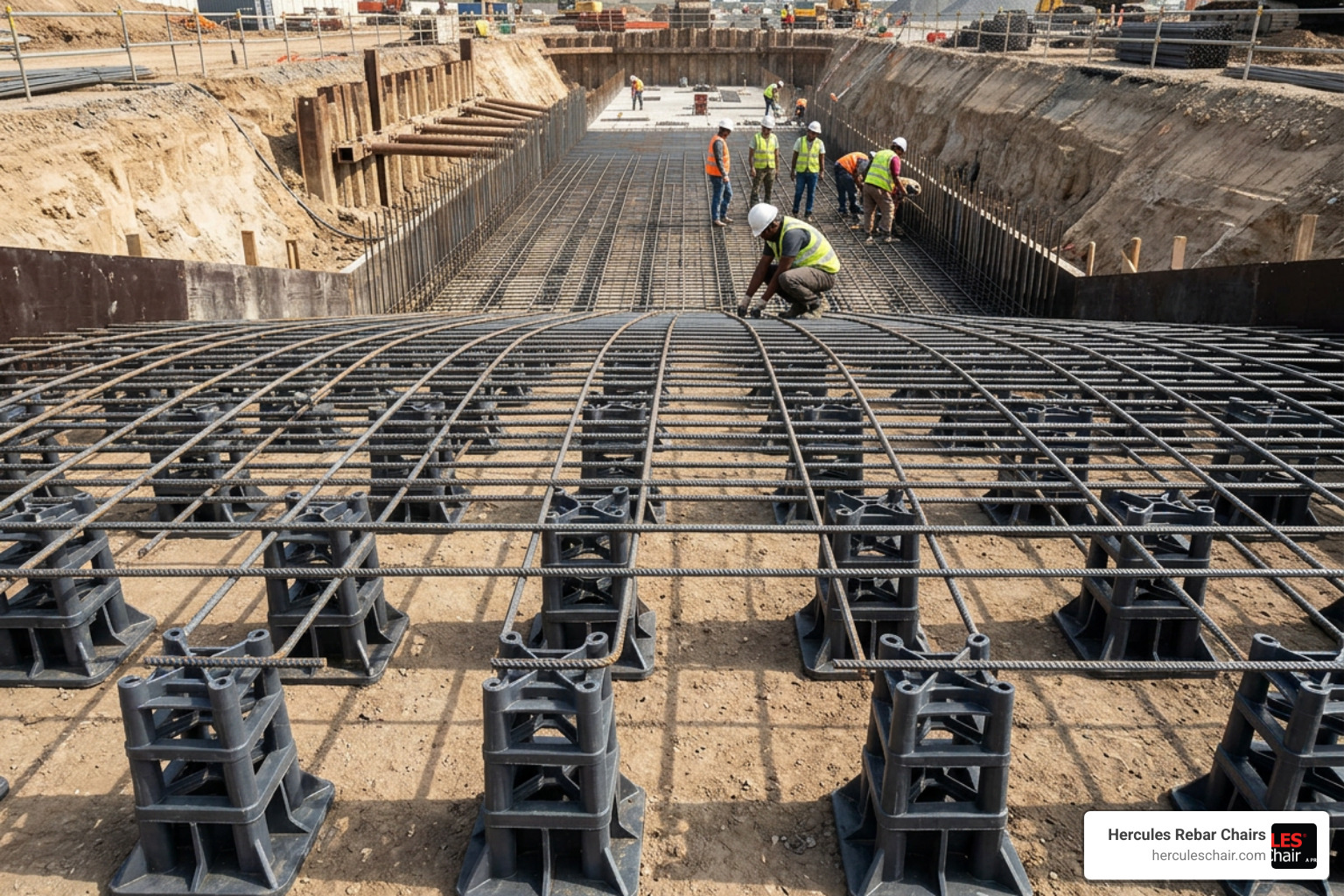
- Material Composition: Industrial-grade polypropylene copolymer or heavy-duty polyethylene. These materials are formulated to withstand extreme impact, UV exposure, and cold weather without becoming brittle.
- Load Capacity: High-quality plastic high chairs are engineered to support substantial weight. For example, heavy-duty 4-leg or 6-leg plastic high chairs can support loads ranging from 600 lbs to over 800 lbs per chair.
- Rebar Compatibility: Tall chairs are designed with versatile cradles or snap-in seats. They typically accommodate rebar sizes from #3 (3/8″ diameter) up to #5 (5/8″ diameter) or even #6 (3/4″ diameter) to handle heavy structural steel.
- Packaging and Pallet Volumes: Because deep slab projects are high-volume, these chairs are packaged for industrial scale. For example, standard 12″ to 12-1/4″ high chairs are typically sold in boxes of 50, with 12 boxes per pallet (totaling 600 units per pallet) to meet commercial demands.
Why Heavy-Duty Plastic High Chairs Outperform Traditional Alternatives
In the past, contractors relied heavily on metal high chairs or wire bolsters to support upper rebar mats. However, as concrete technology has advanced, heavy-duty plastic has quickly become the industry standard for deep slabs.
To understand how different heights and materials compare across various projects, refer to The Ultimate Guide to Rebar Chairs Types Uses and Sizing for Concrete Slabs.
Below is a detailed breakdown of how heavy-duty plastic high chairs compare to traditional metal wire supports:
| Feature | Heavy-Duty Plastic High Chairs | Traditional Metal Supports |
|---|---|---|
| Corrosion Resistance | 100% Rust-proof; impervious to chemicals and moisture | Highly susceptible to rust; requires plastic coating |
| Installation Speed | Fast snap-in design; no wire tying required | Slow; requires manual wire tying to secure rebar |
| Weight | Extremely lightweight; easy to transport in bulk | Heavy; labor-intensive to move around the job site |
| Concrete Flow | Wide, open design allows maximum aggregate flow | Can cause voids if aggregate gets trapped in dense wire |
| Cost Efficiency | Highly economical; reduces labor costs significantly | Expensive; high material costs and slow labor |
| Thermal Expansion | Matches concrete expansion, preventing micro-cracks | Expands differently than concrete, risking internal stress |
Benefits of Plastic 12 Inch Rebar Chairs
Heavy-duty plastic chairs offer a range of unique benefits that make them ideal for deep slabs:
- Non-Corrosive Properties: Plastic will never rust. In coastal areas, wastewater facilities, or chemical plants, using plastic ensures that moisture penetrating the concrete will not cause the support system to corrode and fail.
- Snap-In Design: Many premium plastic chairs feature a snap-and-lock mechanism. Instead of spending hours tying rebar to the chairs with steel wire, workers can simply push the rebar down into the chair’s seat until it snaps into place. For smaller elevations, heavy-duty plastic chairs showcase how this snap-in feature saves massive amounts of labor time.
- Maximum Concrete Flow: Tall plastic chairs are engineered with wide, open legs and minimal surface area. This ensures that when concrete is poured, the aggregate flows freely around and through the chair, preventing air pockets or structural voids.
- Lightweight Strength: Made from recycled industrial polymers, these chairs are incredibly strong yet lightweight. A single worker can easily carry a box of 50 chairs across a muddy job site, which is physically impossible with heavy metal alternatives.
Overcoming the Limitations of Metal Supports in Deep Slabs
While metal is incredibly strong, using tall metal supports in deep slabs presents several severe risks:
- Rust Bleeding: If a metal chair sits on the vapor barrier or mud slab, moisture can travel up the metal legs over time. This leads to rust, which expands to up to ten times its original volume, causing the surrounding concrete to crack and spall.
- Structural Degradation: Once rust begins on a metal chair, it can spread directly to the main structural rebar grid, compromising the entire foundation.
- Tipping and Sinking: Metal wire chairs with narrow, pointed feet can easily puncture vapor barriers or sink into soft subgrades (like sand or loose dirt) under heavy loads.
To protect your project from these structural hazards, you can read Dont Let Your Rebar Sink a Guide to Concrete Chairs to learn how to keep your reinforcement perfectly positioned.
Spacing and Installation Guidelines for Tall Supports
Proper installation is just as important as choosing the right chair. Because 12 inch rebar chairs are exceptionally tall, any improper spacing or alignment can lead to the chairs buckling or tipping under the weight of the concrete pour.

When setting up your grid, it is essential to select the right support height for your specific slab design. For a detailed breakdown of choosing the right height for different slab thicknesses, check out From 4 Inch to 6 Inch Choosing the Right Rebar Chair Support.
Recommended Spacing and Quantity Estimation
For 12-inch supports, the industry standard is to place chairs 2 to 3 feet apart along the length of the rebar.
To calculate the exact number of chairs you need for your project, follow this simple formula:
- Determine the Grid Area: Calculate the total square footage of your rebar grid.
- Apply the Spacing Rule: For heavy structural loads, assume one chair every 6 to 9 square feet (which equates to roughly 2.5-foot spacing in both directions).
- Add a Safety Margin: Always add 5% to 10% to your total count to account for irregular edges, double-reinforcement zones, and heavy walking paths where extra support is needed.
For a deeper dive into sizing and spacing across various project types, read Concrete Bar Chair Sizes for Every Project.
When purchasing, keep in mind that high-volume projects are best served by bulk packaging. High-quality 12-inch chairs are typically sold in cartons of 100 to make bulk commercial ordering straightforward and cost-effective.
Frequently Asked Questions About Tall Rebar Supports
Do you leave 12-inch rebar chairs in the concrete after pouring?
Yes, rebar chairs are designed to be permanently left inside the concrete after it is poured. Because they are made from inert materials like polypropylene, they do not react chemically with the concrete.
The concrete flows completely around the chair, locking it into the cured matrix. This permanent placement does not compromise the structural integrity of the slab; in fact, by keeping the steel perfectly positioned, it guarantees the slab meets its design strength. You can explore a deep dive into this topic in Chair-ish Your Concrete Everything You Need to Know About Rebar Support Systems.
What projects require a 12-inch clearance height?
A 12-inch clearance height is typically required for massive concrete structures, including:
- Commercial Foundations: High-rise buildings, heavy industrial warehouses, and large distribution centers.
- Civil Infrastructure: Bridge decks, highway overpasses, and water treatment facilities.
- Thick Slabs-on-Grade: Designed to handle heavy point-loads from machinery or storage racks.
To learn more about finding the perfect height balance for your project—ensuring it is neither too high nor too low—read The Goldilocks Guide to Concrete Bar Chair Sizes Not Too Big Not Too Small.
Where can I buy high-quality 12-inch rebar chairs in bulk?
For large-scale commercial projects, you can purchase tall rebar chairs through commercial concrete accessory distributors or major building supply retailers. For example, high-quality 12-inch rebar chairs are widely available in bulk cartons of 100, which provides a convenient way to procure necessary quantities for local jobs. For larger industrial projects, ordering by the pallet (typically 600 units) directly from commercial suppliers is highly recommended to secure the best freight rates and bulk pricing.
Conclusion
When it comes to deep slabs, you cannot afford to compromise on structural integrity. Selecting the right 12 inch rebar chairs ensures that your heavy rebar grids remain perfectly positioned, code-compliant, and stable throughout the entire concrete pour.
At Hercules Rebar Chairs (T.J. Harris Co.), we are proud to be America’s #1 concrete support manufacturer, with over 14 million units sold across the USA. Our signature red, heavy-duty plastic chairs are engineered to save you time and money on the job site while ensuring absolute code compliance. Whether you are pouring a massive commercial foundation in Texas, a bridge deck in California, or an industrial floor in Ohio, our products are designed to deliver unmatched strength and stability.
Ready to secure your next major pour? Explore our full range of concrete support products to find the perfect heavy-duty solutions for your project.