

Why Getting Concrete Slab Thickness Right Matters From the Start
Getting concrete slab thickness right is one of the most important decisions on any pour — and one of the most commonly underestimated.
Here’s a quick reference for the most common applications:
| Application | Recommended Thickness |
|---|---|
| Residential patio / walkway | 4 inches |
| Garage floor (passenger vehicles) | 4–5 inches |
| Driveway (SUVs / light trucks) | 5–6 inches |
| Commercial floor (retail, light traffic) | 5–6 inches |
| Warehouse / industrial (forklifts) | 6–8 inches |
| Heavy industrial / loading areas | 8–12+ inches |
| Parking garage (elevated deck) | 8 inches+ |
These are starting points. The right thickness for your project depends on soil conditions, expected loads, reinforcement strategy, and local code requirements — all of which we’ll cover in detail below.
A slab that’s too thin cracks, settles, and fails under load. A slab that’s too thick wastes concrete, adds unnecessary dead weight, and drives up costs without adding real value. Neither outcome is good. The goal is matching thickness to actual demand — not guessing, and not defaulting to “thicker is always safer.”
I’m Jordan Harris, a licensed Professional Engineer with a master’s degree in structural engineering and five years of hands-on experience designing large-scale concrete structures. At T.J. Harris Company, I work daily with contractors on concrete slab thickness decisions and the rebar support systems that make those designs perform in the field. In the sections ahead, I’ll break down the numbers, the engineering principles, and the practical job-site realities that determine the right slab thickness for any application.
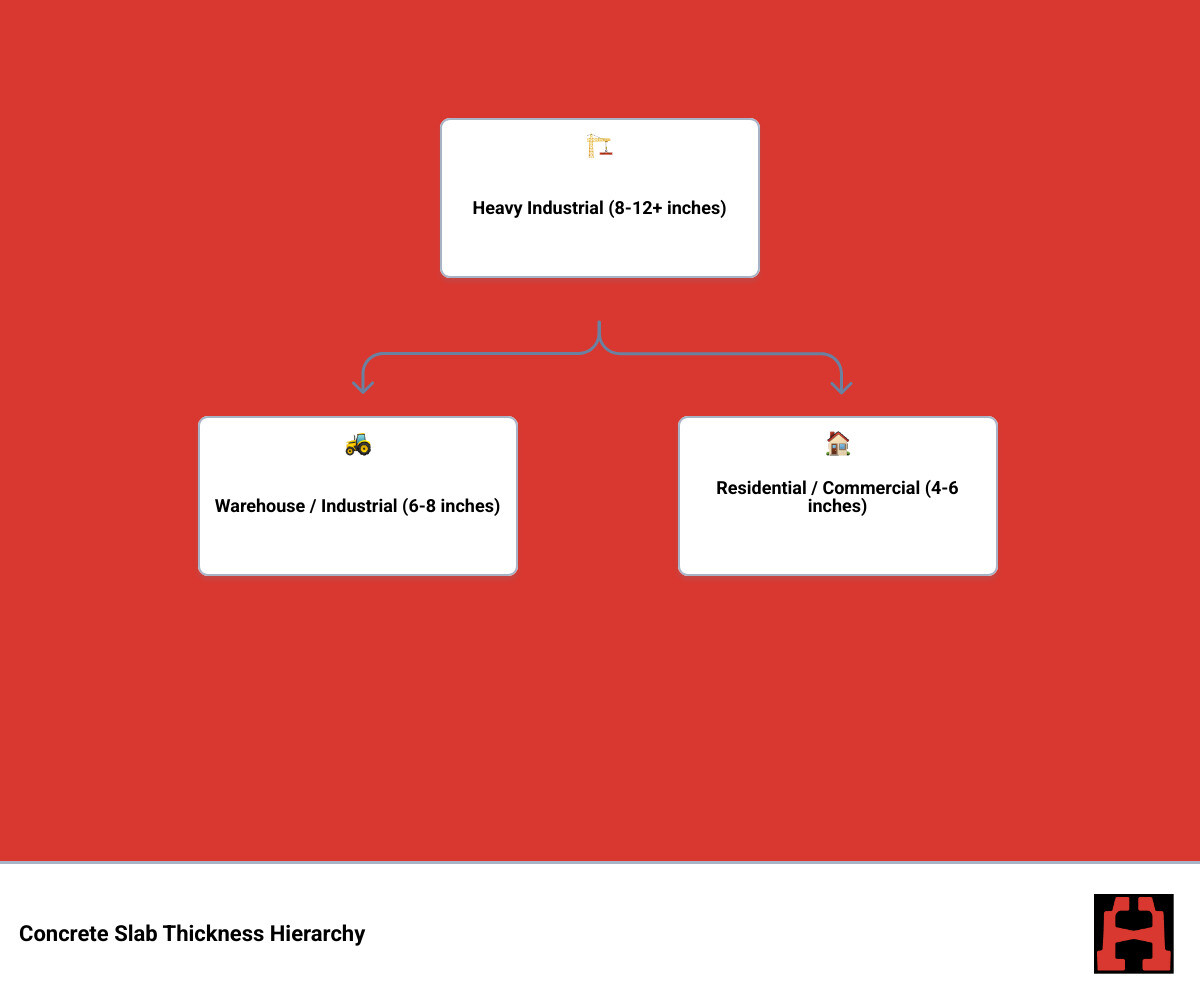
Easy concrete slab thickness glossary:
Standard Concrete Slab Thickness for Common Applications
For most projects, we start by matching the slab to the use case, then adjust for soil, climate, reinforcement, and code. That is much smarter than copying what the neighbor did or trusting the timeless job-site phrase, “Yeah, 4 inches should be fine.”
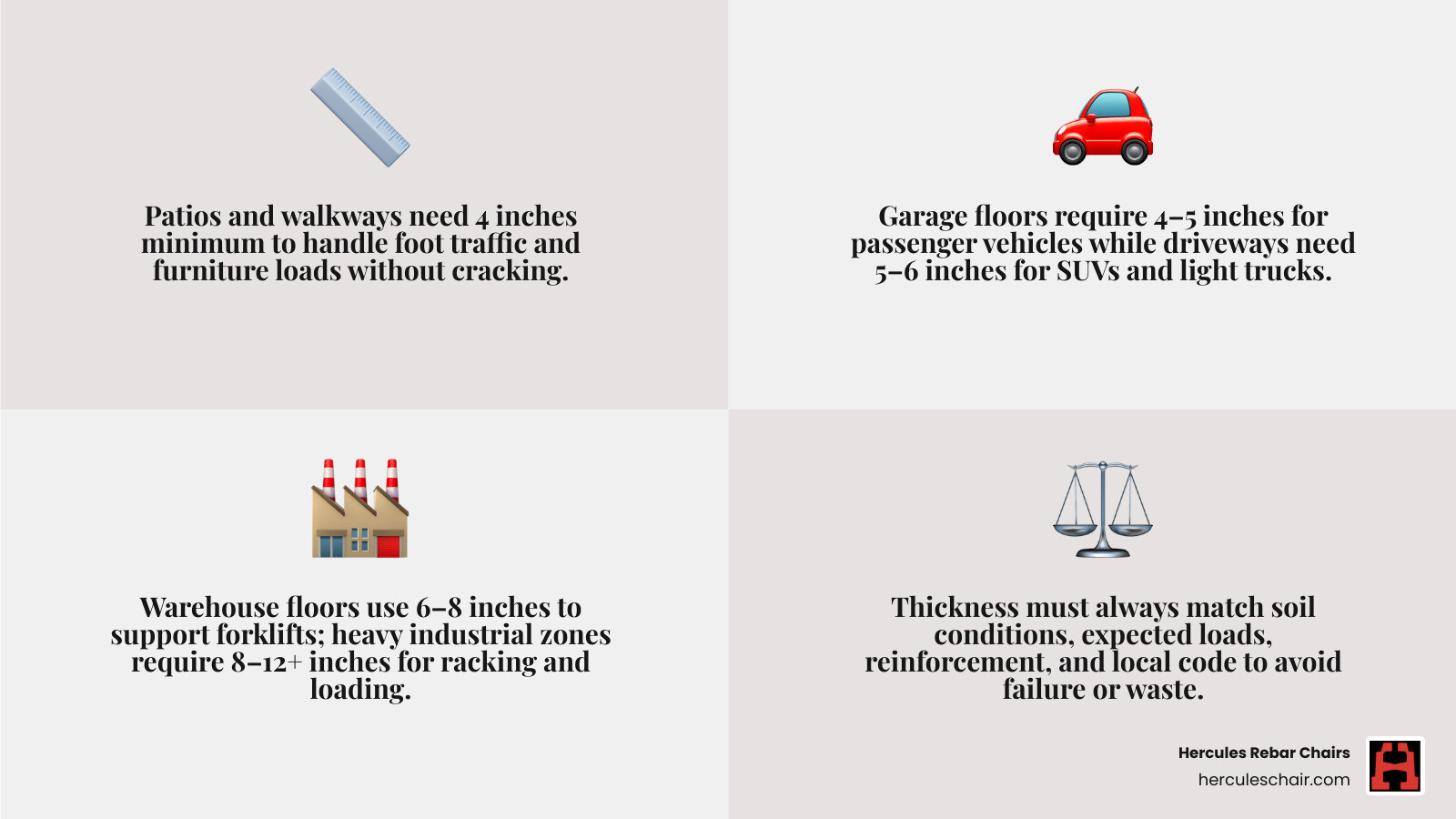
| Application | Common Thickness | Typical Use |
|---|---|---|
| Patio / walkway | 4 inches | Foot traffic, furniture |
| Garage floor | 4-5 inches | Passenger vehicles |
| Residential driveway | 5-6 inches | SUVs, pickups, light trucks |
| Retail / light commercial | 5-6 inches | Light traffic, moderate loads |
| Warehouse / industrial | 6-8 inches | Forklifts, pallet jacks, racks |
| Heavy industrial / loading areas | 8-12+ inches | Heavy equipment, high point loads |
| Parking structures | 6-8 inches ground level, 8 inches+ elevated | Vehicle traffic, exposure, structural spans |
For general code context, structural concrete work in the U.S. is commonly tied to ACI and IBC provisions; a public code reference is available in Alabama Building Code Concrete Requirements. If you are planning the pour itself, our Slab-Tastic: How to Build a Concrete Slab Like a Pro guide walks through the field steps.
Residential Patios and Walkways
For a standard backyard patio or walkway, 4 inches is the usual recommendation. That thickness works well for:
- Foot traffic
- Patio furniture
- Grills
- Normal residential use
A typical patio slab should also have:
- 3,000 to 4,000 PSI concrete
- A well-compacted base
- About 3 to 6 inches of gravel beneath the slab
- Control joints spaced appropriately
If the patio will support something heavier, 4 inches stops being the safe default. Hot tubs, outdoor kitchens, masonry fireplaces, or vehicle traffic usually push the slab into the 6 to 8 inch range, often with reinforcement and sometimes with thickened edges or isolated pads at the load points.
A good compromise on many patios is not making the entire slab thicker, but using thickened edges or localized deepened sections where the loads actually occur. That saves concrete while putting strength where it matters.
Driveways and Garage Floors
Driveways and garages live harder lives than patios. Tires create repeated loading, and the weight is concentrated in wheel paths rather than spread evenly.
Typical residential recommendations are:
- 4 to 5 inches for garage floors serving passenger cars
- 5 to 6 inches for driveways with SUVs, pickups, or light trucks
- 6 to 8 inches when heavier trucks, RVs, or trailers are expected
A 4-inch slab on good soil can support roughly 40 to 100 PSF live loads, but wheel loads are more punishing than simple uniform floor loads. That is why driveways often need more thickness than a patio even when they look similar at first glance.
Reinforcement matters here too, but it does not rescue a slab that is fundamentally too thin. We cover that distinction in Why Your 4-Inch Slab Might Not Need Rebar and When It Does.
Commercial and Industrial Facilities
Commercial floors usually begin around 5 to 6 inches and can quickly climb to 8, 10, or 12 inches depending on traffic and equipment.
Common ranges include:
- 5 to 6 inches for retail and light commercial floors
- 6 to 8 inches for warehouses with forklifts and racking
- 8 to 12+ inches for heavy manufacturing, loading docks, and high point loads
Industrial slabs are not governed by thickness alone. Designers also look at:
- Rack leg loads
- Forklift axle loads
- Dynamic loading
- Joint performance
- Curling and shrinkage behavior
- Soil support and drainage
For parking-related slabs, Parking Garage Concrete Slab Specification gives a useful reference point: about 6 inches for standard passenger vehicle slabs at ground level, 7 to 8 inches for light commercial loads, and 8 inches or more for elevated decks.
Engineering Factors: Soil, PSI, and Reinforcement
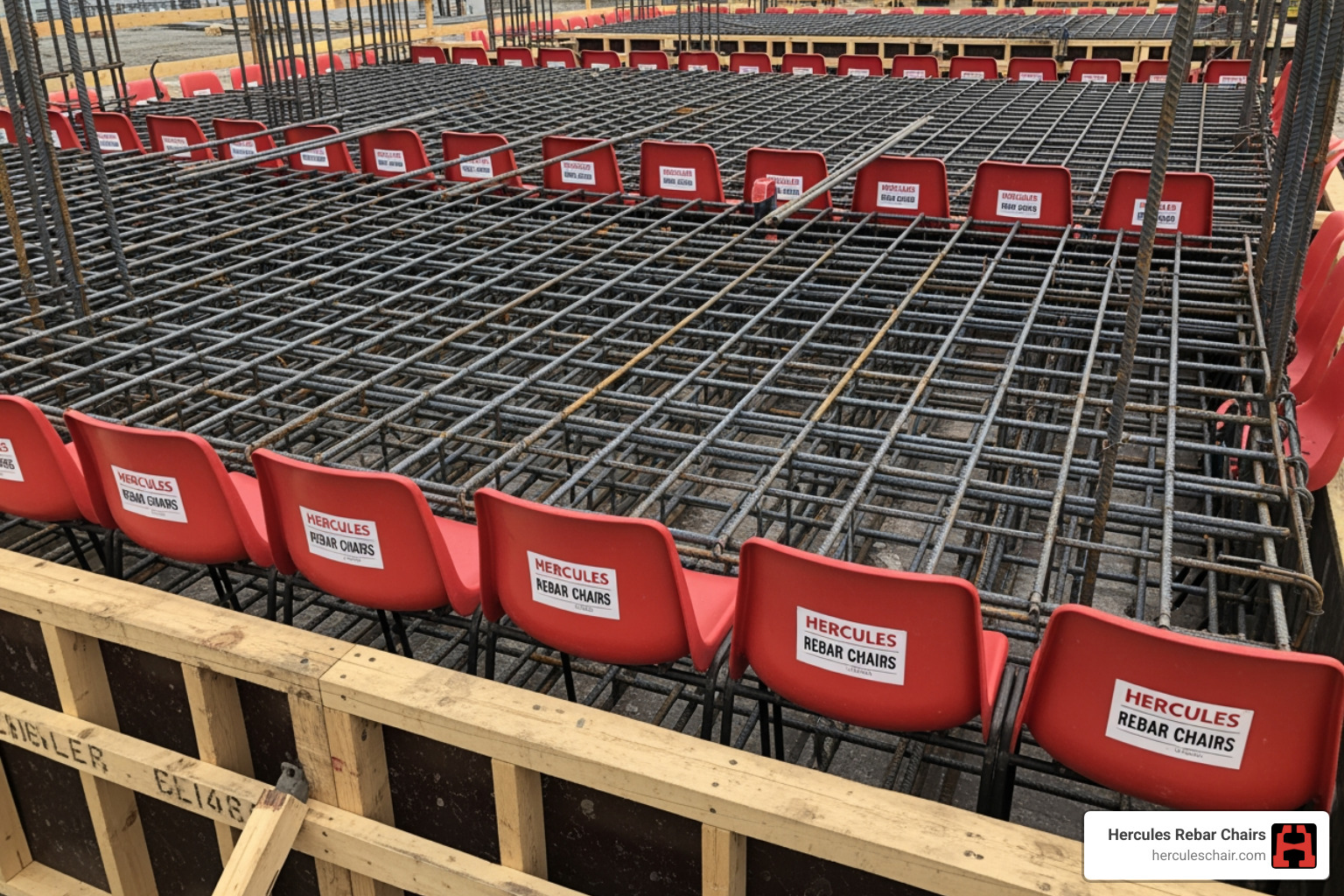
Thickness is only one part of the system. A slab is only as good as what is under it and inside it.
The biggest supporting factors are:
- Soil bearing quality
- Subgrade compaction
- Gravel base depth
- Concrete compressive strength
- Reinforcement type and placement
- Climate exposure
If soil is soft, expansive, wet, or poorly compacted, even a thick slab can crack or settle. Expansive clay is a common headache in many U.S. regions and can heave or shrink enough to distress slabs badly. In freeze-thaw climates, we also need drainage, proper air entrainment, and a stable base so trapped water does not become a slab’s worst winter hobby.
A practical slab-on-grade assembly often includes:
- Compacted subgrade
- 3 to 6 inches of compacted gravel or crushed stone
- Vapor barrier where interior moisture control matters
- Reinforcement supported at the right elevation
- Concrete matched to exposure and load
For reinforcement placement basics, see Slab Strong: Mastering Rebar Placement for Durable Concrete.
How Concrete Slab Thickness Affects Load Capacity
Thicker slabs generally carry more load because they distribute stress over a larger section and reduce flexural demand. That sounds obvious, but the real trick is understanding what kind of load you have.
We usually separate loads into:
- Uniform loads, like people or stored goods spread out
- Point loads, like rack posts or hot tub legs
- Dynamic loads, like forklifts or rolling vehicles
- Dead loads, including the slab’s own weight
For suspended floors, serviceability often governs thickness even more than bending strength. In plain English: a slab that is technically strong enough can still be too thin because it deflects too much. That is why span-to-depth rules in ACI 318 matter. The Slab Thickness Optimizer | ACI 318 Structural Tool shows typical starting points like L/20 for simply supported one-way slabs and L/28 for continuous ones.
Thickness also increases self-weight. A 200 mm slab weighs about 480 kg per square meter before any live load is added. In multi-story structures, that extra dead load affects beams, columns, and foundations. In high-rise work, floor slab systems can account for 40% to 60% of total structural concrete volume, so small thickness changes have big consequences.
The Role of Reinforcement in Thin vs. Thick Slabs
Reinforcement helps concrete perform, but it does not rewrite physics.
Here is the short version:
- Wire mesh helps distribute shrinkage cracking
- Rebar grids provide real tensile capacity and crack control
- Fibers help reduce plastic shrinkage and surface cracking
- None of the above make an undersized slab magically adequate
Fiber reinforcement is useful, especially for shrinkage control, but it should not be treated as a full substitute for steel in load-bearing situations. That is one of the most common misunderstandings we see.
Just as important as the reinforcement type is the placement. Steel that falls to the bottom during the pour is far less effective than steel held at the intended height. That is why supports matter. Our guides on Elevate Your Concrete: Why Bar Chairs Are Essential for Strong Slabs and The Ultimate Guide to Rebar Chairs: Types, Uses, and Sizing for Concrete Slabs explain how proper support helps maintain cover, compliance, and actual field performance.
Performance Realities: Tolerances and Costs

On paper, a 4-inch slab sounds exact. In the field, thickness varies. Sometimes a lot.
Measured project data shows slab-on-ground thickness standard deviation ranging from about 0.47 to 0.90 inches across several projects with more than 2,000 cores. Elevated slabs showed an average standard deviation of about 0.46 inches across 3,454 measurements. In practical terms, a standard deviation around 1/2 inch means about 68% of the slab will fall within plus or minus 1/2 inch of the average.
That matters because tolerance standards can be surprisingly tough to hit. If the average thickness exactly equals the specified thickness, about 30% of the floor may end up thinner than a minus 1/4 inch tolerance would allow. In some minimum-thickness specs, contractors may need to place an average thickness roughly 1-1/2 inches greater than the minimum to virtually guarantee compliance.
So when we talk about concrete slab thickness, we are not just discussing design intent. We are discussing actual as-built reality. Our Rebar Slab Support Complete Guide covers one of the controllable parts of that reality: keeping reinforcement where it belongs during placement.
Determining Existing Concrete Slab Thickness
Sometimes the question is not “What should I pour?” but “What do I already have?”
Common ways to verify an existing slab’s thickness include:
- Checking original plans or archived construction documents
- Measuring at an exposed edge
- Drilling a small test hole and using a hooked wire to measure depth
- Coring the slab
- Using non-destructive methods such as ground-penetrating radar or impact-echo
Knowing the thickness is important for more than curiosity. It affects:
- Structural load assessments
- Anchor design
- Equipment installation
- Remodel planning
- Moisture testing for floor coverings
For moisture testing under ASTM F2170, probe depth depends on slab thickness. Sensors are placed at 40% of slab depth for one-sided drying and 20% for two-sided drying. If you do not know thickness, you cannot place sensors correctly, which means you may not get reliable flooring readiness data.
Cost Implications of Increasing Thickness
Thickness changes cost more than many owners expect because every extra inch adds concrete volume across the entire area.
A useful rule of thumb is:
- Each additional inch increases volume by about 8.3% of a foot-thick equivalent over the same area
- One inch of depth equals about 0.31 cubic yards per 100 square feet
So a 500 square foot slab at 4 inches needs roughly 6.17 cubic yards of concrete, while that same slab at 6 inches needs about 9.26 cubic yards. That is a major jump in material, finishing effort, and sometimes reinforcement.
Research-based examples also show real-world budget impact. For a typical 500 square foot slab, increasing thickness from 125 mm to 150 mm can add roughly ₹4,000 to ₹5,000 in material costs. Different markets have different pricing, but the principle is universal: thicker slabs cost more up front.
That said, underbuilding is usually more expensive in the long run. Repairs, replacement, downtime, joint failure, and settlement can wipe out any savings fast. Our Slab on Grade Foundations Pros and Cons article digs deeper into the bigger system-level tradeoffs.
Frequently Asked Questions about Concrete Slab Thickness
Can a concrete slab be too thick?
Yes. A slab can absolutely be too thick for the job.
Usually the problem is not structural danger but inefficiency:
- Wasted material
- Higher concrete and labor cost
- Added dead load
- Longer drying and curing behavior
- Potentially greater thermal and shrinkage stresses if detailing is poor
For slab-on-grade patios, going much beyond 6 inches without a real load reason is often just paying for extra concrete. For suspended slabs, unnecessary thickness also increases loads on the rest of the structure. So while “go thicker” is safer than “go thinner” in many residential cases, the best answer is still right-sized design.
Does slab thickness change the required curing time?
It changes drying and moisture retention more than the standard strength milestone.
Concrete is commonly evaluated at 28 days, but that does not mean all slabs behave the same during that period. Thicker slabs hold more internal moisture and can dry more slowly, especially in cool weather. They also retain hydration heat longer. That can be helpful early on, but it can also affect finishing, shrinkage, and readiness for floor coverings.
Good curing practice still matters regardless of thickness:
- Protect the surface from rapid moisture loss
- Keep the slab moist for at least 7 days when specified
- Avoid premature loading
- Follow mix-specific and climate-specific recommendations
Our Slab Happy: A Step-by-Step Guide to Concrete Pouring guide covers the field side of curing and finishing.
What is the minimum thickness for a structural suspended slab?
There is no one-size-fits-all answer because suspended slabs depend on span, support conditions, loads, reinforcement, and deflection criteria.
Common ACI-style starting points include:
- One-way simply supported slab: about L/20
- One-way continuous slab: about L/28
- Cantilever slab: about L/10
For two-way slabs and flat plates, thickness is often controlled by deflection and punching shear around columns. High-strength rebar can even increase required thickness in some cases because serviceability, not just strength, controls the design.
A practical rule is this: suspended slabs are usually thicker than slabs-on-grade serving similar occupancies because they must span between supports. For a deeper discussion of span-to-depth logic and design judgment, see Slab Thickness Selection Guide.
Conclusion
Choosing the right concrete slab thickness is a balancing act between load, soil, reinforcement, climate, constructability, and budget. The winning design is rarely the thinnest slab and rarely the thickest one. It is the slab that fits the actual job.
That is where good detailing and good support hardware make a real difference. At Hercules Rebar Chairs, we help contractors keep reinforcement at the correct elevation so the slab they designed is closer to the slab they actually build. Our red chairs are easy to identify on site, built for durability, and trusted across the U.S. to save time, support code compliance, and keep concrete work moving.
If you are planning a pour and want help sizing support products correctly, calculate your project needs with the Hercules Rebar Chair Estimator.