

Why Contractors Trust Tripod Hercules Rebar Chairs on Every Pour
Tripod Hercules rebar chairs are the go-to rebar support solution for concrete contractors who need speed, strength, and code compliance without the headache of wire tying.
Here’s a quick look at the core product lineup:
| Model | Height | Rebar Size | Best For |
|---|---|---|---|
| 911 | 1.5 in. | #4 | 4–5 inch slabs |
| 912 | 3 in. | #3, #4, #5 | 6–8 inch slabs |
| 944 | 2 in. | Steel mesh | Thin-slab mesh applications |
| 924 | 3 in. clearance | #4, #5 | 3-bar footer stands |
| 928 | 3 in. clearance | #4, #5 | 2-bar footer stands |
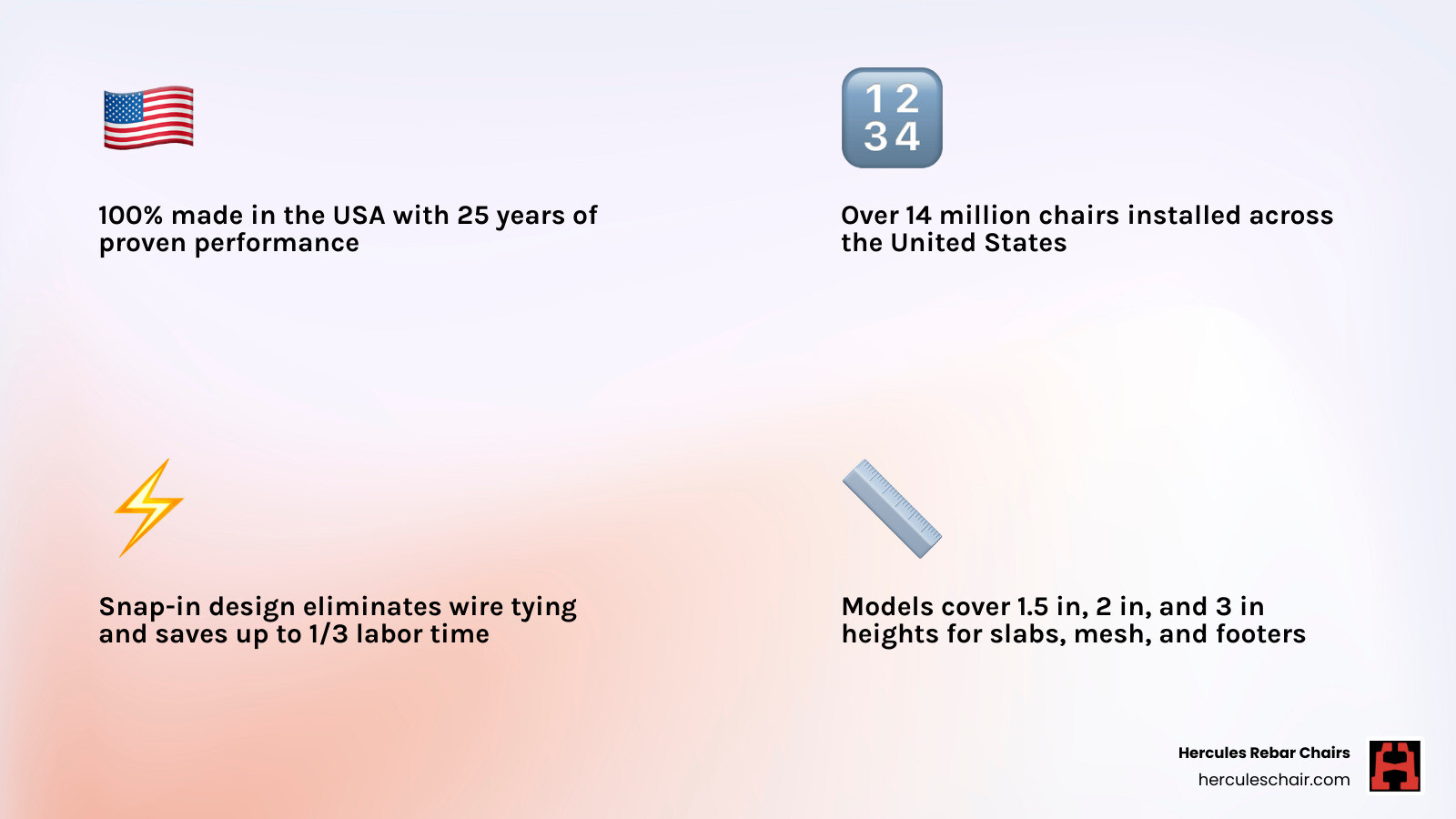
All Hercules chairs use a snap-in design — no wire tying required — and are made 100% in the USA.
If you’re a concrete contractor, you already know the pain. You’ve spent hours hunched over a rebar grid, twisting wire ties by hand, only to watch rebar shift during the pour anyway. It’s slow, it’s frustrating, and it costs you real money.
That’s exactly the problem Hercules set out to solve — and with over 14 million chairs in use across the United States, the results speak for themselves.
I’m Jordan Harris, a licensed Professional Engineer and structural engineer with hands-on experience designing large-scale concrete projects, and I now help lead product development at T.J. Harris Company, the family business behind the Hercules Chair. My engineering background gives me a direct understanding of how tripod Hercules rebar chairs perform under real load conditions and why proper rebar elevation is critical to concrete integrity. In the sections below, I’ll walk you through everything you need to know to choose the right chair for your next pour.
The Engineering Excellence of Tripod Hercules Rebar Chairs
What makes Tripod Hercules Rebar Chairs different is not just that they hold rebar up off the ground. Plenty of products claim to do that. The real difference is how they do it.
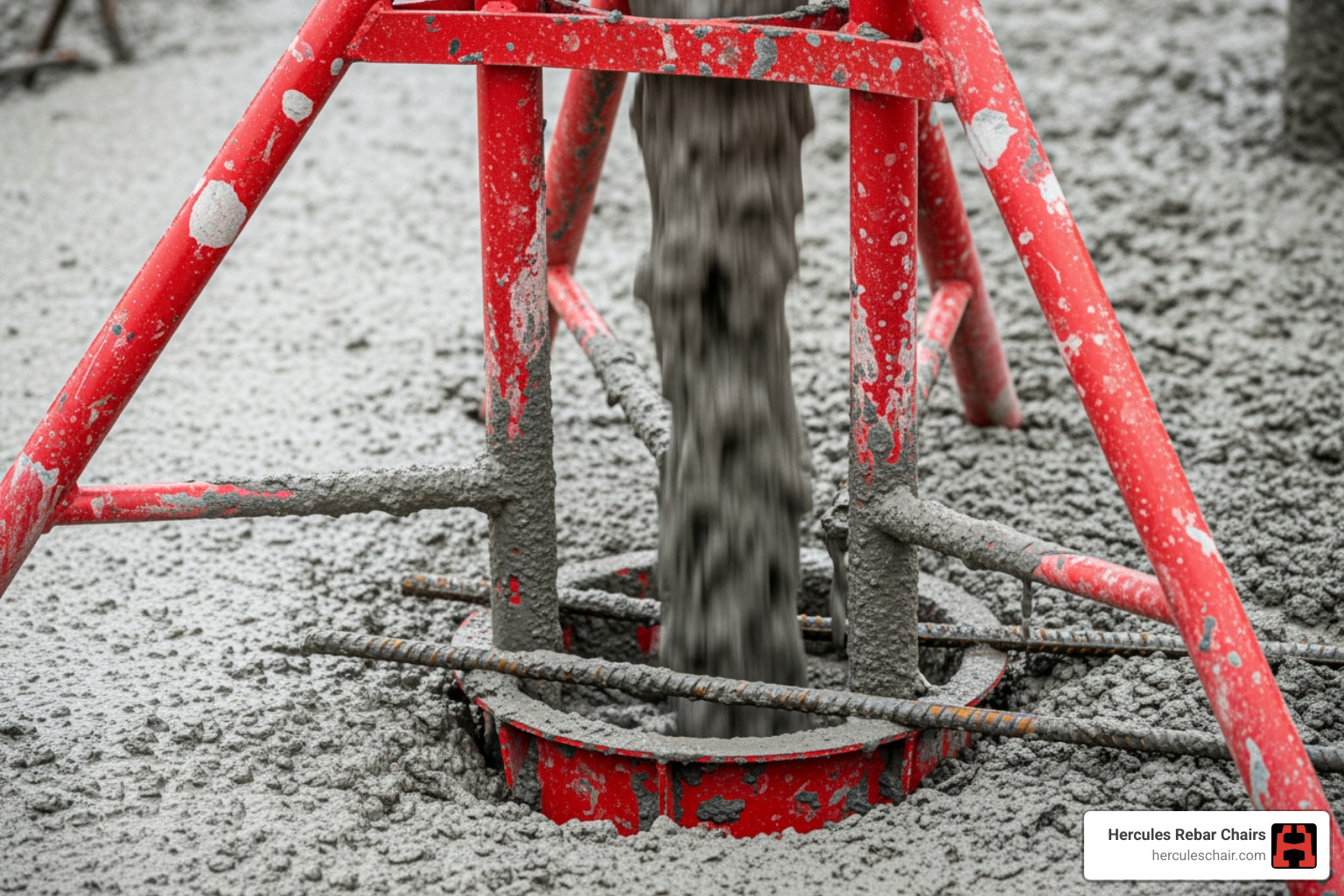
Our tripod-style support design creates stable contact with the surface below while still leaving open space for concrete to move around the chair during the pour. That matters because trapped voids or blocked flow around reinforcement can work against the very reason you installed supports in the first place.
The key engineering benefits are straightforward:
- Stable tripod footprint helps prevent rocking and tipping
- Snap-in clips hold reinforcement in position without wire tying
- Patented polypropylene construction resists corrosion
- Open geometry promotes maximum concrete flow around the support
- Rounded base edges help protect vapor barriers and foam boards
That “maximum concrete flow” point deserves extra attention. When concrete can move freely around the chair, it better surrounds both the rebar and the support. In practice, that helps maintain more consistent coverage and reduces the chance of shadowing or poorly consolidated pockets near the support point. Better concrete encapsulation means better protection for the reinforcing steel and more reliable long-term slab performance.
In other words, the chair should disappear into the pour as a support, not act like a roadblock. That is exactly how our design is intended to work.
This is also why our supports can help maintain structural integrity better than old-school wire-tying alone. Wire ties may connect bars to each other, but they do not reliably elevate them off the subgrade. If the steel sinks, drifts, or gets kicked during placement, concrete cover changes. And when cover changes, performance changes. Proper support is not a luxury item. It is basic concrete quality control.
If you want a broader primer on rebar support systems, we recommend Sitting Pretty: Everything You Need to Know About Rebar Supports and Chair-ish Your Concrete: A Deep Dive into Rebar Support Systems.
Sizing and Compatibility for Modern Concrete Reinforcement
Choosing the right chair comes down to two things:
- The bar or mesh you need to support
- The concrete cover or slab thickness you need to maintain
Here is a practical comparison of the main slab-support models.
| Model | Support Type | Clearance to Bottom Bar | Compatible Reinforcement | Recommended Application |
|---|---|---|---|---|
| 911 | Rebar chair | 1.5 in. | #4 rebar | 4-5 inch slabs |
| 912 | Rebar chair | 3 in. | #3, #4, #5 rebar | 6-8 inch slabs |
| 944 | Mesh chair | 2 in. | Steel mesh | Thin-slab mesh support |
The most common compatibility question is simple: which bars fit which chairs?
The answer, based on the product data in our lineup, is:
- Model 911 supports #4 rebar
- Model 912 supports #3, #4, and #5 rebar
- Models 924 and 928 footer stands support #4 and #5 rebar
- Model 944 is built for steel mesh rather than standard rebar bars
If your slab design calls for #3, #4, or #5 bars and you need 3 inches of clearance to the bottom bar, the 912 is typically the right pick. If you are working with #4 bars in a thinner slab, the 911 is usually the better fit.
This is where a lot of field problems start: using the wrong support height because “it looked close enough.” Concrete does not care about close enough. If the slab is designed around a certain steel position, the support needs to match it.
For more on selection and sizing, see The Ultimate Guide to Rebar Chairs: Types, Uses, and Sizing for Concrete Slabs and From Dobies to Double Mats: A Comprehensive Look at Rebar Chair Types.
Optimizing Slab Thickness with Tripod Hercules Rebar Chairs
The recommended slab ranges in our product line are clear:
- The 1.5-inch Model 911 is ideal for 4-5 inch concrete slabs
- The 3-inch Model 912 is ideal for 6-8 inch concrete slabs
Why those ranges? Because the support height has to work with the intended cover and the reinforcement layout. A chair that is too tall can place the steel too high in the slab. Too short, and the steel ends up too close to the ground. Neither is a smart gamble.
A simple rule of thumb:
- For sidewalks, patios, driveways, garage slabs, and other thinner slab applications using #4 rebar, start with the 911
- For thicker slabs, commercial floors, heavier residential work, and applications needing 3 inches to the bottom bar, use the 912
The 911 has an overall height of about 2-5/8 inches and is designed so both pieces of reinforcement can snap into place. It can also be used at every crossing for improved grid stability. If you want to view the retail listing for that model, here is the exact link: Hercules 1-1/2 in. Rebar Chair (50-Pack) 911 – The Home Depot.
Specialized Support for Steel Mesh
Not every reinforced slab uses bar grids. For mesh applications, that is where Model 944 comes in.
The 944 is a 2-inch steel mesh chair intended for thin-slab mesh reinforcement. Instead of trying to make a rebar chair do a mesh chair’s job, it is better to use the support built for the material you are placing. That helps keep the mesh elevated where it belongs instead of letting it settle near the bottom, which is one of the most common reasons mesh ends up doing less than the designer intended.
If your project includes welded wire reinforcement or similar mesh layouts, do not force a bar chair into service. Use the correct mesh support and keep the installation consistent.
For a deeper look, read Elevate Your Slab with Concrete Mesh Chairs.
Labor Efficiency and the Snap-In Revolution
Let us talk about the reason many crews become loyal to Hercules after the first job: speed.
Traditional wire tying takes time. A lot of it. Every tie adds labor, and every adjustment means more bending, twisting, and reworking. Our snap-in design removes that bottleneck by letting the reinforcement click into place without wire tying.
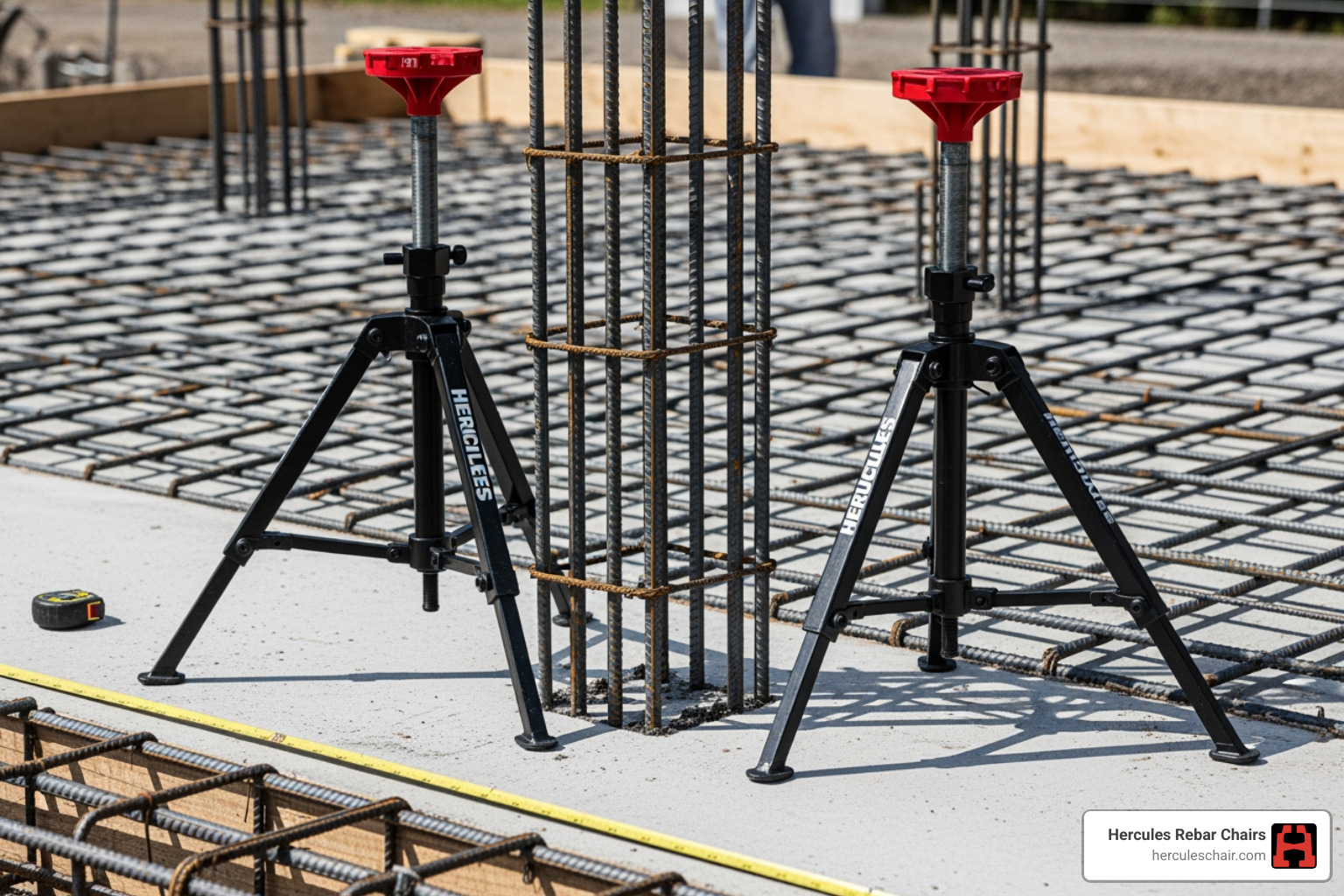
Research across the product line shows Hercules chairs can reduce placement time by about 1/3 compared to traditional wire-tying methods. That is not a tiny efficiency gain. On a busy project, it can mean hours saved on setup. In some real-world uses, crews have reported saving tens of hours over the course of a job.
The benefits over traditional tying include:
- Faster installation
- Less repetitive hand work
- Easier repositioning before the pour
- More consistent elevation control
- Fewer chances for the grid to shift out of place
The labor-cost math is pretty simple. If installation time drops by one-third, labor cost for that task drops by roughly the same proportion, assuming crew size stays similar. Exact savings depend on wage rates, project size, and reinforcement layout, but the direction is clear: less time spent tying means less labor burned before the mud even arrives.
And because rebar snaps into place, crews can make adjustments without having to untwist and redo a pile of wire ties. That is one of those small jobsite wins that does not sound exciting until you have had to fix a misaligned grid for the third time before lunch.
The 3-inch Model 912 is sold in 100-packs and has been listed in the roughly $81.16 to $83.66 range, which helps keep material cost predictable as well. You can also browse availability through Hercules Rebar Chairs – Amazon.com.
For more on why support systems improve productivity, see Elevate Your Concrete: Why Bar Chairs Are Essential for Strong Slabs.
Advanced Applications: Vapor Barriers, Walls, and Footers
A great chair has to perform in the real world, not just on a clean showroom slab that has never met a muddy boot.
That means it needs to work on:
- Vapor barriers
- Rigid foam insulation
- Horizontal slab installations
- Vertical wall reinforcement
- Footing layouts
One of the most common concerns we hear is whether plastic chairs will puncture vapor barriers or foam board. Our product research addresses that directly. Hercules chairs are designed with rounded base edges and flexible corners to help prevent puncturing vapor barriers and rigid insulation. The wide, stable base spreads load rather than concentrating it into a sharp point.
So yes, they are suitable for use on top of vapor barriers and rigid foam when installed correctly.
That matters because puncturing the barrier below a slab can create a whole different set of problems, especially in moisture-sensitive projects. A chair should protect your elevation without creating a new headache underneath.
Another frequent question is whether the chairs work only in flat slab applications. They do not. The 1.5-inch chair information specifically confirms they can be used in vertical concrete walls as well as horizontal applications. That makes them useful when reinforcement needs secure positioning in wall forms, not just on grade.
And yes, the chairs are left in place and buried in the concrete. They are not removed during the pour. That is exactly how they are intended to function.
If you want more background on support choice, read Don’t Let Your Rebar Sink: A Guide to Concrete Chairs and What Are Concrete Bolster Chairs and Why Do You Need Them?.
Tripod Hercules Rebar Chairs for Specialized Footer Applications
Footings are their own animal. When you need multiple parallel bars held at the right spacing and height, a standard single-bar rebar chair is not always the best tool. That is where our footer stands come in.
The main difference between footer stands and standard rebar chairs is their purpose:
- Standard rebar chairs support intersecting bar grids or individual reinforcement lines
- Footer stands support multiple parallel bars in footing configurations at fixed spacing
Our lineup includes:
- Model 924: 3-bar footer stand
- Model 928: 2-bar footer stand
Both provide 3 inches of ground clearance and are designed for #4 and #5 rebar. The 924 uses pre-engineered 5-inch spacing between bar snaps, which helps maintain a consistent footing layout without field guessing. Recommended placement for the 3-bar stand is every 4 feet.
That means footer stands do two jobs at once:
- They elevate the steel off the ground
- They maintain bar spacing across the footing run
This is a major difference from standard slab chairs, which mainly focus on elevation at crossings or support points.
If you are comparing products in the lineup, footer stands are the answer when the project calls for structured multi-bar footing support rather than a slab grid. You can explore the full lineup here: Our Products.
Frequently Asked Questions about Hercules Supports
How are Hercules tripod rebar chairs different from surveying tripods or layout equipment?
This is a good clarification because the word “tripod” shows up in more than one part of construction.
Hercules tripod rebar chairs are concrete reinforcement supports. Their job is to hold rebar or mesh at the proper elevation during a pour so the steel ends up in the right position inside the concrete.
Surveying tripods and layout equipment do something completely different. They hold instruments used for measuring, aligning, or locating points on a site. Floor targets and layout tools are not rebar supports and they do not become part of the concrete structure.
So if you are searching for “tripod hercules rebar chairs,” you are looking for reinforcement supports used in slabs, walls, and footings, not layout gear.
Are these chairs compliant with CRSI Class 1 requirements?
Yes. Product information for the Hercules line indicates these supports meet CRSI Class 1 support requirements, which is important for contractors and engineers focused on proper rebar positioning and code compliance.
That matters because reinforcement has to stay where the design intends it to be. A support that does not maintain the required steel position can compromise concrete cover, durability, and performance.
Our polypropylene construction also provides the benefit of being non-corrosive, which is a practical advantage over supports that may be vulnerable to rust-related concerns.
If code compliance is a priority on your job, that is exactly the kind of box you want checked before the pour starts, not after the inspector raises an eyebrow.
Can workers walk on the rebar grid after installation?
Yes, that is one of the standout performance benefits. Hercules chairs are designed to be strong enough that workers can walk on the installed rebar grid without the supports collapsing under normal jobsite movement.
This matters for both productivity and confidence during placement. Crews need to move through the work area to finish setup, inspect spacing, and prepare for the pour. If the supports crush or tip over under foot traffic, the elevation control you worked so hard to establish can disappear fast.
With more than 14 million units in use across the United States and over 25 years of production history, these supports have built their reputation in actual field conditions, not just in product sheets.
Conclusion: Why Hercules is America’s #1 Choice
When contractors choose Hercules Rebar Chairs, they are choosing a support system built around the things that matter most on real jobs:
- Fast installation
- Reliable rebar elevation
- Strong footing under load
- Better concrete flow around the support
- Compatibility with slabs, walls, mesh, and footers
- Protection for vapor barriers and rigid foam
- Code-focused performance
We manufacture Hercules Rebar Chairs at T.J. Harris Co. right here in the USA, and our products are 100% USA made. We have been producing them for more than 25 years, and with over 14 million units sold, the trust behind the red chair is hard to miss.
If you are ready to spec the right support for your next slab, wall, or footing, start with Our Products. For more guidance, you may also find these resources helpful:
- Elevate Your Concrete: Why Bar Chairs Are Essential for Strong Slabs
- The Ultimate Guide to Rebar Chairs: Types, Uses, and Sizing for Concrete Slabs
- From Dobies to Double Mats: A Comprehensive Look at Rebar Chair Types
- Sitting Pretty: Everything You Need to Know About Rebar Supports
Bottom line: if you want rebar support that works hard, installs fast, and holds up when the job gets busy, Tripod Hercules Rebar Chairs are still the heavyweight champions.