

What Is a Slab on Grade Foundation?
A slab on grade is a concrete foundation poured directly on prepared ground — no basement, no crawl space, just a reinforced concrete slab sitting at ground level.
Here’s a quick breakdown:
| Feature | Details |
|---|---|
| What it is | A concrete slab poured directly on compacted soil or gravel |
| Common thickness | 4–6 inches for residential; thickened edges up to 12 inches |
| Best for | Flat sites, warm climates, tight budgets |
| Key layers | Native soil → gravel → insulation → vapor barrier → concrete |
| Main advantage | Simple, fast, and cost-effective to build |
| Main drawback | No under-floor access for utilities after the pour |
Slab-on-grade foundations are one of the most widely used foundation types in residential and light commercial construction — especially across the southern and western United States. They’re popular because they’re straightforward to build, less expensive than basements, and when done right, extremely durable.
But they’re not the right choice for every site or every climate. And the decisions you make before the pour — subgrade prep, reinforcement placement, utility routing — determine whether your slab lasts decades or develops problems within years.
I’m Jordan Harris, a licensed Professional Engineer with a master’s degree in structural engineering and five years of experience on large-scale concrete projects. Today I work with T.J. Harris Company, where our rebar support products have been used in slab-on-grade pours across the country — so I’ve seen what separates a slab that holds up from one that doesn’t.
Understanding the Slab on Grade Foundation
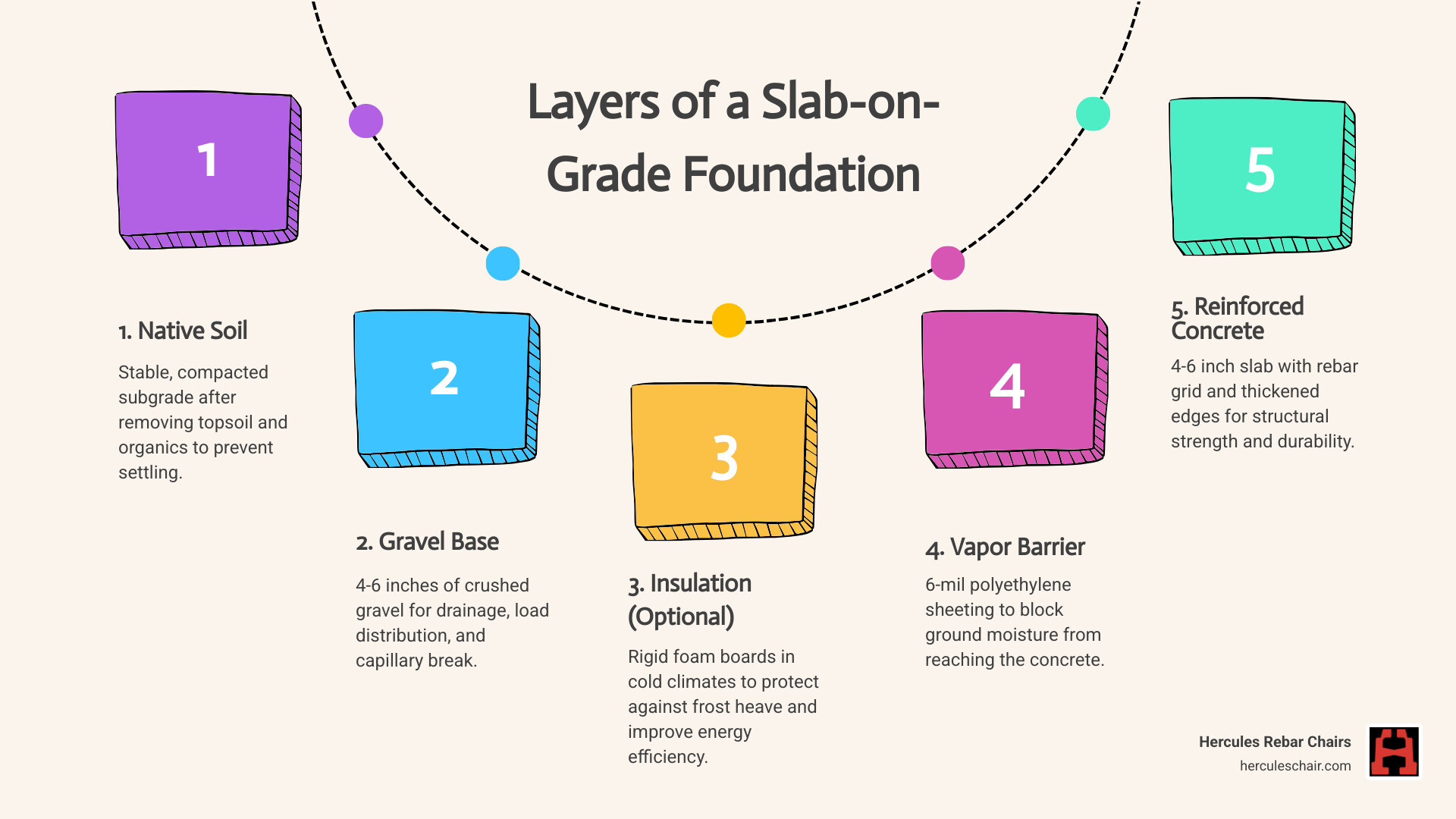
When we talk about a slab on grade foundation, we are describing a structural engineering system where the building’s foundation is created by pouring concrete into a mold set directly into the ground. Unlike a basement or a crawlspace, there is no hollow space between the structure and the earth. This makes the building less vulnerable to pests like termites and prevents the “moisture time bomb” often associated with damp basements.
According to the WBDG Guide to Floor Slabs, these systems are highly efficient because the foundation serves as both the structural support and the finished floor surface. However, because the slab sits directly on the grade, site preparation is the most critical phase. We start by stripping topsoil and organics, followed by compacting the subgrade to at least 95% density.
A successful slab on grade depends on several layers working in harmony:
- Subgrade: The native soil, compacted to handle the building’s load.
- Subbase/Base: Usually 6 inches of crushed stone or gravel. This acts as a capillary break to keep moisture from wicking up into the concrete.
- Vapor Barrier: A heavy-duty polyethylene sheet that prevents radon gas and moisture from entering the home.
- Reinforcement: Steel rebar or wire mesh held at the correct height by supports (like our Hercules Rebar Chairs) to provide tensile strength.
- Concrete: The final pour, typically 3,000 to 4,000 psi.
Monolithic vs. Floating Slab on Grade
Not all slabs are created equal. Depending on your climate and soil, we generally choose between two main types:
- Monolithic Slab: Often called a “monopour,” this is a single pour where the slab and the footings (the thickened perimeter) are created at the same time. This is incredibly popular in warmer states like Texas, Arizona, and Florida because it’s fast and requires only one visit from the concrete truck. As noted in the JLC Field Guide: Structural Slabs, monolithic slabs are cost-effective but work best on stable, well-drained soil.
- Floating Slab: In this design, the footings are poured first and allowed to cure. Then, the slab is poured inside the footings, usually separated by an expansion joint. This allows the slab to “float” or move slightly independently of the perimeter walls, which can be helpful in areas with minor soil movement or during temperature swings.
Utility Planning and Site Prep
One of the biggest “gotchas” with a slab on grade is that once the concrete is poured, your plumbing and electrical layouts are permanent. We often say the plumber should be the first trade on the site. Every pipe and conduit must be precisely located and tested for leaks before the gravel is even leveled.
Properly bedding these utilities in clean fill and marking them with color-coded caution tape 12 inches below grade is a pro tip that saves massive headaches later. If a pipe is forgotten or misplaced, you’re looking at a jackhammer and a very expensive repair. This is also why we emphasize Why Your Slab Needs Rebar Chair Supports; if your reinforcement isn’t held at the right height, it can interfere with utility depths or fail to protect the concrete from cracking around those penetrations.
The Advantages and Disadvantages of Slab Foundations
Why choose a slab on grade over a basement? For many, it comes down to the “three Cs”: Cost, Comfort, and Convenience.
The Advantages:
- Cost Efficiency: A typical basement requires three concrete truck visits (footings, walls, floor) and massive excavation. A slab often requires just one or two, saving thousands in labor and material.
- Termite Resistance: With no hollow crawlspaces or wooden floor joists near the dirt, termites have a much harder time finding a way in.
- Thermal Mass: Concrete holds temperature well. If you have large south-facing windows, the slab can soak up sun during the day and release heat at night.
- Low Maintenance: You don’t have to worry about basement floods, moldy crawlspaces, or sump pump failures.
If you are building a garage or a workshop, the durability of a slab is unmatched. We’ve even put together a guide on How to Master Garage Slab Rebar Placement to help DIYers and pros get that perfect, crack-free finish.
Potential Challenges with Slab on Grade Construction
While we love slabs, we have to be honest about the downsides:
- Utility Access: As mentioned, if a pipe bursts under the house, you have to break through the floor to fix it.
- Remodeling Difficulty: Want to move a bathroom ten years from now? It’s going to be a lot harder (and messier) than if you had a crawlspace.
- Soil Sensitivity: Slabs are prone to cracking if the soil settles unevenly. Unlike a basement that has deep footings, a slab is only as good as the dirt beneath it.
- Flood Risk: Because the house is only about 8 inches above the ground, slabs are more vulnerable to rising water than elevated foundations.
To mitigate these, we focus on Slab Strong: Mastering Rebar Placement to ensure the concrete can handle the stresses of minor soil movement without failing.
Sustainability and Environmental Impact
The environmental conversation around concrete is a heavy one—literally. Research shows that concrete contributes 8% of total global greenhouse gas emissions. In fact, for every ton of concrete produced, nearly one ton of greenhouse gases is released.
However, because a slab on grade uses significantly less concrete than a full basement (which has walls 8–10 feet high), it is often the more “eco-friendly” traditional choice. Some builders are even experimenting with plywood slabs on grade. These involve the same gravel and insulation layers but replace the concrete with cross-laminated plywood to slash the building’s embodied carbon.
As the team at FNF Foundation points out, a well-insulated slab can be part of a high-performance “Passive House” design, using the earth’s natural 50°F temperature to help regulate the home’s climate.
Essential Steps for a Durable Slab Installation
Building a slab that lasts decades isn’t about luck; it’s about following a proven sequence. We always recommend starting with a geotechnical soil analysis to ensure the ground can actually support the weight.
Once the site is cleared, the process looks like this:
- Forming: Setting the perimeter boards to the exact elevation.
- Gravel and Prep: Spreading at least 6 inches of gravel and compacting it until it’s rock-hard.
- Moisture Control: Laying the vapor barrier and taping all seams.
- Reinforcement: This is where we shine. Following a Rebar Placement Guide is vital. If the rebar ends up at the bottom of the slab, it does nothing. It needs to be in the top third of the concrete to resist the tension that causes cracks.
- The Pour: Using a mix (usually 3,000–3,500 psi) with the right slump.
- Curing: Keeping the slab wet or using a curing compound for at least 7 days to reach full strength.
Before you order materials, make sure you know How to Calculate Rebar for Slab so you don’t run short halfway through the pour!
Reinforcement and Support Systems
Concrete is like a superhero with one major weakness: it is incredibly strong when you push on it (compression) but very weak when you pull on it (tension). That’s why we use rebar.
To make that rebar work, it has to stay in the “Goldilocks” zone—not too high (where it might pop through the surface) and not too low (where it sits in the dirt and rusts). This is why choosing the right Concrete Bar Chair Sizes is so important.
At Hercules, we’ve sold over 14 million units because our red chairs are easy to see, snap onto the rebar securely, and don’t sink into the vapor barrier. Whether you are using heavy bars or wire mesh, The Ultimate Guide to Rebar Chairs can help you pick the right height for your 4-inch or 6-inch slab.
Climate Considerations and Frost Protection
If you live in a cold climate like Alaska or Connecticut, you might think a slab on grade is impossible because of “frost heave”—where freezing water in the soil expands and cracks the foundation.
But thanks to modern engineering, we use Frost-Protected Shallow Foundations (FPSF). By adding “skirt insulation” (rigid polystyrene foam) around the perimeter of the slab, we can trap the earth’s natural heat. This keeps the soil under the slab at a steady 46-50°F (8-10°C), even when it’s sub-zero outside.
Check out these regional solutions for more detail:
Frequently Asked Questions about Slab Foundations
How thick should a residential slab be?
For most homes, a 4-inch slab is the standard. However, if you are planning on heavy loads (like a large kitchen island or a heavy vehicle in a garage), we often recommend 6 inches. The edges of the slab, where the walls sit, are usually thickened to 12 inches to act as a footing.
Can you install radiant heating in a slab on grade?
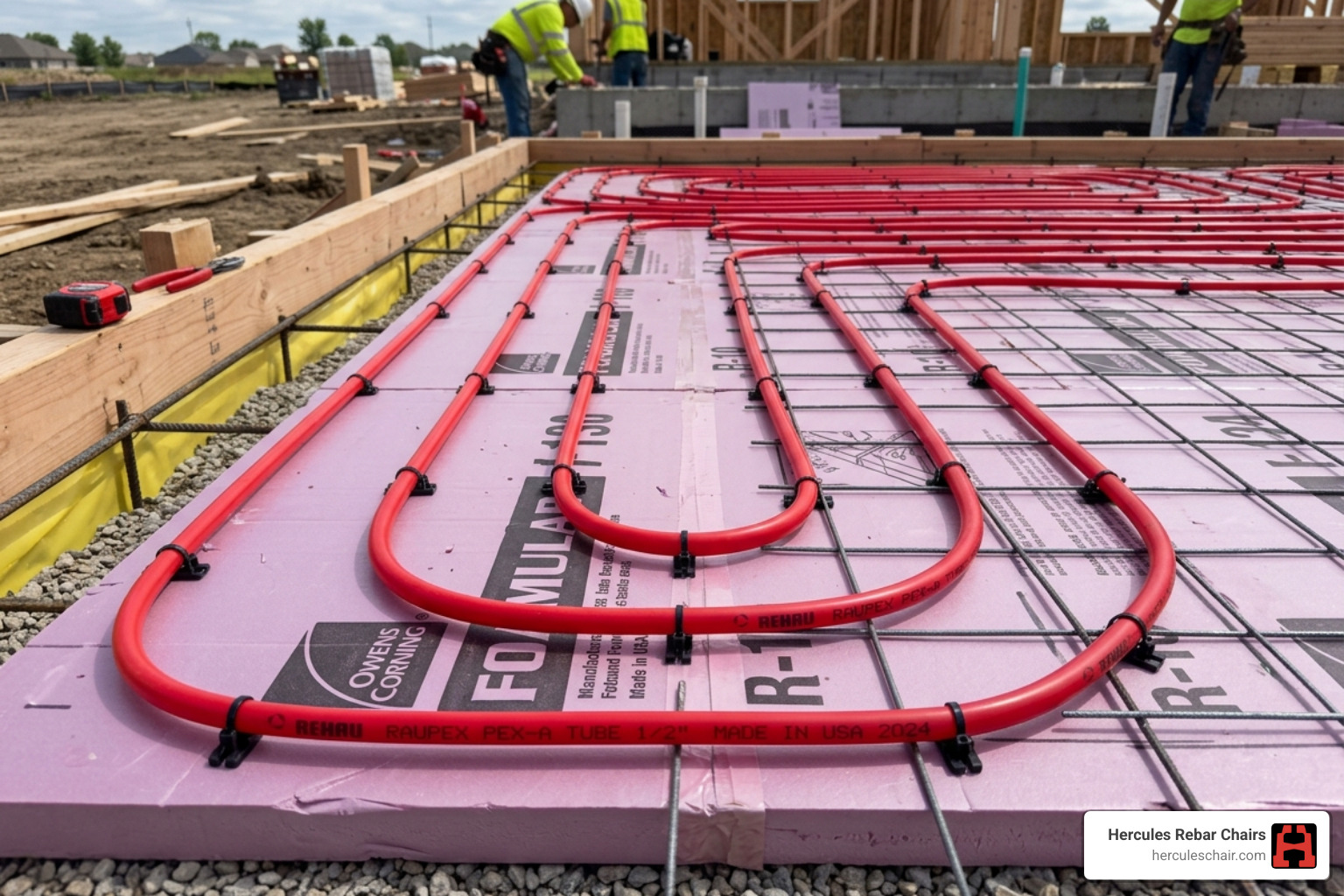
Absolutely! In fact, slabs are the best foundation for radiant heat. We zip-tie PEX tubing to the rebar grid before the pour. Once the concrete is in, the entire slab becomes a giant radiator that keeps your feet warm all winter. It’s incredibly energy-efficient and comfortable.
How do you prevent frost heave in cold climates?
The secret is insulation and drainage. By using a thick layer of gravel (which doesn’t hold water) and rigid foam insulation around the perimeter, you prevent the ground from freezing underneath the slab. This is a code-approved method that allows slab construction even in the coldest parts of the US.
Conclusion
A slab on grade foundation is a fantastic choice for many homeowners and builders. It offers a blend of affordability, durability, and energy efficiency that is hard to beat, especially in warmer climates or on flat lots. While it requires meticulous planning for utilities and high-quality site preparation, the long-term benefits of a mold-free, termite-resistant home are well worth the effort.
At Hercules Rebar Chairs, we believe that the strength of your home starts with the integrity of your concrete. That’s why we’ve become America’s #1 choice for concrete supports. With 14 million units sold and a reputation for saving time and money on the job site, our products ensure your reinforcement stays exactly where the engineers intended.
Ready to start your project? Make sure your slab is built to last with the best supports in the business.